A Masterpiece of Engineering

We think that we design pretty neat things these days.  We laugh at the man who said that the world would probably only need four or five computers.  Those of us who are old enough can remember when we did a sum on the newly invented pocket calculator that gave us the answer 0.7734, which said “hello” when we turned the calculator upside down.

But whilst researching my latest book I came across some pretty amazing statistics about a design that we all treat as commonplace – each and every human being.

Our 1.5kg brain comprises around 100 billion neurons, of 10,000 different types. Each neuron can have thousands of synapses (input connections from other neurons) and each synapse has perhaps a thousand molecular scale switches.  A single human brain is estimated to contain more switches than the entire internet.

Contained within our skin are around 650 muscles attached to over 200 bones, which vary in size from the femur in our thigh to the stirrup bone in the ear.  The muscle/bone combination is precise enough to paint a masterpiece, or to putt a golf ball twenty feet into a hole.

We have around 60,000 miles of veins and arteries and 1500 miles of pipes in our lungs.

Within our lymph nodes we have billions of B cells, each of which is different and each one defends against a particular very specific infection.

The list goes on – but you get the point.

Yet this whole complex organism is built from a single cell.

We begin as one single cell.  Within the cell is our DNA, the supposed blueprint for our manufacture.  We have a massive 3 billion base pairs (characters in the ‘code’) in our DNA. Yet there are around 50,000 billion different cells in the body.  Each cell is different, in function and in position – some nerve cells can be several feet long.  How can we imagine that there is enough information contained within our DNA to define our fully functioning body?

But we do start from just one cell.  And each cell only responds to the signals that cross the cell membrane.   As we develop, the cell is what it is as a result of its history – its ancestor cells.  And each of those cells only responded to the signals that crossed it’s membrane.  It’s like a massive pyramid, built the wrong way up – with the apex at the bottom.  The process is incredibly robust.  Look at identical twins.  Most of their development is as separate human beings and yet the final ‘product’ is identical.

A human being is truly a masterpiece of engineering.

Is it reasonable to state with certainty that this happened by chance?  Is it reasonable to assert that the properties of the sub-atomic particles in the universe are such that they behave in precisely the right way to manufacture you or I from a single cell by sheer luck? Or would that be a blind leap of faith?


See also:

https://philhemsley.wordpress.com/2013/03/03/information-dna-and-evolution/

https://philhemsley.wordpress.com/2012/09/17/the-dna-enigma/


Scientific support for The Rainbow Economy

A link to a fascinating talk below.  The beginning is rather depressing, but the finish supports the solution proposed in The Rainbow Economy.

Do listen to it all.

http://www.ted.com/talks/paul_piff_does_money_make_you_mean.html?utm_source=email&source=email&utm_medium=social&utm_campaign=ios-share


“The Big Picture” – an honest examination of God, science and purpose – OUT NOW

“I recommend this book to all thinking people – we might just change the world.” 

“This book will definitely make you think and then think again. Hemsley did his research for this book, and I received many answers to questions I’ve pondered over the years.”

“it is a welcome relief to come across a book that presents such a broad and balanced overview”

“This book covers an considerable amount of territory in its 253 pages.”

The Big Picture is a much-needed book that allows the reader to consider the big questions of life without feeling bludgeoned to adopt the author’s opinion. The book explains basics of science, philosophy and religion in a straightforward manner.

It will encourage all those who want to live a good and purposeful life and would like a sound basis for doing so. Such readers may find a resonance with the teaching of Jesus and this book will explore whether we can trust what has been recorded in the gospel accounts, and whether the findings of science and a reasoned understanding of the Bible are consistent or contradictory.

Many books in the arena of science and faith are hostile and adversarial. The authors set up straw men of their opponent’s arguments, dismantle them and then preach their own arguments to their disciples. The author of The Big Picture recognises that there are intelligent atheists and intelligent believers, and that a case can always be made for whatever someone wants to believe. The reader is therefore treated with respect

ebook

paperback

Amazon UK

The Big Picture - cover

The Author’s Fear

For all those of us who write about God, I found the following by George MacDonald in an anthology of 365 readings compiled by CS Lewis.

If I mistake, He will forgive me.  I do not fear him: I fear only lest, able to see and write these things, I should fail of witnessing and myself be, after all, a castaway – no king but a talker; no disciple of Jesus, ready to go with Him to the death, but an arguer about the truth.

A wise reminder!


Goodness – me!

Do you ever stop to think what you would like on your gravestone when you are dead?  It’s a good way of finding out what we really want to be like.  I don’t think any of us would like to see phrases like:

“Always selfish and greedy”

“Never had time for anyone else”

“Vindictive and hateful”

When we see a new baby, at a christening who would want to think that the baby would grow up to be a thief, or to have a string of husbands who she cheated on and deserted, or to be a child molester.

We know deep down that we want to be good.

In the 11th century, Anselm of Canterbury described how being good is possible through ‘goodness’, and how supreme goodness is God.  So that desire to be good is actually us wanting to be like God (supreme goodness), to act like God, to be in his image.

St John’s describes in his gospel that God is love.  So when we love one another, our love is possible through love, which is through God.  We are choosing to act like God, to be part of God.

Each of us has the essence of goodness in us, and the essence of love in us.  God is goodness and God is love, so we all have God within us.  Sometimes we choose to ignore goodness and love, and instead choose to be selfish, vindictive or hateful.  But that is not what we want to be – as we found at the start of this post.

The true Christian religion is about helping us to be what we want to be – good and loving.  It is about connecting with that goodness and love within us; God within us.  It is about learning from Christ what goodness and love looks like, and trying to imitate him.

And if you want to be good and loving, then that means that you want to be like God.  Jesus said that ‘if you have seen me then you have seen God’; Jesus represented supreme goodness and love in human form.  So if you want to be good and loving, since Jesus was supremely good and loving, then you want to be like Jesus, and if you want to be like Jesus you can call yourself a Christian.

Christians pray to help make that connection with goodness and love.  Here’s an example of a Celtic prayer from Lindisfarne:

Help me dear Lord to care too much

To love too freely

To pray unceasingly

To forgive endlessly

To laugh fearlessly

To question

To live

To be who I am

To be where I am

To be what I am

To hope

To believe

To reach out my hand

That’s a good prayer, isn’t it?  It’s about connecting with God within us.  It’s asking God to help us be who we want to be.

Do you want to be the sort of person that the prayer describes?  You can take a step closer by praying that prayer.

Related posts

https://philhemsley.wordpress.com/2012/06/21/an-argument-for-and-definition-of-god/

https://philhemsley.wordpress.com/2012/12/29/the-god-of-science/


Proof of God?

A friend asked “Let us suppose it was absolutely certain there was no god but many people honestly believed there was – how different would the world look today?”

I could answer that if there was no God there would be no universe and no people to observe it.

Clearly, as we are both intelligent people we must be talking about something different when we say the word ‘god’.

The God that I conclude exists is a creator, and a God who sustains the universe.  Clearly the universe exists and continues to exist.  Ask a physicist why and he will probably say ‘because of the laws of physics’.  A rose is a rose by any other name, so at minimum my God is the laws of physics – we just choose to give it different names.

Perhaps my friend’s question is going beyond that definition of God.  Perhaps he is asking about a God who has ‘character’, a ‘me’-ness that I have.  (I know that I exist, there is an essence that is ‘me’).  What would things be like if there was not a God who had an essence of ‘me’?

It’s actually not easy to define what ‘I’ am.  Science of course shows that my brain has massively complex computational ability, but that doesn’t really help.  Literature and philosophy, and our daily experience tells me that there are things like love, joy, peace, thoughts, free will.  Let’s consider these as parts of ‘me’, and think – what if there were not a god who also had these characteristics.

But once again, the same sort of argument applies.  God is love, joy, peace.  Therefore without God there would be no love, joy or peace.  There would be no literature, there would be no mathematics, no equations, there would be not science.

Free will though is slightly different.  We know we have free will, and yet it is inexplicable by science.  It is inconsistent with the laws of physics.  Free will seems a bit of a paradox.  If God is the laws of physics, and free will is inconsistent with the laws of physics then how can that work?  A rational explanation is that free will is something that is a gift of God, that is not constrained by the laws of physics.  Therefore we begin to see what would be different in my friends question.  Without God we would have no free will, we would not be able to choose right from wrong, we would simply be robots who respond to stimuli.

But to explore the question further.  My last paragraph introduced right and wrong.  We know that there is right and wrong – even if we don’t always know what is right and what is wrong.  Right and wrong are different from free will, so let’s suppose that we were able to have free will but had no knowledge of right and wrong.  Clearly right and wrong exist.  Goodness and evil exist.  And yes, my definition of God includes ultimate goodness.  So without God we would have no constraint on what we do, we would simply live to serve ourselves.  The world would be governed simply by whoever was strongest.  We would be like most of the rest of the animal kingdom.  States like North Korea would be everywhere and left unchecked.  Anarchy would reign.  The world would be a very different place to live.

So have I proved God exists?  I think so (but I would) – simply because my definition of God includes everything that we know exists.  I define that it is not possible for anything to exist without God, and so anything which exists must be God.

My friend asked what if God didn’t exist but people believed that he did.  I hope that I have shown that such a question is not directly answerable, it is like the “can god make a thing so heavy that he cannot lift it” question, or “can God make something that doesn’t exist”.  But perhaps I’ve also been able to answer the questions behind the question.  Will it satisfy my friend?  I doubt it.  If any of us really doesn’t want to change our views then no amount of logical reasoning will make a difference.  But perhaps others will find the discussion interesting….

If you found this post interesting you might also like:

https://philhemsley.wordpress.com/2013/05/03/goodness-me/

https://philhemsley.wordpress.com/2012/12/29/the-god-of-science/

https://philhemsley.wordpress.com/2012/06/19/can-god-answer-prayer-in-a-universe-that-operates-according-to-the-laws-of-physics/

Brian Cox’s “Wonders of life – what is life?” .. a review

Yesterday evening I watched the first in a new Brian Cox series on the wonders of life.  I was left with an uncomfortable feeling about the way the content was presented. In essence, the program shows very little science but a lot of metaphysical opinion. In essence it it propaganda.  As best as I can, I’ve transcribed phrases from the program in blue (thanks to iPlayer), to show what I mean.

“no matter how unscientific it sounds this, this idea that there is some kind of soul or spirit or animating force that makes us what we are that exists after our death is common.…. it ‘feels right’, it is hard to accept that you are … just something that emerges from an inanimate bag of stuff”.  This is filmed against the backdrop of smoky fires and gravestones where people are gathering to ‘connect with their dead relatives’. 

This section clearly communicates that spirituality is a magical force that is outside of science and is necessary to explain life – ‘spirit of the gaps’ – but that such an idea is wrong.  Although we might not like it we are just a bag of stuff (no explanation, but trust me, I’m a professor celebrity).

So this has set up the straw-man god that is not part of the natural world, but is outside of it, tinkering occasionally to start life through magical means.  No mention of a God who created and sustains the laws of physics themselves.

Feelings, and indeed we are ‘just something that emerges’ i.e. they have no meaning or purpose.  This is a metaphysical view that is essential if the idea of a purposeful God who set the universe in motion is abhorrent – yet the filming and presentation are designed to manipulate those same feelings.  This is not science, it is carefully crafted propaganda.

“if we are to say that science can explain everything about us then it is incumbent on science to answer the question what is it that animates living things what is it the difference between a piece of rock carved into a gravestone and me? …. For millennia, some form of spirituality has been evoked to explain what it means to be alive and how life began.  It is only recently that science has begun to answer these deepest of questions”  ,

Although the words don’t strictly say it, the message is clearly that science can explain life; no other explanation is necessary.  Again, the alternative is some magical force outside nature. The false dichotomy presented again (science OR spirituality) allows no space for a god who is consistent with scientific discovery, where scientific discovery allows us to learn more about God.  So science is getting busy and is providing the answers, which are:

  • Energy transforms from one form to another, and that caused and explains life – that is the reason we are here.  All life continues to be powered by the same process of transforming energy from one form to another.
  • We all have DNA, which is the “blueprint for life” and continues the organisation of the chemical processes from generation to generation, and shows that we have common ancestry with every other living things

“life is … a collection of chemical processes that harness flow of energy to create local islands of order…. Far from being some chance event ignited by some mystical spark the emergence of life on earth might have been the inevitable consequence of the laws of physics …. A living cosmos might be the only way our cosmos can be”

Mystical spark or science – the false dichotomy perpetuated.

The program focuses on a god of mysticism and magic, and appears not to know of the Christian God.

The God of Christianity is believed to be the creator of the universe, the cause of the Big Bang, the author of the laws of physics, the inventor and sustainer of a cosmos that has the inevitable consequence of producing life.  A God who cannot be seen – yet can be seen everywhere.  A God whose power has gifted us with the ability to feel and understand, and who gives meaning to each of us.  A God who is love; the love we feel is part of God rather than ‘just some emerging thing’.

It is frustrating when scientific programmes such as these don’t present a balanced view of the metaphysics.

Other posts which might be of interest:

https://philhemsley.wordpress.com/2013/04/07/god-miracles-and-the-laws-of-physics/

https://philhemsley.wordpress.com/2012/12/29/the-god-of-science/

https://philhemsley.wordpress.com/2013/04/14/proof-of-god/

https://philhemsley.wordpress.com/2012/06/21/an-argument-for-and-definition-of-god/


A vision and purpose for 2013

In the 2011 UK census, nearly 60% of the population want to be recognised as Christian.  Many other surveys show that the proportion of the population who regularly attend church services is between 5% and 15%.  (Tearfund report on churchgoing 2007, http://www.eauk.org/church/research-and-statistics/english-church-census.cfm, Religious Trends – Brieley)

This data shows that there are 45 – 55% of the UK population who want to be associated with Christianity but are not being supported by the various churches in the country.  To my mind this is not an acceptable situation.  Something must change.

The popular representation of Christians is that we are uncaring unloving people:  We are sexist, not allowing women bishops.  We are homophobic, not allowing gay marriage or gay clergy.  We are ignorant – ignoring scientific data and insisting that the world is 6000 years old and was created in six days.  We are hypocrites and child molesters.  We instantly jump to judge everyone else’s behaviour whilst being just as bad ourselves.  Our bottom line is that “you are going to Hell if you don’t believe what I believe”.  Of course, that’s complete b*****cks, but it certainly doesn’t encourage anyone to explore what Christianity is actually about.  I wrote my first book “The Leap” to address some of these issues.

So there is an image barrier that prevents the 55% exploring their spiritual roots.  But there are many other barriers. To name a few:

  • long working hours leave people exhausted (Nearly 20% of men and 6% of women work over 49 hours per week – 2011 census).  We want to relax and do something enjoyable at the weekend and the image of sitting in a cold uncomfortable church pew is not very attractive.
  • entertainment is at our fingertips in the comfort of our own homes, we don’t want to go to the trouble of going out.
  • nearly 50% of the population live alone (2011 census).  There’s all the housework to do. The barrier of going out alone can be immense, loneliness is a hard habit to break

Jesus came to bring life in abundance.  We are missing out!  We catch glimpses of what life in abundance might be in the spirit of the Olympics,  in the national celebrations and street parties of the Jubilee.  Neighbours got to know each other, perhaps speaking for the first time in years.  The hearts of the people in this nation are good – look at the response when Claire Squires died – nearly £1million donated. http://www.justgiving.com/Claire-Squires2

The church in the UK needs to provide opportunities for this spirit (which is a reflection of the spirit of God within all of us) to grow, for individuals to explore and develop their spiritual side, their humanity.

We need to fight against the materialist mindset that tells us we are simply a bunch of chemicals.

We need to fight against the economic mindset that tells use we are just consumers, human resources, a drain on the economy.

We need to free and inspire the hearts and minds of every man, woman and child to love one another, forgive one another, and love God – with all our hearts, minds and souls.

Let’s go for it! Let 2013 be a year we remember.

The God of Science

Neuroscientist Michael Graziano has speculated on the connection between the material and the spirit world.  His book “God Soul Mind Brain” has the stated aim to describe ‘the mechanistic understanding of the spirit world’.  With is background he makes the assumption that ‘mechanism’ is the reality and perception is the illusion.

“we do not perceive the world as it is, the brain constructs a simulated world”

“colour is not actually out there…. The same set of wavelengths may look green to you in a different context or grey or blue”

“We experience the model rather than the reality”

The statements are fascinating reminders of what the brain does: it constructs a simulated world, it provides the stimulus to allow the experience of colours, it somehow appears to create a model in our brains.

However, it is a false assumption that the mechanism is the reality and the perception is the illusion.   Accepting the assumption is like saying that the material pages of a book and the printed ink are the reality, and the story that the book tells or the information that it contains is not the reality.  Whist nobody would disagree that the book is the material and the story is not, which of them is the reality?

In a book, we read the words rather than perceiving the paper and letters and we construct in our imagination a picture and an experience based on the words and story within the book.  In the only scale of importance that matters to a human being, the book is the words, not the paper and ink.  War and Peace is a famous story, the paper that it was written on was just the framework for holding it. The story is eternal although the paper decays. To a human being, the story is the reality.

Consider a work of art; the material is not the masterpiece, it is merely a framework which holds the masterpiece.  The canvas and paint is meaningless, the picture is the meaning.

If we can free ourselves of the dogma of materialism then we can perhaps begin to consider that in the universe created from nothing, where particles are only potentialities until they are observed the reality is the experience, the qualia, the ‘I’, and that the material is just the skeleton for holding the reality.

The material universe is meaningless until it is perceived, the perception of it gives it meaning.

The butterfly nebula is beautiful when it is observed; without observation it is meaningless.

Two bags of chemicals are meaningless, but the intimate relationship between two people who are in love has immense meaning and purpose.

Is this so strange?  When we look at the quantum level of the material, there is no such thing as paper or ink.  There are particles and forces that we cannot understand.  They are outside of our ability to perceive, so we think of them as miniature versions of ping pong balls and sticks.  They are only potentialities until they are observed.  What we consider material reality is not really real, it performs its function only when it is perceived and observed.  So perhaps what we perceive as real day to day, the material world, is similarly non-material. Perhaps the only reality is our perception, our model.

So what of God in this?  Jesus spoke of God living in us and us in him.  Perhaps our material framework that holds us is part of God.  As Anselm wrote, everything is what it is through extreme goodness, through God, so we are what we are through and within God.  We are told that God is love, and that we are made in his image.  Jesus said that ‘if you have seen me, you have seen the father’; I don’t think he was talking about his flesh, but his ‘being’ – his ‘spirit’.  Our framework (our body and brain) is a small part of a material universe that is created and sustained by God.  If that universe is within God, part of God, then we too are ‘in him’, as he is ‘in us’.

And what of laws of physics, of evolution and biology?  We can create mathematical models of inanimate physical objects, and we can observe the behaviour of molecules and cells which seems to be beyond the possibility of simply responding to those physical laws – yet seems to be consistent, predictable, and purposeful. Within the framework where the universe is within and part of God there may be causes other than the laws of physics for the astonishing growth and development of the human being from the single cell; a God whose will ‘knits us together in our mother’s womb’. In the same way that our ‘will’ causes our hands to move, makes our choices, interacts with others, so God’s will can cause our bodies to grow and develop, to form our brain, to manufacture us as the masterpiece we are, our body being the receptacle for our spirit.

It is the non-material that motivates us, the non-material that leads to change, the non-material that makes our world like it is rather than a desolate moonscape.  The non-material is master over matter.  The non-material is the meaning, the meaning is the reality.

Who would disagree that there is a ‘spirit of Christmas’, all of society embracing a season of joy and giving.  People speak of the true spirit of Christmas; we know that there is something that transcends each of us as individuals.  It is part of the sprit that is God.

When we observe a beautiful woodland track, sunlight shining through the leaves to create a dappled light settling on a trickling stream, that beauty is part of the essence that is God.

When we listen to a sublime piece of music that moves us to tears, or an energising rock ballad that lifts our hearts with passion, that is part of God.

When we love someone, our love is part of the supreme love that is God.

When we meet friends in a party, in a community, that spirit of community is part of God’s spirit of community.

If we can appreciate that the greater reality is the spirit, and the material is just the framework then we can see God and the universe in a whole new light.  The universe can be considered the canvas for a cosmic work of art, a magnificent symphony of action and awe.  Life is a molecular dance of astonishing intricacy and beauty.  We are permitted to explore and understand through science.  We are permitted to glimpse the canvas and participate in the dance; characters created by the dance emerging as individual caring, loving, interacting beings partaking of some of the glory that is the story; individual masterpieces beyond the beautiful, whose reality is our character, our choices, our nature, our soul.  Creatures of purpose and with purpose.  Creatures honoured with the possibility of relating to our creator, the master artist, engineer, scientist, musician, teacher, parent, friend, but never are we his equal.

So this is the God of Science:  A God who was there before the universe began.  An un-created, creator God who gave ‘nothing’ the ability to become ‘something’.  A God who sustains, and maybe actually is, the very fabric of the universe. A God who actually is the laws of physics, who benevolently guides providence to bring life out of a set of chemicals.   A God who imbues the chemical dance that is us with the ability to feel, to taste, to see, to experience: love, joy, peace, fulfilment, intellectual challenge, selflessness, forgiveness, anger, hate, disgust, bitterness.  Perhaps even a God who is love, joy, peace, fulfilment…. But a God who allows us to experience both the good and the bad, and who allows us to choose to pursue that which is good, or that which is not.

Add to this the God revealed to us by Jesus Christ and we begin to understand the complete context.
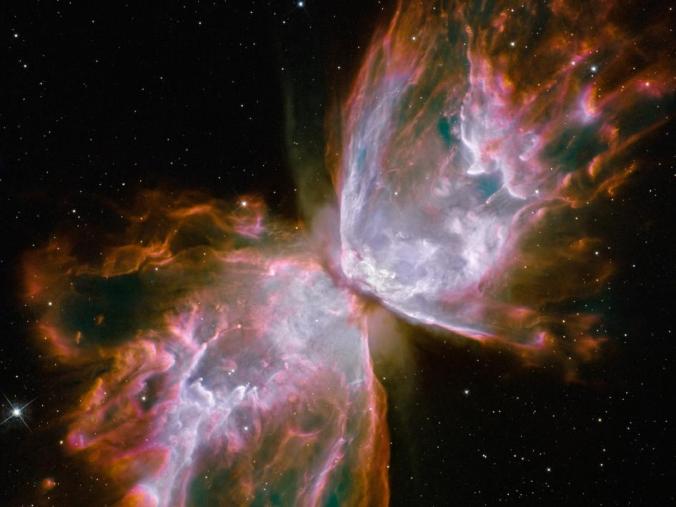
butterfly nebula

Questions raised by the Neon Roberts case

According to the BBC news the judge in the Neon Roberts said doctors accepted that radiotherapy had side effects: it could slightly impair intellect and carried some risks of causing infertility but most children coped well – and there would be no quality of life at all if you were dead.  At first this sounds very logical, but it seems to me that it reflects a very irrational view of life and death that has perhaps come to be accepted without thinking.

It assumes that there is no life after death, that the value of life is only the short period of life on earth, and it assumes that the only value in life is the quality of life of the individual.

This is a self-centred worldview, a Darwinian view that each individual is only important to himself and consequences for others are secondary.  The essence of humanity is lost.  All of Christ’s teaching about loving one’s neighbour is ignored.

If there is no life after death (the secular view) then a dead person no longer exists and it does not matter to them whether they are alive or dead.  Almost all religions view our spiritual being as continuing to exist after physical death.  If that is the case, then the quality of spiritual life continues after death, and again we should not fear death.

In each case, the impact of death is on those who remain behind; on those who miss the person who had died.  That is indeed a serious impact, but I wonder if it is something that institutions such as courts are best placed to decide on – they are not the ones left to pick up the pieces.