The Big Picture – an honest examination of God, Science and Purpose

If you have wondered if science, faith and reason are compatible then this is a book for you.

The book explores how everything (including science) is based on faith of some sort.  It explains in understandable terms what science tells us (quantum physics, evolution, DNA, neuroscience etc), and what it can’t tell us, and presents some of the documentary and rational evidence for and basis of Christianity – useful if you want to base your outlook on information instead of propaganda.

The style is a combination of balanced data presentation and respectful discussion; you will not be brow-beaten into having to agree with the author!

Click on the book cover (right) to order your copy.

Richard Miles – Archaeology: A Secret History

The description of this program on iPlayer is “Archaeologist Richard Miles presents a series charting the history of the breakthroughs and watersheds in our long quest to understand our ancient past. He begins by going back 2,000 years to explore how archaeology began by trying to prove a biblical truth – a quest that soon got archaeologists into dangerous water.”

Unfortunately the tone and style of presentation of the program was similar to the description.  The program frequently asserts that there is conflict between Archaeology and Biblical truth, and implies that Archaeology has proved the Bible to be wrong.  The church is presented as a dogma bound institution that can only consider that everything in the Bible is to be taken literally.  The church’s only contact with scientific methods was to use them to show that the world was created a few thousand years ago.  Isn’t he aware that different parts of the Bible are written in different genre’s?  Would he think that if archaeology could prove that there wasn’t a good Samaritan then that must show that Jesus was lying when he told the parable?  Does he think that Christians really believe that the Genesis account is to be taken literally?  As far back as the early fifth century St Augustine was forthright in his criticism of literal interpretation of Genesis.

The presenter, Dr Miles, frequently implies that archaeologists were ‘in dangerous water’ by thinking – thinking is something that is presumably not allowed by the church.  Doesn’t he know that many of the greatest minds have been and continue to be Christians?  Even the greatest secular scientists realize that questions of God are not trivial.

Dr Miles  appears dismissive of the approach of looking for evidence to support a theory (Empress Helena seeking for evidence of Jesus’ crucifixion) – isn’t he aware that this is precisely the scientific method – build a large Hadron collider to look for a Higgs bosun for instance?  

Dr Miles seems far happier to find something and then simply guess what it might mean.  He appeared disappointed that the speculations of John Frayre (sp?) who ‘instinctively knew’ that the triangular objects had been made by human hand were not immediately adopted.

So for me, the undercurrent of generating a false conflict between God and Archaeology/Science, and the implied rejection of ‘belief’ spoilt what could otherwise have been an interesting and enjoyable program.  I am disappointed that the BBC feel the need to generate some sort of conflict or controversy in so much of their programming.

Related posts:

https://philhemsley.wordpress.com/2012/04/29/things-that-a-minimalist-christian-does-not-have-to-believe-the-genesis-account-of-creation/

https://philhemsley.wordpress.com/2012/06/21/an-argument-for-and-definition-of-god/

https://philhemsley.wordpress.com/2013/03/11/how-far-should-we-trust-scientific-prediction/

Proof of God?

A friend asked “Let us suppose it was absolutely certain there was no god but many people honestly believed there was – how different would the world look today?”

I could answer that if there was no God there would be no universe and no people to observe it.

Clearly, as we are both intelligent people we must be talking about something different when we say the word ‘god’.

The God that I conclude exists is a creator, and a God who sustains the universe.  Clearly the universe exists and continues to exist.  Ask a physicist why and he will probably say ‘because of the laws of physics’.  A rose is a rose by any other name, so at minimum my God is the laws of physics – we just choose to give it different names.

Perhaps my friend’s question is going beyond that definition of God.  Perhaps he is asking about a God who has ‘character’, a ‘me’-ness that I have.  (I know that I exist, there is an essence that is ‘me’).  What would things be like if there was not a God who had an essence of ‘me’?

It’s actually not easy to define what ‘I’ am.  Science of course shows that my brain has massively complex computational ability, but that doesn’t really help.  Literature and philosophy, and our daily experience tells me that there are things like love, joy, peace, thoughts, free will.  Let’s consider these as parts of ‘me’, and think – what if there were not a god who also had these characteristics.

But once again, the same sort of argument applies.  God is love, joy, peace.  Therefore without God there would be no love, joy or peace.  There would be no literature, there would be no mathematics, no equations, there would be not science.

Free will though is slightly different.  We know we have free will, and yet it is inexplicable by science.  It is inconsistent with the laws of physics.  Free will seems a bit of a paradox.  If God is the laws of physics, and free will is inconsistent with the laws of physics then how can that work?  A rational explanation is that free will is something that is a gift of God, that is not constrained by the laws of physics.  Therefore we begin to see what would be different in my friends question.  Without God we would have no free will, we would not be able to choose right from wrong, we would simply be robots who respond to stimuli.

But to explore the question further.  My last paragraph introduced right and wrong.  We know that there is right and wrong – even if we don’t always know what is right and what is wrong.  Right and wrong are different from free will, so let’s suppose that we were able to have free will but had no knowledge of right and wrong.  Clearly right and wrong exist.  Goodness and evil exist.  And yes, my definition of God includes ultimate goodness.  So without God we would have no constraint on what we do, we would simply live to serve ourselves.  The world would be governed simply by whoever was strongest.  We would be like most of the rest of the animal kingdom.  States like North Korea would be everywhere and left unchecked.  Anarchy would reign.  The world would be a very different place to live.

So have I proved God exists?  I think so (but I would) – simply because my definition of God includes everything that we know exists.  I define that it is not possible for anything to exist without God, and so anything which exists must be God.

My friend asked what if God didn’t exist but people believed that he did.  I hope that I have shown that such a question is not directly answerable, it is like the “can god make a thing so heavy that he cannot lift it” question, or “can God make something that doesn’t exist”.  But perhaps I’ve also been able to answer the questions behind the question.  Will it satisfy my friend?  I doubt it.  If any of us really doesn’t want to change our views then no amount of logical reasoning will make a difference.  But perhaps others will find the discussion interesting….

If you found this post interesting you might also like:

https://philhemsley.wordpress.com/2013/05/03/goodness-me/

https://philhemsley.wordpress.com/2012/12/29/the-god-of-science/

https://philhemsley.wordpress.com/2012/06/19/can-god-answer-prayer-in-a-universe-that-operates-according-to-the-laws-of-physics/

God, miracles and the laws of physics.

If something is consistent with the laws of physics, can it be a miracle?  If something behaves inconsistently with the laws of physics, does it prove that there is a God? Does a scientific explanation of an event say anything about the existence or non-existence of God? 

Consider the statement, “The earthquake was caused by the contraction of the crust of the earth”.  The statement in itself clearly says nothing about the existence or non-existence of God.  Yet people have often read meaning into disastrous events, considering them to be ‘acts of God’.

Whilst they may be right, just over 2000 years ago a tower fell on eighteen people and killed them.  At the time an investigation might have concluded that the tower fell due to subsidence of the foundations, or poor workmanship – there might have been a completely explainable ‘natural’ cause.  Yet there were probably a number of people who thought that this was God’s judgement on those eighteen people. The event is referred to in the Bible, and we hear that Jesus spoke to the crowd saying, “those eighteen on whom the tower in Siloam fell and killed them: do you think that they were worse offenders than all the others who lived in Jerusalem?”  Clearly Jesus didn’t consider this event to have been an act of God.

Let’s consider another sequence of events that was also described in the Bible.  Jesus tells one of his followers to:

 “go down to the lake and throw in a line. Open the mouth of the first fish you catch, and you will find a large silver coin. Take it and pay the tax for both of us.” (Ref Matthew 17:27)

Clearly this might be explained by the following ‘natural’ sequence of events:  A merchant on a quayside dropped some coins and one fell into the water.  A fish happened to be attracted to the large shiny silver coin, and tried to eat it (we use such ‘lures’ to catch fish today).  The coin got stuck in the fish’s mouth.  The fish was rather hungry and particularly attracted to the bait on the disciple’s fishing line.  The fish was caught on the disciple’s line and he found the coin.  This explanation is fully consistent with the laws of science and our experience of the sorts of things that happen every day. But that’s not enough to satisfy us.  We can’t believe that it just happened by chance.

So why do we find the event so surprising?  Is it because we know that the particular chain of events is very unlikely?  We know that people drop money. We know that fish are attracted to shiny objects and swallow them. We know that people catch fish. So to catch a fish with a coin in its mouth does not seem so very unlikely.  Each event by itself is possible, although the complete chain of events becomes increasingly unlikely – I don’t personally recall hearing of anyone else who has caught a fish with a coin in its mouth. What makes the story special is that Jesus predicted that the first fish to be caught would have a coin in its mouth, and that he instructed the disciple to do such a strange thing in order to get the coin.  We recognise that there must be a ‘fix’ going on somewhere.

Derren Brown has been filmed tossing coins.  The film shows him tossing ten ‘heads’ in a row.  The probability of that happening by chance is (0.5)10 = 1 in 1024.  When we see something happening that has only a one in a thousand chance we know that there must be some fix, especially when we know the man is a conjurer – and yet we’ve seen it with our own eyes.  The explanation is that he spent days being filmed tossing coins until the unlikely event actually came up.  The difference in the story above is that Jesus only had one shot at getting it right.

Almost every week someone wins the lottery.  The chance of there being a winner of the lottery is extremely high.  Yet if a friend gave you a ticket in advance of the lottery and said “This ticket will win”, and then you did win you would know that the friend had fixed it in some way.  If you knew that your friend was not a crook, but had your best interests in mind it might make you pay somewhat more attention to what he said in future.

The conclusion from all these examples is that it is quite possible for something to be fully consistent with the known behaviour of the matter in the universe and yet still require some explaining.  Is there some sort of ‘fixing’ going on that we don’t know about?

Examples of ‘fixing’ are taken by many to be indication of there being a God; scientific evidence for God. And such examples may not contravene the laws of physics, but just be very unlikely events.  As we look at the discoveries of science there is no point doubting the validity, but (depending on your starting point) some things seem to be incredibly unlikely.  It is worth wondering, is there some sort of ‘fixing’ needed?

furry dice


Related posts:

https://philhemsley.wordpress.com/2012/06/19/can-god-answer-prayer-in-a-universe-that-operates-according-to-the-laws-of-physics/

https://philhemsley.wordpress.com/2012/06/21/an-argument-for-and-definition-of-god/

https://philhemsley.wordpress.com/2012/06/03/evolution/


How far should we trust scientific prediction?

Scientific models can accurately predict behaviour of what we have measured. Popular science programmes imply that we can assume that what we haven’t measured is equally predictable.  Are they correct?

We can record data from all sorts of events.  A man walks to work, we can record how far he has got at which time, and we can plot a graph of it.  We can then derive an equation to fit a curve through the data points that we have recorded. Programs like excel do this automatically.  Some equations will fit the data very badly; others will match each point of data exactly.  So we now have some equations that match the data, but those equations do not predict what happened before and after we recorded our data.  They do not predict how the man got up and walked around his house before leaving for work, or how he sat on his chair for three hours before walking to get a coffee.  In this case it is easy to see that the equations are only valid as a model for the data that has been recorded.  We would be completely wrong to use them to predict all the walking that the man does in his life.

We have all seen a graphical representation of a sound.  Whenever any sound or noise is recorded it can be represented by a graph.  Once we have the raw data, it is possible to define equations that describe the shape of the data.  This is known as Fourier Analysis.  So, we have our raw data, and we have our equations, and we can find that the equations almost perfectly match the behaviour of the raw data.  In our Fourier analysis, we can take a short stretch of  completely random signal, and we can analyse it and model it with equations that match it almost perfectly.  But if we try to use those equations to predict the precise signal in the section of the noise before or after what we have analysed we will get completely the wrong answer.  The sort of shape will look similar, but the detail will be completely different.

Both of these are examples of what science does.  It records data and then it determines equations that match the data that has been recorded.  We use these equations to immense practical purpose and most of the time they hold true.  When measurement doesn’t match the equations then we tend to dismiss the measurement as faulty.  Nobody would believe me if I claim to have invented a perpetual motion machine!

However, we must recognise that we may simply be in a short stretch of ‘white noise’ and it would be bad science and bad logic to insist that our equations hold true outside of the domain in which they were developed and tested.  Commentaries about potential other universes,  events before Big Bang, or even events in the distant past of our own universe or planet fall into this category.  It is not an act of science, but an act of faith to assume that the behaviour of the material universe has always been and always will be the same, as that which we see today.

White-noise

Information, DNA and evolution.

Many of those who are interested in the subject of evolution and life point out that the genetic code is a tremendous carrier of information, and often raise the question of where that information comes from. 

Intuitively we know that there is more information in, say, a recipe for baking a cake than in the statement that “it is raining”, but it is difficult to intuitively define or quantify information.

Information is something that can be transmitted from ‘A’ to ‘B’ (through space or time or whatever) which gives ‘B’ the ability to know something that they didn’t know before.  Information conveys some meaning.

By itself a steady white light shone from A to B can only convey a tiny bit of information, perhaps only that “there is a light at A”.  And if the light flashes once per second it might convey that “there is a light at A that flashes once per second”.  With the addition of a decoder, say a lighthouse signal book, a regularly flashing light might convey the information that “that is Portland Bill lighthouse”.  However, in that case the additional information that “Portland Bill light transmits such and such a sequence of flashes” has already been transmitted, and so perhaps it’s more accurate to say that the flashing light ‘activates’ the previously transmitted information, or that the previously transmitted information ‘decodes’ the information in the flashing light.

Often information needs to be transmitted from A to B in a secure way so that ‘C’ and ‘D’ cannot understand it.  i.e the information from A cannot be activated by anyone other than B.  The goal is to make the information without the decoder or ‘key’ indecipherable.  In that case, what might seem to be a string of random letters does actually contain a vast amount of information.  Yet without the decoder, the highly informative signal and the string of random letters look very similar; in practice both signals have the same potential to carry information.  Consider the following strings of letters and spaces:

  1. life exists on earth
  2. hLif eexist so neart
  3. kudw wzuara ib wlerg
  4. ne wvkdmtfcng cdjvgd

It is easy to see that the second contains the same information as the first, but with the letters moved one space to the right, with the spaces kept in the same place.

The third sentence is less obviously not random, but there is a hint that it might convey the same information in that the word lengths are the same.  After a little time sat at a typewriter one might realise that the key is to type the letter to the right of the one in the sequence above on a standard UK keyboard.

The fourth sentence is indeed random.

When C or D intercepts a string of letters from A then they may attempt to decode the string without knowing the key.  For short strings this becomes impossible, but for longer strings it may be possible to find repeating patterns for instance that can be matched to known phrases.  We might look for the most common letter in the string and assume that it is the letter ‘e’ for instance, and so on.  And then we judge whether we have broken the code by whether the resulting new string of letters has any meaning.  But once again, C or D must be able to recognise the meaning when they see it.  They must for instance know the language that A and B speak – so they too have received some prior information by another route.

We can represent a string of DNA bases by a string of letters (we have immediately introduced a ‘code’ that needs a decoder by doing this of course).

From our scientific experimentation we have discovered that many of these strings contain information.  We have for example found that the machinery within the cell is able to convert the DNA string into proteins: the cell is able to decode the DNA.  Knowing that DNA is a code has led to a lot of effort aimed at identifying what it does; at decoding it. The first step has been trying to identify the complete code – hence the human Genome project.  Once the complete string has been generated then we can try to decode it.

According to the Human Genome Project website (http://www.ornl.gov/sci/techresources/Human_Genome/project/info.shtml) less than 2% of the complete string of human DNA actually contains the codes that define the amino acid sequences in proteins.  About half of the genome contains repeating sequences that don’t code for protein, and are often called ‘junk’ DNA; since it was unknown what they do, the initial response was to reject them as junk.  However, as the above-referenced site states: “Deriving meaningful knowledge from the DNA sequence will define research through the coming decades to inform our understanding of biological systems. This enormous task will require the expertise and creativity of tens of thousands of scientists from varied disciplines in both the public and private sectors worldwide.” Indeed, recent research by the Encode project suggests that most of the DNA is indeed useful, not for making proteins but being involved in controlling the process.

As an aside, the techniques used in the human genome project have been applied to identifying the bacteria that caused the Black Death. It seems that the DNA of bacteria that caused the Black Death is not so different from plague bacteria around today; perhaps we should be worried….  http://www.nature.com/nature/journal/vaop/ncurrent/full/nature10549.html

A question often asked is, “where does all the information come from?”

Much of what we do generates information.  Forensic science is highly developed at decoding clues to determine the likely course of events in criminal cases.  North American Indian trackers can follow people for many miles based on the information left by footprints.  Air crash investigators read the information left on the debris to try to determine what caused a given disaster.  The information is physically recorded in the ‘clues’, and our knowledge and intelligence is able to ‘activate’ the information.  In many cases the information can be traced back eventually to an intelligent source, although that cannot be concluded when for example decoding the information held in geological rock formations.

However, whilst all of these activities generate information, they are basically one-off events that need to be deciphered.  None generates the sort of information found in this sentence for instance.  None generate information in a code-like format of information; none generate a sequence of instructions.

In all of our daily experience of instructional information transfer, of codes and deciphering, the information has been generated by an intelligent mind.  So the question behind the question is, “is the information contained in the DNA code generated by an intelligent source?”

It is argued that an unintelligent machine cannot generate more information than is inherently within the machine.  For example, can we imagine a computer program coming up with an equation that has not been already programmed into it?  And it is then argued that the cell is a molecular machine and so unable to generate more information than is contained within it and hence there must be an external Intelligent Designer that has generated and implanted the information in the cell.  However, I don’t find these arguments thorough.

A cellular machine operates within an environment, so if for example a mutation causes a change in the information contained then the survival or death of the mutated cell will add the information that the mutation was good or bad; the good mutation survives and the bad fails and more information is added to the DNA. It seems to me that this is a perfectly adequate explanation for the generation of the information in DNA, and is completely consistent with the type of God I describe in “The God of Science”

Brian Cox’s “Wonders of life – what is life?” .. a review

Yesterday evening I watched the first in a new Brian Cox series on the wonders of life.  I was left with an uncomfortable feeling about the way the content was presented. In essence, the program shows very little science but a lot of metaphysical opinion. In essence it it propaganda.  As best as I can, I’ve transcribed phrases from the program in blue (thanks to iPlayer), to show what I mean.

“no matter how unscientific it sounds this, this idea that there is some kind of soul or spirit or animating force that makes us what we are that exists after our death is common.…. it ‘feels right’, it is hard to accept that you are … just something that emerges from an inanimate bag of stuff”.  This is filmed against the backdrop of smoky fires and gravestones where people are gathering to ‘connect with their dead relatives’. 

This section clearly communicates that spirituality is a magical force that is outside of science and is necessary to explain life – ‘spirit of the gaps’ – but that such an idea is wrong.  Although we might not like it we are just a bag of stuff (no explanation, but trust me, I’m a professor celebrity).

So this has set up the straw-man god that is not part of the natural world, but is outside of it, tinkering occasionally to start life through magical means.  No mention of a God who created and sustains the laws of physics themselves.

Feelings, and indeed we are ‘just something that emerges’ i.e. they have no meaning or purpose.  This is a metaphysical view that is essential if the idea of a purposeful God who set the universe in motion is abhorrent – yet the filming and presentation are designed to manipulate those same feelings.  This is not science, it is carefully crafted propaganda.

“if we are to say that science can explain everything about us then it is incumbent on science to answer the question what is it that animates living things what is it the difference between a piece of rock carved into a gravestone and me? …. For millennia, some form of spirituality has been evoked to explain what it means to be alive and how life began.  It is only recently that science has begun to answer these deepest of questions”  ,

Although the words don’t strictly say it, the message is clearly that science can explain life; no other explanation is necessary.  Again, the alternative is some magical force outside nature. The false dichotomy presented again (science OR spirituality) allows no space for a god who is consistent with scientific discovery, where scientific discovery allows us to learn more about God.  So science is getting busy and is providing the answers, which are:

  • Energy transforms from one form to another, and that caused and explains life – that is the reason we are here.  All life continues to be powered by the same process of transforming energy from one form to another.
  • We all have DNA, which is the “blueprint for life” and continues the organisation of the chemical processes from generation to generation, and shows that we have common ancestry with every other living things

“life is … a collection of chemical processes that harness flow of energy to create local islands of order…. Far from being some chance event ignited by some mystical spark the emergence of life on earth might have been the inevitable consequence of the laws of physics …. A living cosmos might be the only way our cosmos can be”

Mystical spark or science – the false dichotomy perpetuated.

The program focuses on a god of mysticism and magic, and appears not to know of the Christian God.

The God of Christianity is believed to be the creator of the universe, the cause of the Big Bang, the author of the laws of physics, the inventor and sustainer of a cosmos that has the inevitable consequence of producing life.  A God who cannot be seen – yet can be seen everywhere.  A God whose power has gifted us with the ability to feel and understand, and who gives meaning to each of us.  A God who is love; the love we feel is part of God rather than ‘just some emerging thing’.

It is frustrating when scientific programmes such as these don’t present a balanced view of the metaphysics.

Other posts which might be of interest:

https://philhemsley.wordpress.com/2013/04/07/god-miracles-and-the-laws-of-physics/

https://philhemsley.wordpress.com/2012/12/29/the-god-of-science/

https://philhemsley.wordpress.com/2013/04/14/proof-of-god/

https://philhemsley.wordpress.com/2012/06/21/an-argument-for-and-definition-of-god/


The God of Science

Neuroscientist Michael Graziano has speculated on the connection between the material and the spirit world.  His book “God Soul Mind Brain” has the stated aim to describe ‘the mechanistic understanding of the spirit world’.  With is background he makes the assumption that ‘mechanism’ is the reality and perception is the illusion.

“we do not perceive the world as it is, the brain constructs a simulated world”

“colour is not actually out there…. The same set of wavelengths may look green to you in a different context or grey or blue”

“We experience the model rather than the reality”

The statements are fascinating reminders of what the brain does: it constructs a simulated world, it provides the stimulus to allow the experience of colours, it somehow appears to create a model in our brains.

However, it is a false assumption that the mechanism is the reality and the perception is the illusion.   Accepting the assumption is like saying that the material pages of a book and the printed ink are the reality, and the story that the book tells or the information that it contains is not the reality.  Whist nobody would disagree that the book is the material and the story is not, which of them is the reality?

In a book, we read the words rather than perceiving the paper and letters and we construct in our imagination a picture and an experience based on the words and story within the book.  In the only scale of importance that matters to a human being, the book is the words, not the paper and ink.  War and Peace is a famous story, the paper that it was written on was just the framework for holding it. The story is eternal although the paper decays. To a human being, the story is the reality.

Consider a work of art; the material is not the masterpiece, it is merely a framework which holds the masterpiece.  The canvas and paint is meaningless, the picture is the meaning.

If we can free ourselves of the dogma of materialism then we can perhaps begin to consider that in the universe created from nothing, where particles are only potentialities until they are observed the reality is the experience, the qualia, the ‘I’, and that the material is just the skeleton for holding the reality.

The material universe is meaningless until it is perceived, the perception of it gives it meaning.

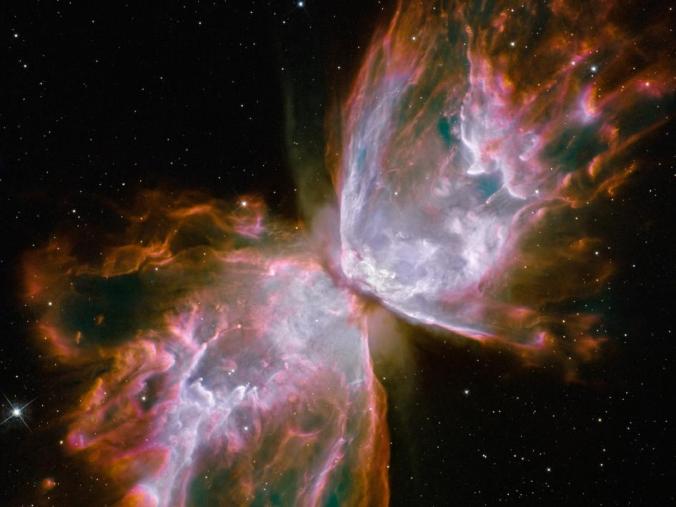
The butterfly nebula is beautiful when it is observed; without observation it is meaningless.

Two bags of chemicals are meaningless, but the intimate relationship between two people who are in love has immense meaning and purpose.

Is this so strange?  When we look at the quantum level of the material, there is no such thing as paper or ink.  There are particles and forces that we cannot understand.  They are outside of our ability to perceive, so we think of them as miniature versions of ping pong balls and sticks.  They are only potentialities until they are observed.  What we consider material reality is not really real, it performs its function only when it is perceived and observed.  So perhaps what we perceive as real day to day, the material world, is similarly non-material. Perhaps the only reality is our perception, our model.

So what of God in this?  Jesus spoke of God living in us and us in him.  Perhaps our material framework that holds us is part of God.  As Anselm wrote, everything is what it is through extreme goodness, through God, so we are what we are through and within God.  We are told that God is love, and that we are made in his image.  Jesus said that ‘if you have seen me, you have seen the father’; I don’t think he was talking about his flesh, but his ‘being’ – his ‘spirit’.  Our framework (our body and brain) is a small part of a material universe that is created and sustained by God.  If that universe is within God, part of God, then we too are ‘in him’, as he is ‘in us’.

And what of laws of physics, of evolution and biology?  We can create mathematical models of inanimate physical objects, and we can observe the behaviour of molecules and cells which seems to be beyond the possibility of simply responding to those physical laws – yet seems to be consistent, predictable, and purposeful. Within the framework where the universe is within and part of God there may be causes other than the laws of physics for the astonishing growth and development of the human being from the single cell; a God whose will ‘knits us together in our mother’s womb’. In the same way that our ‘will’ causes our hands to move, makes our choices, interacts with others, so God’s will can cause our bodies to grow and develop, to form our brain, to manufacture us as the masterpiece we are, our body being the receptacle for our spirit.

It is the non-material that motivates us, the non-material that leads to change, the non-material that makes our world like it is rather than a desolate moonscape.  The non-material is master over matter.  The non-material is the meaning, the meaning is the reality.

Who would disagree that there is a ‘spirit of Christmas’, all of society embracing a season of joy and giving.  People speak of the true spirit of Christmas; we know that there is something that transcends each of us as individuals.  It is part of the sprit that is God.

When we observe a beautiful woodland track, sunlight shining through the leaves to create a dappled light settling on a trickling stream, that beauty is part of the essence that is God.

When we listen to a sublime piece of music that moves us to tears, or an energising rock ballad that lifts our hearts with passion, that is part of God.

When we love someone, our love is part of the supreme love that is God.

When we meet friends in a party, in a community, that spirit of community is part of God’s spirit of community.

If we can appreciate that the greater reality is the spirit, and the material is just the framework then we can see God and the universe in a whole new light.  The universe can be considered the canvas for a cosmic work of art, a magnificent symphony of action and awe.  Life is a molecular dance of astonishing intricacy and beauty.  We are permitted to explore and understand through science.  We are permitted to glimpse the canvas and participate in the dance; characters created by the dance emerging as individual caring, loving, interacting beings partaking of some of the glory that is the story; individual masterpieces beyond the beautiful, whose reality is our character, our choices, our nature, our soul.  Creatures of purpose and with purpose.  Creatures honoured with the possibility of relating to our creator, the master artist, engineer, scientist, musician, teacher, parent, friend, but never are we his equal.

So this is the God of Science:  A God who was there before the universe began.  An un-created, creator God who gave ‘nothing’ the ability to become ‘something’.  A God who sustains, and maybe actually is, the very fabric of the universe. A God who actually is the laws of physics, who benevolently guides providence to bring life out of a set of chemicals.   A God who imbues the chemical dance that is us with the ability to feel, to taste, to see, to experience: love, joy, peace, fulfilment, intellectual challenge, selflessness, forgiveness, anger, hate, disgust, bitterness.  Perhaps even a God who is love, joy, peace, fulfilment…. But a God who allows us to experience both the good and the bad, and who allows us to choose to pursue that which is good, or that which is not.

Add to this the God revealed to us by Jesus Christ and we begin to understand the complete context.

butterfly nebula

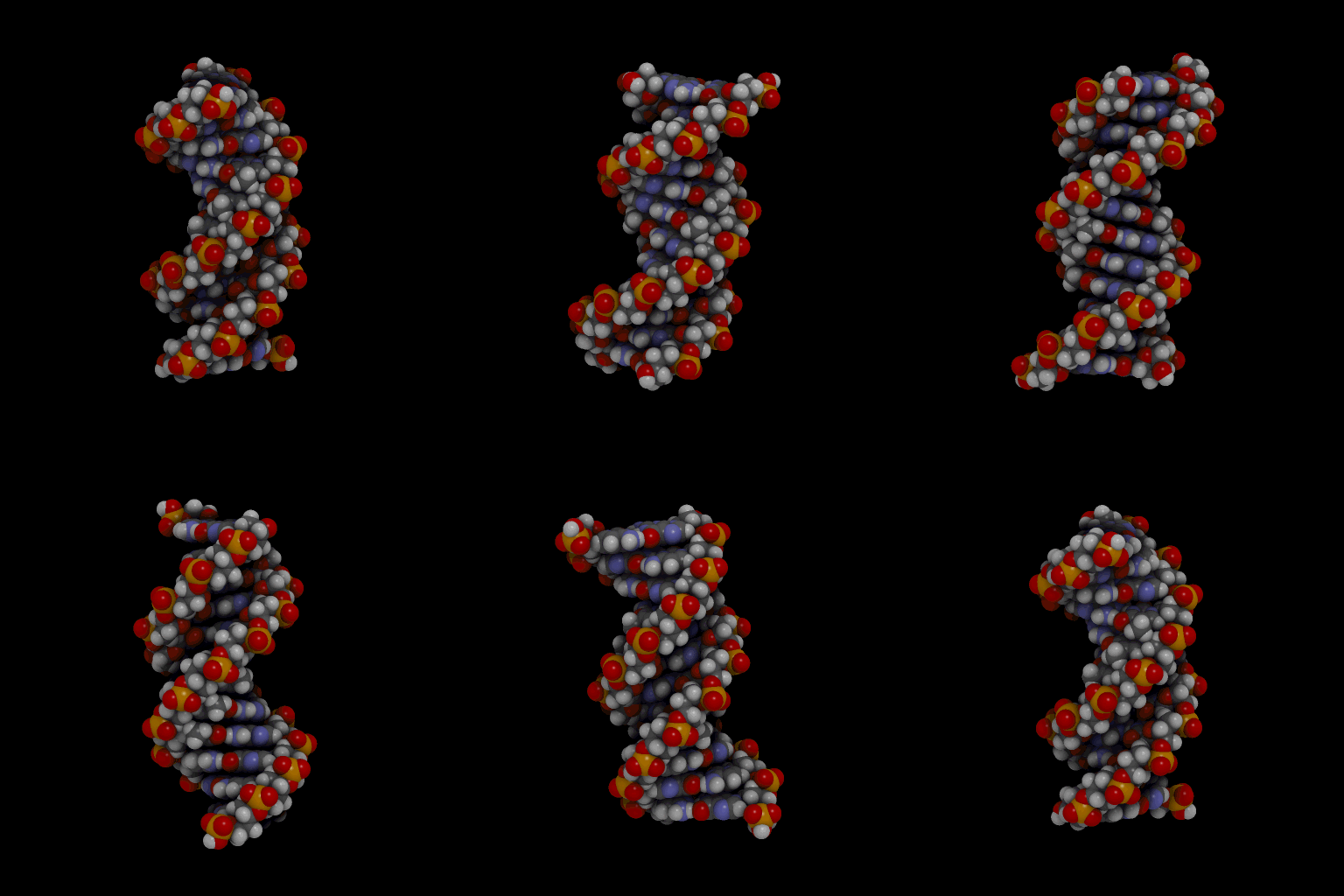
The DNA enigma

DNA is amazing stuff.  A precisely structured sequence of base pairs that is unique to each of us as an individual.  A record of our ancestral history.  A template for the manufacture of our proteins.  The blueprint for each of us.

The human DNA chain of around 3 billion characters has been assembled over perhaps the last billion and a half years (from the first evidence of cells with a nucleus), and has changed with the changing animals that carried it, through perhaps a billion generations.

DNA appears to be the mechanism of inheritance, the instruction set that ensures that beneficial features from parents are transmitted to the offspring.  It appears to be the key that defines a naturalistic explanation of how we have come to be here.  But is it?

Is there enough information within DNA to define each of us?  Or is something more needed?

As we remember that each of us begins as a single fertilised cell containing the combined DNA from our father’s sperm and our mother’s egg, then let’s remind ourselves of what the information in the DNA is being asked to define.

  1. The precise geometric construction of our bodies:
    1. The position, shape, type and interconnection of each of our fifty trillion cells
    2. The complete development cycle, that is robust enough to cope with different environments and with physical damage.  A development cycle which maintains the living organism as a functional entity at each stage in the process
    3. Major systems, fully functioning and cooperating with each other
      1. Circulatory System
      2. Respiratory System
      3. Immune System
      4. Skeletal System
      5. Excretory System
      6. Urinary System
      7. Muscular System
      8. Endocrine System
      9. Digestive System
      10. Nervous System
      11. Reproductive System
      12. A fully programmed brain that can control the operation of the body, but that can also think, conceptualise, communicate, empathise, create works of art, music, appreciate beauty, love, hate, choose.  A brain that appears to have, and for all practical purposes has free will.

This is weighty stuff to place onto DNA.

Indeed, the functionality does not seem to match the information capacity of the DNA; the DNA of an amoeba is ten times longer than that of a human, yet the functionality is minimal in comparison.

Has familiarity bred contempt?  Do we see ourselves too superficially?  Have we lost our awe at our own construction?  Have we deluded ourselves into thinking that we understand?

Have we forgotten that all that we are physically began with that one cell?  One cell and its DNA, is it really sufficient to make a human?

Image