Is it possible to be a Christian and right wing?

It’s not complicated.  Jesus said “Those who accept my commandments and obey them are the ones who love me.”

And what are His commandments?

“‘You must love the Lord your God with all your heart, all your soul, and all your mind.’ This is the first and greatest commandment. A second is equally important: ‘Love your neighbor as yourself.’ The entire law and all the demands of the prophets are based on these two commandments.”

and here are some more details:

“If you lend only to those who can repay you, why should you get credit? …  Lend to them without expecting to be repaid”

“Give to those who ask, and don’t turn away from those who want to borrow”

How does this square with austerity measures imposed by the wealthy on the poor?

Just asking…..

Time to repent.

In an earlier post I wrote “Inequality between the richest and the poorest is a man-made thing. Men have put it in place. Men defend it. Men can dismantle it.”  I was wrong.

Recent events clearly show that left alone, mankind is selfish, greedy and tribal.  Only when empowered by the spirit of love and goodness can men and women make a difference.

We need more leaders who promote that spirit, but we are cursed with politicians such as Trump who despise love and goodness.  Many of the Brexit arguments from both sides were appealing to our baser nature.  And we listen to them and subdue the spirit of love in our heart.

So what must we do to change the state of things?  We were given the answer two thousand years ago:

“Repent, and give up our life of sin”

Each one of us needs to take stock of our values and choose to live by what really matters: to love our neighbour as ourselves.  We need to embrace the spirit of love and goodness, accept forgiveness for how we have been and from now on choose to love.  That is the only way that the evil in this world will be defeated.

For more details, go to your local church or read:

Christianity why bother cover

A contemporary Genesis

One morning I felt the inspiration to write a modern version of the Genesis account of creation, incorporating and alluding to the scientific discoveries of recent times.  I hope that nobody chooses to take offence:

Before the beginning of time and matter in our universe, there was God.  Of his works other than our universe we know nothing, but of his works in this universe we have learned much through the gift of our intellect. Of all his purpose in our universe we can know only what he has chosen to reveal to us, and he has revealed that we were his purpose.  One purpose alone or one purpose among many is not for us to know.

God chose to create this universe.  He created time, and then he tore nothingness into matter and antimatter, and in that great explosion from nothing he caused there to be an excess of matter over antimatter.  And he causes matter to interact with matter through invisible forces acting across nothingness. And ripples of that rending apart of nothing remain until this day for us to observe with wonder.

Since God knows his plans, he chooses to cause matter to behave in a consistent way. He allows the tiniest particles to behave in individually unpredictable ways, but in community he causes them to follow his chosen laws.  In the presence of spirit, whether God’s own or that of humans or other spiritual beings, God allows his laws to be suspended.  God continues to sustain and guide his creation, acting as and when he chooses and allowing individuals to choose how to act.

And so for billions of years, although years were yet to be invented, the universe unrolled according to the laws that God had chosen.  Particles formed into atoms, atoms formed into great stars and stars drew together into galaxies.  The first stars grew to such a size that the interaction between the matter and the forces caused great energy and the explosion of the stars, and in those explosions new atoms were formed.  God was making the building blocks of life, the carbon and the oxygen atoms.  Out of those explosions, and according to God’s laws of interaction new stars formed, and planets were formed around those stars.

One of those planets, the earth, had the right conditions for the next phase in God’s plan.  The planet was at first a molten mass, bombarded from space by asteroids and meteors as the turmoil of the formation of the particular sun and galaxy subsided.  A crust was formed on the molten mass, and a gaseous atmosphere formed above the crust.  In that atmosphere and on the crust, the carbon, hydrogen and oxygen atoms joined to form more complex short molecules.  When the time was right, these short molecules formed into long chain molecules.  These very special molecules continued to work according to the laws that God had chosen for the atoms and particles.  The molecules had different purposes, some formed into cell membranes, some formed into little molecular machines, and some formed into very long instruction chains.  And God caused them to be combined into what we today would call cells, and God had given them the mechanism to multiply in number.

To the first cells he gave the task of changing the atmosphere of the earth.  Using the energy of the nearest star, the sun, the cells separated oxygen from carbon dioxide and pumped the oxygen into the atmosphere.  For more than a billion years the cells carried out their task of preparing the atmosphere of the earth, getting ready for the more complex organisms that were next on his plan.

When conditions were right, the individual cells formed into groups or communities that were dependant on each other, where each cell in the group performed slightly different functions and so the new organism was able to both become larger but also to perform more complex functions.  God gave the individual cells the means to evolve a mechanism that would carry the instructions for each cell in the group to perform its function, and to respond to the communications from other cells within the group.  And so, multicellular organisms were formed.

The instructions embedded in each of these cells ran to billions of characters in length.  The mechanisms of the cell and these instructions were both necessary for the cells to operate and grow, and to reproduce from generation to generation.  God didn’t plan to make all organisms identical, so he designed ways and means of bringing variation to the offspring of the organisms.  He allowed “random” variations due to inaccurate copying, and he caused deliberate mixing of the instructions in one organism with another, requiring separate organisms to come together in order to create the next generation.  The organisms themselves thus had to live in partnership and community to survive.

So God had established a process of growing a wide diversity of organisms of increasing functionality that relied on each other to survive and thrive.  Whilst each individual organism would be allowed to behave in an individual way, only those that were successful in progressing God’s plan survived and reproduced.  God chose to allow a process of competition to develop the organisms as he wanted; a process which required individual capability and cooperation between individual cells within an organism, and between organisms of the same type.  Through this phase of God’s plan he used the law of “survival of the fittest” to perfect each organism, and to select which organisms to perfect.  The organisms didn’t know anything of right and wrong.

But that was not the end of God’s purpose, although it took billions of years to accomplish.  His plans were greater than that, for there to be beings in his likeness; beings that would design and create, but more than that, beings that would know right from wrong, beings that would love, spiritual beings that would know and seek God himself.

So he selected one of the organisms and he planted his spirit in that organism and gave it an awareness of God himself, and he gave that organism the ability to know what is right and what is wrong, and he gave that organism the ability to choose to do what is right or what is wrong.  That organism is mankind, the pinnacle of God’s creation. 

You might not be ready to accept this new account. Certainly it is not literally correct, but maybe it is more relevant to today’s society in the same way that the original Genesis was relevant to the society of its day.  It conveys that all of us are spiritual and material beings, willed by God as the culmination of a creative process of unimaginable complexity spanning billions of years, following the creation of time itself.  Mankind: created with the opportunity to know God and to relate to him, but allowed the alternative of rejecting and ignoring him.

Excerpt from “The Big Picture – an honest examination of God, Science and Purpose”
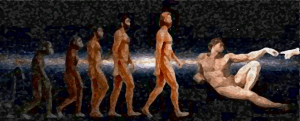
evolution

A morning prayer for the wealthy

Dear Lord,

Father, Son and Holy Spirit,

Thank you for bringing me safely through another night and for the promise of a new day.
Thank you for blessing me with health, wealth and good friends, and thank you for my family.

Thank you for the blessings that I can bring to others. Forgive me please for the times when I have not acted as you would wish, and please strengthen and encourage me to carry out your will in the future. Guide my steps to places and people who I can bless, and form in my heart the desire and will to be that blessing. Let me feel joy at the good that I have been able to do in your name.

It is hard to be joyful when there is evil confronting us each day, sustained by misguided beliefs and the cold hard hearts of so many.

Yet all good things come from you and are part of you, so please help me to know you, love you and enjoy your presence. Please lift my spirit to worship and praise you, and to appreciate your gifts to me. Please be present with me every moment of the day and night, filling me with your goodness and keeping me from harm. Please protect those who I love, and heal those who are suffering in body, mind and spirit.

In this cruel and selfish world, I ask that you work in all people to draw us to love you with all our heart, mind, soul and strength, and to love our neighbour as ourselves.

Please correct the growing culture of inequality where we, your children, believe others to be less important and valuable than we are. Help us to see each human being as our brother or sister, parent or child, and to love them as such.

Father, let your spirit drench this land as the wind and rain of winter. Convince the people in this nation of your existence, bring us to see our sin, and to repentance and forgiveness. Draw us close to you.

And please mould your church to feed us with the bread of life and to help us praise you as you deserve. Please remove the barriers that we put in the way of people who would follow you, forgive our mistakes and guide our actions to properly serve you and those we live among.

I ask all this in Jesus’ name, for I believe and trust that this is your will.

Amen

“Christianity – Why Bother?” … out now

Belief in God is claimed to be on the decline, and many cannot see a reason to question whether God might exist. What would be the point? Why make the effort? That is why “Christianity, Why Bother?” deserves a read. It answers the question that its title asks.

The book discusses some of the misconceptions of Christianity, and then moves on to examine the basis for belief and explains some of the practical and day-to-day benefits of being a Christian. The author shares some of his experiences since he became a Christian at the age of forty. The aim is simply to address the question, “why bother?”

Christianity why bother cover

Click here to buy on Amazon.

There are no border controls on the Kingdom of God

Jesus taught that “the Kingdom of God is at hand”. But how do we get there? Do we need a passport, or apply for a visa? Do we have to pass an entrance test to become a citizen?
Anselm described God as supreme goodness, and John’s gospel tells us that God is love; “But anyone who does not love does not know God, for God is love. And if God is love, love is God.
But God is more than that, he has ‘person-ness’ that I describe in “Four steps of reason leading to a personal God” . So we can think of love as part of his realm, his kingdom. Therefore to live in love is to live in the Kingdom of God. Every act of goodness or love is by definition carried out in the Kingdom of God. Every time a person choses to act kindly to a neighbour, they are in the Kingdom of God. Every time they choose not to respond in a loving, good way they are choosing to live outside the Kingdom of God. It doesn’t matter whether they call themselves Christian, Moslem, Hindu or atheist – acting is love is acting in the Kingdom of God.
Because it is our choice whether we act, or live, in the Kingdom of God there are no border controls. God does not make any demands, or set any tests for those who want to live there. We simply decide. I choose to love, therefore by definition I choose to live in the Kingdom of God.
But by definition, if I choose to be selfish then I am not in the Kingdom of God, because selfishness is not love, and therefore is not part of the Kingdom of God. If I live selfishly, I am in the Kingdom of Me.
Clearly we move in and out of the Kingdom of God every hour of every day. Perhaps we all need to be a little more conscious of which Kingdom we want to live in.

The Man Born to be King

Good guidance from a fellow blogger (and wife).

The Man Born to be King.

I think I might be a panentheist – I hope it’s catching!

The ancient Celts knew a thing or two. They were not the wild fighters who the Sheriff of Nottingham brought in to drive Kevin Costner’s Robin Hood from his idyllic woodland village. They had a special understanding of the nature of things. According to “The Celtic Way” by Ian Bradley they held “a conviction that the presence of God was to be found throughout creation – in the physical elements of earth, rock and water, in plants trees and animals and in the wayward forces of wind and storm.”

Bradley goes on to say that “We are not in the world of pantheism here but in the much more subtle and suggestive realm of panentheism – the sense that God is found both within creation and outside it.”

Elsewhere I have written that God is ‘the laws of physics’ – it’s just another name for the thing which causes matter to behave in the way that it does. Without God/’the laws of physics’ there can be no matter – God and matter are not independent, and so matter is (part of) God. (see “Proof of God?”)

I have also noted that there are non-material things: love, justice, purpose etc. These must similarly be part of God – reflected in the Biblical passages which state that God is love. (see “An argument for, and definition of God”)

This understanding of the nature of God leads us to realise that you don’t need to go somewhere to meet God – he doesn’t live in church or a monastery – he is all around us, and within us, sustaining our physical bodies and our environment: “we are what we are through and within God”. (see “The God of Science”)

The Celts understood this. Not within the scientific context that I have described, but in the practical day-to-day knowledge of God. Perhaps we need to refresh our view and understanding of science to reflect this Celtic wisdom: science is simply the study of God!
There is no separate sacred / secular division, no God / nature division, no heaven / earth division; they are all part of God who is God of everything.


A robust intellectual basis for Christianity is not enough.

I like to understand why things are like they are. As a child I was taught that science provides the answers that I needed.

When in later life I became a Christian I thought that there was a conflict between science and God, but for a while reconciled this with the idea that ‘God can do anything’. A simple idea, but science and faith was not an area that I really wanted to explore.

We are given the impression that ‘science knows’, but we just haven’t been told yet. About five years ago I decided to find out. What does science know? What does it still not know? Are there things it can never know? Taking everything into account, what story best fits all the facts, a godless universe or one with a God?

I adopted an analytical approach, but avoided the temptation to dig too deeply into details of each field. I just tried to understand the underlying principles sufficiently to see what they contribute to the big picture. I found that most people feel uncomfortable outside of their specialist field, that few seem willing to take the necessary overview.

Having read a couple of books like ‘The Edge of Evolution” by the Intelligent Design proponents I began thinking that it may be possible to prove God exists. But then I read secular books on the origins of life and realised that everyone accepts the remarkable unlikelihood of life but that it doesn’t provide irrefutable proof – there are alternative explanations such as the multiverse theory.

I needed to find out where the Bible came from; could I trust it, and if so, why? I researched the source of the NT documents in particular, and some of the gospel accounts that are excluded from the Bible (the Da Vinci code stuff). I realised that the gospel accounts are not trying to prove who Jesus was and what he did, but that they wouldn’t have been written if he hadn’t done some amazing things. The accounts are simply people trying to capture what happened for future generations. The Bible is not a spells book: “Do this and God will do that for you”.

I reached a number of conclusions about how to understand and respond to the big picture of what’s going on. Realising that everything requires a level of faith (including science of course), I suggest a response which recognises that many religious and scientific dogmas are unproven and unprovable – but unnecessary. I call the response “Minimalist Christianity”. I wrote up what I found in “The Big Picture”, found a publisher and then set about marketing my masterpiece.

There is a robust intellectual basis for Christianity, and I would commend it to others, but I recently realised that in exploring it I was falling into a bit of a trap. Because I have necessarily spent several years testing and probing, viewing things sceptically, I let my personal spiritual life become analytical too. My reasoning has shown that God exists, and that he must have a ‘personality’ and want to interact with each of us, but I have not really been responding to the real God – just developing an intellectual one.

We need to ‘get to know God’ as more than an idea; I need to follow my own advice! It is from the integrity of that relationship that the power to fulfil our purpose will flow. We need analysis to know that we can trust, but then we need to act on that trust to complete the experience. Having determined that the rock exists, we need to actively build the house of our life on it!

“Anyone who listens to my teaching and follows it is wise, like a person who builds a house on solid rock. Though the rain comes in torrents and the floodwaters rise and the winds beat against that house, it won’t collapse because it is built on bedrock.” Jesus circa 30AD

“Here, there be dragons”

Centuries ago many people used to live their entire lives within a few miles of where they were born. Occasionally travellers would pass through with tales of far-away places which held wonders, treasures and maybe ‘dragons’. But few would dare cross the borders surrounding their small world of familiarity.

Dragon-Linda_BlackWin24_JanssonNowadays many people again live their entire lives within a relatively small environment. Maybe it is not physical, since modern transportation puts the whole world within reach, but I’m speaking of relationships, culture and spirituality.

Our sphere of friends is gathered through encounters where we like to pass our time: work, the sports club, the toddler group or school, the pub. We meet like-minded people in comfortable environments and put down roots there. Occasional travellers pass through with tales of other lifestyles: we get peeps at them on the TV reality shows, a foreigner might join our band, or a tragedy might move us out of our comfortable world. But “few dare cross the borders of their small world of familiarity”, and most will lobby to maintain their personal utopia.

We understand how the world works through what we have learned through personal experience, the media and common sense.  With our Western worldview glasses we know such things as: the economy has to be healthy, everyone should be educated and democracy is the only system that works. And of course we should all have rights, to health, happiness and freedom, particularly freedom of speech. We seldom stop to question the basis on which we have decided that all of these ‘truths’ are correct. When we hear tales of other cultures we are fearful that they will invade our territory and bring unimaginable horrors and suffering.

But perhaps we are most fearful of uncharted spiritual seas. England used to be a Christian nation, although deeply divided between Protestant and Catholic, but has largely come to believe in Scientism; the religion that science can explain everything. It can be comforting to think that science can tell us why Grandma died, and to hope that in the future cancer will be conquered. Occasionally we will hear tales of a spiritual realm, something that is not simply made of ‘stuff’, and strangers will speak of God and tell us that we have a ‘soul’. A frequent response is to ignore such ramblings, or to accept that such things may be ‘okay’ for them, but I’m quite happy in my own ideas thank you very much.

Secretly, if we are bold enough to ask ourselves, we will admit that our small-world outlook is largely driven by fear. We are afraid that we will lose our basis for life, even if it doesn’t seem to be working too well for us at the moment. We would love to befriend those in different circles, experience different cultures, and reach a satisfying understanding of who we are spiritually; we yearn to find our soul and our purpose.

It is the beginning of a new year: 2015. Two thousand and fifteen years after a special baby was born. Who as a man spoke strange tales of a spiritual realm and a God. A man whose words gave us a rock to build our lives on. A man who willingly allowed himself to be crucified to show that death could not hold him – or us. A man who Christians call God. Perhaps it is time to take our courage in our hands and explore this strange new land? Many have gone there before, but few have returned with tales of dragons! Instead, they come back with stories of hope and fulfilled purpose; the promised land. Shall we go?