On life, and death

Have you reached the point yet of wondering what happens when you die?  Perhaps the current pandemic will prompt more of us to think about this important question.  It is important because of the impact that the answer has on us whilst we are alive.

There is an unspoken assumption behind all the current fears and actions that death is a bad thing; that we must do whatever we can to extend life – even if the extended life comprises sitting in an armchair in a care home gazing out the window or watching daytime TV.  I use the term ‘extend’ deliberately instead of the more common term ‘save’ because we are all destined to die;  rescuing someone from drowning does not ‘save’ their life, it extends it.  But to what purpose?

Actually, it may be that rescuing someone from drowning does ‘save’ their life, in that the experience may cause them to turn from a previous pointless and self-centred existence to a life of love and purpose.  The fact that someone cared about them enough to rescue them may make them realise the importance of relationships, the importance of selflessness, the importance of love.

People who have gone through near death experiences often become dramatically changed, dedicating the rest of their lives to acts of loving kindness to others.  So it is indeed possible to save someone’s life. But it is the quality, value and purpose of the life that is saved rather than the biological state of being alive for ever.

We confuse the biological life with what I will call spiritual life.  An amoeba has biological life, a tree has biological life, and so does a virus.  But none of these have spiritual life.  They do not ‘experience’ life, they have not brain to sustain any form of consciousness and they simply live biologically.  There may be other forms of higher life (apes, dolphins) that can ‘experience’ life; I don’t know because I’m not one of them.  But I do know that I experience life.  When I eat a curry I ‘experience’ a taste, but even that is hard to pin down.

If you Google “The Qualia Problem” you will find a paper by Frank Jackson which states that:

“I think that there are certain features of the bodily sensations especially, but also of certain perceptual experiences, which no amount of purely physical information includes. Tell me everything physical there is to tell about what is going on in a living brain, the kind of states, their functional role, their relation to what goes on at other times and in other brains, and so on and so forth, and be I as clever as can be in fitting it all together, you won’t have told me about the hurtfulness of pains, the itchiness of itches, pangs of jealousy, or about the characteristic experience of tasting a lemon, smelling a rose, hearing a loud noise or seeing the sky.”

But whatever it means for me to experience the taste of the curry, I know that there is a ‘me’ to experience it.  It is that ‘me’, not the biological me which I long to preserve, whose ‘life’ I want to save.  And so the big question is, does that ‘me’, that spiritual me, cease to be when my physical body ceases to be?

If the spiritual ‘me’ will end when the biological me ends, there will be no ‘me’ to experience that I am dead.  Do not grieve for me, I will no longer exist.

Of course I will remain in your memory, and you will look back on your memories with joy and sadness – as with all memories.  They are not erased simply because I die; they are as real as they are today while I live.   But if extending my life gives me no ‘spiritual’ life at all, then any new memories will bring sadness in remembering my final days.  So what will be the value of extending my biological life when I have no spiritual life?  The preservation of my decaying body simply to avoid biological death will bring sadness to overshadow previous memories, and will in practice bring mourning forward before my death.

This may sound heartless, particularly if you have not yet lost your parents or other loved ones.  But before you condemn me, I have suffered loss.  I have lost a child, at birth.  I have lost both of my parents.  And I know the pain that the pointlessness of the latter days of their lives brought them.  My father knowing he had to suffer the pain of prostate cancer with no hope of end other than death; my mother wondering when the pointlessness would end, her daily routine seeing her sitting on her bed gazing out at the suburban street for hours.  I grieved over them all when they died, and the grief is still there of course, many years later, just less acute.

I am not heartless.  No.  I want to see people truly, spiritually ‘live’ whilst they have biological life.

But what if the spiritual ‘me’ continues to exist beyond death?  What if my purpose is indeed eternal?  And how can I know?

The crew of early sailing ships believed that there were other lands over the horizon.  Europeans believed that there must be a large land mass south of the equator before they found it.  And brave adventurous souls set off to find it.  Some came back and told others that it was true, and soon constant travel to and fro confirmed it.  That made it easy for those who had not been there to ‘know’ that Australia existed.

But it’s not quite the same with life beyond biological death.  Our bodies cease to function and eventually the flesh rots and we are left with a skeleton.  We don’t find dead people returning to re-inhabit their skeletons; there is no free travel between here and any ‘afterlife’.  At least, not that we are aware of.

Imagine for a moment a caterpillar.  It has a physical body, it eats and excretes, it moves around and (pretending for a moment that it has the capability) experiences the physical domain of the leaf.  And then, after it has grown and fattened up, it appears to die.  It becomes encased in a shell and the caterpillar’s physical form decays.  But it is still alive, rather than being dead, it is being transformed into something different.  The butterfly that emerges from the cocoon bears no resemblance to the caterpillar, and is not even constrained to living on the leaf.  A thing of beauty, it soars into the air and is a delight to see.  Yet it cannot return and tell the caterpillars who remain on the leaf that there is life beyond the cocoon.  Neither should we expect human spirits return to tell us what happens beyond biological death.

And yet… one did return.  No ordinary man, but a man who had turned the lives of those he met upside down;  A man who taught the secrets of true spiritual life to those who would listen – yet more than a great teacher;  A man who healed those who were physically ill by the touch of his hand, yet more than a great doctor;  A man who brought biological life back into a friend’s physical body after they had been buried in a tomb for three days;  A man who willingly surrendered his body to excruciating crucifixion and inevitable physical death and burial in a tomb.

Two days later, his tomb was empty.  Although his friends and more importantly his enemies searched everywhere for it, no body was to be found, just some folded grave clothes.  His enemies were desperate to find the body to disprove the claims of his closest friends that he was alive; that they had seen him, spoken with him, and touched him.

Madness we say – they must have imagined it.  And yet such a madness that they were willing to die rather than deny it.  Such a madness that they were filled with joy, and their lives were transformed;  freed from the greed and selfishness of their world – sharing all they had with one another, loving one another.  Such a madness that they began to understand the secrets their friend had taught them about what a true spiritual life looks like.  Such a madness that brought ‘life in abundance’, not just for them but for all who listened to their eye witness accounts and trusted and believed them.  A madness that has affected millions upon millions over the past 2000 years.

Our decision of what we believe happens when our bodies physically die has enormous impact on our lives whilst our physical bodies live. Do we trust in the eyewitness accounts of what happened to that man, and hope and expect  that spiritual life is not snuffed out with our decaying bodies?   Do we choose to believe that our spiritual selves will live on, no longer constrained to the two dimensional leaf of this world but soaring into the sky of eternity; that we will be transformed from caterpillars to butterflies.  Do we start putting into practice the words of wisdom that bring spiritual life today?

Madness?  Or the sanest decision that we ever make?  Do we trust or ignore the evidence?  Do we dare to find out?

Foreword to The Big Picture

Scientific discovery has brought material benefits and physical comfort to mankind.  The predictability of matter leads us to assume that it behaves according to fixed laws, and this belief has led engineers to develop tools and machinery to manipulate the environment, doctors to develop cures for many diseases, and farmers to grow crops with greatly increased yields.  Many of the scourges of previous times have been overcome leading, in the Western world at least, to longer lifetimes and better health.  However, this has also led to the belief that everything is predictable and controllable. If anything goes wrong (by which we mean it causes us distress or discomfort) then it must be fixable, and if it hasn’t been fixed it must be someone else’s fault.

Personal rights have grown, but personal responsibility has diminished.  Laws to protect the weak have bred the belief that it is the state’s job and not our individual duty to help out those less fortunate than ourselves.  Mechanisation that was supposed to give more leisure time has led to lost jobs and loss of purpose.  Competition and the shrinking of the geographical world has meant that there is someone, somewhere who will work harder or longer hours than we do, and the pressure grows to produce more for less.  The availability of loans means that goods can be obtained now if we promise to pay later.  To pay the loan we need a job.  Fear of job loss drives us to work longer hours and accept less pay. The purpose of life becomes to produce.  The mechanism which fuels demand and production is the economy.  The economy becomes the measure of the health of a nation.

Is that what it’s all about?

Is my value simply what I can produce?

Am I measured just by what I can earn?

If I retain the worldview that the economy is king then the implication is yes, but that doesn’t feel right.  I want to be valued and loved as a person.  I want a worldview that speaks to my heart and my mind and not just my wallet, and I want it to be based on sound thinking and evidence.

Science has brought great technological and medical benefits to mankind; cars, televisions, fridges, telephones, electricity and so on.  But science has also brought guns and bullets, pollution, global drug trafficking and job losses.  Science seems to dominate my life, telling me what I should or shouldn’t do to keep healthy, avoid risk and live longer, but it doesn’t tell me why I would want to live longer.  Science doesn’t give any purpose to my life.

Religion offers purpose, but it too seems to want to control me and dominate me.  Religion has been used as justification for many great atrocities: the Spanish Inquisition, child sacrifices, the Crusades.  Religious people seem to want to tell me how to behave, and to judge and criticise me, claiming to represent the will of God.

I want to know the truth.  I want to know what science can tell me about how the universe works, and perhaps where I came from.  I want the benefits that science can bring, but not at the cost of becoming a slave to its dictates.  I want to know why I am here, what my purpose in life is, or even if there is one.  If there is a God I want to know what He thinks. I want the benefit of knowing that I have a purpose, but not at the cost of becoming a slave to rules from another human being.

And so I investigate, weigh up evidence in all forms and seek a holistic worldview that works.  I have explored what we know from the physical and biological sciences, and I have researched historical evidence for God. I have tested what is actually known, and what is speculation, extrapolation or personal opinion and rhetoric.

This book presents my conclusions, and some of the evidence that brought me to draw them.  I offer what I believe is a consistent, healthy and constructive worldview based on sound evidence.  I’ve called it Minimalist Christianity.  Whether you agree with my conclusion or not, I hope that many of the myths that currently inhibit so many of us will have been weakened or dispelled.  I hope that a step can be taken towards finding purpose and experiencing life in abundance.

Time to repent.

In an earlier post I wrote “Inequality between the richest and the poorest is a man-made thing. Men have put it in place. Men defend it. Men can dismantle it.”  I was wrong.

Recent events clearly show that left alone, mankind is selfish, greedy and tribal.  Only when empowered by the spirit of love and goodness can men and women make a difference.

We need more leaders who promote that spirit, but we are cursed with politicians such as Trump who despise love and goodness.  Many of the Brexit arguments from both sides were appealing to our baser nature.  And we listen to them and subdue the spirit of love in our heart.

So what must we do to change the state of things?  We were given the answer two thousand years ago:

“Repent, and give up our life of sin”

Each one of us needs to take stock of our values and choose to live by what really matters: to love our neighbour as ourselves.  We need to embrace the spirit of love and goodness, accept forgiveness for how we have been and from now on choose to love.  That is the only way that the evil in this world will be defeated.

For more details, go to your local church or read:

Christianity why bother cover

A contemporary Genesis

One morning I felt the inspiration to write a modern version of the Genesis account of creation, incorporating and alluding to the scientific discoveries of recent times.  I hope that nobody chooses to take offence:

Before the beginning of time and matter in our universe, there was God.  Of his works other than our universe we know nothing, but of his works in this universe we have learned much through the gift of our intellect. Of all his purpose in our universe we can know only what he has chosen to reveal to us, and he has revealed that we were his purpose.  One purpose alone or one purpose among many is not for us to know.

God chose to create this universe.  He created time, and then he tore nothingness into matter and antimatter, and in that great explosion from nothing he caused there to be an excess of matter over antimatter.  And he causes matter to interact with matter through invisible forces acting across nothingness. And ripples of that rending apart of nothing remain until this day for us to observe with wonder.

Since God knows his plans, he chooses to cause matter to behave in a consistent way. He allows the tiniest particles to behave in individually unpredictable ways, but in community he causes them to follow his chosen laws.  In the presence of spirit, whether God’s own or that of humans or other spiritual beings, God allows his laws to be suspended.  God continues to sustain and guide his creation, acting as and when he chooses and allowing individuals to choose how to act.

And so for billions of years, although years were yet to be invented, the universe unrolled according to the laws that God had chosen.  Particles formed into atoms, atoms formed into great stars and stars drew together into galaxies.  The first stars grew to such a size that the interaction between the matter and the forces caused great energy and the explosion of the stars, and in those explosions new atoms were formed.  God was making the building blocks of life, the carbon and the oxygen atoms.  Out of those explosions, and according to God’s laws of interaction new stars formed, and planets were formed around those stars.

One of those planets, the earth, had the right conditions for the next phase in God’s plan.  The planet was at first a molten mass, bombarded from space by asteroids and meteors as the turmoil of the formation of the particular sun and galaxy subsided.  A crust was formed on the molten mass, and a gaseous atmosphere formed above the crust.  In that atmosphere and on the crust, the carbon, hydrogen and oxygen atoms joined to form more complex short molecules.  When the time was right, these short molecules formed into long chain molecules.  These very special molecules continued to work according to the laws that God had chosen for the atoms and particles.  The molecules had different purposes, some formed into cell membranes, some formed into little molecular machines, and some formed into very long instruction chains.  And God caused them to be combined into what we today would call cells, and God had given them the mechanism to multiply in number.

To the first cells he gave the task of changing the atmosphere of the earth.  Using the energy of the nearest star, the sun, the cells separated oxygen from carbon dioxide and pumped the oxygen into the atmosphere.  For more than a billion years the cells carried out their task of preparing the atmosphere of the earth, getting ready for the more complex organisms that were next on his plan.

When conditions were right, the individual cells formed into groups or communities that were dependant on each other, where each cell in the group performed slightly different functions and so the new organism was able to both become larger but also to perform more complex functions.  God gave the individual cells the means to evolve a mechanism that would carry the instructions for each cell in the group to perform its function, and to respond to the communications from other cells within the group.  And so, multicellular organisms were formed.

The instructions embedded in each of these cells ran to billions of characters in length.  The mechanisms of the cell and these instructions were both necessary for the cells to operate and grow, and to reproduce from generation to generation.  God didn’t plan to make all organisms identical, so he designed ways and means of bringing variation to the offspring of the organisms.  He allowed “random” variations due to inaccurate copying, and he caused deliberate mixing of the instructions in one organism with another, requiring separate organisms to come together in order to create the next generation.  The organisms themselves thus had to live in partnership and community to survive.

So God had established a process of growing a wide diversity of organisms of increasing functionality that relied on each other to survive and thrive.  Whilst each individual organism would be allowed to behave in an individual way, only those that were successful in progressing God’s plan survived and reproduced.  God chose to allow a process of competition to develop the organisms as he wanted; a process which required individual capability and cooperation between individual cells within an organism, and between organisms of the same type.  Through this phase of God’s plan he used the law of “survival of the fittest” to perfect each organism, and to select which organisms to perfect.  The organisms didn’t know anything of right and wrong.

But that was not the end of God’s purpose, although it took billions of years to accomplish.  His plans were greater than that, for there to be beings in his likeness; beings that would design and create, but more than that, beings that would know right from wrong, beings that would love, spiritual beings that would know and seek God himself.

So he selected one of the organisms and he planted his spirit in that organism and gave it an awareness of God himself, and he gave that organism the ability to know what is right and what is wrong, and he gave that organism the ability to choose to do what is right or what is wrong.  That organism is mankind, the pinnacle of God’s creation. 

You might not be ready to accept this new account. Certainly it is not literally correct, but maybe it is more relevant to today’s society in the same way that the original Genesis was relevant to the society of its day.  It conveys that all of us are spiritual and material beings, willed by God as the culmination of a creative process of unimaginable complexity spanning billions of years, following the creation of time itself.  Mankind: created with the opportunity to know God and to relate to him, but allowed the alternative of rejecting and ignoring him.

Excerpt from “The Big Picture – an honest examination of God, Science and Purpose”

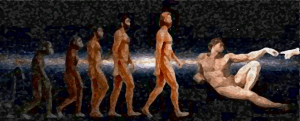
evolution

David Bowie – The Hysteria, the Sorrow, the Frustration and the Hope

A clear thinking article.

theweeflea's avatarTheWeeFlea.com

This is my article on David Bowie in Christian Today   – it is slightly amended because I wanted to tidy up a couple of things.  The article came as a result of a conversation with my wife, Annabel, as she gave me a lift down to the church.  And then all these ideas just popped into my head, so I wrote them down and quite surprizingly it has gone, as they say, ‘viral’.  There are so many ‘Bowies’ out there – who need to hear the Good News!  As always comments appreciated.

Its great that The Scotsman has put much of this on their website!

And The Herald

David Bowie’s death, grief, and the frustration of a society that has nothing to offer the lonely

It was a shock. Of course it was. Make your coffee, switch on the radio and you hear Life on Mars on Radio 4. What…

View original post 1,353 more words

A morning prayer for the wealthy

Dear Lord,

Father, Son and Holy Spirit,

Thank you for bringing me safely through another night and for the promise of a new day.
Thank you for blessing me with health, wealth and good friends, and thank you for my family.

Thank you for the blessings that I can bring to others. Forgive me please for the times when I have not acted as you would wish, and please strengthen and encourage me to carry out your will in the future. Guide my steps to places and people who I can bless, and form in my heart the desire and will to be that blessing. Let me feel joy at the good that I have been able to do in your name.

It is hard to be joyful when there is evil confronting us each day, sustained by misguided beliefs and the cold hard hearts of so many.

Yet all good things come from you and are part of you, so please help me to know you, love you and enjoy your presence. Please lift my spirit to worship and praise you, and to appreciate your gifts to me. Please be present with me every moment of the day and night, filling me with your goodness and keeping me from harm. Please protect those who I love, and heal those who are suffering in body, mind and spirit.

In this cruel and selfish world, I ask that you work in all people to draw us to love you with all our heart, mind, soul and strength, and to love our neighbour as ourselves.

Please correct the growing culture of inequality where we, your children, believe others to be less important and valuable than we are. Help us to see each human being as our brother or sister, parent or child, and to love them as such.

Father, let your spirit drench this land as the wind and rain of winter. Convince the people in this nation of your existence, bring us to see our sin, and to repentance and forgiveness. Draw us close to you.

And please mould your church to feed us with the bread of life and to help us praise you as you deserve. Please remove the barriers that we put in the way of people who would follow you, forgive our mistakes and guide our actions to properly serve you and those we live among.

I ask all this in Jesus’ name, for I believe and trust that this is your will.

Amen

“Here, there be dragons”

Centuries ago many people used to live their entire lives within a few miles of where they were born. Occasionally travellers would pass through with tales of far-away places which held wonders, treasures and maybe ‘dragons’. But few would dare cross the borders surrounding their small world of familiarity.

Dragon-Linda_BlackWin24_JanssonNowadays many people again live their entire lives within a relatively small environment. Maybe it is not physical, since modern transportation puts the whole world within reach, but I’m speaking of relationships, culture and spirituality.

Our sphere of friends is gathered through encounters where we like to pass our time: work, the sports club, the toddler group or school, the pub. We meet like-minded people in comfortable environments and put down roots there. Occasional travellers pass through with tales of other lifestyles: we get peeps at them on the TV reality shows, a foreigner might join our band, or a tragedy might move us out of our comfortable world. But “few dare cross the borders of their small world of familiarity”, and most will lobby to maintain their personal utopia.

We understand how the world works through what we have learned through personal experience, the media and common sense.  With our Western worldview glasses we know such things as: the economy has to be healthy, everyone should be educated and democracy is the only system that works. And of course we should all have rights, to health, happiness and freedom, particularly freedom of speech. We seldom stop to question the basis on which we have decided that all of these ‘truths’ are correct. When we hear tales of other cultures we are fearful that they will invade our territory and bring unimaginable horrors and suffering.

But perhaps we are most fearful of uncharted spiritual seas. England used to be a Christian nation, although deeply divided between Protestant and Catholic, but has largely come to believe in Scientism; the religion that science can explain everything. It can be comforting to think that science can tell us why Grandma died, and to hope that in the future cancer will be conquered. Occasionally we will hear tales of a spiritual realm, something that is not simply made of ‘stuff’, and strangers will speak of God and tell us that we have a ‘soul’. A frequent response is to ignore such ramblings, or to accept that such things may be ‘okay’ for them, but I’m quite happy in my own ideas thank you very much.

Secretly, if we are bold enough to ask ourselves, we will admit that our small-world outlook is largely driven by fear. We are afraid that we will lose our basis for life, even if it doesn’t seem to be working too well for us at the moment. We would love to befriend those in different circles, experience different cultures, and reach a satisfying understanding of who we are spiritually; we yearn to find our soul and our purpose.

It is the beginning of a new year: 2015. Two thousand and fifteen years after a special baby was born. Who as a man spoke strange tales of a spiritual realm and a God. A man whose words gave us a rock to build our lives on. A man who willingly allowed himself to be crucified to show that death could not hold him – or us. A man who Christians call God. Perhaps it is time to take our courage in our hands and explore this strange new land? Many have gone there before, but few have returned with tales of dragons! Instead, they come back with stories of hope and fulfilled purpose; the promised land. Shall we go?

Do we worship the same God?

There is and can only be one God.

I am not going to defend that statement but to take it as read and see where it leads in the context of different religions.  If you don’t want to accept the statement, this post is not for you so please don’t waste your time and energy reading further.

There is and can only be one God.

That one God is love.  Without God there can be no love.  And so each and every act of love is an act of God.  If a Christian loves, that is God within them.  If a Moslem loves then that is God within them.  If an atheist loves that is God within them.

That one God created and sustained the universe. He sends the rain on the good and the bad.  His laws of science knit us together in our mother’s womb, allow us to experience the world, and present us with the alternatives of love or hate, good or evil.

That one God has made each of us as an individual.  Each of us is a ‘me’.  He has given us freedom to choose to love or hate, to be good or evil.  As individuals we choose.  If we choose to love we choose God whether we know it or not, whether we are Christian, Moslem, Hindu, atheist, agnostic or Jedi.

If someone prays to the single God, creator and sustainer of the universe, to the God who is love, the God who is goodness and power, does it matter what religion they are in?

If someone chooses love and goodness, does it matter what religion they are in?

What is religion? According to the Oxford dictionary it is:

“The belief in and worship of a superhuman controlling power, especially a personal God or gods”

and

“A particular system of faith and worship”

http://www.oxforddictionaries.com/definition/english/religion

A follower of one religion can challenge whether the “system of faith and worship” of another religion is accurate.  A Christian can reasonably challenge whether what Islam teaches about what is right and wrong is right – but can a Christian challenge which God a Moslem is praying to? Or vice versa?

Can a Christian say that a Moslem worships a different God?  Or can the Christian only say to the Moslem that “you don’t know God like I do”?

I don’t need to use Christians and Moslems for the example.  I could have used Evangelical and Liberal Christians, Protestants and Catholics.

I believe that the teaching of Christ is the best description of what God intends for each of us, and that Jesus life and death are the greatest demonstration of how God loves each and every one of us.  I can guide others to the same source of love and goodness that I have found, but am I to criticise and judge them if they do not understand the Bible in the same way that I do?  Isn’t my job to love, and aren’t I supposed to leave the judgement up to God?

Isn’t religions job to help me do my job?  Surely religion is not there to put obstacles in the way of me loving others?

What does God think of all the conflict that is caused by religious dogmatism about what he is like?  Does he simply want us to get on with loving Him, and loving our neighbour as ourselves?

Grace and love to you all.

Direct from the San Francisco Book Review

The Big Picture – An Honest Examination of God, Science and Purpose
By P D Hemsley
eLectio Publishing, $4.99, 266 pages, Format: eBook

A former atheist/agnostic who gave God a chance offers open-minded readers this work which is both ambitious in scope and credible in approach: //The Big Picture: An Honest Examination of God, Science, and Purpose//.  Polarizing subject matter such as God and science, evolution, and intelligent design are revisited with the goal of gently challenging entrenched thinking on both sides.

Hemsley, a Chartered Engineer, “has lived on both sides of the faith fence.” His book is comparable to a technical presentation designed for a general audience. It is highly organized with stated goals, evidence, and the author’s conclusions. Fluid, straightforward writing helps the reader progress through several chapters or conclusions dealing with faith, science, purpose and design, quantum physics, free will, reason, Jesus, and more. Even so, those with less of a scientific bent will need to exercise their concentration skills in the scientific sections.

The strength of this book lies in complexity and compatibility. The chapters “Science Describes an Incredible Universe” and “The Universe Exhibits Design and Purpose” make for fascinating reading, especially the subsection where “challenged by the complexity of the biological machinery” Hemsley explores how a modern-day designer would engineer a human being and how long it would take. Additionally, the author’s version of the Genesis creation account featuring the compatibility of scientific discoveries and God’s design is an interesting interpretation to consider.

No emotional appeals are made to the atheist, agnostic, hardcore creationist, or plain honest seeker for a change in his or her worldview. In the words of the author, a self-described Minimalist Christian: “Whether you agree with my conclusion or not, I hope that many of the myths that currently inhibit so many of us will have been weakened or dispelled. I hope that a step can be taken towards finding purpose and experiencing life in abundance.”

http://citybookreview.com/the-big-picture-an-honest-examination-of-god-science-and-purpose/

Click HERE to buy a copy.

A fresh understanding of Grace

St Paul asked the rhetorical question “Well then, should we keep on sinning so that God can show us more and more of his wonderful grace?”  He then went on to answer with complicated and metaphorical language about being buried with Christ through baptism.  But I read this just after reading a facebook post from someone I care about behaving in a way that frankly won’t bring them happiness, and is simply satisfying their lustful urges. Looking at how I felt puts a new and simpler perspective on the question.

Let’s take it as read that God is love, and that he loves each one of us deeply.  We also need to understand that sin harms us deeply.  It may satisfy an immediate urge, but it harms us.  In the same way that it saddens me to see those I love harming themselves, it must sadden God so much more to see us harming ourselves.  Yet God still loves us, and in the same way that I still care about the person above, he cares about us.  I will not reject that person, and God will not reject us.  But it saddens Him so much that he was prepared to see Jesus tortured and killed on the cross to try to get through to us.

So if St Paul’s language seems confusing, just put yourself in God’s place and imagine how you would feel seeing your beloved son or daughter self-harming.  You would long for them to give up their life of sin, and return to your loving arms.  If they wanted to make a fresh start,  you would do whatever it takes to wipe their slate clean.  And that is just what God has done for us.

That’s why we shouldn’t keep on sinning; it causes God more pain and sadness and it does us no good either.

Simple.