Great Britain? I hope so.

Eighty years ago this nation was at a crisis.  Politicians of the day worked together for the good of Britain and Europe.  The monarch was respected and brought hope to the people suffering – visiting Coventry after the horrific bombings, addressing our nation and urging us to pull together to fight against fascist powers that were oppressing the poor, the weak and the scapegoat Jews.  It was a time where national values and pride meant doing the right thing for our neighbours.

Fast forward to today.  We have in power an unelected leader who is treating our Queen with contempt, as a tool to be used as he sees fit.  We see those in high office treat our honourable institution of parliament with utter disrespect – lounging on the front benches. New scapegoats are created.  Our traditions are trampled.  Unelected oligarchs and manipulators hold powerful positions.  The similarities with the fascist regimes that “Great” Britain united to defeat are startling.

We will have a general election soon.  It will be a test.  Has our nation abandoned the values that we once held dear, and for which men and women gave their lives in our finest hour?  Or will truth and goodness prevail?  This will not be an election about Brexit, but it will be a test of what we are as a nation.  It will be a test of our values.  I hope and pray that we will choose truth, justice and honour.

Jesus teaching on workers pay

Jesus taught about the kingdom of God. In one example a wealthy man ensured that the workers all received enough pay for their needs, although it cost him more than it needed to. He knew that he would still have sufficient for himself.

If you are wealthy then this might be a good example to follow.

And if you are a worker, take heed too: if you are lucky enough to have a job, your needs are no different from the one who doesn’t.

The story is recorded in Matthew 20:

“For the Kingdom of Heaven is like the landowner who went out early one morning to hire workers for his vineyard. He agreed to pay the normal daily wage and sent them out to work.

“At nine o’clock in the morning he was passing through the marketplace and saw some people standing around doing nothing. So he hired them, telling them he would pay them whatever was right at the end of the day. So they went to work in the vineyard. At noon and again at three o’clock he did the same thing.

“At five o’clock that afternoon he was in town again and saw some more people standing around. He asked them, ‘Why haven’t you been working today?’

“They replied, ‘Because no one hired us.’

“The landowner told them, ‘Then go out and join the others in my vineyard.’

“That evening he told the foreman to call the workers in and pay them, beginning with the last workers first. When those hired at five o’clock were paid, each received a full day’s wage. 10 When those hired first came to get their pay, they assumed they would receive more. But they, too, were paid a day’s wage. 11 When they received their pay, they protested to the owner, 12 ‘Those people worked only one hour, and yet you’ve paid them just as much as you paid us who worked all day in the scorching heat.’

13 “He answered one of them, ‘Friend, I haven’t been unfair! Didn’t you agree to work all day for the usual wage? 14 Take your money and go. I wanted to pay this last worker the same as you. 15 Is it against the law for me to do what I want with my money? Should you be jealous because I am kind to others?’

16 “So those who are last now will be first then, and those who are first will be last.”

Making decisions as a community

Often we have to make decisions as a community; a family, a nation, a team.  How do we go about it?  Usually we will simply ask “what do you think we should do?”  And then we will argue against the other person’s proposal.   When the decision is finally made there is conflict and resentment from those who suggested doing something else.  The results of this approach can be extremely damaging.

For instance, the government ask “do you want to leave the EU?”  Half of us say yes and half of us say no, and so half of us are very upset that we have not been listened to.  The nation is split in two.

Or a local authority will make a proposal to close Children’s Centres and then ask people’s opinion on the proposal, calling it a consultation.  But it is simply a consultation on whether you like the proposal or not.  The consultation doesn’t lead to a better solution, but just to anger from those who will be harmed by the proposal.

The steps we go through, probably unconsciously, when we decide something for ourselves can be summarised as:

  1. What is a the problem
  2. What are the alternative solutions
  3. What are the advantages and disadvantages of each
  4. What do we want to do

But when we try to make decisions as a community our normal approach is:

  1. What do you want to do?
  2. I don’t want to do that, but this.

We end up arguing, simply because trying to decide something without even knowing what problem we are trying to solve.

In both of the examples above, the process could have been different.

For example, the question could have been “What factors are important in deciding whether to remain in the EU, and how important do you think each factor is?”

With the results of this consultation, the government could have framed a proposal for how to deal with the different issues, explained the proposal and the reasoning used to get to it, and then (if necessary) asked for agreement to proceed.  In essence this is requiring the government to carry out ‘completed staff work’ (http://govleaders.org/completed-staff-work.htm) before submitting a proposal for approval.  If they have done their work well, the conclusion would simply need our approval.

Try this approach in your community.  Let me know if it helps.

How to create the society that we deserve.

As a society, we decide what we value. Where do we want our work to generate value?  Do we value our transport infrastructure, do we value our children’s education, do we value our police force, our armed forces, caring for the elderly, the weak and the sick?  If we do, then our work has to be generating value in those areas.

Every hour we work generates more value than we receive as pay.  But who decides where the value that we create goes?  Clearly we can decide where we spend the value that we earn, but the extra value is retained by our employer, often private sector companies.

Businesses are responsible to their owners (shareholders) and have the responsibility to maximise income for the owners.  Their goal is to channel the value that we create to the owners.  Businesses do not have souls. Businesses are only interested in caring for the sick if it generates more income for the owners.  They are purely financially driven.  That is not a criticism but a fact.  It keeps things simple, and can produce very efficient and focussed activities.

In order to create the nation that the people want, we need a regulatory environment that directs value where we want it and allows the businesses to operate within that environment.   That is the role of government, through the tax and regulatory systems.

There is plenty of value generated in this country, we just need to see it allocated to the right areas.  At the moment, too much is allocated to a small number of people.  The activities that benefit us all are not valued enough by the few who decide where to ‘spend’ the value that they acquire.

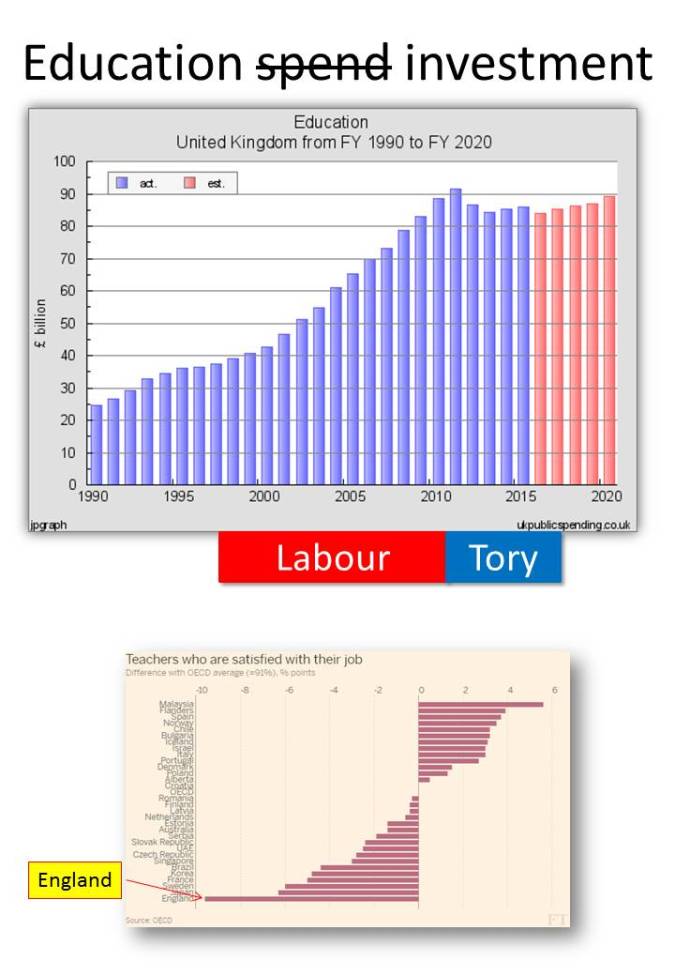
As a society, we have the right to decide what we value and a right to ensure that our work creates value in areas that are important to us.  If we want to be cared for when we are old, we need people working to care for us.  If we want safe streets we need our police force.  If we want our children taught well we need teachers.

If more people work in these areas, it may mean less people working in other areas.  We may have to accept less people working in the finance industry, or the retail industry for example.  But surely a civilised society values caring for its people higher than moving money around, or selling more stuff?

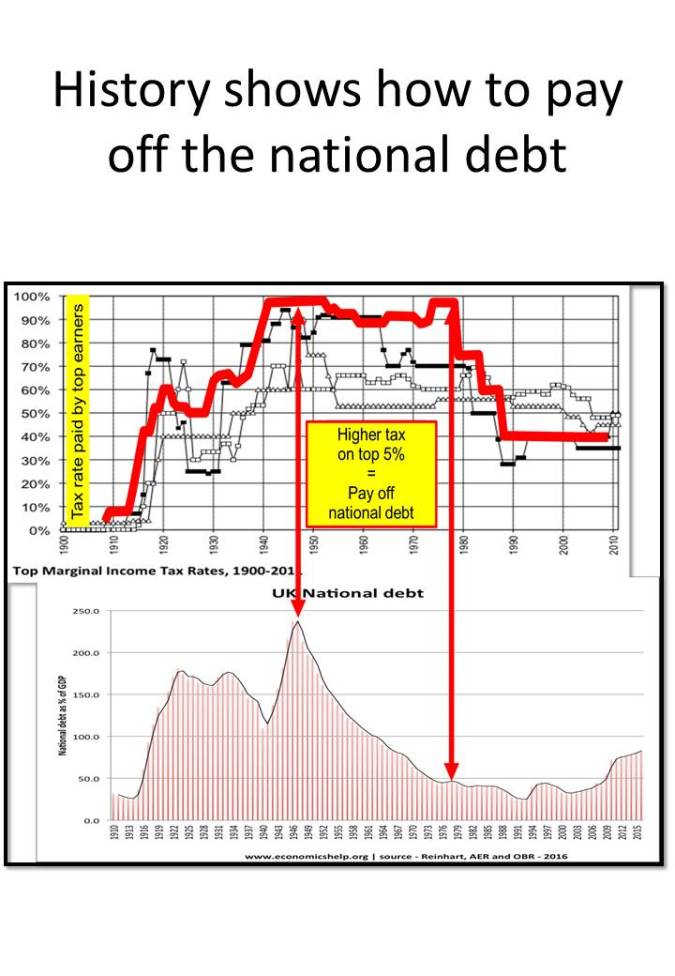
So, we need a taxation system that allows the society that we deserve to be funded.  That is why it is important to regain more control of the allocation of value.  Government needs to take back control from businesses, and from the top 5% of earners.

But what about the argument that ‘they will just go somewhere else’.  The value that is currently channelled to the wealthy is being created here.  It will still be created here.  All that will happen if the owner of a company decides to emigrate is that they will be harvesting the value created in the country that they go to.  The value created in our country will stay here for the benefit of our citizens.

So when we get the chance , let’s vote for the society that we deserve.  Let’s grasp our future with excitement and hope, and not shrink from the opportunity to make this nation great.
Draw your own conclusions

Here is some data.  It should be more powerful than rhetoric.  Draw your own conclusions…

Why it is right to reverse the increase in Inheritance Tax threshold.

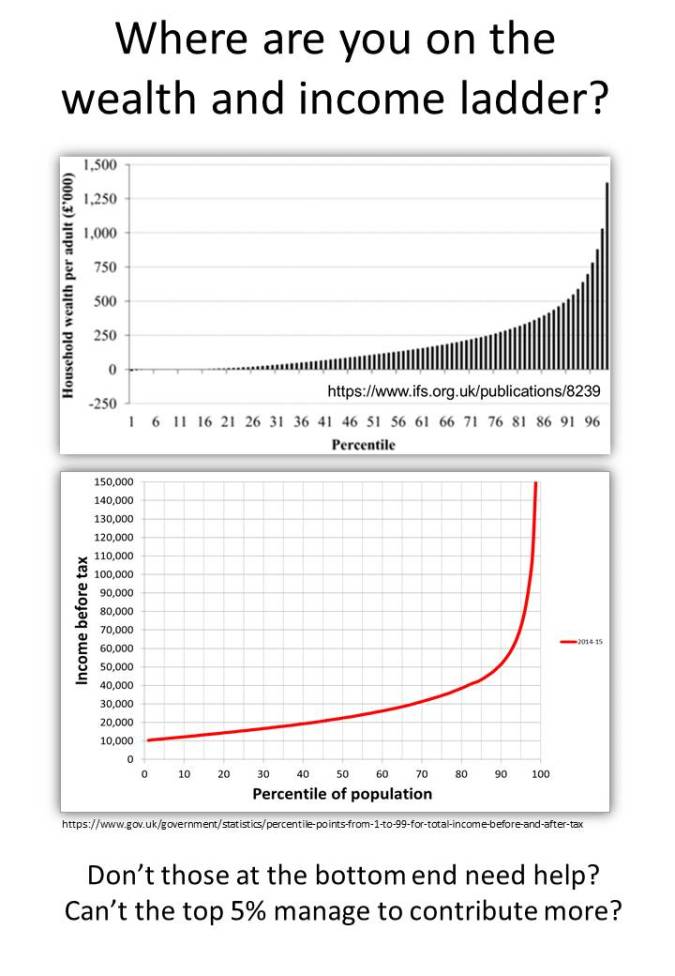
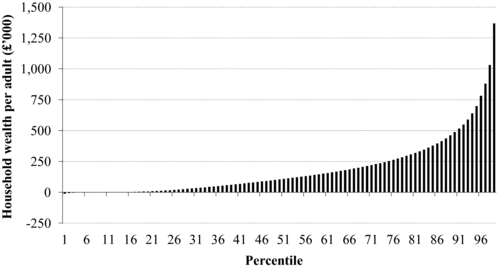
The Institute of Fiscal Studies says that “..wealth is distributed very unequally. One per cent of households have negative net wealth of greater than £12,000 per adult (the 1st percentile), while the 9th percentile is £0 so 9 per cent of households have no positive net wealth. Wealth at the median is £104,000 per adult. Wealth at the very top increases dramatically across a small number of percentiles – the 95th and 99th percentiles are £0.7 million and £1.4 million per adult respectively. In fact, the estimates of wealth held at the very highest percentiles could be underestimates;”

There is no problem with saving your income to increase your wealth.  But there is a problem when inherited wealth means that those who have not had the good fortune to have wealthy parents or ancestors are denied the chance to ‘better’ themselves.

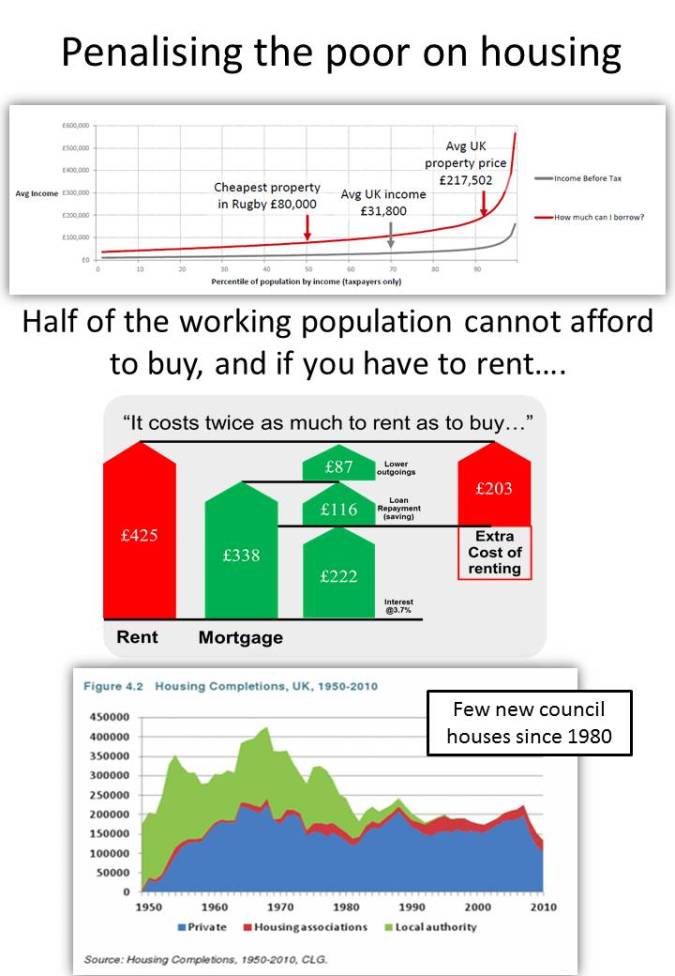
This is more than an academic problem.  For example, for most people, the biggest expenditure is housing.  If you look at how much you can borrow, and at typical house prices then two-thirds of people cannot buy a home without help from someone who has wealth.  The graph above shows that perhaps a third of the population have insufficient wealth to avoid the having to enter the private rental market.  The high cost of renting means they have less chance of building themselves a better future – the rules are stacked against them.

That is why it is right to reverse the increase in Inheritance Tax threshold, we need to even out the playing field.

It is time to cut VAT.

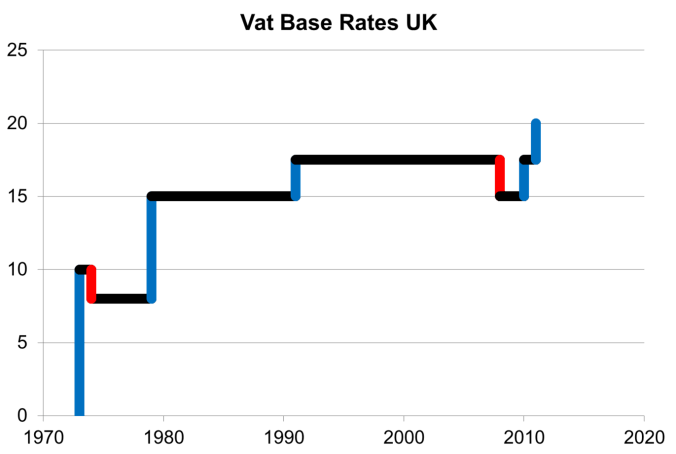
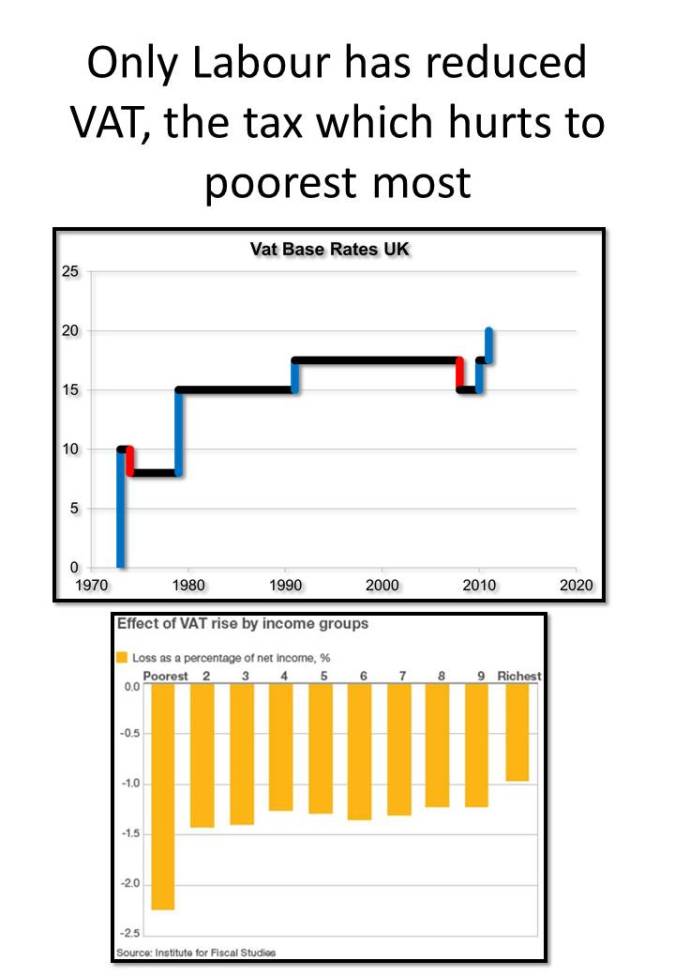
VAT is a tax on what we spend.  Everybody has to pay VAT at the same rate, rich and poor alike.  The following chart shows which parties have changed the basic rate of VAT since its introduction by the Conservative government on 1973.

VAT rate changes

Increasing VAT puts a bigger burden on the poor than the rich, as shown by the following analysis of the most recent VAT risk from 17.5% to 20%:

Reducing the rate of VAT will ease life for the less well off, increase sales, increase business activity and lead to higher employment.  That will increase income and corporation tax revenues and reduce the cost benefit payments as there will be less people out of work.

It is time to cut VAT, not to consider increasing it.

How can Theresa May call herself a Christian?

“If someone had enough money to live well and sees a brother in need but shows no compassion – how can God’s love be in that person?” 1 John 3:17

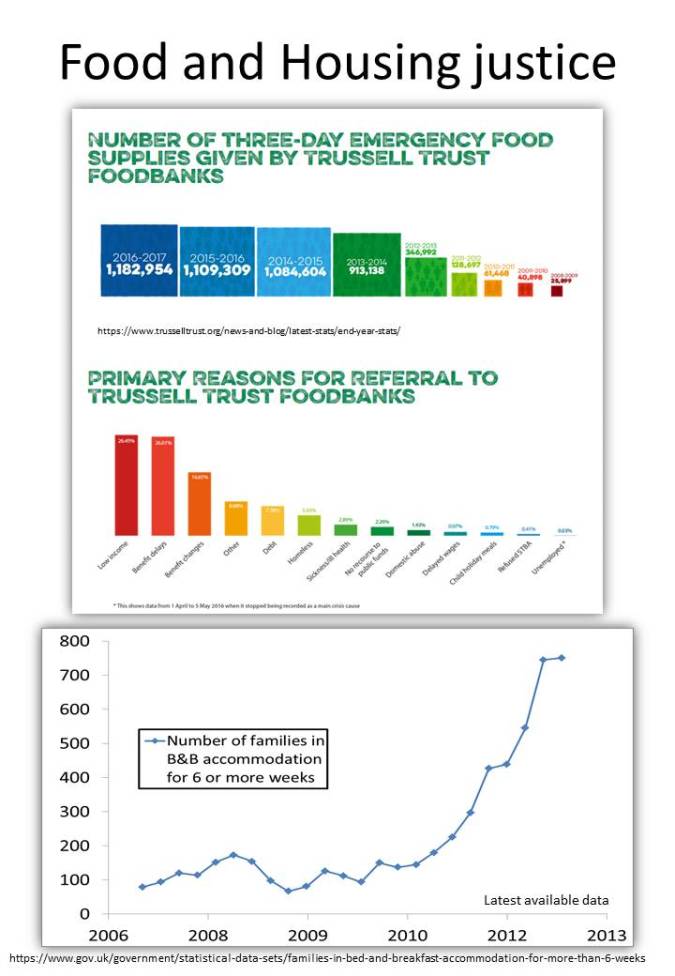
The Conservative party have overseen the rise in homelessness and food bank usage, hardship caused by severe sanctioning of benefits, zero hour contracts, deep cuts in public services.  Yet Mrs May has called herself a Christian.  I don’t understand how.  Jesus said “If you love me, obey my commandments” John 14:15 yet I see no sign of that.

Jesus calls us to love our neighbour, not to exploit them.  He noted that the widows offering of a few small coins was worth far more than the trumpeted gifts of the wealthy.  She gave all she had to live on.

Unfortunately the Conservative government have demanded all from the poorest in society.  There have been plenty of opportunities for a change of heart – now it is time for a change of government.

Why the media and the establishment hate Jeremy Corbyn….

“This is the message that you have heard from the beginning: We should love one another.  We must not be like Cain, who belonged to the evil one and killed his brother.  And why did he kill him?  Because Cain had been doing what was evil, and his brother had been doing what was righteous. So don’t be surprised dear brothers and sisters, if the world hates you.”

I don’t really need to add anything.  We can all recognise who is who in this story.

(There really is a lot of wisdom in the Bible. This was written by St John.)

How to really make Britain great again.

The headline tells us “Brexit to send UK tumbling down world economic league table…”.  and we ask “Is this making Britain great again?”

But the headline, indeed the whole question of where Britain ranks in the world economy has absolutely NOTHING to do with whether Britain is great.  What matters is whether Britain is becoming more human.

Being human has nothing to do with the economy or wealth, but everything to do with values. It is about valuing everybody equally, irrespective of colour, class, wealth or religion. It is about selfless behaviour for the good of others. It is about acting with integrity and speaking truth. It is about doing what is right, irrespective of the consequences.

Britain will become great when those who are well off are willing to contribute enough to ensure the wellbeing of those who are not well off,  when we are willing to give up our own comforts for those who have nothing,  when we are willing to give sanctuary to those fleeing war dispite the risk of personal harm.

Britain will become great when we stop expecting a political system that gives everyone all the rights that they demand, but encourages us all to self-centredness. We cannot demand perfection from public services that we are not prepared to fund. We need to stop demanding perfect treatment from others, when we cannot give it ourselves.  We need to stop demanding that teachers work until midnight to keep up.  We need to stop expecting to be treated in A&E within minutes when we have drunkenly staggered into a lamppost.  We need to stop abandoning our personal responsibility for our own circumstances.

Britain will become great only when we choose to love one another; when we learn to contribute what we can, and to keep our expectations of others reasonable.  That is my hope for 2017.  Make it yours.