Before the universe began.

The bowler beats the bat and the ball hits the batsman’s pad.  There is a loud appeal and the umpire calls for ‘hawkeye’ to predict where the ball was going. Hawkeye is a system that tracks the flight of the ball and predicts, using the laws of physics, where the ball would have gone if the batsman’s pad had not got in the way.  The batsman’s innings depends on the prediction.Those same laws of physics and tracked trajectory of the ball can be run in reverse, to predict where the ball came from.  The prediction will be completely accurate back until the point when the ball left the bowler’s hand.  The prediction will extrapolate back a series of parabolas, to infinity.
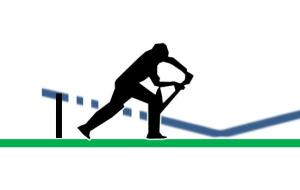
It’s common sense.  Hawkeye makes valid predictions where the assumptions included in the model are correct.  But where the assumptions break down, the prediction will be wrong.  So it is with all science.  Where assumptions break down then science will be wrong.  We test our assumptions where we have data – back as far almost as the beginning of the universe, but we cannot test beyond there.  And so although science can make predictions of what was before the beginning of the universe, it would be wrong to believe them.  We have to accept that we don’t know, and can never know whether there was a ‘bowler’ or whether the ball came bouncing from infinity…

The headline of the following and similar articles are therefore completely misleading

Stephen Hawking Claims To Know What Happened Before The Big Bang

although the text is more accurate: “Hawking had previously said in one of his lectures that the events that occurred before the Big Bang have no consequences that can be observed, therefore they are not defined because there is no way to measure what happened…….  Even the amount of matter in the universe can be different to what it was before the Big Bang, as the Law of Conservation of Matter, will break down at the Big Bang.”  Hawking recognised that the laws of physics ‘change’ …. allowing the existence of the ‘bowler’.


I think I might be a panentheist – I hope it’s catching!

The ancient Celts knew a thing or two. They were not the wild fighters who the Sheriff of Nottingham brought in to drive Kevin Costner’s Robin Hood from his idyllic woodland village. They had a special understanding of the nature of things. According to “The Celtic Way” by Ian Bradley they held “a conviction that the presence of God was to be found throughout creation – in the physical elements of earth, rock and water, in plants trees and animals and in the wayward forces of wind and storm.”

Bradley goes on to say that “We are not in the world of pantheism here but in the much more subtle and suggestive realm of panentheism – the sense that God is found both within creation and outside it.”

Elsewhere I have written that God is ‘the laws of physics’ – it’s just another name for the thing which causes matter to behave in the way that it does. Without God/’the laws of physics’ there can be no matter – God and matter are not independent, and so matter is (part of) God. (see “Proof of God?”)

I have also noted that there are non-material things: love, justice, purpose etc. These must similarly be part of God – reflected in the Biblical passages which state that God is love. (see “An argument for, and definition of God”)

This understanding of the nature of God leads us to realise that you don’t need to go somewhere to meet God – he doesn’t live in church or a monastery – he is all around us, and within us, sustaining our physical bodies and our environment: “we are what we are through and within God”. (see “The God of Science”)

The Celts understood this. Not within the scientific context that I have described, but in the practical day-to-day knowledge of God. Perhaps we need to refresh our view and understanding of science to reflect this Celtic wisdom: science is simply the study of God!
There is no separate sacred / secular division, no God / nature division, no heaven / earth division; they are all part of God who is God of everything.


A robust intellectual basis for Christianity is not enough.

I like to understand why things are like they are. As a child I was taught that science provides the answers that I needed.

When in later life I became a Christian I thought that there was a conflict between science and God, but for a while reconciled this with the idea that ‘God can do anything’. A simple idea, but science and faith was not an area that I really wanted to explore.

We are given the impression that ‘science knows’, but we just haven’t been told yet. About five years ago I decided to find out. What does science know? What does it still not know? Are there things it can never know? Taking everything into account, what story best fits all the facts, a godless universe or one with a God?

I adopted an analytical approach, but avoided the temptation to dig too deeply into details of each field. I just tried to understand the underlying principles sufficiently to see what they contribute to the big picture. I found that most people feel uncomfortable outside of their specialist field, that few seem willing to take the necessary overview.

Having read a couple of books like ‘The Edge of Evolution” by the Intelligent Design proponents I began thinking that it may be possible to prove God exists. But then I read secular books on the origins of life and realised that everyone accepts the remarkable unlikelihood of life but that it doesn’t provide irrefutable proof – there are alternative explanations such as the multiverse theory.

I needed to find out where the Bible came from; could I trust it, and if so, why? I researched the source of the NT documents in particular, and some of the gospel accounts that are excluded from the Bible (the Da Vinci code stuff). I realised that the gospel accounts are not trying to prove who Jesus was and what he did, but that they wouldn’t have been written if he hadn’t done some amazing things. The accounts are simply people trying to capture what happened for future generations. The Bible is not a spells book: “Do this and God will do that for you”.

I reached a number of conclusions about how to understand and respond to the big picture of what’s going on. Realising that everything requires a level of faith (including science of course), I suggest a response which recognises that many religious and scientific dogmas are unproven and unprovable – but unnecessary. I call the response “Minimalist Christianity”. I wrote up what I found in “The Big Picture”, found a publisher and then set about marketing my masterpiece.

There is a robust intellectual basis for Christianity, and I would commend it to others, but I recently realised that in exploring it I was falling into a bit of a trap. Because I have necessarily spent several years testing and probing, viewing things sceptically, I let my personal spiritual life become analytical too. My reasoning has shown that God exists, and that he must have a ‘personality’ and want to interact with each of us, but I have not really been responding to the real God – just developing an intellectual one.

We need to ‘get to know God’ as more than an idea; I need to follow my own advice! It is from the integrity of that relationship that the power to fulfil our purpose will flow. We need analysis to know that we can trust, but then we need to act on that trust to complete the experience. Having determined that the rock exists, we need to actively build the house of our life on it!

“Anyone who listens to my teaching and follows it is wise, like a person who builds a house on solid rock. Though the rain comes in torrents and the floodwaters rise and the winds beat against that house, it won’t collapse because it is built on bedrock.” Jesus circa 30AD

“A good robot is hard to find”

I came across this article, and it reminded me how amazing the animal world is, and in particular human beings.  It only took  250 million generations since the first fossil evidence of animals to evolve a human, and each one is built from a single fertilised egg.

http://www.computerworld.com/s/article/9249079/A_good_robot_is_hard_to_find_or_build?pageNumber=1


Direct from the San Francisco Book Review

The Big Picture – An Honest Examination of God, Science and Purpose
By P D Hemsley
eLectio Publishing, $4.99, 266 pages, Format: eBook

A former atheist/agnostic who gave God a chance offers open-minded readers this work which is both ambitious in scope and credible in approach: //The Big Picture: An Honest Examination of God, Science, and Purpose//.  Polarizing subject matter such as God and science, evolution, and intelligent design are revisited with the goal of gently challenging entrenched thinking on both sides.

Hemsley, a Chartered Engineer, “has lived on both sides of the faith fence.” His book is comparable to a technical presentation designed for a general audience. It is highly organized with stated goals, evidence, and the author’s conclusions. Fluid, straightforward writing helps the reader progress through several chapters or conclusions dealing with faith, science, purpose and design, quantum physics, free will, reason, Jesus, and more. Even so, those with less of a scientific bent will need to exercise their concentration skills in the scientific sections.

The strength of this book lies in complexity and compatibility. The chapters “Science Describes an Incredible Universe” and “The Universe Exhibits Design and Purpose” make for fascinating reading, especially the subsection where “challenged by the complexity of the biological machinery” Hemsley explores how a modern-day designer would engineer a human being and how long it would take. Additionally, the author’s version of the Genesis creation account featuring the compatibility of scientific discoveries and God’s design is an interesting interpretation to consider.

No emotional appeals are made to the atheist, agnostic, hardcore creationist, or plain honest seeker for a change in his or her worldview. In the words of the author, a self-described Minimalist Christian: “Whether you agree with my conclusion or not, I hope that many of the myths that currently inhibit so many of us will have been weakened or dispelled. I hope that a step can be taken towards finding purpose and experiencing life in abundance.”

http://citybookreview.com/the-big-picture-an-honest-examination-of-god-science-and-purpose/

Click HERE to buy a copy.

Am I just a computer simulation?

Research suggests that human brain has more switches than the entire internet.  Each of the 125 trillion synapses that connect our 200 billion brain cells appears to have perhaps 1000 molecular scale switches. (ref 1)

Some areas of our brain take the input from our nerve cells and begin to process them.  They pass through other processing areas that start to interpret the signals; this sequence of signals from an eye might show us that an object is moving for instance.  Other areas deal with hearing or touch or smell.  Most of these areas carry out their functions without imposing on our consciousness.  At the top level, our brain presents a model of our environment to our conscious self.  The conclusion of this would seem to be that we are living within a computer simulation: generated by our brains based on input from the senses around our bodies interacting with our environment.  The question is, are we interacting with the computer simulation or are we the simulation itself?

Back in 2001 the Nick Bostrom speculated that scientific knowledge and computer power would at some time in the future increase sufficiently to build a simulation of the human brain in a computer (ref 2).  That computer would also be able to build a sufficiently complete model of the universe that an individual simulated human brain would not be able to distinguish it from the real thing.  The model would include not only one simulated person, but many, so that each ‘person’ had the true ‘experience’ of interacting with other ‘people’.

He reasoned that since the people who created this simulation would be likely to run a number of simulations (like our kids run lots of ‘Sims’ scenarios)  “Then it could be the case that the vast majority of minds like ours do not belong to the original race but rather to people simulated by the advanced descendants of an original race.”

There are inherent assumptions that Bostom builds on:  that our consciousness and ‘me-ness’ are simply emerging characteristics of the complex computer circuitry within our brain, and that science and technology will continue to advance until we understand and can model the brain operation.  The reasoned conclusion is that if these assumptions are correct then you and I are simulated beings in a computer simulation.

If that is the case, then we might conclude that it is of little consequence to switch off a particular simulation, in the same way that we are quite happy to switch off our computer.

But what if an alternative view is correct, that ‘we’ are not the simulation itself?  What if there is something about us that is more than an emergent property of a highly complex computer? What if there is a ‘me’ that transcends the ‘matter’ that makes up the computer in my head?  What happens then if the computer is switched off?  Do I cease to exist, or do I simply cease to interact with this particular computer?

The answer to that question lies beyond science and technology. We will have to look elsewhere for guidance.

———————————

References:

1) http://www.cnet.com/uk/news/human-brain-has-more-switches-than-all-computers-on-earth/

2) Are you living in a computer simulation? Philosophical Quarterly (2003) Vol. 53, No 211, pp.243-255. (First Version: 2001)) Nick Bostrom

———————————

For more on this topic and others see The Big Picture- an honest examination of God, Science and Purpose

———————————

Four steps of reason leading to a personal God

As I begin this post, I ask myself “Am I deciding what to write?”  You might think that a strange question with an obvious answer, but if I were to have a materialist view of things then I would struggle to answer with a ‘yes’.  At the heart of the problem is the question of whether I have free will or not.  Am I able to exert any choice on any decision (such as what to write) or is my action simply a result of the state of the molecules in my brain at the particular time when I think I am making a choice?

If there is nothing but matter, and matter behaves according to strict laws then there is no scope for me, or you, to make a free choice about anything.  Holders of the materialist view have argued that those who believe in free will need to demonstrate a mechanism before free will can be accepted to exist.

I do not subscribe to that view of things.  A bumblebee flies even if I am unable to demonstrate the mechanism.

Other disagreements with such a view are subjective.  Whilst I recognise that many of my actions might indeed be simply as a result of my brain state at a given time, I identify situations where I stop myself behaving according to ‘habit’ and consciously choose to behave differently.

From a practical viewpoint, our whole society is built on the basis that we have free will.  If I have no free will to be able to choose how to behave, then what right has society to imprison me for murder?  I would have had no choice but to kill my neighbour – it would have been an action that simply resulted from the chemical configuration in my brain at the time.

So for all practical and from all subjective points of view, I accept that we have free will.

That is step one; that we have free will.

The fact that I can call an opinion subjective inherently means that there is an “I” that is choosing to have an opinion.  Similarly, I speak about personal experience which requires there to be a person.  My personal subjective view is that there is indeed an “I” who is considering the facts and deciding what to write.  Descartes’ famous statement “I think therefore I am” argues that the only thing I know is that there is an “I” who thinks, and therefore “I” must exist – even if everything else is just my imagination.

So step two is that there is an “I” who exists.

The next thing to consider is how I exist (with the proviso that my physical being might be a delusion – but I still exist).   I exist because I have the ability to exist; something is causing me to exist.  I am not causing myself to exist, it is something apart from me that is ensuring that I exist.  Some might call that something ‘the laws of physics’, but I shall choose here to call that something God.

That is step three.  There is something that sustains me (and everything else) that can be called God.

The final step is to ask whether it is reasonable to imagine that this something (God) could sustain an “I”, who has free-will (which must operate outside the laws of physics) without itself having an “I-ness” to it.  Can the physical properties of a human being, which are sustained by God, ‘create’ an “I-ness” that God does not have itself?  Can “I-ness” be dependent on the sustaining power of God and yet above and separate from God?  And if not, then the power that sustains us must also have an “I-ness” about it.

Step four: the power that sustains us has itself the characteristics of “I-ness”: it is a person God.

A Masterpiece of Engineering

We think that we design pretty neat things these days.  We laugh at the man who said that the world would probably only need four or five computers.  Those of us who are old enough can remember when we did a sum on the newly invented pocket calculator that gave us the answer 0.7734, which said “hello” when we turned the calculator upside down.

But whilst researching my latest book I came across some pretty amazing statistics about a design that we all treat as commonplace – each and every human being.

Our 1.5kg brain comprises around 100 billion neurons, of 10,000 different types. Each neuron can have thousands of synapses (input connections from other neurons) and each synapse has perhaps a thousand molecular scale switches.  A single human brain is estimated to contain more switches than the entire internet.

Contained within our skin are around 650 muscles attached to over 200 bones, which vary in size from the femur in our thigh to the stirrup bone in the ear.  The muscle/bone combination is precise enough to paint a masterpiece, or to putt a golf ball twenty feet into a hole.

We have around 60,000 miles of veins and arteries and 1500 miles of pipes in our lungs.

Within our lymph nodes we have billions of B cells, each of which is different and each one defends against a particular very specific infection.

The list goes on – but you get the point.

Yet this whole complex organism is built from a single cell.

We begin as one single cell.  Within the cell is our DNA, the supposed blueprint for our manufacture.  We have a massive 3 billion base pairs (characters in the ‘code’) in our DNA. Yet there are around 50,000 billion different cells in the body.  Each cell is different, in function and in position – some nerve cells can be several feet long.  How can we imagine that there is enough information contained within our DNA to define our fully functioning body?

But we do start from just one cell.  And each cell only responds to the signals that cross the cell membrane.   As we develop, the cell is what it is as a result of its history – its ancestor cells.  And each of those cells only responded to the signals that crossed it’s membrane.  It’s like a massive pyramid, built the wrong way up – with the apex at the bottom.  The process is incredibly robust.  Look at identical twins.  Most of their development is as separate human beings and yet the final ‘product’ is identical.

A human being is truly a masterpiece of engineering.

Is it reasonable to state with certainty that this happened by chance?  Is it reasonable to assert that the properties of the sub-atomic particles in the universe are such that they behave in precisely the right way to manufacture you or I from a single cell by sheer luck? Or would that be a blind leap of faith?


See also:

https://philhemsley.wordpress.com/2013/03/03/information-dna-and-evolution/

https://philhemsley.wordpress.com/2012/09/17/the-dna-enigma/


Fear of science

There are millions of people spending their working life pushing forward scientific knowledge.  The breadth of knowledge discovered by the hands of so many scientists is beyond anyone’s comprehension.  Pronouncements by the scientific community have become almost the word of God.  Nobody has the evidence to question them. And yet…. sometimes they just don’t seem right.  They make us uneasy.  We fear that scientists have overstepped their knowledge, and often rightly so. We must not be afraid to voice our concerns, see for example https://philhemsley.wordpress.com/2013/11/22/mitochondrial-donation-some-concerns/

With so much knowledge out there, and so many people working on science, many in society have come to believe that science will eventually be able to answer every question.  “Eventually we will know everything about how the universe works. Science will allow us to live forever.  Technology will reverse global warming.  We will finally leave earth and colonise the solar system and universe.  Maybe we will even learn to travel through time itself, and finally we will be able to meet the maker of it all and ask why he made such a mess of things….”

Of course, many of these ideas come from science fiction, but literature influences our culture and outlook.  All of the ideas above seem reasonable extrapolations of where we have got to, and are often reinforced by the fantasizing of high profile scientists. http://www.dailymail.co.uk/sciencetech/article-1270531/Stephen-Hawking-backs-possibility-time-travel-millions-years-future.html

There is another group of people who have a different outlook. They believe that the literal explanation for everything that has happened, and prediction of everything that is going to happen in the future is written in a collection of books and manuscripts compiled from 2000-4000 years ago, called the Bible.  The first of these books describes how the world was created and populated with all the plants and animals as completely formed organisms. The whole process took just six days.  This literal interpretation of the book of Genesis will inevitably lead to a fear of science; “Will those millions of people prove my belief’s wrong?  Have I built my life on a lie?”

How can we overcome our fear of science?  How can we tame and control this beast, and stop it turning round and destroying us?

The only way to overcome our fears is to face them.  We need the courage to try to understand what science is and what it isn’t, what it can tell us and what it can’t.  We need to understand the assumptions behind all science.  We must not get lost in the detail, but we need to set the whole in context.  We need a guide.

Many of my posts on this blog are intended to help us think about scientific issues:

https://philhemsley.wordpress.com/2013/03/11/how-far-should-we-trust-scientific-prediction/

https://philhemsley.wordpress.com/2013/03/03/information-dna-and-evolution/

https://philhemsley.wordpress.com/2013/04/07/god-miracles-and-the-laws-of-physics/

and my book “The Big Picture” can equip the reader to begin to understand how to deal with science.  Reviewers seem to think it works:

https://www.goodreads.com/review/show/766354330

https://www.goodreads.com/review/show/767596412

There are other resources that help understand how we might deal with science, and I refer to many in the book.  But I hope that my years of spare time researching of these big questions will be of benefit to others, if only as a starting point for further discovery.

As I mentioned above,  if we are afraid of science, the best thing to do is to confront our fears.  And it’s best to confront them with a friendly guide.


The Big Picture – an honest examination of God, Science and Purpose

If you have wondered if science, faith and reason are compatible then this is a book for you.

The book explores how everything (including science) is based on faith of some sort.  It explains in understandable terms what science tells us (quantum physics, evolution, DNA, neuroscience etc), and what it can’t tell us, and presents some of the documentary and rational evidence for and basis of Christianity – useful if you want to base your outlook on information instead of propaganda.

The style is a combination of balanced data presentation and respectful discussion; you will not be brow-beaten into having to agree with the author!

Click on the book cover (right) to order your copy.