How YOU can help achieve affordable rent

Rents are too high. A single person over the age of 21 on minimum wage of £6.50 an hour will earn around £1000 a month, less deductions. Even with the lowest rent prices, half of that will go on rent leaving around £120 a week for everything else.

Here’s a painless way to get rent down. It just needs some visionary people with a little capital to decide to do something about it.

Here is an example:
£60,000 invested in a building society or bank will be doing well to make 3% interest (although a ‘help to buy’ ISA can give 4%) e.g http://www.halifax.co.uk/savings/?WT.ac=SNCA1012

Therefore a good (4%) return on that £60,000 is £2400 a year, or £200 a month.
If we are happy with a 4% return on our savings, then why not but a property and rent it out at the same return?

The cheapest (1 bedroom) property available today is £395 a month. http://www.rightmove.co.uk/property-to-rent/property-56267795.html

There is a flat for sale in Rugby for £60,000. (http://www.rightmove.co.uk/property-for-sale/property-54091703.html?premiumA=true )

Using the £60,000 to buy the property, we could charge a very fair rent of (say) £250 a month, offering a low rental price and getting a very good return on the investment. (£250 instead of £200 to include an allowance for maintenance and fees)..

This represents a saving of a third on the lowest rental cost, and would give someone on low income the chance of an improved standard of living, and maybe even the chance to save enough to put down a deposit on a house of their own.

And all of this giving the same (or better) return that we get from the building society. Maybe there is a little more risk – but there is the benefit of doing something personally to help the current difficult situation for the poor in our town.

If enough of us do this, then it might even cut the overall rental market price (supply and demand!) with wider benefits.  I know that not everyone can help in this way, but some can, and it makes a difference to each person who is helped.

If you are interested and want to take it further, I’m happy to share my experience so far (I have made use of a legacy from when my mother died to do this). Please get in touch privately.

rent

Greece is on the verge of a great future – don’t throw it away!

What is it that defines a successful country? The wellbeing of the citizens, or the nation’s riches? The two are not the same.

Wellbeing: feeling loved and valued, health, happiness, contributing to society –these are the things that matter, that make us human. These do not come with national wealth but with equality and relationships – how people value and treat each other.

In the war, everyone was ‘in it together’ and although times were hard, apart from the obvious war wounds, people were healthy, valued and fulfilled. Society became much more equal. If Greece chooses to adopt a true attitude of unity (not like Cameron’s phony ‘Big Society’) where everyone looks out for each other, where those with more help out those with less – because they matter as fellow human beings – then Greece will thrive!

The worry is that Greece is so keen to stay in the “Euro” club that they will give up their wellbeing to do so. They are already feeling un-valued, un-loved and betrayed. They are dealing with institutions, but institutions don’t have a soul and don’t care about people, so why is Greece surprised. But they don’t have to shackle themselves to the rich man’s yoke to live well.

So long as there is food on the table and friends to eat it with, so long as their whole society unites in a common cause, they will thrive. But if they choose to be victims of the wealthy, if their society chooses to take what they can as individuals then they will indeed suffer. The richer Greeks will be materially fine but the poor will hurt, health for all will worsen, there will be riots and unrest, and productivity will reduce too – the signs are already there.

Greece is at a crossroads, but it’s not the crossroads reported in the press. It is a crossroads of its citizen’s attitude to each other. They can lead the world in showing how to be successful without being serfs to the economic barons. I hope that they choose wisely.

2014-09-01-13.09.24

Work and Pay

I think the world has become confused about work.

Instead of thinking that work is something to be endured to bring in the money we need to live, or a means of making us rich we should think of our work as our contribution to fulfilling the needs of society. We need to start thinking of it as ‘what can I give’ instead of ‘what do I get’.

And in a similar manner, society needs to think more clearly about the needs of the individual. All of us need to eat, sleep and live somewhere that we can call home. And the reciprocal side of the exchange is that when someone contributes to society, then society has a duty of love to meet the needs of that person.

Jesus told a parable of a man who hired workers for his vineyard. Some he hired in the morning, some in the afternoon, and some just before closing time. But he paid them all the same. He paid them what they needed to live. But of course, those who worked all day felt that this was not just and grumbled. Yet the vineyard owner pointed out that they were happy to work for their agreed wages, and they had received them. All the workers were willing to work. They were willing to make their contribution to society, even if there was no immediate work required. And they all had the same needs. The vineyard owner met their needs. Why can’t we follow this example?

Similarly, how do we decide how much someone should be paid? Is it according to the contribution that the job makes to society? How valuable is it to society when a person sits at a desk and manages our money? How valuable is it to society when a person removes the rubbish that we create during the week? How valuable is it to society when a person serves us a meal in a café or restaurant? I have to say that the most valued workman I’ve encountered is the one who came to clear our blocked drains when the raw sewerage was overflowing! Yet he is paid less than I am, when I spend much of my time sitting at a computer terminal.

It is not my aim to claim that job A is X times as valuable as job B, but to add into our thinking and actions that we need to be willing to pay each person sufficient to meet their needs.

Unfortunately the recent trend is that the rich are getting richer and the poor are getting poorer. I don’t have a problem with unequal pay, and with pay that reflects the value to society of the work. But I do take issue with a system that ignores the ‘need’ part of the equation.

Can you and I do anything? Yes we can. Even if it is only being willing to pay a fair price instead of the lowest price for goods and services.

But also, the reward for our work is more than just money. We all value the respect of our fellow human beings. One thing that we can all do is to treat everyone, in whatever job, with respect and with appreciation.

And similarly, when we are working, we can consider our work as more than just a job but as a contribution to society. The bricklayer can choose to be building a home instead of laying some bricks.

And we also need to respect those who are seeking work but unable to find it. Not only do they receive no wages, our benefit system disrespects them and prevents them making their contribution to the good of us all. Can’t we treat them like those in Jesus’ parable who were looking for work , and who at the end of the day were then paid what they needed to live.

Let’s think on these things as we go about or daily life of working, waiting, shopping and ‘consuming’.  Let’s change our attitudes.

Financial advice from Money Box Live, or Pope Francis?

I was listening to the radio program Money Box Live last week. They were talking about pensions. It seems that if you delay taking your pension for a year then the amount of your pension increases by about 10% per year when you do take it. I guess this is a government scheme to reduce spending on pensions today at the cost of increasing it in future years, perhaps when there may be another government in power – but that’s not the point of this article. The thing that caught my attention was that they got a mathematician to describe the best time to take your pension.

The longer you delay, the higher the pension when you take it, but the less time you take it for. So if you know when you are going to die (which you can look up in statistical tables) the mathematician was working out a time at which the total amount of money you receive reaches a maximum.

All very logical and calculable, so why am I writing about it? Because it is a symptom of the cancerous thinking that underlies so many decisions today:
Our goal is to maximise the money we get, even if we only get it on the day before we die.

We forget that the more we have, even when we don’t need it, the less there is for others.

We don’t consider that the schemes we invest our money in minimise costs, such as the wages of the lowly paid, or maximise income, such lending our money at high rates of interest.

We ignore the fact that making decisions on the basis of maximising our income reinforces the extremely unfair financial systems that we have today, where the rich are getting richer and the poor are getting poorer.

It is not easy to turn down opportunities to make more, or spend less. It is natural to want to buy the cheapest milk, or trainers, or energy – but each decision has its consequence.
When we invest to minimise our tax bill, we are placing the burden of paying for our public services on others. We are encouraging our government to introduce ‘austerity’ measures – “sanctioning” benefit claimants if they miss an appointment (in effect, fining them 100% of their income). We place the burden of balancing the government’s books on the poor.

My mother died last year. She didn’t spend the pension she received, and her investments grew, and we were surprised at the amount of money that she left. I have to decide what to do with the money I inherited. Money Box Live would tell me to invest to maximise my income. But I agree with Pope Francis, I reject that basis for my decisions. How about you?

Austerity is working? III

The world economy is in difficulty and has been for many years now.  Debt is embedded in the system: individuals owe money to banks (who live off lending them more), nations owe money to the financial markets. All measures of wealth show that the richest are getting richer and the poorest are getting poorer. (See Austerity is working II).

People agree that the ideal is not a flat distribution of wealth.  They think that the distribution of wealth favours the rich too much, but in reality it favours the rich much more than we realise:
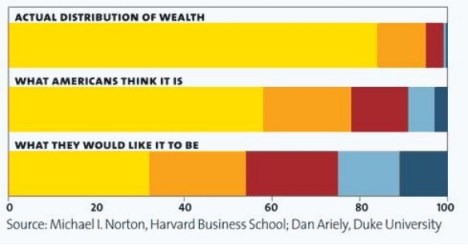
wealth distribution

But is there a problem with this? It depends on your personal philosophy.

For instance, if I think it is right that one human being, through no effort of its own (e.g as a result of who its parents are and where they happen to live) should be 1 million times richer than another, then this data in itself will not worry me.

Similarly, if instead of comparing myself to those who have more income than me I compare myself to those with less then I will not enjoy any feelings of being ‘hard done by’.

Opinions vary, but it seems that around $50000 is an ideal income for happiness. http://www.learnvest.com/knowledge-center/the-price-of-happiness-50000-123/ and a 2012 UK headline stated that “Families need £36,800 to live acceptably, study says” http://www.bbc.co.uk/news/uk-18770783  Anyone earning more than that is likely to feel very comfortable.

So, in the rich West, most people are basically happy most of the time, cocooned by an income where financial concern is limited to sustaining the present level of comfort rather than worrying where the next meal is coming from.  Most of the time the inequality of wealth doesn’t really impact, apart from leading to a few grumbles and jealous thoughts about those who earn more than we do. Passivity rules until or unless a crisis occurs which affects us as individuals, and then we get to see how difficult the situation really is for those who the system exploits and tramples… the poorest.

As I said in my earlier post (Austerity is working?) the current crisis has not noticeably affected the rich.  Maybe there has been some mild discomfort for the better off, but the brunt of the austerity is taken, as usual, by the poorest.

Most of us realise that this is profoundly unjust.

Most of us want something to be done about this, but we look at our politicians and realise that they simply don’t understand.  They are not even in the ‘mild discomfort’ bracket, and simply cannot empathise with those who have NO money at all to feed their family; those who have to get the basics for survival from the multiplying food banks.  The people want the politicians to understand, hence petitions challenging MPs to experience living on low income:  http://www.change.org/en-GB/petitions/iain-duncan-smith-iain-duncan-smith-to-live-on-53-a-week

The gulf in understanding is emphasised when the rich Mayor of London advocates greed:

Johnson called for the rich to be hailed for their contribution to paying for public services as he said that the top 1% of earners contribute 30% of income tax. “That is an awful lot of schools and roads and hospitals that are being paid for by the super-rich. So why, I asked innocently, are they so despicable in the eyes of all decent British people? Surely they should be hailed like the Stakhanovites of Stalin’s Russia, who half-killed themselves, in the name of the people, by mining record tonnages of coal?”

The mayor added: “It seems to me that though it would be wrong to persecute the rich…. http://www.theguardian.com/politics/2013/nov/27/boris-johnson-thatcher-greed-good

What exacerbates the injustice is the despair that there is no hope of changing the system.  Those who have the power are those who benefit from the present system, and they have no intention of changing it.  The democratic process which in theory would allow the people to choose honourable and just leaders offers no serious alternative.  The traditional parties are basically indistinguishable, and so people begin to jump at any possibly credible alternative, such as the right wing UKIP party – not realising that the basis of the policies of UKIP is as flawed as the traditional parties.

And here we approach the reason for our problem. Economics works by trying to predict the behaviour of the masses to different financial laws and environments. And behaviour of the masses responds to the moral climate generated by the media and politicians. Changing the moral climate is a necessary part of the solution, but at present there are few trying to instigate the essential global climate change.

Governments are afraid of doing anything to damage the economy.  They will only introduce humane policies if the pressure against the injustices of the system becomes too strong: if there is sufficient discomfort that we ordinary people are jogged out of our passivity; and when the politicians are at risk of losing their power.  Today, ordinary people are stirring, but as yet they don’t see any way of ousting the politicians.  In the past, these sorts of frustration have led to revolution and bloodbath.

Is there any alternative?

For an answer I look at the most recent success of humanity over greed and selfishness.  I look at the transition from an evil apartheid regime ruling South Africa to a Rainbow Nation.  I look to what made the difference between a bloody revolution and a peaceful change.

Mandela realised that trying to force a powerful opponent who had suppressed and oppressed millions of fellow human beings to hand over power by violence would lead to immense human tragedy.  The mind-set of all oppressors includes fear of retribution, indeed, doesn’t justice demand retribution on the oppressor?  Doesn’t justice demand an angry and violent response to injustice?  That is the response of human nature.  And if you are like me, you will have an inner core of anger at the injustice in our country today.  It would feel right to ‘persecute the rich’, and the frustration at not being able to do so makes the anger and bitterness deeper.  We are justified in feeling that – justice demands a fairer system.

But that is not the way.  “An eye for an eye makes everyone blind”.

Mandela changed the hearts and minds of those in power.

The first step was to jog the world out of passivity, to show the world the oppression and to campaign for justice.  The South African government could no longer claim ignorance about their unjust position.  They realised that apartheid was untenable and so the barrier to change moved to one of fear of retribution if they were to lose power.  We see the beginnings of that same fear in Boris Johnson’s comment that “it would be wrong to persecute the rich” – but I think we are in the situation where world leaders are still convincing themselves that the present system is OK.  “Economic Apartheid” is working just fine!

Mandela’s second step was to graciously talk with those in power.  He was willing to forgive their past injustice, and to lead his followers to forgive.  He was not prepared to accept future injustice, future oppression of either the blacks or whites by the other group.  He presented the vision of a rainbow nation, and inspired both blacks and whites to embrace that vision.  Mandela gave up justified bitterness for the sake of the people, and he taught his nation to do the same.  We need to learn from his approach.

So where are we today?  We know that Economic Apartheid is unjust, but too many people have adopted the Johnson mantra ‘greed is good’, or are not sufficiently discomfited to shift from passivity.  There is not yet enough voice crying out against economic injustice, and there are too many who justify it or ignore it.  That needs to change.  You and I need to change.  We need to speak out.

Then we need a vision for a “Rainbow Economy”, and a change in mind-set that underpins it.  That will be the topic of a future post.

………………………………………………..

Related links:

https://philhemsley.wordpress.com/2013/12/10/austerity-is-working/

https://philhemsley.wordpress.com/2013/12/27/austerity-is-working-ii/

To ensure that you hear about the Rainbow Economy, click the ‘follow’ button.

 

Basic economics?

Have we forgotten what money is?  Money is a promise.  I do something helpful for you, but since you can’t do something helpful in return at the same time you promise to do something later.  Money is the lubricant that allows us to be helpful to each other but know that we will receive something helpful to us in return.  Banknotes carry the words “I promise to pay the bearer …”

This basic principle has been forgotten, and greed and fear leads people to collect more promises, or to put too high a price on their helpful work.  In an economic crisis people are afraid to use their promises, hoarding them instead.  Those who have made the promises are not able to redeem them, and to survive they have to make more promises – more than they are able to deliver.  Money, the lubricant, is taken out of the system and it stops working – try running your car without lubricant!

This presents an obvious solution to our present economic difficulties.  We should stop hoarding promises, and those who have lots of promises should allow others to discharge them.

What does that mean in practice?  Stop, or reduce what we save, and instead spend our money to give employment to others so that they don’t have to borrow to live.

A controversial suggestion to encourage this would be to change income tax to a saving tax.     If you earn a million and spend 900,000 then it is not taxed, but the 100,000 is taxed.  You can keep whatever you spent the 900,000 on, because that’s giving employment to others, who then give employment to others…..  it keeps the system lubricated.

But even without governmental tinkering we can all do our bit.  Be happy to buy what you need,  employ others instead of doing it yourself, give away the promises (money) that you don’t need.

Simple? Worth a try?

………………………………………………………………………………………………………………….

https://philhemsley.wordpress.com/2013/12/10/austerity-is-working/

https://philhemsley.wordpress.com/2013/12/27/austerity-is-working-ii/