Money, Church, Jesus and me.

There is a church which has assets of £8,700,000,000 at the start 2020, at the start of the pandemic.  The nation struggled and many were in financial despair.  What might Jesus have hoped that the church would do?

The church did not ‘hide their gold in the ground’, or put it in a deposit account earning perhaps 1% return. Instead it invested its assets and achieved a growth of 10.4% in the year.  Would Jesus have been happy with that stewardship of the money?

The church spent some of the money that they received, but at the end of 2020 the assets of the church had grown by £500,000,000 to £9,200,000,000.  Is God blessing that church with growth?

“You say, ‘I am rich; I have acquired wealth and do not need a thing.’ But you do not realize that you are wretched, pitiful, poor, blind and naked. I counsel you to buy from me gold refined in the fire, so you can become rich; and white clothes to wear, so you can cover your shameful nakedness; and salve to put on your eyes, so you can see.”

Over Christmas, a small church agreed to spend £1000 to make up food hampers for those on Free School Meals.  As a result, fifty families were blessed.  People were inspired to donate towards the cost of the parcels, which meant that it actually cost the church nothing.  Was God rewarding their generous spirit?

I saw a Facebook post recently that made me think:

It is so easy to criticize those who have more money than us.  But we could equally say:

There is a charity, set up by a Christian pastor, which buys and builds houses that are loaned to local churches to house and support vulnerable homeless people.  So far they have housed 1226 people.  They raise the money through people investing in their project rather than by donating money.  They offer a 5% financial return on investment so that investors have the twin benefit of knowing that a homeless person is being housed and loved, and getting an above average return on investment. (https://www.greenpastures.net/)   The charity is growing; does that make Jesus smile?

We may worry about money; it is natural.  Everything today is described by its economic value, or the cost to do it; phrases and a culture used to justified austerity.  In such an environment it is hard not to put a financial value on everything, and to be thrifty.  Consider another quote that I came across said:

“The smart way to keep people passive and obedient is to strictly limit the spectrum of acceptable opinion, but allow very lively debate within that spectrum. That gives people the sense that there’s free thinking going on, while all the time the presuppositions of the system are being reinforced by the limits put on the range of the debate.”  Noam Chomsky

That is today’s truth. Greed is now accepted as good in this country. People simply debate how much greed. But we don’t call it greed, we use phrases like ‘reserves’, ‘savings’, ‘retirement plan’ to avoid confronting whether we should be keeping our money to ourselves.  Jesus said:

“Do not store up for yourselves treasures on earth, where moths and vermin destroy, and where thieves break in and steal.  But store up for yourselves treasures in heaven, where moths and vermin do not destroy, and where thieves do not break in and steal.  For where your treasure is, there your heart will be also.”

Dealing with money is not easy, but it is SO important.  It must not become our treasure, but it is certainly a tool.  It allows us to be a blessing to others in as little time as writing a cheque – and time is a stress for many. It blesses us to bless others, but if we agonise about the smallest financial decision then our worrying steals our time, our energy, and can lead to conflict!  We need to train ourselves to be instinctively generous.  We might reflect on these phrases of Jesus, remembering that he spoke them because he loves us; because they are good for us:

“Therefore I tell you, do not worry about your life, what you will eat or what you will drink, or about your body, what you will wear. Is not life more than food, and the body more than clothing?”

“Give to everyone who asks you, and if anyone takes what belongs to you, do not demand it back.”

“None of you can become my disciple if you do not give up all your possessions.”

And as St Paul wrote:

“Remember this: Whoever sows sparingly will also reap sparingly, and whoever sows generously will also reap generously. Each of you should give what you have decided in your heart to give, not reluctantly or under compulsion, for God loves a cheerful giver.  And God is able to bless you abundantly, so that in all things at all times, having all that you need, you will abound in every good work.”

Why we still need the pandemic.

As I listened to the news this morning, I began to realise that we are not yet ready for this pandemic to end.  We still haven’t learned what we need to learn.

We still haven’t learned that one person is just as valuable and important as another.

We haven’t learned that money and economic systems must be our servant and not our master.

Can you believe that as a nation we are debating whether it is necessary to ensure that children should be fed?  Of course it is!  We would not contemplate not feeding our own children, so the question betrays that we think ‘our’ children are more valuable than ‘their’ children. 

We are debating whether, if we do have to help, is it better to give food vouchers or food parcels to the poor.  Why would we not simply give the money? Because ‘they’ are not to be trusted to spend it wisely, whilst ‘we’ have so much money that we can spend it frivolously and still have full bellies.

Within this nation, within this world, we don’t value one person as much as another .  The pandemic is forcing us to see this and learn our lesson – but we are not there yet.

Money is a man-made invention; a tool that should allow everyone to contribute what they are able to society and to receive what they need from society.  Yet an alien would see that although there is food in supermarkets, there are people who have no food but are not allowed to eat it.   The alien would see that whilst some people are contributing according to their abilities, others are not permitted to – those same people who are not allowed to eat.  The alien would see that – for instance – there are those who have no homes but that those with building skills are building bigger houses for those who already have them. 

The alien would ask why.  Why is this person allowed to eat, but that one is not?  Why are people building this person a bigger house when that person has nowhere to live?  The alien would conclude that ‘this’ person must be different from ‘that’ person; a superior being, more valuable and important.

Our actions show that we do not believe that one person is just as valuable and important as another.

We might say ‘everyone matters’ and ‘everyone is equally important’. And if we really mean it, then we have become subservient to an economic system that does not allow us to express that belief.  We have sacrificed our beliefs in fundamental  morality and truth to an artificially generated concept – money – that is supposed to be our servant but that has become our master.

We have become slaves to an economic situation where two equally important human beings receive grossly unequal shares of the fruits of the labour of society, and where two equally important human beings are given vastly different opportunities to use their skills and abilities to contribute to society.

The Nazis outwardly claimed superiority over other races – but don’t our actions show that we hold those beliefs in our hearts?  

That is one lesson of this pandemic. Have we learned it yet? If we have learned it, are we not ashamed?  If so, we can repent and amend our thinking and our actions. 

And have we learned yet from that pandemic that we have become slaves to our economic system?  That we have sacrificed our morality, our humanity to a man-made mechanism?  When we have learnt that lesson we need to decide what we are going to do about it:  Individually, and as a nation.

So perhaps we are not yet ready for this pandemic to end.  Perhaps we still haven’t learned what we need to learn.  But I hope it won’t take us too long!

How should we respond to climate change? – A Christian perspective

The earth’s climate has seen dramatic change. Four and a half billion years ago, the earth was formed.  Its atmosphere had massively high levels of carbon dioxide, and there was very little oxygen.  Miraculously, life originated in this extremely hostile environment, and for the next one and a half billion years or so the cyanobacteria began cleaning up the atmosphere and enriching it with oxygen and allowing the formation of the protective ozone layer.

Over the next two billion years the beautifully designed process of evolution took those earliest forms of life and developed them into the staggering array of life that we take so readily for granted today.   Darwin hinted at the beauty of the process in the final paragraph of his book “the origin of species” when he wrote “There is grandeur in this view of life, with its several powers, having been originally breathed into a few forms or into one; and that, whilst this planet has gone cycling on according to the fixed law of gravity, from so simple a beginning endless forms most beautiful and most wonderful have been, and are being, evolved.”

So it is clear that man-made climate change will not destroy the planet, nor will it extinguish life.  But it will disrupt the extremely finely balanced ecosystem that sustains the human race.  That disruption will enlarge areas of local extinction of humans (desert regions), and in the extreme the whole planet could become unsuitable for human life.  Whilst wealthy countries are able to create local ‘microclimates’ with technology, for example air conditioning, people sentenced to live in the ‘natural’ local climate will inevitably suffer and may face extinction.  We already see an increase in suffering from natural disasters such as the cyclone Idai, and other increasingly destructive climactic events.

Greater parts of the world will become uninhabitable not just for humans, but for the cornucopia of other species who thrive in the environment that spawned us.  New species will emerge, but many of our present ‘friends’ will disappear.

The first book of the Bible describes how we were given the world to look after.  It is clear from the description above that if we don’t look after it then it will not be taken away from us, but we will be taken away from it.  This is reminiscent of the description of Adam and Eve being taken away from the Garden of Eden: the garden still thrives, but they were no longer in it.

God allows us to do things that harm us.  He doesn’t want us to, but he allows it.  Such action is called sin.  The basis of the Old Testament law was that God gave us rules that would bring us wellbeing, but our selfishness leads us to choose ways that harm ourselves and others.  Greed, lust, envy, and all the ‘sins’ damage both us and our neighbour.  Climate change is damaging to us and to our neighbour, and so the actions that leads to climate change are ‘sin’.  God permits us to damage the planet that sustains us, but it is not His will.  And disobeying the will of God is sin.  It is not good for us to do it!

There is not space here to fully discuss how we, through our actions are hurting God themselves, but we might empathise by imagining how we would feel if after giving a loved one a beautiful gift – perhaps a bunch of flowers,  we see them slowly trashing it, picking off one petal at a time.

So, how should we, as Christians, respond to the challenge of climate change?

First of all, we must recognise that it is real! (see for instance https://climate.nasa.gov/effects/)

Climate change is not the sin, but the consequence of our sin.  We need to reflect on what sins are the root cause of climate change.  Greed, selfishness, gluttony, envy will be high on our list, but a thorough examination of our lifestyle (in the context of and comparison with the other seven and a half billion people on the plant) must bring insight.

We then need to ‘repent of our sins and turn to God’.  There is surely enough evidence that we know that we are sinning, but we need to let the evidence sink into our hearts and truly convict us before we can honestly repent.  Until we reach that state then we might feel a little guilty but we will not have the power that comes from true repentance.  We need to be so convicted that we get on our knees, confess, and ask for forgiveness.

We must work with God to eliminate our sinful behaviour. We will need to be bold, counter-cultural and outrageously attractive in our approach.  We are Christ’s representatives, and our response has to mirror his character. And we must encourage our brothers and sisters to do the same.  Not only must we turn from our damaging practices, but we must do our utmost to relieve the suffering of those whose homes and livelihoods are ruined by the changing climate.  A radical change in our lifestyle must include loosening our grip on our wallets.

For example, we need to ask ourselves why we need to go to America, or China, or Australia for our holidays, for a speaking engagement, or for work.  99% of the world’s population cannot afford these luxuries – and yet many are closer to God than we are.  http://www.globalrichlist.com/

We have to challenge every decision of where we spend our money.  Should we always buy the cheapest, or should our buying decisions be made to minimise planetary damage?

We can make reparation for the damage caused by our personal sin.  We can ‘offset’ our carbon emissions, for example “Climate Stewards helps you to offset unavoidable carbon emissions by supporting community forestry, water filter and cookstove projects in the developing world”.  Some are beginning to do this for holidays or the odd long haul flight, but that is surely just lip-service.  Should we not examine our carbon emissions over our lifetime and offset them?  (see https://www.climatestewards.org/) At only £20 a tonne, many of us are in the privileged financial position to be able to do that.  There is real potential for tree planting projects to ‘buy some time’: https://www.sciencenews.org/article/planting-trees-could-buy-more-time-fight-climate-change-thought.  And churches can do the same, committing to offset past energy usage and adding carbon offset as a statutory spend each year.  It is much easier if we all make the commitment together.  Leadership from our Bishops can help here.

Those of us who live comfortably in brick houses in rural England can send financial assistance to those whose pole and dagga houses are swept away by floods or typhoon. (see https://www.christianaid.org.uk/emergencies/south-asia-floods-appeal)   As James says:  “Suppose you see a brother or sister who has no food or clothing, and you say, ‘Good-bye and have a good day; stay warm and eat well’—but then you don’t give that person any food or clothing. What good does that do?  So you see, faith by itself isn’t enough. Unless it produces good deeds, it is dead and useless.”  Communication is so good that we see our ‘brother or sister who has no food or clothing’ daily on our TV’s or computer screens.

We will of course fail to live up to our aspirations, but we can try. And when we fail, God’s grace will free us to try again.

And finally a thought about our legacy.  The younger generation are worried.  Environmental issues are at the top of their concerns.  And the younger generation tend not to know Christ.  We have a wonderful opportunity to bring them hope, both for a world to live in and from a God who loves them.  That is a far better legacy than bequeathing a scorching earth that is hardly able to sustain human life.

Let us be at the forefront of change, not dragging our feet but leading the way to a sustainable future.

We can all afford to help.

In the west, if our fence blows down we can usually afford to fix it without any worry.  In Mozambique, they have suffered a devastating cyclone, with 90% of Beira damaged or destroyed.

https://www.theguardian.com/world/2019/mar/19/cyclone-idai-worst-weather-disaster-to-hit-southern-hemisphere-mozambique-malawi

I was heavily involved in setting up the Casa Reom centre for street children.  It suffered severe damage.  Can you help them recover from this disaster?  Every little helps…

https://www.give.net/CycloneAppeal


Jesus teaching on workers pay

Jesus taught about the kingdom of God. In one example a wealthy man ensured that the workers all received enough pay for their needs, although it cost him more than it needed to. He knew that he would still have sufficient for himself.

If you are wealthy then this might be a good example to follow.

And if you are a worker, take heed too: if you are lucky enough to have a job, your needs are no different from the one who doesn’t.

The story is recorded in Matthew 20:

“For the Kingdom of Heaven is like the landowner who went out early one morning to hire workers for his vineyard. He agreed to pay the normal daily wage and sent them out to work.

“At nine o’clock in the morning he was passing through the marketplace and saw some people standing around doing nothing. So he hired them, telling them he would pay them whatever was right at the end of the day. So they went to work in the vineyard. At noon and again at three o’clock he did the same thing.

“At five o’clock that afternoon he was in town again and saw some more people standing around. He asked them, ‘Why haven’t you been working today?’

“They replied, ‘Because no one hired us.’

“The landowner told them, ‘Then go out and join the others in my vineyard.’

“That evening he told the foreman to call the workers in and pay them, beginning with the last workers first. When those hired at five o’clock were paid, each received a full day’s wage. 10 When those hired first came to get their pay, they assumed they would receive more. But they, too, were paid a day’s wage. 11 When they received their pay, they protested to the owner, 12 ‘Those people worked only one hour, and yet you’ve paid them just as much as you paid us who worked all day in the scorching heat.’

13 “He answered one of them, ‘Friend, I haven’t been unfair! Didn’t you agree to work all day for the usual wage? 14 Take your money and go. I wanted to pay this last worker the same as you. 15 Is it against the law for me to do what I want with my money? Should you be jealous because I am kind to others?’

16 “So those who are last now will be first then, and those who are first will be last.”

How to create the society that we deserve.

As a society, we decide what we value. Where do we want our work to generate value?  Do we value our transport infrastructure, do we value our children’s education, do we value our police force, our armed forces, caring for the elderly, the weak and the sick?  If we do, then our work has to be generating value in those areas.

Every hour we work generates more value than we receive as pay.  But who decides where the value that we create goes?  Clearly we can decide where we spend the value that we earn, but the extra value is retained by our employer, often private sector companies.

Businesses are responsible to their owners (shareholders) and have the responsibility to maximise income for the owners.  Their goal is to channel the value that we create to the owners.  Businesses do not have souls. Businesses are only interested in caring for the sick if it generates more income for the owners.  They are purely financially driven.  That is not a criticism but a fact.  It keeps things simple, and can produce very efficient and focussed activities.

In order to create the nation that the people want, we need a regulatory environment that directs value where we want it and allows the businesses to operate within that environment.   That is the role of government, through the tax and regulatory systems.

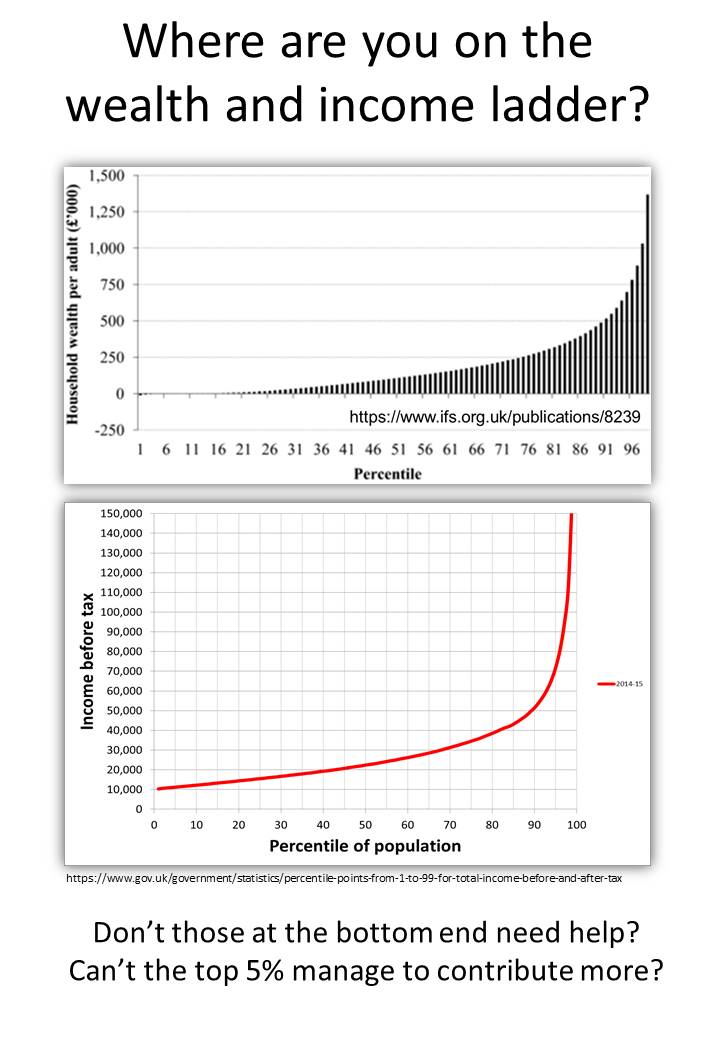
There is plenty of value generated in this country, we just need to see it allocated to the right areas.  At the moment, too much is allocated to a small number of people.  The activities that benefit us all are not valued enough by the few who decide where to ‘spend’ the value that they acquire.

As a society, we have the right to decide what we value and a right to ensure that our work creates value in areas that are important to us.  If we want to be cared for when we are old, we need people working to care for us.  If we want safe streets we need our police force.  If we want our children taught well we need teachers.

If more people work in these areas, it may mean less people working in other areas.  We may have to accept less people working in the finance industry, or the retail industry for example.  But surely a civilised society values caring for its people higher than moving money around, or selling more stuff?

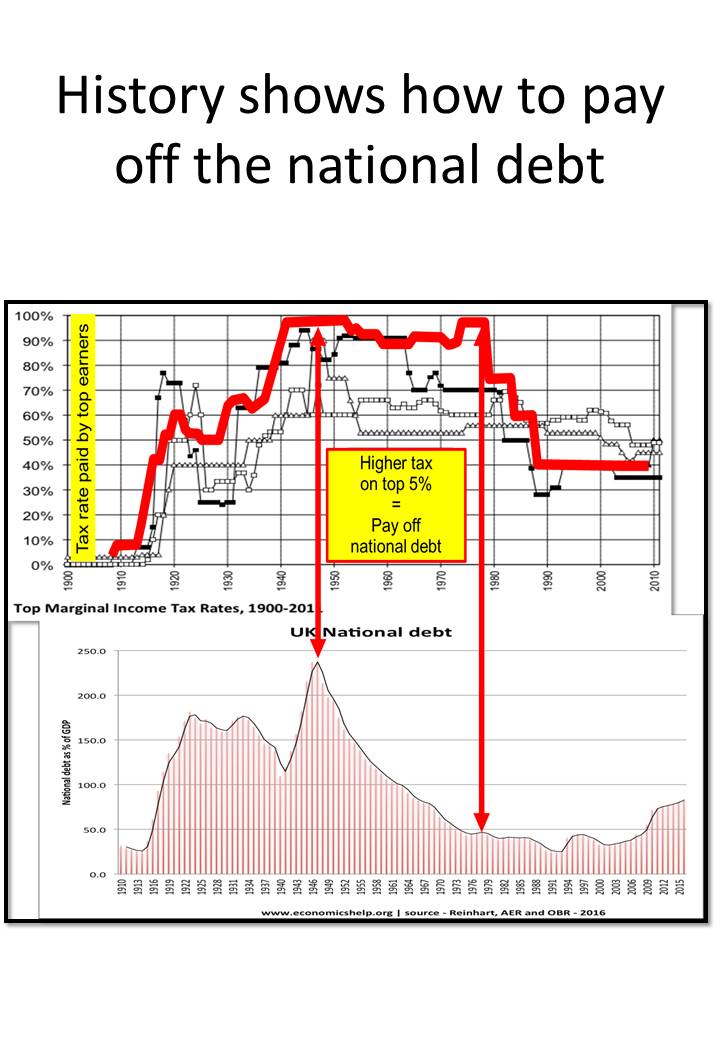
So, we need a taxation system that allows the society that we deserve to be funded.  That is why it is important to regain more control of the allocation of value.  Government needs to take back control from businesses, and from the top 5% of earners.

But what about the argument that ‘they will just go somewhere else’.  The value that is currently channelled to the wealthy is being created here.  It will still be created here.  All that will happen if the owner of a company decides to emigrate is that they will be harvesting the value created in the country that they go to.  The value created in our country will stay here for the benefit of our citizens.

So when we get the chance , let’s vote for the society that we deserve.  Let’s grasp our future with excitement and hope, and not shrink from the opportunity to make this nation great.

Draw your own conclusions

Here is some data.  It should be more powerful than rhetoric.  Draw your own conclusions…

It is time to cut VAT.

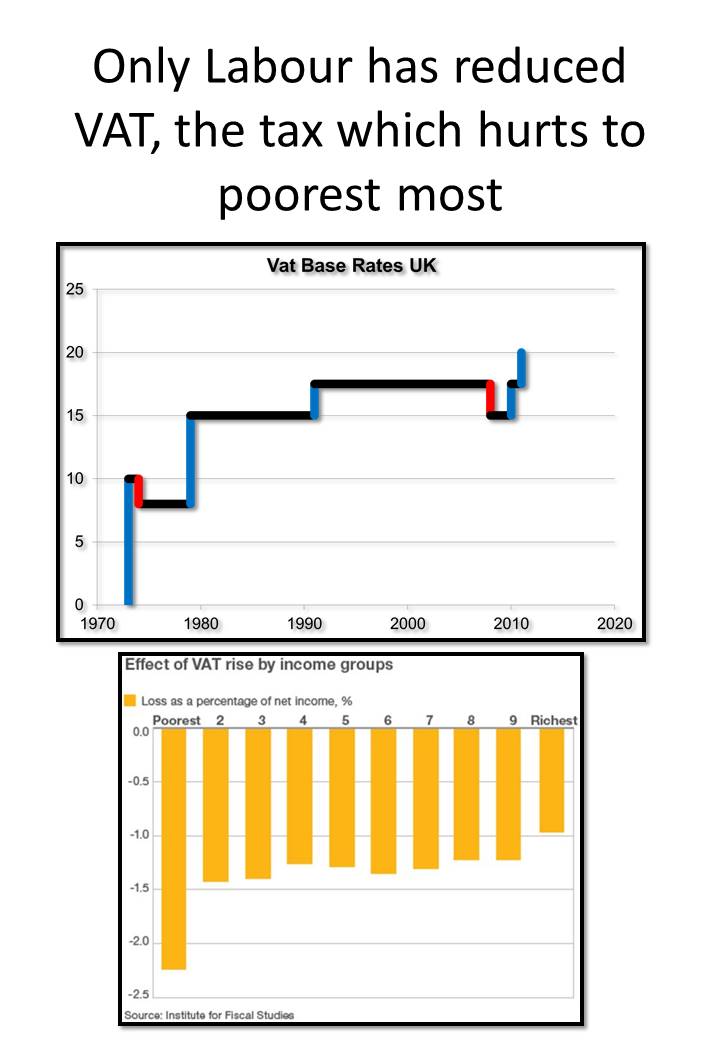
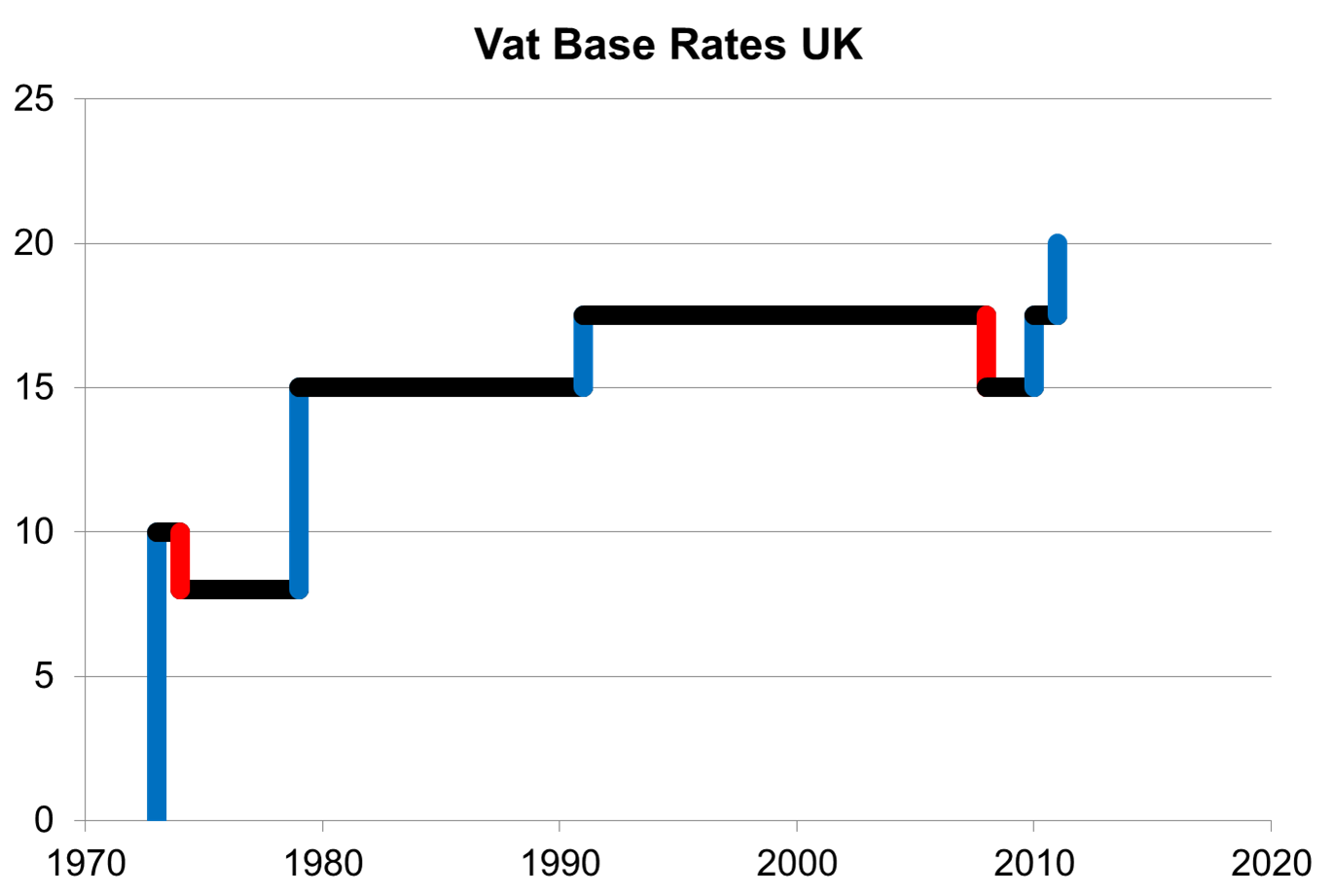
VAT is a tax on what we spend.  Everybody has to pay VAT at the same rate, rich and poor alike.  The following chart shows which parties have changed the basic rate of VAT since its introduction by the Conservative government on 1973.

VAT rate changes

Increasing VAT puts a bigger burden on the poor than the rich, as shown by the following analysis of the most recent VAT risk from 17.5% to 20%:

Reducing the rate of VAT will ease life for the less well off, increase sales, increase business activity and lead to higher employment.  That will increase income and corporation tax revenues and reduce the cost benefit payments as there will be less people out of work.

It is time to cut VAT, not to consider increasing it.

Why we need more council houses

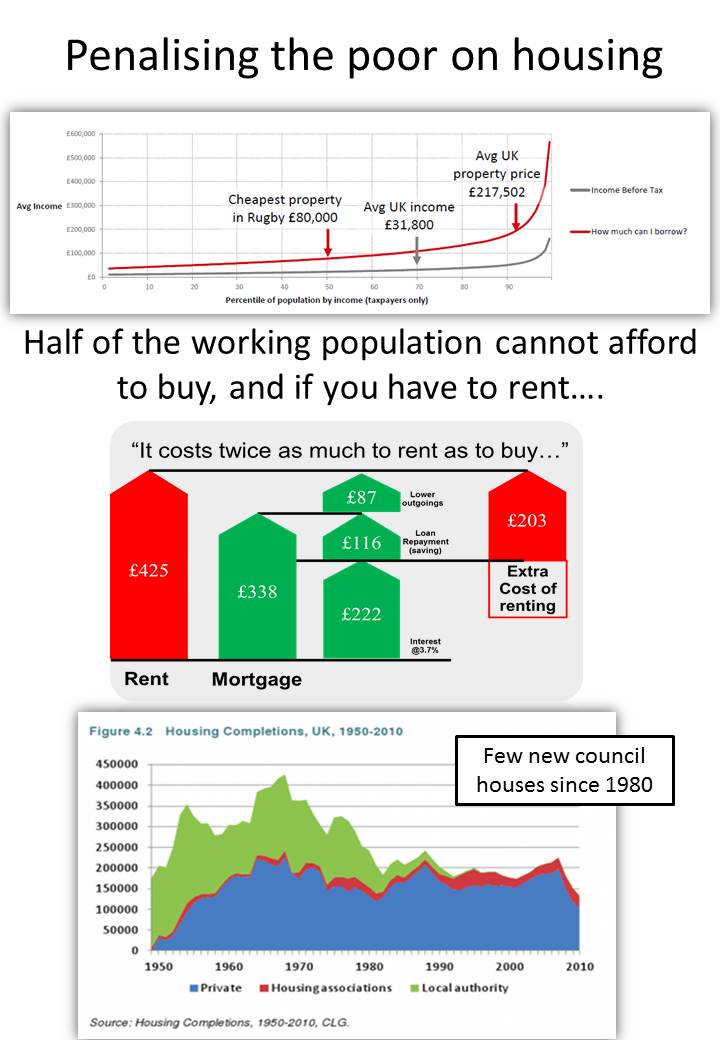
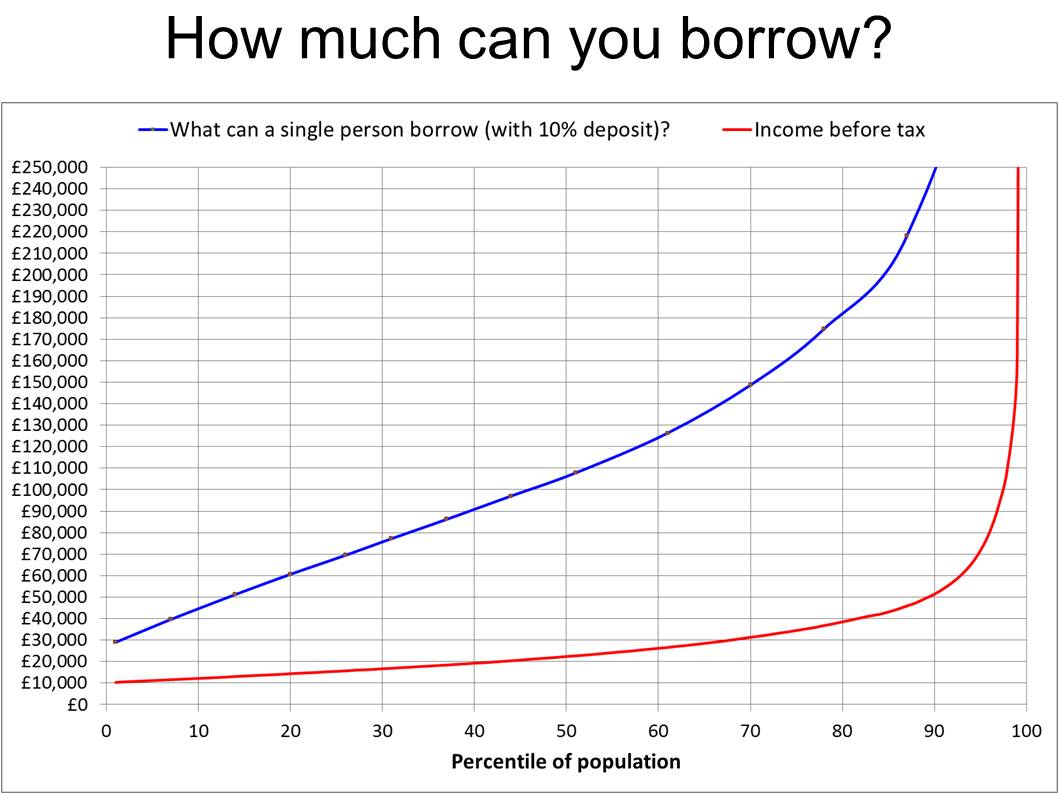
The chart below shows the income distribution in the UK (latest figures available from government statistics) and the corresponding amount that you can borrow if you have a 10% deposit (using the Halifax building society mortgage calculator).

Two thirds of the working population would be earning too little to buy a house for £150,000 by themselves. If you do not have the ‘bank of Mum and Dad’ then you have no chance.

Your only option is to rent, from the private sector, at a cost that is higher than your mortgage repayments would be if you were able to get a loan.

That is why we NEED more council houses.

That is why I’m voting for a Labour government. (see Pledge 2)

How can Theresa May call herself a Christian?

“If someone had enough money to live well and sees a brother in need but shows no compassion – how can God’s love be in that person?” 1 John 3:17

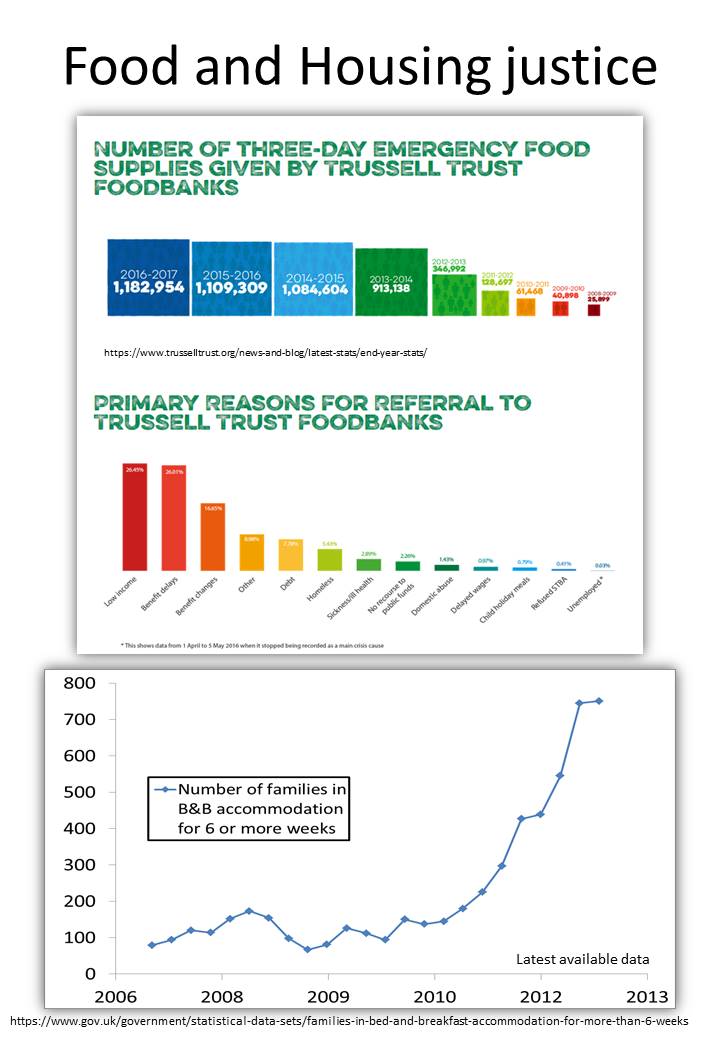
The Conservative party have overseen the rise in homelessness and food bank usage, hardship caused by severe sanctioning of benefits, zero hour contracts, deep cuts in public services.  Yet Mrs May has called herself a Christian.  I don’t understand how.  Jesus said “If you love me, obey my commandments” John 14:15 yet I see no sign of that.

Jesus calls us to love our neighbour, not to exploit them.  He noted that the widows offering of a few small coins was worth far more than the trumpeted gifts of the wealthy.  She gave all she had to live on.

Unfortunately the Conservative government have demanded all from the poorest in society.  There have been plenty of opportunities for a change of heart – now it is time for a change of government.