The End of Evolution

Living things are amazingly complex and refined organisms.  Contained within our skin are muscles, organs, a nervous system, a circulatory system, an immune system, a digestive system, a reproductive system, a repair system, a growth system, and perhaps the most complex of all, a brain.

We are amazed and baffled by the latest smartphones and tablets, yet they are incredibly primitive compared with the brain.  Research has shown that there are more switches in a single brain than in the entire internet!  (http://www.cnet.com/news/human-brain-has-more-switches-than-all-computers-on-earth/ )

Yet all the complexity of the human body grows from a single cell.

One cell divides into two, then four, then eight.  On and on, dividing, specialising, growing and dying in a precise order to gradually construct the fully grown human being.  And the developing body self-programs the control systems and brain in a robust and repeatable process.

How can such a robust process happen?  Where are the instructions to tell the cells what to do?  Is it in the DNA?

There are 3 billion base pairs in human DNA.  Is it really possible that all the information necessary to grow and operate fifty trillion different cells over the entire lifespan of a human is fully encoded in the DNA of the original single cell?  Even if we used one base pair to define the position of each cell we are 10,000 times too short of information carrying capacity in the DNA.

But it’s worse than that.  In the DNA base pair system of numbering the letters CAGT are equivalent to numbers in base 4.  In base 10, the number fifty trillion (50,000,000,000,000) uses eleven characters, but in base 4 we would need 23 characters.  Our 3,000,000,000 DNA base pairs can only now specify 150,000,000 positions – 300,000 times less than we need just to define the position of each cell.

In addition to the position and type of cell, we are asking the DNA to carry the information to define the construction sequence and to program all of our behaviour patterns, our “operating system.”

What are the chances of that? Yet it happens.  Humans grow from a single cell every day.  Billions of us.

This sort of mathematics is often applied to the beginning of life, and show that the odds of forming even the simplest protein by chance are like looking for a single molecule in the whole mass of the earth. Yet it happened.

And how likely is the evolutionary process?  In their book The Origins of Life the authors John Maynard Smith and Eörs Szathmáry identify a number of what they call “Major Transitions” without which we would not exist such as:

  • From replicating molecules to populations of molecules in compartments
  • From independent replicators to chromosomes
  • From RNA as gene and enzyme to DNA as gene and protein as enzyme
  • From bacterial cells (prokaryotes) to cells with nuclei and organelles (eukaryotes)
  • From asexual clones to sexual populations
  • From single-celled organisms to animals, plants and fungi

What are the chances of that?  Yet it happened.

Here is a summary of the history of the earth and life on earth:

13.8 billion years ago: universe created

13.5 billion years ago: first stars form

5 billion years ago: the Sun forms, perhaps as a second or third generation star.

4.5 billion years ago: The earth formed as a molten mass. For the next 700 million years it was probably bombarded by large objects, and the energy of the collisions probably kept the earth molten up until…

3.8 billion years ago: earth crust solidified. Manufacture of pre-biotic chemicals needed for the life to exist

3.5 billion years ago: fossil evidence of cellular cyanobacteria.  .

1.5 billion years ago: first eukaryotic cells (cells with a nucleus) evident

1 billion years ago: first metaphytes (multicellular algae and higher plants)

500 million years ago: first metazoans (invertebrate and vertebrate animals)

1/4 million years ago: first homo-sapiens

Let’s put the evolutionary timeline into perspective of number of generations:

Bacteria typically reproduce every hour, so in the 3.5 billion years since cyanobacteria first emerged there have been about 35 trillion generations, although there seems to have been little evolutionary change in the 2 billion years before the first cells with a nucleus appeared.

Animals first emerged around 500 million years ago, and with a typical generation of 2 years implying around 250 million generations to move from the first animals to one with all of the complexity that we see in a human.

Against this backdrop, the evolutionary process has been incredibly fast; remember the extremely complex product that it has developed.  Yet it happened.

There are those who claim that all this happened as a result of sheer luck.

There are others for whom the following text seems to better describe things:

You made all the delicate, inner parts of my body and knit me together in my mother’s womb. Thank you for making me so wonderfully complex! Your workmanship is marvellous—how well I know it. You watched me as I was being formed in utter seclusion, as I was woven together in the dark of the womb.

For me, the findings of science hint strongly at a God who is continuously engaged in sustaining and interacting with the universe and life that he brought into being.  I find this fully consistent with the God that is revealed through a reasoned understanding of the Bible and demonstrated through the life of Christ.  I accept that it is not indisputably demonstrated, but I find the evidence sufficiently convincing to give my life as a result.

These issues are explored more fully in The Big Picture

See also:

https://philhemsley.wordpress.com/2012/06/03/evolution/

https://philhemsley.wordpress.com/2012/11/19/if-evolution-is-true/

https://philhemsley.wordpress.com/2013/03/03/information-dna-and-evolution/



Direct from the San Francisco Book Review

The Big Picture – An Honest Examination of God, Science and Purpose
By P D Hemsley
eLectio Publishing, $4.99, 266 pages, Format: eBook

A former atheist/agnostic who gave God a chance offers open-minded readers this work which is both ambitious in scope and credible in approach: //The Big Picture: An Honest Examination of God, Science, and Purpose//.  Polarizing subject matter such as God and science, evolution, and intelligent design are revisited with the goal of gently challenging entrenched thinking on both sides.

Hemsley, a Chartered Engineer, “has lived on both sides of the faith fence.” His book is comparable to a technical presentation designed for a general audience. It is highly organized with stated goals, evidence, and the author’s conclusions. Fluid, straightforward writing helps the reader progress through several chapters or conclusions dealing with faith, science, purpose and design, quantum physics, free will, reason, Jesus, and more. Even so, those with less of a scientific bent will need to exercise their concentration skills in the scientific sections.

The strength of this book lies in complexity and compatibility. The chapters “Science Describes an Incredible Universe” and “The Universe Exhibits Design and Purpose” make for fascinating reading, especially the subsection where “challenged by the complexity of the biological machinery” Hemsley explores how a modern-day designer would engineer a human being and how long it would take. Additionally, the author’s version of the Genesis creation account featuring the compatibility of scientific discoveries and God’s design is an interesting interpretation to consider.

No emotional appeals are made to the atheist, agnostic, hardcore creationist, or plain honest seeker for a change in his or her worldview. In the words of the author, a self-described Minimalist Christian: “Whether you agree with my conclusion or not, I hope that many of the myths that currently inhibit so many of us will have been weakened or dispelled. I hope that a step can be taken towards finding purpose and experiencing life in abundance.”

http://citybookreview.com/the-big-picture-an-honest-examination-of-god-science-and-purpose/

Click HERE to buy a copy.

A Masterpiece of Engineering

We think that we design pretty neat things these days.  We laugh at the man who said that the world would probably only need four or five computers.  Those of us who are old enough can remember when we did a sum on the newly invented pocket calculator that gave us the answer 0.7734, which said “hello” when we turned the calculator upside down.

But whilst researching my latest book I came across some pretty amazing statistics about a design that we all treat as commonplace – each and every human being.

Our 1.5kg brain comprises around 100 billion neurons, of 10,000 different types. Each neuron can have thousands of synapses (input connections from other neurons) and each synapse has perhaps a thousand molecular scale switches.  A single human brain is estimated to contain more switches than the entire internet.

Contained within our skin are around 650 muscles attached to over 200 bones, which vary in size from the femur in our thigh to the stirrup bone in the ear.  The muscle/bone combination is precise enough to paint a masterpiece, or to putt a golf ball twenty feet into a hole.

We have around 60,000 miles of veins and arteries and 1500 miles of pipes in our lungs.

Within our lymph nodes we have billions of B cells, each of which is different and each one defends against a particular very specific infection.

The list goes on – but you get the point.

Yet this whole complex organism is built from a single cell.

We begin as one single cell.  Within the cell is our DNA, the supposed blueprint for our manufacture.  We have a massive 3 billion base pairs (characters in the ‘code’) in our DNA. Yet there are around 50,000 billion different cells in the body.  Each cell is different, in function and in position – some nerve cells can be several feet long.  How can we imagine that there is enough information contained within our DNA to define our fully functioning body?

But we do start from just one cell.  And each cell only responds to the signals that cross the cell membrane.   As we develop, the cell is what it is as a result of its history – its ancestor cells.  And each of those cells only responded to the signals that crossed it’s membrane.  It’s like a massive pyramid, built the wrong way up – with the apex at the bottom.  The process is incredibly robust.  Look at identical twins.  Most of their development is as separate human beings and yet the final ‘product’ is identical.

A human being is truly a masterpiece of engineering.

Is it reasonable to state with certainty that this happened by chance?  Is it reasonable to assert that the properties of the sub-atomic particles in the universe are such that they behave in precisely the right way to manufacture you or I from a single cell by sheer luck? Or would that be a blind leap of faith?


See also:

https://philhemsley.wordpress.com/2013/03/03/information-dna-and-evolution/
https://philhemsley.wordpress.com/2012/09/17/the-dna-enigma/


God, miracles and the laws of physics.

If something is consistent with the laws of physics, can it be a miracle?  If something behaves inconsistently with the laws of physics, does it prove that there is a God? Does a scientific explanation of an event say anything about the existence or non-existence of God? 

Consider the statement, “The earthquake was caused by the contraction of the crust of the earth”.  The statement in itself clearly says nothing about the existence or non-existence of God.  Yet people have often read meaning into disastrous events, considering them to be ‘acts of God’.

Whilst they may be right, just over 2000 years ago a tower fell on eighteen people and killed them.  At the time an investigation might have concluded that the tower fell due to subsidence of the foundations, or poor workmanship – there might have been a completely explainable ‘natural’ cause.  Yet there were probably a number of people who thought that this was God’s judgement on those eighteen people. The event is referred to in the Bible, and we hear that Jesus spoke to the crowd saying, “those eighteen on whom the tower in Siloam fell and killed them: do you think that they were worse offenders than all the others who lived in Jerusalem?”  Clearly Jesus didn’t consider this event to have been an act of God.

Let’s consider another sequence of events that was also described in the Bible.  Jesus tells one of his followers to:

 “go down to the lake and throw in a line. Open the mouth of the first fish you catch, and you will find a large silver coin. Take it and pay the tax for both of us.” (Ref Matthew 17:27)

Clearly this might be explained by the following ‘natural’ sequence of events:  A merchant on a quayside dropped some coins and one fell into the water.  A fish happened to be attracted to the large shiny silver coin, and tried to eat it (we use such ‘lures’ to catch fish today).  The coin got stuck in the fish’s mouth.  The fish was rather hungry and particularly attracted to the bait on the disciple’s fishing line.  The fish was caught on the disciple’s line and he found the coin.  This explanation is fully consistent with the laws of science and our experience of the sorts of things that happen every day. But that’s not enough to satisfy us.  We can’t believe that it just happened by chance.

So why do we find the event so surprising?  Is it because we know that the particular chain of events is very unlikely?  We know that people drop money. We know that fish are attracted to shiny objects and swallow them. We know that people catch fish. So to catch a fish with a coin in its mouth does not seem so very unlikely.  Each event by itself is possible, although the complete chain of events becomes increasingly unlikely – I don’t personally recall hearing of anyone else who has caught a fish with a coin in its mouth. What makes the story special is that Jesus predicted that the first fish to be caught would have a coin in its mouth, and that he instructed the disciple to do such a strange thing in order to get the coin.  We recognise that there must be a ‘fix’ going on somewhere.

Derren Brown has been filmed tossing coins.  The film shows him tossing ten ‘heads’ in a row.  The probability of that happening by chance is (0.5)10 = 1 in 1024.  When we see something happening that has only a one in a thousand chance we know that there must be some fix, especially when we know the man is a conjurer – and yet we’ve seen it with our own eyes.  The explanation is that he spent days being filmed tossing coins until the unlikely event actually came up.  The difference in the story above is that Jesus only had one shot at getting it right.

Almost every week someone wins the lottery.  The chance of there being a winner of the lottery is extremely high.  Yet if a friend gave you a ticket in advance of the lottery and said “This ticket will win”, and then you did win you would know that the friend had fixed it in some way.  If you knew that your friend was not a crook, but had your best interests in mind it might make you pay somewhat more attention to what he said in future.

The conclusion from all these examples is that it is quite possible for something to be fully consistent with the known behaviour of the matter in the universe and yet still require some explaining.  Is there some sort of ‘fixing’ going on that we don’t know about?

Examples of ‘fixing’ are taken by many to be indication of there being a God; scientific evidence for God. And such examples may not contravene the laws of physics, but just be very unlikely events.  As we look at the discoveries of science there is no point doubting the validity, but (depending on your starting point) some things seem to be incredibly unlikely.  It is worth wondering, is there some sort of ‘fixing’ needed?

furry dice


Related posts:

https://philhemsley.wordpress.com/2012/06/19/can-god-answer-prayer-in-a-universe-that-operates-according-to-the-laws-of-physics/

https://philhemsley.wordpress.com/2012/06/21/an-argument-for-and-definition-of-god/

https://philhemsley.wordpress.com/2012/06/03/evolution/


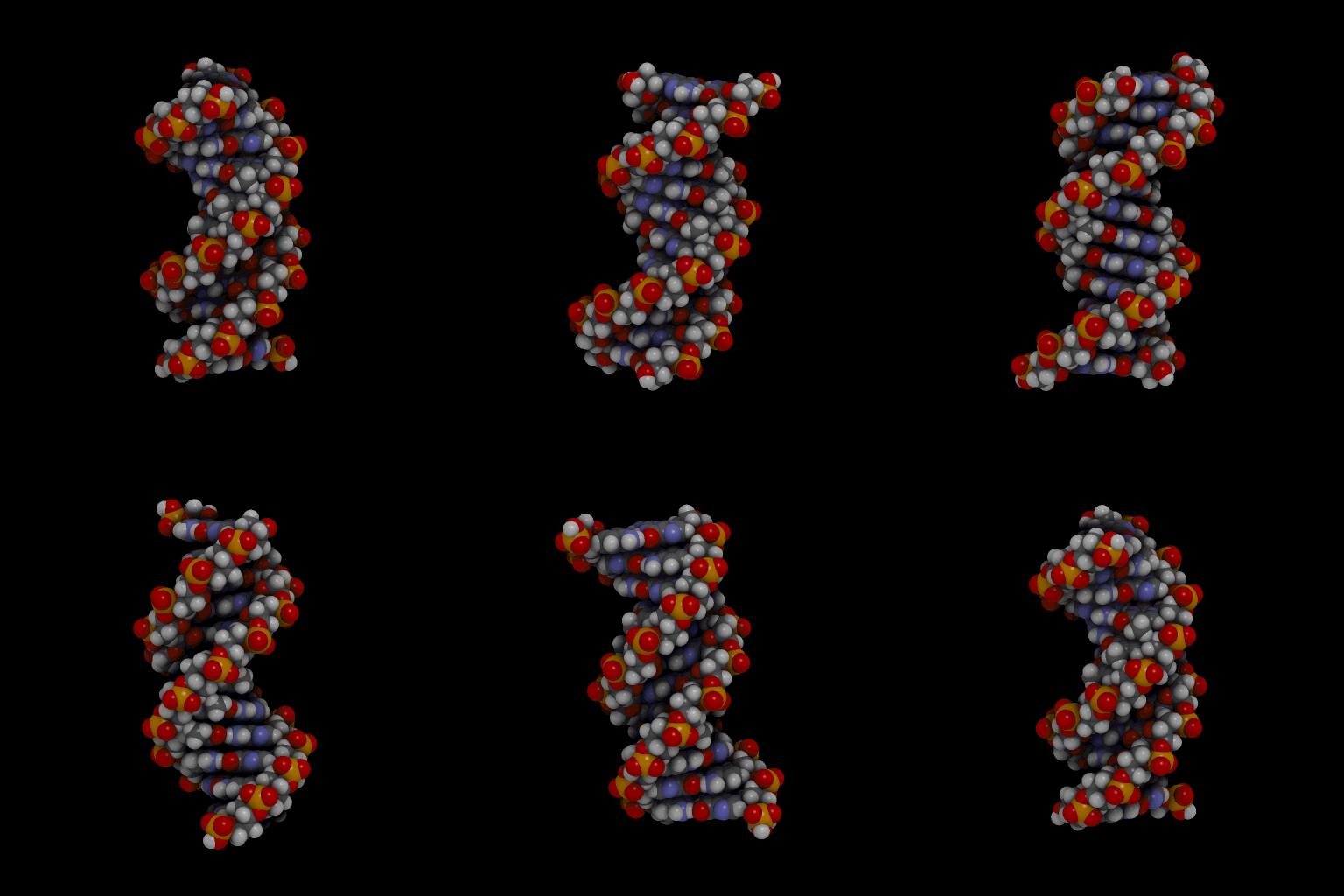
The DNA enigma

DNA is amazing stuff.  A precisely structured sequence of base pairs that is unique to each of us as an individual.  A record of our ancestral history.  A template for the manufacture of our proteins.  The blueprint for each of us.

The human DNA chain of around 3 billion characters has been assembled over perhaps the last billion and a half years (from the first evidence of cells with a nucleus), and has changed with the changing animals that carried it, through perhaps a billion generations.

DNA appears to be the mechanism of inheritance, the instruction set that ensures that beneficial features from parents are transmitted to the offspring.  It appears to be the key that defines a naturalistic explanation of how we have come to be here.  But is it?

Is there enough information within DNA to define each of us?  Or is something more needed?

As we remember that each of us begins as a single fertilised cell containing the combined DNA from our father’s sperm and our mother’s egg, then let’s remind ourselves of what the information in the DNA is being asked to define.

  1. The precise geometric construction of our bodies:
    1. The position, shape, type and interconnection of each of our fifty trillion cells
    2. The complete development cycle, that is robust enough to cope with different environments and with physical damage.  A development cycle which maintains the living organism as a functional entity at each stage in the process
    3. Major systems, fully functioning and cooperating with each other
      1. Circulatory System
      2. Respiratory System
      3. Immune System
      4. Skeletal System
      5. Excretory System
      6. Urinary System
      7. Muscular System
      8. Endocrine System
      9. Digestive System
      10. Nervous System
      11. Reproductive System
      12. A fully programmed brain that can control the operation of the body, but that can also think, conceptualise, communicate, empathise, create works of art, music, appreciate beauty, love, hate, choose.  A brain that appears to have, and for all practical purposes has free will.

This is weighty stuff to place onto DNA.

Indeed, the functionality does not seem to match the information capacity of the DNA; the DNA of an amoeba is ten times longer than that of a human, yet the functionality is minimal in comparison.

Has familiarity bred contempt?  Do we see ourselves too superficially?  Have we lost our awe at our own construction?  Have we deluded ourselves into thinking that we understand?

Have we forgotten that all that we are physically began with that one cell?  One cell and its DNA, is it really sufficient to make a human?

Image

Evolution

I don’t think that most people realise that Richard Dawkins’ claim about Evolution is that it allows one to be an ‘intellectually satisfied atheist’. He does not claim that evolution proves that there is no God. Unfortunately this is not the impression that is created by comments by new atheists. Additionally we find that so-called ‘creationist’ Christians insist that God made the world in literally 6 days as described at the start of the book of Genesis. It is no wonder that many people think that evolution is inconsistent with Christianity, and since evolution is amply demonstrated the (false) conclusion drawn is often that science and evolution have proved that God doesn’t exist.

I am a qualified engineer, trained and experienced in designing things, Fellow of the Institution of Mechanical Engineers. In engineering we see evolutionary processes at work improving our designs. We test our designs against one another to find out which is best, select the best and then seek to improve it further. The ‘best’ design changes over time and our processes mean that our products change over time to adapt to the new environment; to seek the new ‘best’. Evolution is a necessary part of the design process, but it is not the complete design process. Evolution is the tool that ensures that the design always adapts to the requirements of the customer. I have no problem with a God who created and sustains the universe.

Christians should not be afraid of science, but should embrace it.  How better to appreciate the wonder of the universe and the stupendous ingenuity of the every living creature, from the amoeba to the human, from the mustard seed to the mightiest tree.  We can learn more about God and we can learn more about ourselves by studying the material world.

But we must not become deluded that science is all that there is. Science is about observation of the repeatable, the measurable. Some things are not repeatable (miracles for instance) and some things whilst measurable are not described by the measurement (love for instance). So for a full understanding we need to look beyond science. All religions try to do this, to help us live ‘good’ lives. Philosophy tries to make sense of our existence. It is good to explore what others say but we also need to consider the authority behind the claims as we decide which are true and which are false. And for me, the ultimate authority is Jesus. I listen to what he said, and try to understand and follow it. Why? As Jesus said, ‘believe me because of the miracles, the works that I do’, and because anyone who willingly allows themselves to be crucified has earned the right to be listened to. And I find that what he taught contains such wisdom that it is truly worth putting into practice.