War, religion, God, and why I write

I remember a discussion soon after I became a Christian where I was asked “so what about all the other religions?”  My reply was that they were simply mistaken.  I think the remark was taken to be rather arrogant.

I read the news today. I see the conflict, anger and fear; fighting between Moslems of different sects.  I see forced imposition of religious dogma; conversion to another religion punishable by death.  We all know that this is not as it should be. And I am reminded of my reply.

Reason and evidence tells me there is a God, and my whole being tells me that love is our ultimate purpose.  And when I find that love underpins and is at the heart of Jesus teaching I begin to see how it all fits together; how we are meant to be.

If I were God and someone from another religion was praying to me, I would not ignore them because they think I have a different name, I would not condemn them because they don’t understand my intentions for them.  I would be saddened that they are misled, I would try to teach them, and I would restrain some of their actions, but I would still love them.

As a mere human trying to follow God’s purpose, I don’t hate the Muslims, or even the Westborough Baptists, but I believe they are misled and mistaken.  I hate what they do, and I want them to stop.  I want them to understand the truth, and find their real purpose.  I want that for everyone.

If we all really understood Christ’s teaching, if we really loved God with all our heart, and loved our neighbour as ourselves, if we really were ready to forgive others and restore broken relationships we know that the world would be a better place.

That is why I write.  That is why I follow Christ.  That is my purpose.

What is yours?

Direct from the San Francisco Book Review

The Big Picture – An Honest Examination of God, Science and Purpose
By P D Hemsley
eLectio Publishing, $4.99, 266 pages, Format: eBook

A former atheist/agnostic who gave God a chance offers open-minded readers this work which is both ambitious in scope and credible in approach: //The Big Picture: An Honest Examination of God, Science, and Purpose//.  Polarizing subject matter such as God and science, evolution, and intelligent design are revisited with the goal of gently challenging entrenched thinking on both sides.

Hemsley, a Chartered Engineer, “has lived on both sides of the faith fence.” His book is comparable to a technical presentation designed for a general audience. It is highly organized with stated goals, evidence, and the author’s conclusions. Fluid, straightforward writing helps the reader progress through several chapters or conclusions dealing with faith, science, purpose and design, quantum physics, free will, reason, Jesus, and more. Even so, those with less of a scientific bent will need to exercise their concentration skills in the scientific sections.

The strength of this book lies in complexity and compatibility. The chapters “Science Describes an Incredible Universe” and “The Universe Exhibits Design and Purpose” make for fascinating reading, especially the subsection where “challenged by the complexity of the biological machinery” Hemsley explores how a modern-day designer would engineer a human being and how long it would take. Additionally, the author’s version of the Genesis creation account featuring the compatibility of scientific discoveries and God’s design is an interesting interpretation to consider.

No emotional appeals are made to the atheist, agnostic, hardcore creationist, or plain honest seeker for a change in his or her worldview. In the words of the author, a self-described Minimalist Christian: “Whether you agree with my conclusion or not, I hope that many of the myths that currently inhibit so many of us will have been weakened or dispelled. I hope that a step can be taken towards finding purpose and experiencing life in abundance.”

http://citybookreview.com/the-big-picture-an-honest-examination-of-god-science-and-purpose/

Click HERE to buy a copy.

A Masterpiece of Engineering

We think that we design pretty neat things these days.  We laugh at the man who said that the world would probably only need four or five computers.  Those of us who are old enough can remember when we did a sum on the newly invented pocket calculator that gave us the answer 0.7734, which said “hello” when we turned the calculator upside down.

But whilst researching my latest book I came across some pretty amazing statistics about a design that we all treat as commonplace – each and every human being.

Our 1.5kg brain comprises around 100 billion neurons, of 10,000 different types. Each neuron can have thousands of synapses (input connections from other neurons) and each synapse has perhaps a thousand molecular scale switches.  A single human brain is estimated to contain more switches than the entire internet.

Contained within our skin are around 650 muscles attached to over 200 bones, which vary in size from the femur in our thigh to the stirrup bone in the ear.  The muscle/bone combination is precise enough to paint a masterpiece, or to putt a golf ball twenty feet into a hole.

We have around 60,000 miles of veins and arteries and 1500 miles of pipes in our lungs.

Within our lymph nodes we have billions of B cells, each of which is different and each one defends against a particular very specific infection.

The list goes on – but you get the point.

Yet this whole complex organism is built from a single cell.

We begin as one single cell.  Within the cell is our DNA, the supposed blueprint for our manufacture.  We have a massive 3 billion base pairs (characters in the ‘code’) in our DNA. Yet there are around 50,000 billion different cells in the body.  Each cell is different, in function and in position – some nerve cells can be several feet long.  How can we imagine that there is enough information contained within our DNA to define our fully functioning body?

But we do start from just one cell.  And each cell only responds to the signals that cross the cell membrane.   As we develop, the cell is what it is as a result of its history – its ancestor cells.  And each of those cells only responded to the signals that crossed it’s membrane.  It’s like a massive pyramid, built the wrong way up – with the apex at the bottom.  The process is incredibly robust.  Look at identical twins.  Most of their development is as separate human beings and yet the final ‘product’ is identical.

A human being is truly a masterpiece of engineering.

Is it reasonable to state with certainty that this happened by chance?  Is it reasonable to assert that the properties of the sub-atomic particles in the universe are such that they behave in precisely the right way to manufacture you or I from a single cell by sheer luck? Or would that be a blind leap of faith?


See also:

https://philhemsley.wordpress.com/2013/03/03/information-dna-and-evolution/

https://philhemsley.wordpress.com/2012/09/17/the-dna-enigma/


Scientific support for The Rainbow Economy

A link to a fascinating talk below.  The beginning is rather depressing, but the finish supports the solution proposed in The Rainbow Economy.

Do listen to it all.

http://www.ted.com/talks/paul_piff_does_money_make_you_mean.html?utm_source=email&source=email&utm_medium=social&utm_campaign=ios-share


The Rainbow Economy

My three posts “Austerity is working?” I, II, and III have highlighted that there is an inherent injustice in our world today.  And Ian (comments) tell us that even in economic terms austerity is not working.  What is the solution?

I reminded us of the amazing and bloodless transition from an Apartheid regime to a Rainbow Nation that was led by Nelson Mandela.  It worked because he managed to change the hearts and minds of the people to repent of and forgive past injustices, and be reconciled to one another.  He changed the attitudes of the people of the nation of South Africa.  He, Desmond Tutu and others reminded people that everyone, black or white, was equally valuable; not equal (as in identical) but Sons of the same Father.  His vision was a nation which was a single community which treated everyone as a brother, irrespective of colour.  Mandela changed the rules of the game – he change people’s attitudes.

Economics is about predicting the outcome of different actions and regulations. Predictions are based on the response of individuals to those actions educated by the response in similar situations in the past.  The distribution of wealth shown in my earlier posts is a result of the initial distribution of wealth, economic rules and regulations, and people’s attitudes. As a simple formula:

Distribution of wealth today = Fn(Distribution yesterday, Economic Policies, Attitudes)

We have seen that the trend of today’s equation is to distribute the wealth more towards the rich.  We have seen that most people would prefer a more even (but not uniform) distribution.

But it seems that the only variable in the equation above that anyone advocates changing is Economic Policies.  Whether someone is an extreme capitalist or extreme socialist, focus is on tax and spending regulations and regimes – about different Economic Policies.

But what about Attitudes?

I recall a radio interview with one of Margaret Thatcher’s colleagues or friends, asking how she reconciled her hard economic policies with her Christian beliefs.  The reply was that privately she looked to charity to ease the discomfort of those who suffered.  But of course it would have been impossible for her, or the tough government to tell the nation to be charitable, it would reek of hypocrisy.  Instead, her government and policies changed attitudes in that they gave individuals permission to be selfish and greedy – echoed today in Boris Johnson’s speech headlined “Boris Johnson invokes Thatcher spirit with greed is good speech”.

Ian made another comment, that in today’s South Africa there is an “endemic entitlement mentality including laziness, victim mentality, and bitterness that redistribution has not brought what the poor expected”

From these two example. at either end of the wealth spectrum, attitudes focus on self-interest. Such attitudes might be justified by comments like:  “It’s not my job to care about anyone else – that’s the government’s responsibility” or “It’s the government’s responsibility to give me a job – it’s my right, I shouldn’t have to suffer”.

In the past humans lived in groups and tribes where everyone knew each other and everyone looked out for each other.  People lived in communities and all felt responsible for the good of the community as a whole.  There were expectations on individuals to contribute to the community and to help each other if they found someone in need. Relationships were considered important (you had to live with each other after a dispute) and everyone pulled together to make the community work.  

Today we live in states where (generalising) we look to the government to look out for others.  We don’t really care about the community as a whole so long as we are alright.  Relationships matter less because we can always move somewhere else if we fall out with our neighbours, move jobs if we fall out with our boss, and change partners if we fall out with our partner.  Our role in and value to society is as a ‘consumer’, and policies focus on giving the consumer what he wants.  We have expectations of our government, and having paid our taxes we don’t really see that we should do anything more to help them. As long as we as individuals are comfortable we see no need to do so.  We have abdicated our social responsibility to the state.

I think it is time to take it back.

Our attitude needs to change from that of selfish individual consumer.  We need to become once again a member of a community, a member of society who feels responsible for society as a whole.

We need to change our expectations of ourselves and others to do what we can to help each other.  We need to embrace the attitude of “what can I contribute” and respond according to our abilities.  In such a climate we would see for instance Mr Cameron the individual behaving as if we are indeed “all in this together” and using his personal fortune to benefit others.  We would see those who are on state benefits asking what they can do to contribute to society – and being given opportunities to contribute.

We need to value each person equally and encourage each to grow to fulfil their potential. Love has been defined as exerting oneself for the well-being of others.  We need to love more – achieved by looking outwards.  Oswald Chambers said that ‘Self-pity is of the devil”.  Self-pity in difficult circumstances leads to bitterness and a victim mentality.  Self-pity in comfortable circumstances prevents doing what is right for fear of our own needs in the future.

This new attitude is not completely absent from society (see links at the bottom), but it is rarely promoted and needs boldness and courage because it is so counter cultural.  But let’s all be part of the revolution.  A revolution in attitudes rather than government.  A revolution that says “we are all going to make our society healthy …. Starting with me!”  A revolution that calls us to “love one another as we love ourselves”.

So where can we start?

Take a look around and ask “what could I do to help?”  “How can I spend my time better?”  “How can I spend my money better?”  “Who can I help who is struggling?”  “Can I be doing something more valuable than watching TV?”  There are so many possibilities. Can I help a young person contribute to society and earn some money?  What organisations or charities could I help?  Can I mentor someone?  Can I visit a lonely old person, or pay their heating bills?  Now I’m retired, what can I volunteer to help with?  Since I have no time with my busy job, can I support important work financially?

But also, encourage others to do the same.  When our friends grumble at the government for this or that, challenge them to think differently and take back some personal responsibility.  We need to give each other permission to help society, to expect it rather than be surprised by it.  We all need to change mindsets.  We need to spread the word!

And of course we need to let the government – our representatives know what we want them to truly represent.  We need to let them know what sort of economy we want, but we also need to demonstrate that we are ready to contribute too.

So, we are not helpless observers.  Each one of us can make a difference.  Let’s try.

Here as promised are some links which show some of what is happening already:

https://www.gov.uk/government/news/new-official-statistics-show-resurgence-in-volunteering-as-millions-more-give-their-time-to-help-others

http://www.ivr.org.uk/ivr-volunteering-stats

In Britain, philanthropy is more dependent than ever on the generosity of the wealthiest, with the richest 1,000 taking a growing, active and more public role in charitable giving. Even as the latest UK Giving report showed a 20% fall in real terms in the amount the public gave to charity last year, the new Sunday Times Giving List survey showed a more than 20% increase in giving by the wealthy elite.  http://www.thesundaytimes.co.uk/sto/business/BusinessRichList/article1246509.ece

http://www.gatesfoundation.org/

https://www.cafonline.org/PDF/UKGiving2012Summary.pdf

And finally, for encouragement, some quotes from one who claimed to speak for God:

“If anyone forces you to go one mile, go with them two miles.”

“Give to the one who asks you, and do not turn away from the one who wants to borrow from you.”

“Love your enemies, do good to them, and lend to them without expecting to get anything back.”

“Do not store up for yourselves treasures on earth, where moth and rust destroy …. for where your treasure is, there your heart will be also”

“Do not worry about your life, what you will eat and drink; or about your body, what you will wear.  Is not life more important than food, and the body more important than clothes?”

“Why do you look at the speck of sawdust in your brother’s eye and pay no attention to the plank in your own eye?… You hypocrite, first take the plank out of your own eye, and they you will see clearly to remove the speck from your brother’s eye”

Previous posts:

https://philhemsley.wordpress.com/2013/12/10/austerity-is-working/

https://philhemsley.wordpress.com/2013/12/27/austerity-is-working-ii/

https://philhemsley.wordpress.com/2013/12/30/austerity-is-working-iii/

Mitochondrial donation – some concerns

The UK government has decided to consult publicly on the introduction of regulations to allow mitochondrial donation.

I suspect that at the majority of people in the UK have no idea what mitochondrial donation is, what the risks and technical issues are, or what the ethical considerations might be. I wasn’t until very recently!

This short note attempts to give a very brief introduction to the concept and raise some considerations that might inform the discussion.  It is not an expert paper – I am not an expert, but it is an overview to prompt further thought and discussion by the majority of UK citizens, who are also not experts.  A source of information on the topic is “Novel techniques for the prevention of mitochondrial DNA disorders: an ethical review”.

What is Mitochondrial donation?

The majority of human DNA is contained in the cell nucleus, however some is contained in the mothers mitochondria – so called Mitochondrial DNA.  Mutations or abnormalities in mitochondrial DNA (as in all DNA) can lead to disorders in the developing offspring.  Since these disorders are due to the DNA, they are not curable.

“They are progressive, can be very seriously debilitating and disabling. They may also cause miscarriage and stillbirth, death in babies, children and young people, or severe symptoms which onset in adulthood. The symptoms and the age and severity at which they are experienced vary widely between patients, which can make diagnosis difficult. Mitochondrial disorders may affect one organ at a time – for example resulting in blindness or heart failure – or may affect several areas of the body at the same time. Mothers can pass on mitochondrial disorders without having experienced symptoms themselves, which in some cases may mean that they are not aware that they carry mutated mitochondrial DNA that can cause disorders in their children.”[i]

Mitochondria are separate ‘bags’ within a cell, and so can be separated and removed from a cell.  They can be transferred from cell to cell, and so in theory the mitochondria from a parent whose DNA is abnormal can be removed and then replaced with mitochondria from another person who has normal DNA.  The new cell then contains DNA from the female nucleus donor and the father, and a small proportion of DNA from the mitochondria donor.

As with all new technology, implementation is far more difficult than the theory.  However, experimenters believe they are making progress.  Around 30 children worldwide have been born using a technique whereby mitochondria from a donor are injected into the mother cell, providing an excess of mitochondria, in effect trying to dilute the faulty mitochondria.  These trials have indicated a higher than normal incidence of Turners Syndrome (which resulted in miscarriage and a termination), a lack of ovarian development at puberty and short stature.  It may be associated with problems with major organs and mild learning difficulties.

What are some of the risks?

What loving person cannot want to improve the life of another in the best way they can?  If I were a scientist researching mitochondrial diseases I would use all of my expertise to try to find solutions.  In my own job as a design engineer I am continually striving to improve our product, and I sometimes get immensely frustrated by the procedures and processes that are put in place to make sure that new developments are as risk free as possible.  New concepts that I think are very likely to work are often years in development and testing before being introduced into a machine.  But I accept the situation because of the consequences of something going wrong.  A similar situation must apply with Mitochondrial donation.

The amount of testing and refinement that is needed with a new technology depends on the impact if it goes wrong.  Let’s consider some of the impacts if mitochondrial donation were to go wrong.

  • Being genetic, the outcome of the genetic manipulation will be permanently in the gene pool of the descendants.  Our knowledge of how DNA works is still very limited.  Only a few years ago scientists labelled most of the human DNA as ‘junk’, but now controversial recent research is showing that what was previously written off as junk may be important in helping each cell become the type of cell that it needs to be.[ii]  There must be a risk that future generations will suffer unknown and unpredictable consequences of ‘unnatural’ DNA mixing.
  • We really don’t understand how DNA forms our developing body.  We know that a single DNA change can make the difference between a fruit fly having two or four wings, but we don’t know how that happens.  Humans comprise 50 trillion cells, yet our DNA string only contains 3 billion base pairs. That’s more than 10,000 cells per base pair.  We don’t know exactly how so few DNA base pairs can manufacture such a complex entity as a human, although applying engineering principles we can infer that the cell itself must be an intelligent component.[iii]  How will that cell respond to the modified mitochondrial DNA from a donor?  Would it be like running Microsoft software on an Apple computer?
  • The body has evolved to reject unviable embryos.  The trials mentioned above showed that this happens.  Might mitochondrial donation lead to an increase in miscarriages and terminations?  Would the stress and damage to the mother and couple exceed the risk of mitochondrial disease?
  • If mitochondrial donation techniques were to become widespread, but only effective for a proportion cases, what would be the consequence on those parents who still have ‘disabled’ children?  Would the emotional strain be even greater than today?  Would society shun or blame them for having disabled children?
  • We learnt above that often a mother will not know that she has a disorder.  For such parents mitochondrial donation will not be an option, unless there is a universal screening program.  What would be the social and emotional impacts of such a program?

Questioning our assumptions

These are of course only a few of the questions that need to be considered.  However, perhaps it is also important to consider the cultural assumptions that we might be unknowingly making when considering the issues.

A parent will always want the best for their children.  If one were to ask any couple, “would you like a healthy or unhealthy child” then I cannot imagine any couple opting for the latter. However, if you were to ask the parent of a disabled child, “would you rather have Julie or not have Julie” the responses would not be so clear-cut.  If you were to ask “would you rather have Julie but that Julie was not disabled” then the responses would probably lean towards the not disabled Julie.

Anyone who loves others would love to see them fully healthy, intelligent, happy, hard-working, fulfilled, loving and loved, friendly, etc. etc.  Whilst the attributes and character traits of an individual are interlinked, they are not directly and positively correlated.  Health doesn’t lead to happiness.  Intelligence doesn’t lead to being loving or loved.  So we must be wary of concluding that it would have been better if Julie had been born healthy.  She may be more loved, more fulfilled and happier being disabled than she would have been if she had been healthy.  Would Stephen Hawking have become the great physicist that he is if he had not been disabled?

We assume that a long life is better than a short life.  Is this correct?  How do older people think about this?  Are the years in our life more important than the life in our years?

Are we convinced that the end of this life is the end of everything?  If not, then why do we want to keep people from dying? Is it for their sake or ours?

What aspects of life are important, what we produce or the relationships we forge?

Is suffering always a bad thing?  What does evidence suggest?  Would South Africa have successfully transitioned from apartheid to democracy without Mandela suffering years of imprisonment?

In conclusion

This short post was prompted by the UK government’s intention to introduce regulations to allow mitochondrial donation.

We need to question that intention.  This is not an issue to approach lightly and quickly.  Consideration goes beyond the term of a single parliament, and beyond single countries.  I do not feel comfortable that our government, elected by only a small proportion of the population, seems to be intent on adopting a technology which could have severe consequences.

What do you think?

“The Big Picture” – an honest examination of God, science and purpose – OUT NOW

“I recommend this book to all thinking people – we might just change the world.” 

“This book will definitely make you think and then think again. Hemsley did his research for this book, and I received many answers to questions I’ve pondered over the years.”

“it is a welcome relief to come across a book that presents such a broad and balanced overview”

“This book covers an considerable amount of territory in its 253 pages.”

The Big Picture is a much-needed book that allows the reader to consider the big questions of life without feeling bludgeoned to adopt the author’s opinion. The book explains basics of science, philosophy and religion in a straightforward manner.

It will encourage all those who want to live a good and purposeful life and would like a sound basis for doing so. Such readers may find a resonance with the teaching of Jesus and this book will explore whether we can trust what has been recorded in the gospel accounts, and whether the findings of science and a reasoned understanding of the Bible are consistent or contradictory.

Many books in the arena of science and faith are hostile and adversarial. The authors set up straw men of their opponent’s arguments, dismantle them and then preach their own arguments to their disciples. The author of The Big Picture recognises that there are intelligent atheists and intelligent believers, and that a case can always be made for whatever someone wants to believe. The reader is therefore treated with respect

ebook

paperback

Amazon UK

The Big Picture - cover

The Author’s Fear

For all those of us who write about God, I found the following by George MacDonald in an anthology of 365 readings compiled by CS Lewis.

If I mistake, He will forgive me.  I do not fear him: I fear only lest, able to see and write these things, I should fail of witnessing and myself be, after all, a castaway – no king but a talker; no disciple of Jesus, ready to go with Him to the death, but an arguer about the truth.

A wise reminder!


Goodness – me!

Do you ever stop to think what you would like on your gravestone when you are dead?  It’s a good way of finding out what we really want to be like.  I don’t think any of us would like to see phrases like:

“Always selfish and greedy”

“Never had time for anyone else”

“Vindictive and hateful”

When we see a new baby, at a christening who would want to think that the baby would grow up to be a thief, or to have a string of husbands who she cheated on and deserted, or to be a child molester.

We know deep down that we want to be good.

In the 11th century, Anselm of Canterbury described how being good is possible through ‘goodness’, and how supreme goodness is God.  So that desire to be good is actually us wanting to be like God (supreme goodness), to act like God, to be in his image.

St John’s describes in his gospel that God is love.  So when we love one another, our love is possible through love, which is through God.  We are choosing to act like God, to be part of God.

Each of us has the essence of goodness in us, and the essence of love in us.  God is goodness and God is love, so we all have God within us.  Sometimes we choose to ignore goodness and love, and instead choose to be selfish, vindictive or hateful.  But that is not what we want to be – as we found at the start of this post.

The true Christian religion is about helping us to be what we want to be – good and loving.  It is about connecting with that goodness and love within us; God within us.  It is about learning from Christ what goodness and love looks like, and trying to imitate him.

And if you want to be good and loving, then that means that you want to be like God.  Jesus said that ‘if you have seen me then you have seen God’; Jesus represented supreme goodness and love in human form.  So if you want to be good and loving, since Jesus was supremely good and loving, then you want to be like Jesus, and if you want to be like Jesus you can call yourself a Christian.

Christians pray to help make that connection with goodness and love.  Here’s an example of a Celtic prayer from Lindisfarne:

Help me dear Lord to care too much

To love too freely

To pray unceasingly

To forgive endlessly

To laugh fearlessly

To question

To live

To be who I am

To be where I am

To be what I am

To hope

To believe

To reach out my hand

That’s a good prayer, isn’t it?  It’s about connecting with God within us.  It’s asking God to help us be who we want to be.

Do you want to be the sort of person that the prayer describes?  You can take a step closer by praying that prayer.

Related posts

https://philhemsley.wordpress.com/2012/06/21/an-argument-for-and-definition-of-god/

https://philhemsley.wordpress.com/2012/12/29/the-god-of-science/


Why I will never fly with SAS again

It began with a business trip to Poland.  I booked an outward flight with Wizzair for about £27 (including reserving a seat in the front two rows) from Luton, but the return Wizzair flight would have got me home after 8pm on the Friday,  so I decided to go for the earlier SAS route through Copenhagen.  It cost around ten times as much but the extra hours are worth it at the weekend.  First mistake!

I wait at the gate in Gdansk for the first leg flight to Copenhagen.  The flight time arrives.  No plane. No SAS representative to ask what is happening.  The Lot representative on the desk next door tells me that they see the flight is delayed, and while we are speaking the SAS rep turns up, and I see the plane arrive.  I ask the SAS lady and she says I have a slim chance of  getting my connection, and if I miss it then the next SAS to Birmingham will go via Frankfurt and get me to Birmingham at 22.50 … but boarding will be in about 10 minutes.

I decide it would be best to cut my losses and go Wizzair, but SAS don’t cooperate with Wizzair and so I have to ring Carlson (my travel agent) who helpfully check but inform me that the Wizzair flight is full.  They tell me that if SAS got me on the flight to Amsterdam then they can get me to Birmingham with Flybe.  The Amsterday flight is forty minutes later than the Birmingham flight, so that sounds feasible.  If I miss the Birmingham flight then I will have to get the SAS groundstaff at Copenhagen to route me to Amsterdam and Carlson will book the Flybe flight – SAS don’t work with Flybe.  I decide to try it as I’m now the only one who hasn’t yet boarded.  Second mistake!

Things look up as the stewardess says ‘don’t worry, we will be quick – it’s only forty minute flight’.   And then she helpfully announces the departure gates for tight connections.  The forty minutes becomes more of course because of waiting to take off, taxiing, queuing to get off, but I’m in the terminal 15 minutes before the Birmingham flight is due to leave.  There is still hope.  But then I see the queue through passport control.  Fifty people at least, maybe a hundred. And only one passport gate open!  Do I be very un-English and queue jump saying my flight is about to leave?  I see the sign on the board tells me to go to the transfer center and I naively think that perhaps they will be able to get me directly on the flight – like sometime Lufthansa will meet you at the gate when your connection is tight.  Third mistake!

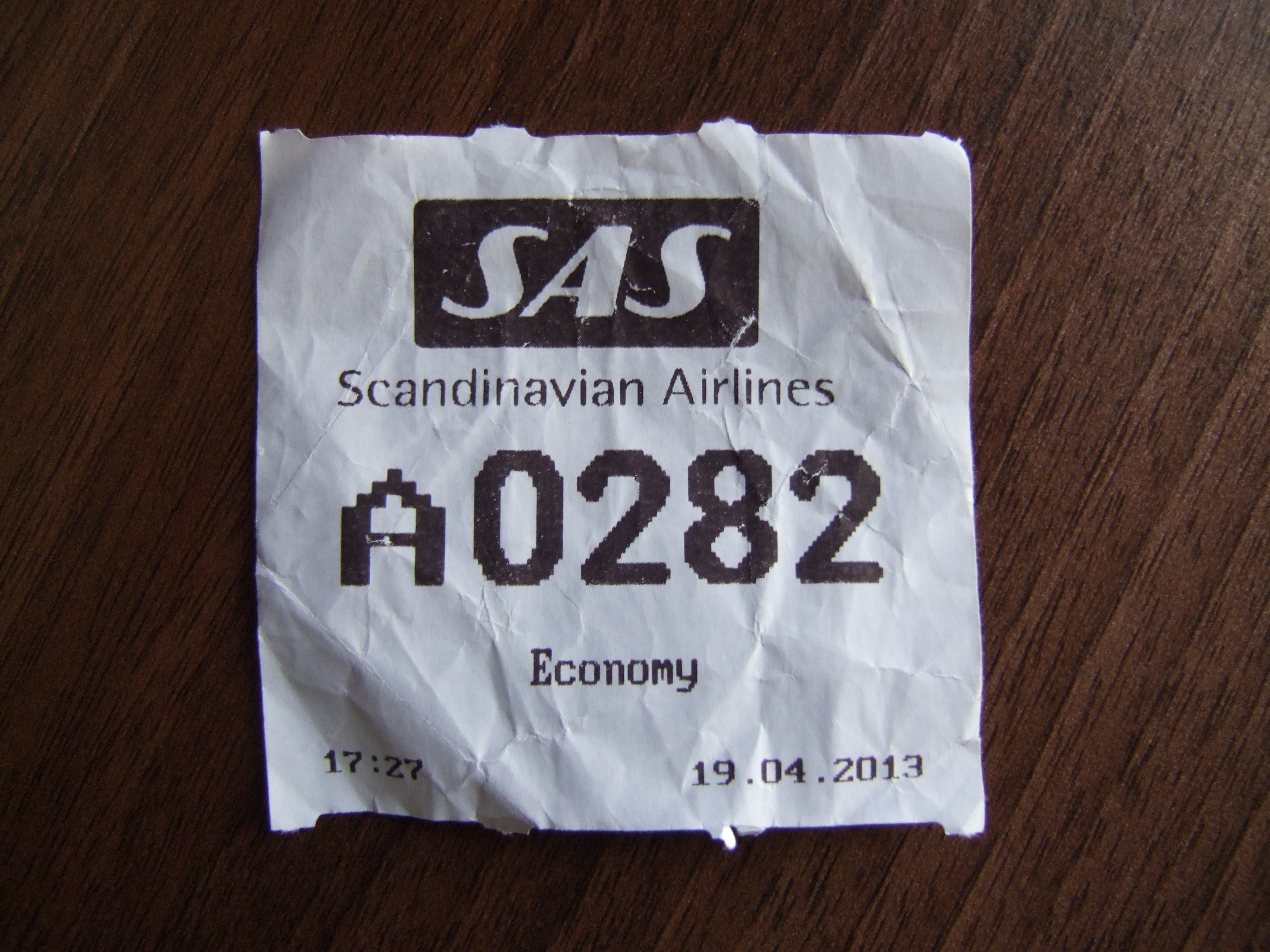
I follow the signs to the transfer center  and then they stop.  Have I arrived?  There is a row of desks but only one person sat at them speaking with a customer.  Nothing tells me it is the transfer center  but I see no more signs telling me where to go.  I realise the chance of getting the Birmingham flight is nil.  But I hold out hope of the Amsterdam option.  The person at the desk finishes with his customer so I approach and ask if it’s the transfer center  he says yes.  I begin to explain my situation but he tells me I have to take a ticket.  Huh?  You take a ticket and when your number comes up I will speak to you.  Oh!  Like the meat counter at Sainsbury’s I guess.  I find a machine which I guess is where you get a ticket, but the first is dead.  The second dispenses a ticket.  It gives me number A182, but he is now dealing with A171.  I quickly estimate, five minutes per person and 11 people in front of me…  I won’t even be able to speak to anyone from SAS until the Amsterdam option is gone.  I ring Carlson again, and speak to the woman I spoke to before.  She helpfully tries to look for other options.  As I watch I see the number that the SAS rep is dealing with is now C007.  Huh?  There are not just A series numbers!  Who knows how many people are in front of me?  Things are looking worse!

But I have my meat queue ticket number, so I explore.  I see that there is a SAS to Heathrow leaving in about forty minutes.  Anywhere in UK will do by now! I find someone at the information stand in the airport and she helpfully rings the gate and finds that there are spaces, but the SAS gate rep tells her that I would have to be ‘in the system’ to get on it.  How do I do that?  Yup! You have to go to the transfer center   But she suggests I could try the SAS lady on gate C4.  I ask, but she curtly tells me that no, she’s just waiting for the last passenger at that gate and … you’ve guessed it … I have to go to the transfer centre.

Back at the transfer center  the A series has moved perhaps two numbers.  I ring Carlson again (we are getting quite familiar now) to see if they can get me on the flight somehow, but the system would mean that whilst they could get me a fresh ticket I’d have to check in  somewhere other than the gate (the transfer center ) so there’s not much hope – but it’s worth a try going to the gate.  I go through passport control, only five in the queue now, and arrive at the gate before boarding is complete.  The SAS staff consult each other but decide, no, they can’t let  me on.  They comment that it would not be a good business model for SAS would it.  I suggest that it is not a good business model that I won’t fly SAS again (I’m getting a little irked by now).

So I need the transfer center  I see that there is one this side of passport control – worth a try, but no, it’s temporarily closed ‘we are sorry for the inconvenience, please use the transfer center the other side of passport control’.  Sigh.  But how do I get back?  All the passport control gates facing out are closed!  With another SAS passenger we find someone to ask.  He resorts to banging on the window of the passport officer’s rest room and he comes and lets us out.

It is still some way off my number at the transfer desk, although there are now four people dealing with the backlog.  I discuss again with Carlson and they tell me there is a BA flight to Heathrow or an SAS flight fifteen minutes after that.  They are just looking up the costs when there is a rush on numbers and A182 flashes up on the screen.  ‘Oh, my number’s just come up, hang on a moment’ and I start to walk to the assistant.  Too late!  He’s now moved on to A183, and the passenger was closer than me.  What?  Do they seriously expect me to take another ticket?  No way!

The nice Carlson lady books me on the BA flight, and my wife kindly comes from Rugby to Heathrow to pick me up.  We arrive home at 11.20pm, having left the office in Poland at midday UK time.  So much for saving a few valuable hours at the weekend.  Thank you SAS for taking such care of me, and treating me like a human being, and doing your best to make my journey smooth and comfortable!   Don’t you realise that treating people like a meat queue will not win friends?

I realised that what we need in situations like this is someone to talk to.  Not a machine that issues you a number.  Not a notice on the noticeboard.  I’d have been quite happy if I’d been quickly able to speak to a SAS representative who then arranged an alternative route.  I know things go wrong, flights are delayed.  But to be simply given a ticket in a queue of unknown length before you can even speak to someone, when your flight options are dwindling – that is the worst, that is the frustration, the hopelessness.  I just want a human being to talk to who can help me sort my problem.  Like the Carlson ladies, who were great!

So SAS have lost my custom, and I recommend that you don’t trust them with your travel plans either.

Oh, and I’m writing this at 4.30am because I need to get it out of my head.  Roll on weekend…..

SAS – shocking air services?  scandinavian air scandal?  can you think of any? feel free to add some of your own.

SAS meat queue ticket