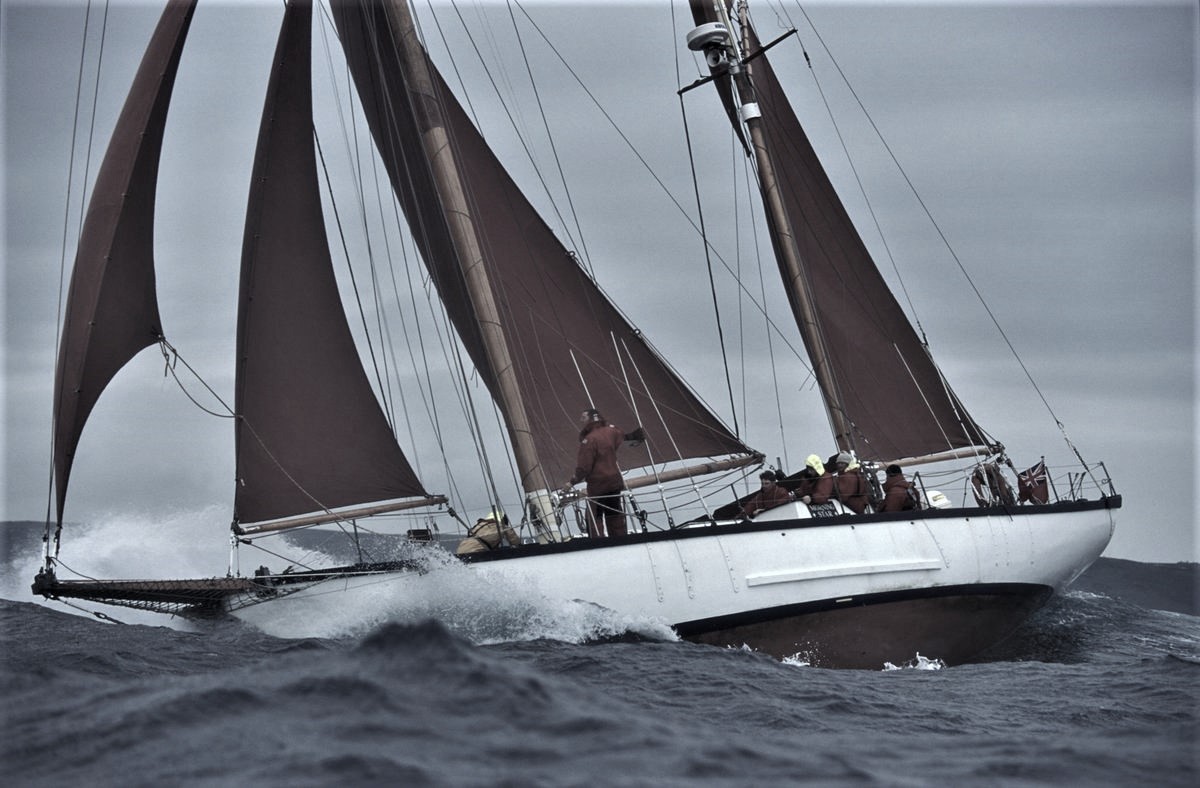
Seeking adventure?

There is an account in the gospels of Jesus sleeping in a boat while a storm rages and seems about to sink it.  The disciples wake Jesus, he calms the storm and then says to his followers “Why are you so afraid? Do you still have no faith?”

Usually we take from this story that Jesus has the power to calm storms, and that we can ask him to calm the storms in our lives.  i.e. call out to Jesus so that we can live placid boring lives. But I think the message is different. 

I was on a sailing boat in storm force winds when a mast fitting broke. We had to get the sail down whilst being tossed in the massive waves, with wind and rain and spray.  It was exciting, we felt alive and ‘present’, …. and yet safe.  Our skipper was completely calm, and so we were confident that we would come to no harm; and we didn’t.  It was a joyful and exhilarating shared experience which we will all remember and which is a bond between us; so much more than flat seas and a gentle breeze.

So I think that instead of offering calm seas in our lives, Jesus is saying ‘I am in your boat, you are perfectly safe.  Go and enjoy the adventure.’ And it is with sadness that he has to calm our storm because we have so little faith.

Do you want adventure?  ‘Safe’ adventure?  Feel free to get in touch…

Supreme power and love indwelling all of space and time, or cheerless physics?

We live in an age of information. I know there is fake news, but there is a vast wealth of knowledge. You can find almost anything you need to know on-line.  Yet just a few decades ago nobody could even conceive of the internet.

It didn’t happen spontaneously. We got here through the hard work and inspiration of highly intelligent designers and visionaries.

Imagine now a vast cloud of molecules in space, the debris perhaps of an exploded star.  Just a collection of atoms and molecules: hydrogen, iron, oxygen, beryllium, carbon, nitrogen, silicone … a little bit of everything perhaps.  But a vast, lifeless, formless cloud drifting in space.

Imagine that there are no influences acting on the cloud of molecules apart from the forces of physics; gravity, weak and strong nuclear interaction, and electromagnetic forces.

We can imagine that those inanimate forces are sufficient to cause the molecule cloud to collapse into a star and some planets.  Over billions of years, gravity slowly pulls the gases together to form a solar system.

But can we imagine that those basic forces are sufficient to organise the lifeless cloud into a butterfly,  a magnolia tree or a human being?

Can we imagine that those basic forces are sufficient to organise the matter that they act on into the internet?  That the molecules organise themselves unaided into a smartphone, or the Mona Lisa, or a performance of Beethoven’s seventh symphony?

Take a molecule cloud, leave it completely alone for ten billion years, come back and you will find fitbits, contraceptive pills and life-forms intent on destroying themselves and each other.

Just through the laws of physics?

Intelligence creating itself, life with all its complexity spontaneously initiating and evolving.

Just through the laws of physics?

Love,  joy,  purpose existing without any material form that you can touch or measure.  Great stories and legends; “The Lord of the Rings” expressed in a myriad of forms…

All of these, with the only ingredients of a molecule cloud and the laws of physics.  Really?

Or is there something more? 

Something which indwells all of space and time, sustaining matter and the forces that act on it, imbuing form on the formless,  bestowing intelligence and ‘self’ on lifeforms, giving purpose to material and non-material reality.  Intelligence that gives intelligence.  Life that gives life? An eternal ‘something’, or ‘someone’ without cause but within everything?

If I put my pride aside, it seems to me that the universe, life, and love point to there being a supreme and eternal, creating, sustaining and loving God.

Not cheerless physics.

Image by David Mark from Pixabay

How do I live a good life?

Nobody wakes up in the morning and thinks, “I’m going to hurt as many people and do as much damage as I can”, unless they are mentally deranged.  Usually we don’t even think about how we are going to live our day, but if we did we’d think something like “I’m going to try to be nice to people, to do my job well, to keep the environment safe”. 

Yet if we look back at the end of a day we are more than likely to think “I wasn’t very nice to X, I did that bit of work badly, I didn’t need to drive so fast”.   And most like as not, we would then justify our actions in our head to make us feel better, “He caught me at a bad moment,  I was late for lunch and wasn’t given time to do a good job,  that idiot in front of me was dawdling and I needed to get home.”  But we have let ourselves down.  We have not been the person we want to be, or could be.  And when we find ourselves doing the same thing every day we avoid thinking about it, and are likely to get angry if someone points it out to use.

There is a better way.  There is a way to be the people we want to be.  And it starts with understanding what’s going on.  An ancient letter written by Saul of Tarsus helps to enlighten us: 

Within us we have two ‘natures’.  We have our ‘sinful nature’ and we have our ‘spirit’.

Out sinful nature is that part of us which clamours ‘me, me, me’ all the time.  Its roots are in the animal instinct that successfully evolved us to survive when everything else was out to eat us, and where if we didn’t grab something for ourselves then something else would.  It is the instinct which leads a lion to defend its territory, the instinct which leads a gerbil to eat its young if there is not enough food, the instinct that leads the black widow spider to eat its mate.  It is the instinct that leads us to crave riches, to accumulate wealth beyond what we can ever use.  It is the instinct which says that the human beings in my tribe are more important than the human beings in yours.

And then there is our spirit.  Our spirit is revolted by the idea of eating our young; we know that we should not eat our babies.  It is our spirit which leads us to help and to make sacrifices for those who are suffering:  looking out for those shielding in the Covid crisis, giving to food banks, marching in Black Lives Matter rallies, campaigning to save the environment.  Our spirit calls us to love, and to goodness.

The ancient letter describes the consequences of following each ‘nature’.  Obeying the spirit leads to life and peace.  But giving in to our sinful nature leads to death; death of love, death of peace, death of goodness.  We become filled with anger, guilt, bitterness, self-pity, depression and despair.

We are slaves to whatever we choose to obey. But many are not willing to make that choice.  We flip flop between doing what we know is right and good, and giving in to our selfish ‘lusts’.  And we live in a constant state of dissatisfaction and guilt.  We strive for more wealth, but it doesn’t satisfy.  And at the same time we wish that injustice would go away; “how can we have food-banks in our country?”

Even if we were to say ‘I choose to obey the spirit, to love and to be good’ we would still find ourselves failing.  And at the end of the day we would be full of guilt and shame, and like as not we would give up.  “The spirit is willing but the flesh is weak”. We need help. 

And there is help available, and hope.  If we have made that decision to obey the spirit, and we do sinful or selfish things then the ancient letter tells us that it is not us that does them, but the sinful nature within us.  It is just that our spirit is not strong enough.  We need to strengthen our spirit, to resist the temptations to give up.  And we can do that. 

The spirit within us is a bit like a battery, it has power but only a limited amount.  We need to plug into the mains.  We need to connect our spirit battery to the mains supply of the spirit that is called the Holy Spirit; an inexhaustible supply of love and goodness – God.   Then the power of sin can be broken.  And how do we connect?  We ask.  We speak with God; we pray.

And we also need to reinforce our decision by focusing on what is good, by giving honour and praise to goodness and love – resisting out sinful nature telling us not to be a ‘goody-goody’.  We remind ourselves of the importance and value of self-sacrificial love.  In a word, we need to worship love and goodness.

We may still do sinful things, but we can plug back in to the mains, pick ourselves up and start again.  We do that by ‘repenting’; an old fashioned word that means wishing that we hadn’t done it and committing to try again. Part of repenting is accepting and confessing that we’ve sinned.  Then we receive forgiveness for what we did wrong and be re-energised to follow the spirit again.  We know that we receive forgiveness because Jesus – God – said that we are to forgive, and so we know that he will forgive us.  And if we are particularly stubborn about accepting that love and goodness (God) would forgive us, then we look at Jesus’s crucifixion; he gave himself as the ritual sacrifice that the Jewish people believed carried off their sins.  And we look at his resurrection – showing that those sins had been dealt with.

When we deliberately choose to obey the spirit, it is empowering.  We do things that please the spirit, and it makes us feel alive.  It brings us peace.  We take joy in the good that we do, and we are able to actively love others.

Think of people you know.  Can you recognise any who are obeying and following the spirit?  It is written that “By their fruit they will be known”.   Fruit that you might look out for are: love, joy, peace, patience, kindness, goodness, faithfulness, gentleness, and self-control.

Wouldn’t we all like to be like that? 

We can be!

Excerpt from The Big Picture: “Am I Open Minded?”

As we start out ask yourself the question, “Am I open minded, ready to follow where evidence leads, with no preconceptions?”

Now I’m sure you’ve answered “yes” because none of us would like to admit otherwise, but actually, it may be impossible to start any investigation without preconceptions.   They are the motivation behind many investigations … the desire to obtain proof of what we already think about something.

Preconceptions are almost inherent in the scientific approach – we think of a theory, and then we investigate to test it.  If we are honest, we will admit that we like our theories and feel good when they are proved right.

Perhaps there is one preconception that I will allow at this stage; that each one of us matters. I matter. You matter.  Our friends and neighbours all matter.  If we don’t matter then there is no point in anything and it’s best not to think any deeper.  That road leads to despair.

If we are going to explore these questions fully we are going to have to consider questions of God, science, reason, history and more.  We are going to have to include objective data and subjective experience; objectivity keeps us from being deluded but it is the subjective that really matters to us.

Even if we try to think about an issue with an open mind, we nevertheless carry many assumptions that we don’t realise.  Speaking personally, my scientific education and engineering career have both instilled a basic assumption of materialism: the fabric of the universe is all there is.  When people talk about a spiritual dimension, is it just another material dimension that we can’t see?  And if there is a spiritual dimension, how can it interact with the physical universe?  Or if there isn’t a separate spiritual dimension then where does God exist?  These are not straightforward questions, but I’ve come to realise that they are valid.   I have had to challenge a lot of what I took simply as common sense and to open my mind to new possibilities.

It can be difficult to refresh our way of thinking, particularly if we are surrounded by others who have a similar outlook to ourselves.  In a recent discussion on European history with a university student he mentioned that such and such country was fascist.  It led me to ask what it is that makes the people there fascist.  Is it genetically programmed into each individual there?  If you took any one of them and brought them up elsewhere would they be fascist?  I think it likely that they wouldn’t.  They are fascist because everyone around them is fascist.  They are unconsciously trained to be fascists.

So what are we doing in our country?  What are we training ourselves to think like?  What assumptions do we hold, and are they valid?  Books such as The Science Delusion by Rupert Sheldrake[i] challenge many of the assumptions of the day.  He asks us to challenge our scientific dogmas, our blind assumptions.  Even if we end up thinking the same as we did before, we have a more solid basis for our beliefs if we go through the process of challenging our assumptions.

Implications

Whenever anyone is presenting a case we might ask ourselves, “If I were to accept what is being presented and agree with the author, what would be the implications for me?  How willing would I be to accept those implications?  Do I need to understand the implications before I start?”

Many parents choose not to have their babies tested for Down’s syndrome because they would not be willing to accept a termination of the pregnancy and so feel that there is no point in knowing before the child is born.  Others might need to understand all the implications before deciding; how accurate is the test, and what are the options available if the child tests positive? Still others might insist that they must have the test because they are not prepared to risk having a child with Down’s syndrome and would terminate the pregnancy if that were shown to be likely by the test.

This is a book that deals with questions of God.  This may worry some people. If they were to be convinced that God is real they would have to become the sort of bigoted judgemental fanatic that represents the worst face of religion.  They may think that they would need to join a religion and accept all that they are told without thinking, and be associated with all the religious atrocities of the past. Or that they will have to give up their Sunday morning lie-in and trot off to church with a bunch of hypocrites. If these thoughts resonate with you, take courage – it doesn’t have to be like that.

Fear

People can be frightened by the prospect of change, but often change is beneficial.  For instance, when redundancies are announced, there is a lot of fear in the workforce.  Some may have been in the same job for thirty years, and they simply don’t know anything else – how will they cope if they have to find another job?  And yet being forced to change jobs can be a most liberating and life-changing experience.  I recall hearing a report that those who remain behind after a round of redundancies are likely to be more stressed than those who have been made redundant.  They are still in the same job, but with increased fear of losing it and still in fear of change, whereas those who have left are now busy rebuilding their new lives and careers.  That’s not to say it’s easy to change, but a change in a job or a worldview can be very liberating.

Peer Pressure

Perhaps we don’t want to change our views because of what others might think of us.  We’ve probably aired our opinions sufficiently to our friends that any major change would be an embarrassment.   Or perhaps we live or work in a culture where there is only one accepted way of thinking.  We might find that we have to live a double life, adopting one attitude at work and another in private.  For instance, to progress a career as a scientist it is necessary to publish papers and learned articles.  Such articles are subject to peer review.  This process is in place to ensure that sound scientific information is published and that mistakes do not get propagated.  But the process inherently risks that only those papers that conform to the present scientific way of thinking are published.  If a scientist becomes too free thinking, then the peer review process may prevent his papers being published and his career may come to a grinding halt.  Reputation is essential, and doing anything that might lose it is risky.

An ambitious scientist may be fearful of embracing religion.  Religion allows that God might interfere with the workings of the world.  That might mean that the universe is not completely predictable, which would seem to undermine the basis of all the work of science.  Allowing the existence of God might mean that it will be impossible to have a complete scientific theory that predicts everything – which is challenging to anyone who invests their life in seeking it.

Similarly, in religious circles it can be damaging not only to one’s career but also to one’s life to challenge the current way of thinking.  Men and women have been labelled heretics and have been burnt at the stake for holding different religious beliefs.

Religious people may have a deep fear of science.  Apart from the vocal assertions made by some atheists that science has done away with God, there can be fear that science might undermine or even disprove certain traditions or beliefs that the given religion may hold dear, or even sacred.  A religious man may have invested so much in his religion that he’s lost the desire, and maybe even the ability, to be open to learning that some of what he’s been taught is incorrect.  Yet surely a truly godly man would be desperate to be corrected if he were misunderstanding God?  In her book Awesome God, Sara Maitland encourages religious people to embrace what can be learned from science:

Start with “God exists” and everything we can learn will tell us more about God.[ii]

So returning to the question, “Am I open minded, ready to follow where evidence leads, with no preconceptions?” we can see that it is almost impossible not to have preconceptions or preconditions.  A first step in challenging them is to consider how we came to believe them in the first place. How did we come to really know what we know?

[i] Rupert Sheldrake: The Science Delusion ISBN 978-1444727944

[ii] Sara Maitland: Awesome God: Creation, Commitment and Joy ISBN: 978-0281054190
Making decisions as a community

Often we have to make decisions as a community; a family, a nation, a team.  How do we go about it?  Usually we will simply ask “what do you think we should do?”  And then we will argue against the other person’s proposal.   When the decision is finally made there is conflict and resentment from those who suggested doing something else.  The results of this approach can be extremely damaging.

For instance, the government ask “do you want to leave the EU?”  Half of us say yes and half of us say no, and so half of us are very upset that we have not been listened to.  The nation is split in two.

Or a local authority will make a proposal to close Children’s Centres and then ask people’s opinion on the proposal, calling it a consultation.  But it is simply a consultation on whether you like the proposal or not.  The consultation doesn’t lead to a better solution, but just to anger from those who will be harmed by the proposal.

The steps we go through, probably unconsciously, when we decide something for ourselves can be summarised as:

  1. What is a the problem
  2. What are the alternative solutions
  3. What are the advantages and disadvantages of each
  4. What do we want to do

But when we try to make decisions as a community our normal approach is:

  1. What do you want to do?
  2. I don’t want to do that, but this.

We end up arguing, simply because trying to decide something without even knowing what problem we are trying to solve.

In both of the examples above, the process could have been different.

For example, the question could have been “What factors are important in deciding whether to remain in the EU, and how important do you think each factor is?”

With the results of this consultation, the government could have framed a proposal for how to deal with the different issues, explained the proposal and the reasoning used to get to it, and then (if necessary) asked for agreement to proceed.  In essence this is requiring the government to carry out ‘completed staff work’ (http://govleaders.org/completed-staff-work.htm) before submitting a proposal for approval.  If they have done their work well, the conclusion would simply need our approval.

Try this approach in your community.  Let me know if it helps.

How to really make Britain great again.

The headline tells us “Brexit to send UK tumbling down world economic league table…”.  and we ask “Is this making Britain great again?”

But the headline, indeed the whole question of where Britain ranks in the world economy has absolutely NOTHING to do with whether Britain is great.  What matters is whether Britain is becoming more human.

Being human has nothing to do with the economy or wealth, but everything to do with values. It is about valuing everybody equally, irrespective of colour, class, wealth or religion. It is about selfless behaviour for the good of others. It is about acting with integrity and speaking truth. It is about doing what is right, irrespective of the consequences.

Britain will become great when those who are well off are willing to contribute enough to ensure the wellbeing of those who are not well off,  when we are willing to give up our own comforts for those who have nothing,  when we are willing to give sanctuary to those fleeing war dispite the risk of personal harm.

Britain will become great when we stop expecting a political system that gives everyone all the rights that they demand, but encourages us all to self-centredness. We cannot demand perfection from public services that we are not prepared to fund. We need to stop demanding perfect treatment from others, when we cannot give it ourselves.  We need to stop demanding that teachers work until midnight to keep up.  We need to stop expecting to be treated in A&E within minutes when we have drunkenly staggered into a lamppost.  We need to stop abandoning our personal responsibility for our own circumstances.

Britain will become great only when we choose to love one another; when we learn to contribute what we can, and to keep our expectations of others reasonable.  That is my hope for 2017.  Make it yours.

“Back in the day …” But why not now?

There was a time when it was wrong to tell a lie.

There was a time when we were taught that “if you can’t say something nice, don’t say anything at all.”

There was a time when we were taught that it was good to share.

There was a time when we were taught to “do as you would be done by”; to treat others as you would like them to treat you.  That every person was our neighbour, irrespective of where they came from, or which ‘tribe’ they belonged to.

All of these were accepted fundamental truths: words of Christ which spoke to our conscience and were proved correct by our experience.

Look at the papers, with the lies and attitudes of politicians in the US election and the Brexit campaign, the inequality, the refugee situation, the callous treatment of the poor, and we can see that we do not live in such a time.

I miss when human beings cared about each other, when decency was valued and we respected each other.  I want to see our nation, our world return to those values.

Do you?

Let it start with you and me.  Let’s vote knowingly, and act selflessly to change society back to what it should be.

A morning prayer for the wealthy

Dear Lord,

Father, Son and Holy Spirit,

Thank you for bringing me safely through another night and for the promise of a new day.
Thank you for blessing me with health, wealth and good friends, and thank you for my family.

Thank you for the blessings that I can bring to others. Forgive me please for the times when I have not acted as you would wish, and please strengthen and encourage me to carry out your will in the future. Guide my steps to places and people who I can bless, and form in my heart the desire and will to be that blessing. Let me feel joy at the good that I have been able to do in your name.

It is hard to be joyful when there is evil confronting us each day, sustained by misguided beliefs and the cold hard hearts of so many.

Yet all good things come from you and are part of you, so please help me to know you, love you and enjoy your presence. Please lift my spirit to worship and praise you, and to appreciate your gifts to me. Please be present with me every moment of the day and night, filling me with your goodness and keeping me from harm. Please protect those who I love, and heal those who are suffering in body, mind and spirit.

In this cruel and selfish world, I ask that you work in all people to draw us to love you with all our heart, mind, soul and strength, and to love our neighbour as ourselves.

Please correct the growing culture of inequality where we, your children, believe others to be less important and valuable than we are. Help us to see each human being as our brother or sister, parent or child, and to love them as such.

Father, let your spirit drench this land as the wind and rain of winter. Convince the people in this nation of your existence, bring us to see our sin, and to repentance and forgiveness. Draw us close to you.

And please mould your church to feed us with the bread of life and to help us praise you as you deserve. Please remove the barriers that we put in the way of people who would follow you, forgive our mistakes and guide our actions to properly serve you and those we live among.

I ask all this in Jesus’ name, for I believe and trust that this is your will.

Amen

Two shirts at Christmas?

Friends on Facebook know that I often share posts highlighting injustice.  And I have written blog posts prompted by claims that ‘austerity’  is working.  But in the face of injustice, with a government that shows no sign of compassion, and with years to the next general election, doesn’t this just breed despair and helplessness: “It’s too big a problem, and what can a single human being do to change things?” So why do I speak out about injustice?

  • To grumble and whinge?  No
  • To cry out for change? Yes
  • To educate that it is indeed injustice? Yes
  • To encourage readers to ask “what can I do?” Definitely.

Many years ago a wise man said “If you have two shirts, give one to the poor. If you have food, share it with those who are hungry.”   He was speaking in a time of great injustice, under a government that brooked no dissent.  There was no changing the system, but he was calling every person to make a difference.  He was challenging the culture of the day.  That is what I hope to achieve.

I choose not to follow the culture of self-interest and greed endemic today, where we are expected to make all decisions on the basis of maximising our personal income. I try to make life decisions on what is good and right, and that includes recognising that I have “two shirts”.  I long for the wealthy to recognise the same.

But where does the strength come from to be counter-culture?  It does not come from the media, or from political leadership.  It comes from the one that the wise man served.

Do you want to make a difference?  Then begin.  Choose goodness.  Choose love.  Transfer your allegiance from the culture of selfishness to the one who is supreme goodness; the one whose birthday the world is celebrating.

Have a great Christmas!

two shirts

“Christianity – Why Bother?” … out now

Belief in God is claimed to be on the decline, and many cannot see a reason to question whether God might exist. What would be the point? Why make the effort? That is why “Christianity, Why Bother?” deserves a read. It answers the question that its title asks.

The book discusses some of the misconceptions of Christianity, and then moves on to examine the basis for belief and explains some of the practical and day-to-day benefits of being a Christian. The author shares some of his experiences since he became a Christian at the age of forty. The aim is simply to address the question, “why bother?”

Christianity why bother cover

Click here to buy on Amazon.