Great Britain? I hope so.

Eighty years ago this nation was at a crisis.  Politicians of the day worked together for the good of Britain and Europe.  The monarch was respected and brought hope to the people suffering – visiting Coventry after the horrific bombings, addressing our nation and urging us to pull together to fight against fascist powers that were oppressing the poor, the weak and the scapegoat Jews.  It was a time where national values and pride meant doing the right thing for our neighbours.

Fast forward to today.  We have in power an unelected leader who is treating our Queen with contempt, as a tool to be used as he sees fit.  We see those in high office treat our honourable institution of parliament with utter disrespect – lounging on the front benches. New scapegoats are created.  Our traditions are trampled.  Unelected oligarchs and manipulators hold powerful positions.  The similarities with the fascist regimes that “Great” Britain united to defeat are startling.

We will have a general election soon.  It will be a test.  Has our nation abandoned the values that we once held dear, and for which men and women gave their lives in our finest hour?  Or will truth and goodness prevail?  This will not be an election about Brexit, but it will be a test of what we are as a nation.  It will be a test of our values.  I hope and pray that we will choose truth, justice and honour.

Jesus teaching on workers pay

Jesus taught about the kingdom of God. In one example a wealthy man ensured that the workers all received enough pay for their needs, although it cost him more than it needed to. He knew that he would still have sufficient for himself.

If you are wealthy then this might be a good example to follow.

And if you are a worker, take heed too: if you are lucky enough to have a job, your needs are no different from the one who doesn’t.

The story is recorded in Matthew 20:

“For the Kingdom of Heaven is like the landowner who went out early one morning to hire workers for his vineyard. He agreed to pay the normal daily wage and sent them out to work.

“At nine o’clock in the morning he was passing through the marketplace and saw some people standing around doing nothing. So he hired them, telling them he would pay them whatever was right at the end of the day. So they went to work in the vineyard. At noon and again at three o’clock he did the same thing.

“At five o’clock that afternoon he was in town again and saw some more people standing around. He asked them, ‘Why haven’t you been working today?’

“They replied, ‘Because no one hired us.’

“The landowner told them, ‘Then go out and join the others in my vineyard.’

“That evening he told the foreman to call the workers in and pay them, beginning with the last workers first. When those hired at five o’clock were paid, each received a full day’s wage. 10 When those hired first came to get their pay, they assumed they would receive more. But they, too, were paid a day’s wage. 11 When they received their pay, they protested to the owner, 12 ‘Those people worked only one hour, and yet you’ve paid them just as much as you paid us who worked all day in the scorching heat.’

13 “He answered one of them, ‘Friend, I haven’t been unfair! Didn’t you agree to work all day for the usual wage? 14 Take your money and go. I wanted to pay this last worker the same as you. 15 Is it against the law for me to do what I want with my money? Should you be jealous because I am kind to others?’

16 “So those who are last now will be first then, and those who are first will be last.”

The trampled poppy

It is 14th November 2018, just three days after the Remembrance Sunday where we promise not to forget the loss of lives in the 1914-18 and other wars.

I am woken by Radio 3:

“The headlines today …

  • Half of the nation of Yemen is on the verge of starvation due to war.
  • Melania Trump is upset at where she sat on an aircraft.

And now some Mozart.”

Unusually I have noticed the incongruity and am prompted to draw attention to it in a blog post.  Normally, like you, I would just get on with my day, not sparing another thought to the fact that half of a nation is on the verge of starvation.

It seems that the poppies have already been trampled in the dirt.

How can any of us claim to be without sin?  Isn’t the correct response to our  hard-heartedness that we humbly admit that we are grossly selfish and undeserving?

Yet despite this, we are still given the opportunity to live purposeful lives.  We believe there is some purpose in life, and in death; we have just remembered millions of deaths.  And if there is eternal life we want part of it.

On that day when we die and are asked whether we have led a good enough life to deserve heaven, none of us can say yes. None of us.  Yet heaven will be full.  It will be full because of the person who we celebrate on another day of remembrance – Christmas Day.

Jesus Christ, son of God, crucified.  A single act in history which allows anyone who in their hearts wishes for it to repent and receive forgiveness.  Our active and passive selfish, greedy, hard-hearted and unloving actions deserve death, but we are allowed eternal life because of that one great sacrifice made on our behalf.  It is our choice – death, or humble acceptance of the sacrifice that Jesus made on the cross and life. To trample the cross, or to embrace it.

Making decisions as a community

Often we have to make decisions as a community; a family, a nation, a team.  How do we go about it?  Usually we will simply ask “what do you think we should do?”  And then we will argue against the other person’s proposal.   When the decision is finally made there is conflict and resentment from those who suggested doing something else.  The results of this approach can be extremely damaging.

For instance, the government ask “do you want to leave the EU?”  Half of us say yes and half of us say no, and so half of us are very upset that we have not been listened to.  The nation is split in two.

Or a local authority will make a proposal to close Children’s Centres and then ask people’s opinion on the proposal, calling it a consultation.  But it is simply a consultation on whether you like the proposal or not.  The consultation doesn’t lead to a better solution, but just to anger from those who will be harmed by the proposal.

The steps we go through, probably unconsciously, when we decide something for ourselves can be summarised as:

  1. What is a the problem
  2. What are the alternative solutions
  3. What are the advantages and disadvantages of each
  4. What do we want to do

But when we try to make decisions as a community our normal approach is:

  1. What do you want to do?
  2. I don’t want to do that, but this.

We end up arguing, simply because trying to decide something without even knowing what problem we are trying to solve.

In both of the examples above, the process could have been different.

For example, the question could have been “What factors are important in deciding whether to remain in the EU, and how important do you think each factor is?”

With the results of this consultation, the government could have framed a proposal for how to deal with the different issues, explained the proposal and the reasoning used to get to it, and then (if necessary) asked for agreement to proceed.  In essence this is requiring the government to carry out ‘completed staff work’ (http://govleaders.org/completed-staff-work.htm) before submitting a proposal for approval.  If they have done their work well, the conclusion would simply need our approval.

Try this approach in your community.  Let me know if it helps.

The truth behind the Tory propaganda

I am not a politician.  I don’t know how to manipulate people to vote for me.  But I do know injustice when I see it, and I do know lies and deceit when I see it, and I have learnt to recognise logical fallacies when I read or hear them.  The Conservative government have taught me well.  Local election results show that the population has unfortunately not learnt the same lesson.

There is massive injustice in our nation.

Look at the distribution of income (latest available figures)

What personal virtue led to the highest earners being paid ten or a hundred times more than those at the bottom?  It was all accident.  Accident of birth that gave them the attributes to succeed in business, or accident of birth that gave them the education and contacts that they needed.  But are they a hundred times more valuable people than the lower paid?  And as by accident they have more income, is it not right that they should give more money to the community? Yet the Conservative government wants them to pay less.  The Conservative government wants their wealth to increase, and wants to put control of our lives in their hands.

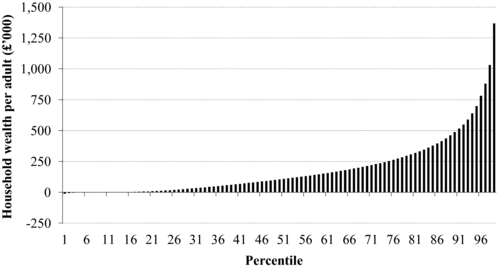
And look at the distribution of wealth.

What personal virtue led to the inheritance of wealth or debt? None, it was all accident of birth.  Without wealth you cannot buy your own home without having to borrow.  You cannot start a business without having borrow.  You cannot have a university education without having to borrow.  And when you borrow without wealth you have to pay high rates of interest.

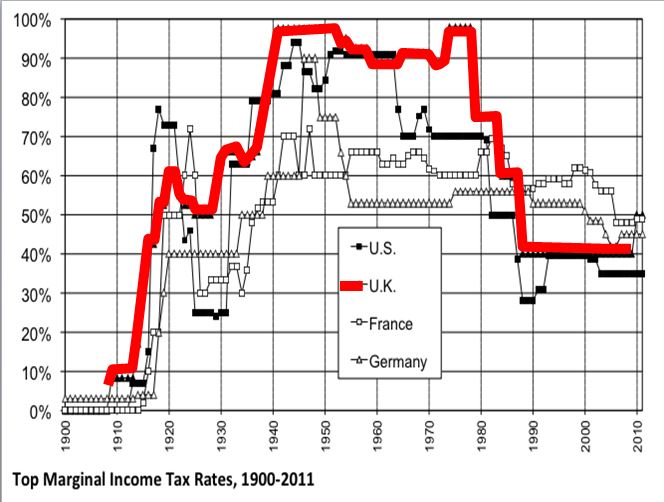
And look at the direction of taxes.

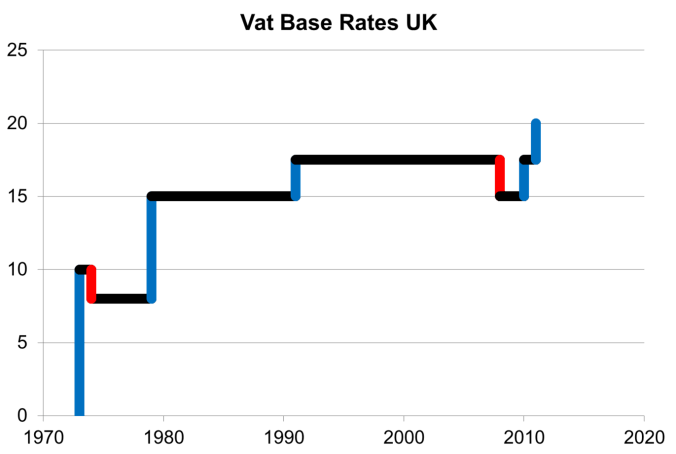
VAT rate changes


The Conservative governments have reduced tax on the highest earners, they have reduced inheritance tax on the wealthiest, they have increased VAT – tax that is paid by everyone – poor and rich alike.

Conservative values are to tax the poor and to increase the wealth of the wealthy.  And yet they manage to manipulate the press and the people to avoid these truths and focus on jingoistic slogans and false national pride.  Oh yes, they are very good politicians – but I have learnt to see though their smokescreen.  I have looked at the data instead of the rhetoric.  I have seen the unnecessary suffering that the Conservatives have caused.  And so I will vote for the party with compassionate and just policies.  Will you join me?

Why we need more council houses

The chart below shows the income distribution in the UK (latest figures available from government statistics) and the corresponding amount that you can borrow if you have a 10% deposit (using the Halifax building society mortgage calculator).

Two thirds of the working population would be earning too little to buy a house for £150,000 by themselves. If you do not have the ‘bank of Mum and Dad’ then you have no chance.

Your only option is to rent, from the private sector, at a cost that is higher than your mortgage repayments would be if you were able to get a loan.

That is why we NEED more council houses.

That is why I’m voting for a Labour government. (see Pledge 2)

How can Theresa May call herself a Christian?

“If someone had enough money to live well and sees a brother in need but shows no compassion – how can God’s love be in that person?” 1 John 3:17

The Conservative party have overseen the rise in homelessness and food bank usage, hardship caused by severe sanctioning of benefits, zero hour contracts, deep cuts in public services.  Yet Mrs May has called herself a Christian.  I don’t understand how.  Jesus said “If you love me, obey my commandments” John 14:15 yet I see no sign of that.

Jesus calls us to love our neighbour, not to exploit them.  He noted that the widows offering of a few small coins was worth far more than the trumpeted gifts of the wealthy.  She gave all she had to live on.

Unfortunately the Conservative government have demanded all from the poorest in society.  There have been plenty of opportunities for a change of heart – now it is time for a change of government.

How to approach the General Election campaign.

“Stop telling lies. Let us tell our neighbours the truth for we are all part of the same body.”

“Get rid of all bitterness, rage, anger, harsh words and slander, as well as all types of evil behaviour. Instead, be kind to each other, tenderhearted, forgiving one another, just as God through Christ has forgiven you”

“Live a life filled with love”

“You can be sure that no immoral, impure or greedy person will inherit the Kingdom of Christ and of God.  For a greedy person is an idolater, worshiping the things of this world.  Don’t be fooled by those who try to excuse their sins, for the anger of God will fall on all those who disobey him.  Don’t participate in the things these people do.  Take no part in the worthless deeds of evil and darkness; instead, expose them.”

In the run-up to this latest election, here are instructions from St Paul on how to behave.  They are as valid today as when they were written, and I long for politicians and those in the media to listen to them.  Let’s encourage them to behave like this when we can.

But they are also a challenge for each one of us.  I find myself getting angry and bitter at what I hear from the campaigns, and I can let it control my responses.  Look at most of discussion threads and you will see the same.  But it does not help to use harsh words or slander; let’s try to put our arguments graciously.

And finally there is the message of justice: “no immoral, impure or greedy person will inherit the Kingdom of Christ and of God” and “the anger of God will fall on all those who disobey him”.  We don’t know how – it may be simply that they become bitter and unhappy individuals, or it may be something more painful.  But if we know that justice will be done then it helps us restrain our own feelings of anger, and perhaps be moved to compassion and mercy instead.

Please share this message to try to make the next few weeks more bearable for us all.

(Quotes are from the book of Ephesians)

God is fair, the economy isn’t, we can do our bit.

Mankind has established a system that breeds injustice. Wealth sucks money from the poor. Those with money enjoy luxury whilst those without struggle to survive.

God is not like that. He is just and fair. The Apostle Peter writes, “This faith was given to you because of the justice and fairness of God”. Faith is available to all, rich or poor.

God is fair. “He gives his sunlight to both the evil and the good, and he sends rain on the just and the unjust alike.” In God’s kingdom, rich and poor are treated fairly.

God is just. In God’s kingdom rich and poor will receive the justice they deserve.

The poor will receive justice for suffering under the unfair economic system of this world. But the actions of the rich sustain that system.

It is so ingrained in our culture to maximise our income that we forget that the more we gain we gain the more someone else loses. Let’s remember.

Let’s question each financial decision to make sure it will reduce the unfairness of the system:  Does it move money from the poor to the rich, or does it help the poor?

“Looking at the man, Jesus felt genuine love for him. “There is still one thing you haven’t done,” he told him. “Go and sell all your possessions and give the money to the poor, and you will have treasure in heaven. Then come, follow me.” At this the man’s face fell, and he went away sad, for he had many possessions. Jesus looked around and said to his disciples, “How hard it is for the rich to enter the Kingdom of God!”

It is hard to go against the flow, but if we choose to reinforce an unfair monetary system, why should we expect to escape justice?

Inequality between the richest and the poorest is man-made

Inequality between the richest and the poorest is a man-made thing. Men have put it in place. Men defend it. Men can dismantle it.

A young person on a modern-day apprenticeship (learning skills that will make a day-to-day difference in our lives) earns just £3.30 an hour, £6300 a year. The starting salary for a banker (who shuffles money around whilst taking a percentage) is in the range of £35000 a year? Is that just?

Is it good that “the rich are 64% richer than before the recession, while the poor are 57% poorer”?

Where do you sit on the UK income scale?

  • If you earn less than £10000 you are in the bottom 5%
  • If you earn more than £21000 then you are in the top 50%.
  • If you earn more than £35000 (starting salary for a banker) then you are in the top 25%.
  • If you earn more than £68000 you are in the top 5%.

If it is right and just that the top 5% earn over ten times more than the lowest paid, then let’s enjoy our position.

If not, then let’s ask ourselves what we can do to make a difference.

And let’s make a new year’s resolution to start to make that difference.

References:
https://www.gov.uk/national-minimum-wage-rates
http://www.prospects.ac.uk/corporate_investment_banker_salary.htm
http://www.independent.co.uk/news/uk/home-news/britains-divided-decade-the-rich-are-64-richer-than-before-the-recession-while-the-poor-are-57-10097038.html
https://www.gov.uk/government/statistics/percentile-points-from-1-to-99-for-total-income-before-and-after-tax