Direct from the San Francisco Book Review

The Big Picture – An Honest Examination of God, Science and Purpose
By P D Hemsley
eLectio Publishing, $4.99, 266 pages, Format: eBook

A former atheist/agnostic who gave God a chance offers open-minded readers this work which is both ambitious in scope and credible in approach: //The Big Picture: An Honest Examination of God, Science, and Purpose//.  Polarizing subject matter such as God and science, evolution, and intelligent design are revisited with the goal of gently challenging entrenched thinking on both sides.

Hemsley, a Chartered Engineer, “has lived on both sides of the faith fence.” His book is comparable to a technical presentation designed for a general audience. It is highly organized with stated goals, evidence, and the author’s conclusions. Fluid, straightforward writing helps the reader progress through several chapters or conclusions dealing with faith, science, purpose and design, quantum physics, free will, reason, Jesus, and more. Even so, those with less of a scientific bent will need to exercise their concentration skills in the scientific sections.

The strength of this book lies in complexity and compatibility. The chapters “Science Describes an Incredible Universe” and “The Universe Exhibits Design and Purpose” make for fascinating reading, especially the subsection where “challenged by the complexity of the biological machinery” Hemsley explores how a modern-day designer would engineer a human being and how long it would take. Additionally, the author’s version of the Genesis creation account featuring the compatibility of scientific discoveries and God’s design is an interesting interpretation to consider.

No emotional appeals are made to the atheist, agnostic, hardcore creationist, or plain honest seeker for a change in his or her worldview. In the words of the author, a self-described Minimalist Christian: “Whether you agree with my conclusion or not, I hope that many of the myths that currently inhibit so many of us will have been weakened or dispelled. I hope that a step can be taken towards finding purpose and experiencing life in abundance.”

http://citybookreview.com/the-big-picture-an-honest-examination-of-god-science-and-purpose/

Click HERE to buy a copy.

A fresh understanding of Grace

St Paul asked the rhetorical question “Well then, should we keep on sinning so that God can show us more and more of his wonderful grace?”  He then went on to answer with complicated and metaphorical language about being buried with Christ through baptism.  But I read this just after reading a facebook post from someone I care about behaving in a way that frankly won’t bring them happiness, and is simply satisfying their lustful urges. Looking at how I felt puts a new and simpler perspective on the question.

Let’s take it as read that God is love, and that he loves each one of us deeply.  We also need to understand that sin harms us deeply.  It may satisfy an immediate urge, but it harms us.  In the same way that it saddens me to see those I love harming themselves, it must sadden God so much more to see us harming ourselves.  Yet God still loves us, and in the same way that I still care about the person above, he cares about us.  I will not reject that person, and God will not reject us.  But it saddens Him so much that he was prepared to see Jesus tortured and killed on the cross to try to get through to us.

So if St Paul’s language seems confusing, just put yourself in God’s place and imagine how you would feel seeing your beloved son or daughter self-harming.  You would long for them to give up their life of sin, and return to your loving arms.  If they wanted to make a fresh start,  you would do whatever it takes to wipe their slate clean.  And that is just what God has done for us.

That’s why we shouldn’t keep on sinning; it causes God more pain and sadness and it does us no good either.

Simple.

“The Big Picture” – an honest examination of God, science and purpose – OUT NOW

“I recommend this book to all thinking people – we might just change the world.” 

“This book will definitely make you think and then think again. Hemsley did his research for this book, and I received many answers to questions I’ve pondered over the years.”

“it is a welcome relief to come across a book that presents such a broad and balanced overview”

“This book covers an considerable amount of territory in its 253 pages.”

The Big Picture is a much-needed book that allows the reader to consider the big questions of life without feeling bludgeoned to adopt the author’s opinion. The book explains basics of science, philosophy and religion in a straightforward manner.

It will encourage all those who want to live a good and purposeful life and would like a sound basis for doing so. Such readers may find a resonance with the teaching of Jesus and this book will explore whether we can trust what has been recorded in the gospel accounts, and whether the findings of science and a reasoned understanding of the Bible are consistent or contradictory.

Many books in the arena of science and faith are hostile and adversarial. The authors set up straw men of their opponent’s arguments, dismantle them and then preach their own arguments to their disciples. The author of The Big Picture recognises that there are intelligent atheists and intelligent believers, and that a case can always be made for whatever someone wants to believe. The reader is therefore treated with respect

ebook

paperback

Amazon UK

The Big Picture - cover

The Big Picture – an honest examination of God, Science and Purpose

If you have wondered if science, faith and reason are compatible then this is a book for you.

The book explores how everything (including science) is based on faith of some sort.  It explains in understandable terms what science tells us (quantum physics, evolution, DNA, neuroscience etc), and what it can’t tell us, and presents some of the documentary and rational evidence for and basis of Christianity – useful if you want to base your outlook on information instead of propaganda.

The style is a combination of balanced data presentation and respectful discussion; you will not be brow-beaten into having to agree with the author!

Click on the book cover (right) to order your copy.

Goodness – me!

Do you ever stop to think what you would like on your gravestone when you are dead?  It’s a good way of finding out what we really want to be like.  I don’t think any of us would like to see phrases like:

“Always selfish and greedy”

“Never had time for anyone else”

“Vindictive and hateful”

When we see a new baby, at a christening who would want to think that the baby would grow up to be a thief, or to have a string of husbands who she cheated on and deserted, or to be a child molester.

We know deep down that we want to be good.

In the 11th century, Anselm of Canterbury described how being good is possible through ‘goodness’, and how supreme goodness is God.  So that desire to be good is actually us wanting to be like God (supreme goodness), to act like God, to be in his image.

St John’s describes in his gospel that God is love.  So when we love one another, our love is possible through love, which is through God.  We are choosing to act like God, to be part of God.

Each of us has the essence of goodness in us, and the essence of love in us.  God is goodness and God is love, so we all have God within us.  Sometimes we choose to ignore goodness and love, and instead choose to be selfish, vindictive or hateful.  But that is not what we want to be – as we found at the start of this post.

The true Christian religion is about helping us to be what we want to be – good and loving.  It is about connecting with that goodness and love within us; God within us.  It is about learning from Christ what goodness and love looks like, and trying to imitate him.

And if you want to be good and loving, then that means that you want to be like God.  Jesus said that ‘if you have seen me then you have seen God’; Jesus represented supreme goodness and love in human form.  So if you want to be good and loving, since Jesus was supremely good and loving, then you want to be like Jesus, and if you want to be like Jesus you can call yourself a Christian.

Christians pray to help make that connection with goodness and love.  Here’s an example of a Celtic prayer from Lindisfarne:

Help me dear Lord to care too much

To love too freely

To pray unceasingly

To forgive endlessly

To laugh fearlessly

To question

To live

To be who I am

To be where I am

To be what I am

To hope

To believe

To reach out my hand

That’s a good prayer, isn’t it?  It’s about connecting with God within us.  It’s asking God to help us be who we want to be.

Do you want to be the sort of person that the prayer describes?  You can take a step closer by praying that prayer.

Related posts

https://philhemsley.wordpress.com/2012/06/21/an-argument-for-and-definition-of-god/

https://philhemsley.wordpress.com/2012/12/29/the-god-of-science/


Richard Miles – Archaeology: A Secret History

The description of this program on iPlayer is “Archaeologist Richard Miles presents a series charting the history of the breakthroughs and watersheds in our long quest to understand our ancient past. He begins by going back 2,000 years to explore how archaeology began by trying to prove a biblical truth – a quest that soon got archaeologists into dangerous water.”

Unfortunately the tone and style of presentation of the program was similar to the description.  The program frequently asserts that there is conflict between Archaeology and Biblical truth, and implies that Archaeology has proved the Bible to be wrong.  The church is presented as a dogma bound institution that can only consider that everything in the Bible is to be taken literally.  The church’s only contact with scientific methods was to use them to show that the world was created a few thousand years ago.  Isn’t he aware that different parts of the Bible are written in different genre’s?  Would he think that if archaeology could prove that there wasn’t a good Samaritan then that must show that Jesus was lying when he told the parable?  Does he think that Christians really believe that the Genesis account is to be taken literally?  As far back as the early fifth century St Augustine was forthright in his criticism of literal interpretation of Genesis.

The presenter, Dr Miles, frequently implies that archaeologists were ‘in dangerous water’ by thinking – thinking is something that is presumably not allowed by the church.  Doesn’t he know that many of the greatest minds have been and continue to be Christians?  Even the greatest secular scientists realize that questions of God are not trivial.

Dr Miles  appears dismissive of the approach of looking for evidence to support a theory (Empress Helena seeking for evidence of Jesus’ crucifixion) – isn’t he aware that this is precisely the scientific method – build a large Hadron collider to look for a Higgs bosun for instance?  

Dr Miles seems far happier to find something and then simply guess what it might mean.  He appeared disappointed that the speculations of John Frayre (sp?) who ‘instinctively knew’ that the triangular objects had been made by human hand were not immediately adopted.

So for me, the undercurrent of generating a false conflict between God and Archaeology/Science, and the implied rejection of ‘belief’ spoilt what could otherwise have been an interesting and enjoyable program.  I am disappointed that the BBC feel the need to generate some sort of conflict or controversy in so much of their programming.

Related posts:

https://philhemsley.wordpress.com/2012/04/29/things-that-a-minimalist-christian-does-not-have-to-believe-the-genesis-account-of-creation/

https://philhemsley.wordpress.com/2012/06/21/an-argument-for-and-definition-of-god/

https://philhemsley.wordpress.com/2013/03/11/how-far-should-we-trust-scientific-prediction/

God, miracles and the laws of physics.

If something is consistent with the laws of physics, can it be a miracle?  If something behaves inconsistently with the laws of physics, does it prove that there is a God? Does a scientific explanation of an event say anything about the existence or non-existence of God? 

Consider the statement, “The earthquake was caused by the contraction of the crust of the earth”.  The statement in itself clearly says nothing about the existence or non-existence of God.  Yet people have often read meaning into disastrous events, considering them to be ‘acts of God’.

Whilst they may be right, just over 2000 years ago a tower fell on eighteen people and killed them.  At the time an investigation might have concluded that the tower fell due to subsidence of the foundations, or poor workmanship – there might have been a completely explainable ‘natural’ cause.  Yet there were probably a number of people who thought that this was God’s judgement on those eighteen people. The event is referred to in the Bible, and we hear that Jesus spoke to the crowd saying, “those eighteen on whom the tower in Siloam fell and killed them: do you think that they were worse offenders than all the others who lived in Jerusalem?”  Clearly Jesus didn’t consider this event to have been an act of God.

Let’s consider another sequence of events that was also described in the Bible.  Jesus tells one of his followers to:

 “go down to the lake and throw in a line. Open the mouth of the first fish you catch, and you will find a large silver coin. Take it and pay the tax for both of us.” (Ref Matthew 17:27)

Clearly this might be explained by the following ‘natural’ sequence of events:  A merchant on a quayside dropped some coins and one fell into the water.  A fish happened to be attracted to the large shiny silver coin, and tried to eat it (we use such ‘lures’ to catch fish today).  The coin got stuck in the fish’s mouth.  The fish was rather hungry and particularly attracted to the bait on the disciple’s fishing line.  The fish was caught on the disciple’s line and he found the coin.  This explanation is fully consistent with the laws of science and our experience of the sorts of things that happen every day. But that’s not enough to satisfy us.  We can’t believe that it just happened by chance.

So why do we find the event so surprising?  Is it because we know that the particular chain of events is very unlikely?  We know that people drop money. We know that fish are attracted to shiny objects and swallow them. We know that people catch fish. So to catch a fish with a coin in its mouth does not seem so very unlikely.  Each event by itself is possible, although the complete chain of events becomes increasingly unlikely – I don’t personally recall hearing of anyone else who has caught a fish with a coin in its mouth. What makes the story special is that Jesus predicted that the first fish to be caught would have a coin in its mouth, and that he instructed the disciple to do such a strange thing in order to get the coin.  We recognise that there must be a ‘fix’ going on somewhere.

Derren Brown has been filmed tossing coins.  The film shows him tossing ten ‘heads’ in a row.  The probability of that happening by chance is (0.5)10 = 1 in 1024.  When we see something happening that has only a one in a thousand chance we know that there must be some fix, especially when we know the man is a conjurer – and yet we’ve seen it with our own eyes.  The explanation is that he spent days being filmed tossing coins until the unlikely event actually came up.  The difference in the story above is that Jesus only had one shot at getting it right.

Almost every week someone wins the lottery.  The chance of there being a winner of the lottery is extremely high.  Yet if a friend gave you a ticket in advance of the lottery and said “This ticket will win”, and then you did win you would know that the friend had fixed it in some way.  If you knew that your friend was not a crook, but had your best interests in mind it might make you pay somewhat more attention to what he said in future.

The conclusion from all these examples is that it is quite possible for something to be fully consistent with the known behaviour of the matter in the universe and yet still require some explaining.  Is there some sort of ‘fixing’ going on that we don’t know about?

Examples of ‘fixing’ are taken by many to be indication of there being a God; scientific evidence for God. And such examples may not contravene the laws of physics, but just be very unlikely events.  As we look at the discoveries of science there is no point doubting the validity, but (depending on your starting point) some things seem to be incredibly unlikely.  It is worth wondering, is there some sort of ‘fixing’ needed?

furry dice


Related posts:

https://philhemsley.wordpress.com/2012/06/19/can-god-answer-prayer-in-a-universe-that-operates-according-to-the-laws-of-physics/

https://philhemsley.wordpress.com/2012/06/21/an-argument-for-and-definition-of-god/

https://philhemsley.wordpress.com/2012/06/03/evolution/


The God of Science

Neuroscientist Michael Graziano has speculated on the connection between the material and the spirit world.  His book “God Soul Mind Brain” has the stated aim to describe ‘the mechanistic understanding of the spirit world’.  With is background he makes the assumption that ‘mechanism’ is the reality and perception is the illusion.

“we do not perceive the world as it is, the brain constructs a simulated world”

“colour is not actually out there…. The same set of wavelengths may look green to you in a different context or grey or blue”

“We experience the model rather than the reality”

The statements are fascinating reminders of what the brain does: it constructs a simulated world, it provides the stimulus to allow the experience of colours, it somehow appears to create a model in our brains.

However, it is a false assumption that the mechanism is the reality and the perception is the illusion.   Accepting the assumption is like saying that the material pages of a book and the printed ink are the reality, and the story that the book tells or the information that it contains is not the reality.  Whist nobody would disagree that the book is the material and the story is not, which of them is the reality?

In a book, we read the words rather than perceiving the paper and letters and we construct in our imagination a picture and an experience based on the words and story within the book.  In the only scale of importance that matters to a human being, the book is the words, not the paper and ink.  War and Peace is a famous story, the paper that it was written on was just the framework for holding it. The story is eternal although the paper decays. To a human being, the story is the reality.

Consider a work of art; the material is not the masterpiece, it is merely a framework which holds the masterpiece.  The canvas and paint is meaningless, the picture is the meaning.

If we can free ourselves of the dogma of materialism then we can perhaps begin to consider that in the universe created from nothing, where particles are only potentialities until they are observed the reality is the experience, the qualia, the ‘I’, and that the material is just the skeleton for holding the reality.

The material universe is meaningless until it is perceived, the perception of it gives it meaning.

The butterfly nebula is beautiful when it is observed; without observation it is meaningless.

Two bags of chemicals are meaningless, but the intimate relationship between two people who are in love has immense meaning and purpose.

Is this so strange?  When we look at the quantum level of the material, there is no such thing as paper or ink.  There are particles and forces that we cannot understand.  They are outside of our ability to perceive, so we think of them as miniature versions of ping pong balls and sticks.  They are only potentialities until they are observed.  What we consider material reality is not really real, it performs its function only when it is perceived and observed.  So perhaps what we perceive as real day to day, the material world, is similarly non-material. Perhaps the only reality is our perception, our model.

So what of God in this?  Jesus spoke of God living in us and us in him.  Perhaps our material framework that holds us is part of God.  As Anselm wrote, everything is what it is through extreme goodness, through God, so we are what we are through and within God.  We are told that God is love, and that we are made in his image.  Jesus said that ‘if you have seen me, you have seen the father’; I don’t think he was talking about his flesh, but his ‘being’ – his ‘spirit’.  Our framework (our body and brain) is a small part of a material universe that is created and sustained by God.  If that universe is within God, part of God, then we too are ‘in him’, as he is ‘in us’.

And what of laws of physics, of evolution and biology?  We can create mathematical models of inanimate physical objects, and we can observe the behaviour of molecules and cells which seems to be beyond the possibility of simply responding to those physical laws – yet seems to be consistent, predictable, and purposeful. Within the framework where the universe is within and part of God there may be causes other than the laws of physics for the astonishing growth and development of the human being from the single cell; a God whose will ‘knits us together in our mother’s womb’. In the same way that our ‘will’ causes our hands to move, makes our choices, interacts with others, so God’s will can cause our bodies to grow and develop, to form our brain, to manufacture us as the masterpiece we are, our body being the receptacle for our spirit.

It is the non-material that motivates us, the non-material that leads to change, the non-material that makes our world like it is rather than a desolate moonscape.  The non-material is master over matter.  The non-material is the meaning, the meaning is the reality.

Who would disagree that there is a ‘spirit of Christmas’, all of society embracing a season of joy and giving.  People speak of the true spirit of Christmas; we know that there is something that transcends each of us as individuals.  It is part of the sprit that is God.

When we observe a beautiful woodland track, sunlight shining through the leaves to create a dappled light settling on a trickling stream, that beauty is part of the essence that is God.

When we listen to a sublime piece of music that moves us to tears, or an energising rock ballad that lifts our hearts with passion, that is part of God.

When we love someone, our love is part of the supreme love that is God.

When we meet friends in a party, in a community, that spirit of community is part of God’s spirit of community.

If we can appreciate that the greater reality is the spirit, and the material is just the framework then we can see God and the universe in a whole new light.  The universe can be considered the canvas for a cosmic work of art, a magnificent symphony of action and awe.  Life is a molecular dance of astonishing intricacy and beauty.  We are permitted to explore and understand through science.  We are permitted to glimpse the canvas and participate in the dance; characters created by the dance emerging as individual caring, loving, interacting beings partaking of some of the glory that is the story; individual masterpieces beyond the beautiful, whose reality is our character, our choices, our nature, our soul.  Creatures of purpose and with purpose.  Creatures honoured with the possibility of relating to our creator, the master artist, engineer, scientist, musician, teacher, parent, friend, but never are we his equal.

So this is the God of Science:  A God who was there before the universe began.  An un-created, creator God who gave ‘nothing’ the ability to become ‘something’.  A God who sustains, and maybe actually is, the very fabric of the universe. A God who actually is the laws of physics, who benevolently guides providence to bring life out of a set of chemicals.   A God who imbues the chemical dance that is us with the ability to feel, to taste, to see, to experience: love, joy, peace, fulfilment, intellectual challenge, selflessness, forgiveness, anger, hate, disgust, bitterness.  Perhaps even a God who is love, joy, peace, fulfilment…. But a God who allows us to experience both the good and the bad, and who allows us to choose to pursue that which is good, or that which is not.

Add to this the God revealed to us by Jesus Christ and we begin to understand the complete context.
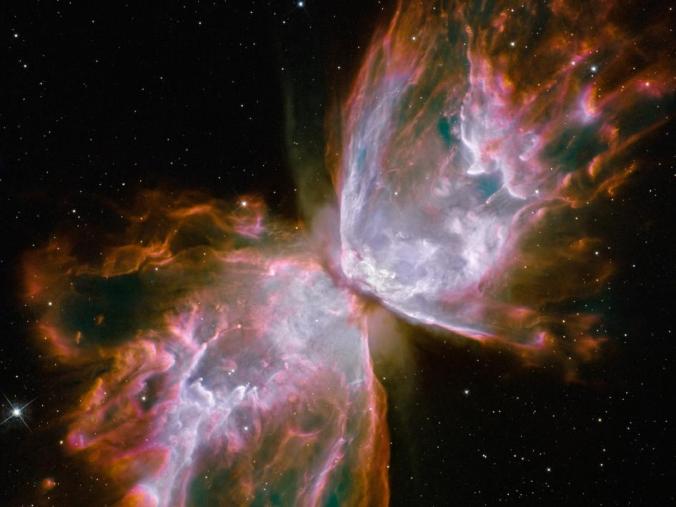
butterfly nebula

Weary?

“Come to me, all you who are weary and burdened, and I will give you rest. Take my yoke upon you and learn from me, for I am gentle and humble in heart, and you will find rest for your souls.  For my yoke is easy and my burden is light” (Matthew 12 v28-39)

Writing ‘devotionals’ you’re supposed to be enthusiastic and inspiring,  to give an uplifting message to start people’s day.  But it’s approaching 10 o’clock and it’s been a long day, and sometimes I just feel weary.  I guess we’ve all been there, we’ve committed to do something, and time is running out but we just are weary.  Maybe it’s homework, a letter to a friend, a report for work, a cake for the cake stall – and we plod on wearily trying to finish it as quickly as we can.

What does Jesus tell us to do?  Come to him.  Take his yoke and learn from him.  But what should we learn?  His yoke is easy and his burden is light.  What does that mean?  If I am struggling then it is not his yoke.  If I rush and get stressed it is not his yoke. If I express irritation at my family for distracting me, that’s not his yoke. If I wait ‘till my family are in bed, sit back, relax, put on some music, take a cup of coffee or a glass of wine and decide to enjoy what I am doing, taking my time, accepting that it may mean a late evening, is that his yoke?  Well, it feels better.  It means I’ve spent time with those I love.  It means I’m able to write out of love rather than guilt.

So tonight, maybe that’s his yoke.  Remembering to love, being patient, persevering, having time for others.  And as I sat down to write this, I hadn’t a clue what to write.  Maybe reading this you feel that I might as well have gone to bed – but even if that is the case, does that matter?  Maybe you’ve had a less inspirational devotional – but isn’t that better than getting stressed and angry, and maybe hurting those that I love?

Lord, how easy it is to forget your teaching, and yet how true it is when we listen.  Thank you for sharing your wisdom with us.  Help us to listen and learn from you, especially when our souls need rest.

………..

I wrote this a few years ago, but post it now for a friend who’s feeling in a rut and tired.