How do we manage the pressure to worry and despair about what is going on in the world?

There is so much that we can see that is worrying, and that we can do nothing about.  (As I write this Los Angeles is suffering intense wildfires, Trump is threatening to take over Greenland, the wars in Ukraine and Gaza are still taking lives, global temperatures continue to rise…)  Yet if we didn’t look at our TVs, papers or phones we would know nothing of this – and surprisingly little is ‘in our face’ – we are not directly affected by most of the list above.

The secret is to realise that we are not God.  These things are beyond our power to control, but we are not helpless or hopeless – we can play our part using the prayer that Jesus taught us:

“May Your kingdom come; may Your will be done on earth – as it is in heaven”

We might reflect that what is going on actually is God’s will; his permissive will.  Throughout history greedy, power hungry bullies have oppressed ordinary people and we have ransacked the natural world.  Jesus was fully aware of the brutal Roman regime, but he didn’t overthrow it.  He healed people, focusing on the individuals around him – and we can do that too.  We can pray the Lord’s prayer and leave the state of the world in his hands, but then get on with interacting with those around us according to his will.  We don’t care less about the global situation, but we can worry less. And we can use our energy to influence our local communities instead.

After putting the world’s troubles in God’s hands, the Lord’s prayer allows us to ask for God’s heap meeting our own needs:  give us our food for the day, forgive our sins (as we forgive), don’t let us yield to temptation, save us from evil.  All of which do personally affect us day by day, and which will allow us to fulfil our daily purpose.

Jesus’ prayer is a powerful gift from God.

How can one God be Father, Son and Holy Spirit?

Christian doctrine tells us that Jesus is God, that the Holy Spirit is God and that ‘the Father’ is God.  And that Jesus is not the Father, who is not the Holy Spirit, who is not Jesus.  And that there is only one God.

Doesn’t it defy common sense and logic? How might we think about this mystery? 

Consider an analogy:  what is War and Peace?  It is a novel by Leo Tolstoy of course.  And of course, we all know what a novel is.  Or do we? 

It is of course the book that you buy in a bookshop?  But is it the paper and ink? No, it’s more than that.  Is it the pattern made by the dark ink on the white paper? No, the same words can be written in different fonts?  And what about different translations? And what if the book is read out loud?

Is it the precise set of words that Tolstoy wrote? – were early drafts not War and Peace? 

Is it the precise story? – then what of screenplays, are they not War and Peace?

War and Peace is the book, it’s the film, it’s the spoken word, it’s all the translations.  The book is not the film, which is not the spoken word.  The Chinese translation is War and Peace, the English translation is War and Peace, but the English translation is not the Chinese translation – there is only one War and Peace.

Something which we think is simple is actually much more complex! 

And so it is with God.  We might think we know who or what God is, but most certainly we don’t.  They are far more complex!  But perhaps thinking about the analogy of War and Peace we will understand a little more.

And here’s a bonus question – did the story exist before Tolstoy wrote it?  Would it cease to exist if humanity was wiped out and there was nobody to remember it? (Isn’t memory just another medium for recording the story anyway).  If another civilisation emerged ten thousand years after humanity died out and were able to read the book, would War and Peace come into existence again?  Or did it continue to exist throughout that period.  Did the tale exist before it was written down, in the same way that 1 + 1 has always equalled 2 – even before there was intelligent life to discover it.  Has War and Peace always existed?  Does this help us understand how Jesus always existed, how ‘in the beginning was the word’?

Good news!

Deep inside each of us we know that we ought to be good.  Perhaps it’s stronger than that, and we want to be good.  But we aren’t as good as we’d like to be, and we often disappoint ourselves and perhaps give up trying, and ignore our shortcomings – burying them in a busy and ‘important’ life.

Millions of years of ‘survival of the fittest’ evolution has honed our human nature to make sure that we thrive physically and materially, even if it is at the expense of others.  We want a better house, a better car, more money.  We want our country to be richer and have a better healthcare system than others.  We recognise that there are laws that we must obey, but we will find ways round them if we can if it improves our lot.  We might get angry about world situations; the dreadful behaviour of the Taliban, or Trump, or Putin, or global warming, or social injustice; demanding action from governments but perhaps being unwilling to actually do much, if anything ourselves.

In this environment, what is the relevance of and role of religion?  And what about God? And do They have anything to do with religion, or us?

Reliable historical texts describe that Jesus brought ‘good news’ to the people of Israel, and that he told his followers to take that good news to all nations.  The people he brought the good news to were probably not that different to us, although with less technology and material possessions; they had the same drives and motivations.  They felt the same disillusionments.  Yet many people were changed by the message he brought, transforming their lives and motivated to take his message to the world. 

So what was this ‘good news’ that Jesus brought, and why don’t we hear it today?

Basically, the good news was (and still is) that ‘You can be good, and this is what being good looks like.’

On top of that simple message, he brought us tools and techniques to help us, the primary one being the tool to free us from the ‘badness’ of our past.  Using his tools we can look forward to what we can become rather than being dragged back by our past mistakes. 

The tool that he offered was repentance; sincere regret and remorse.  But repentance alone is clearly not enough and might simply add a feeling of extreme guilt and worthlessness (who would want to subject themselves to that).  The ‘magic’ that Jesus brought was, and still is authoritative forgiveness.

Forgiveness only works if it is offered by someone with the authority to forgive; it doesn’t mean a thing if I forgive you for stealing, it needs a judge to do so.  In Jesus day the religious leaders recognised that ‘only God can forgive sins’ and so were angry that Jesus did so. 

Today, we don’t have the same understanding of God, and perhaps for us it is better to think of ‘infinite love’ or ‘infinite goodness’ instead of the God.  But how ever we look at it, the magic of Jesus clearly worked at the time and has continued to work ever since – if we repent and ask Jesus to forgive us then he does.

As I wrote in my book “Christianity – why bother?”:

“To live a rich and satisfying life in the future we have to accept that we made mistakes in the past.  We have to want to change for the better.  We have to want to wipe the slate clean and start again. And we do that by accepting God’s forgiveness.

It’s about accepting God’s unconditional love, and then working with Him to become who we are meant to be. And it starts with a decision to submit leadership of our life to Christ.

And this is freedom.

Freedom from the guilt of past sins.

Freedom to love God.

Freedom to love one another.

Freedom to stop sinning and to do what is right without worrying about the future.

Freedom to trust Jesus when he tells us that he has come to bring life in abundance.

Freedom from religious ritual.

In essence, that is the Good News of Christianity; that is the Gospel.”

And what is the role of religion?  Well religion should help us find this truth.  Religion should help us to understand who and what God is, and to help us see what ‘good’ looks like.  Unfortunately, much religion today seems to want to show what is good by living the opposite – a perverse sort of reverse psychology.  Nevertheless, there are many good and solid leaders and grass roots members of religions who are simply trying to tread a good path, trying to live graciously with one another.  Being part of such a community can be a great help and encouragement, and can bring companionship on our journey.  Spending an hour or two of ‘spiritual’ reflection once a week helps us maintain focus and direction.  So yes, there is still a role for religion.

Money, Church, Jesus and me.

There is a church which has assets of £8,700,000,000 at the start 2020, at the start of the pandemic.  The nation struggled and many were in financial despair.  What might Jesus have hoped that the church would do?

The church did not ‘hide their gold in the ground’, or put it in a deposit account earning perhaps 1% return. Instead it invested its assets and achieved a growth of 10.4% in the year.  Would Jesus have been happy with that stewardship of the money?

The church spent some of the money that they received, but at the end of 2020 the assets of the church had grown by £500,000,000 to £9,200,000,000.  Is God blessing that church with growth?

“You say, ‘I am rich; I have acquired wealth and do not need a thing.’ But you do not realize that you are wretched, pitiful, poor, blind and naked. I counsel you to buy from me gold refined in the fire, so you can become rich; and white clothes to wear, so you can cover your shameful nakedness; and salve to put on your eyes, so you can see.”

Over Christmas, a small church agreed to spend £1000 to make up food hampers for those on Free School Meals.  As a result, fifty families were blessed.  People were inspired to donate towards the cost of the parcels, which meant that it actually cost the church nothing.  Was God rewarding their generous spirit?

I saw a Facebook post recently that made me think:

It is so easy to criticize those who have more money than us.  But we could equally say:

There is a charity, set up by a Christian pastor, which buys and builds houses that are loaned to local churches to house and support vulnerable homeless people.  So far they have housed 1226 people.  They raise the money through people investing in their project rather than by donating money.  They offer a 5% financial return on investment so that investors have the twin benefit of knowing that a homeless person is being housed and loved, and getting an above average return on investment. (https://www.greenpastures.net/)   The charity is growing; does that make Jesus smile?

We may worry about money; it is natural.  Everything today is described by its economic value, or the cost to do it; phrases and a culture used to justified austerity.  In such an environment it is hard not to put a financial value on everything, and to be thrifty.  Consider another quote that I came across said:

“The smart way to keep people passive and obedient is to strictly limit the spectrum of acceptable opinion, but allow very lively debate within that spectrum. That gives people the sense that there’s free thinking going on, while all the time the presuppositions of the system are being reinforced by the limits put on the range of the debate.”  Noam Chomsky

That is today’s truth. Greed is now accepted as good in this country. People simply debate how much greed. But we don’t call it greed, we use phrases like ‘reserves’, ‘savings’, ‘retirement plan’ to avoid confronting whether we should be keeping our money to ourselves.  Jesus said:

“Do not store up for yourselves treasures on earth, where moths and vermin destroy, and where thieves break in and steal.  But store up for yourselves treasures in heaven, where moths and vermin do not destroy, and where thieves do not break in and steal.  For where your treasure is, there your heart will be also.”

Dealing with money is not easy, but it is SO important.  It must not become our treasure, but it is certainly a tool.  It allows us to be a blessing to others in as little time as writing a cheque – and time is a stress for many. It blesses us to bless others, but if we agonise about the smallest financial decision then our worrying steals our time, our energy, and can lead to conflict!  We need to train ourselves to be instinctively generous.  We might reflect on these phrases of Jesus, remembering that he spoke them because he loves us; because they are good for us:

“Therefore I tell you, do not worry about your life, what you will eat or what you will drink, or about your body, what you will wear. Is not life more than food, and the body more than clothing?”

“Give to everyone who asks you, and if anyone takes what belongs to you, do not demand it back.”

“None of you can become my disciple if you do not give up all your possessions.”

And as St Paul wrote:

“Remember this: Whoever sows sparingly will also reap sparingly, and whoever sows generously will also reap generously. Each of you should give what you have decided in your heart to give, not reluctantly or under compulsion, for God loves a cheerful giver.  And God is able to bless you abundantly, so that in all things at all times, having all that you need, you will abound in every good work.”

Seeking adventure?

There is an account in the gospels of Jesus sleeping in a boat while a storm rages and seems about to sink it.  The disciples wake Jesus, he calms the storm and then says to his followers “Why are you so afraid? Do you still have no faith?”

Usually we take from this story that Jesus has the power to calm storms, and that we can ask him to calm the storms in our lives.  i.e. call out to Jesus so that we can live placid boring lives. But I think the message is different. 

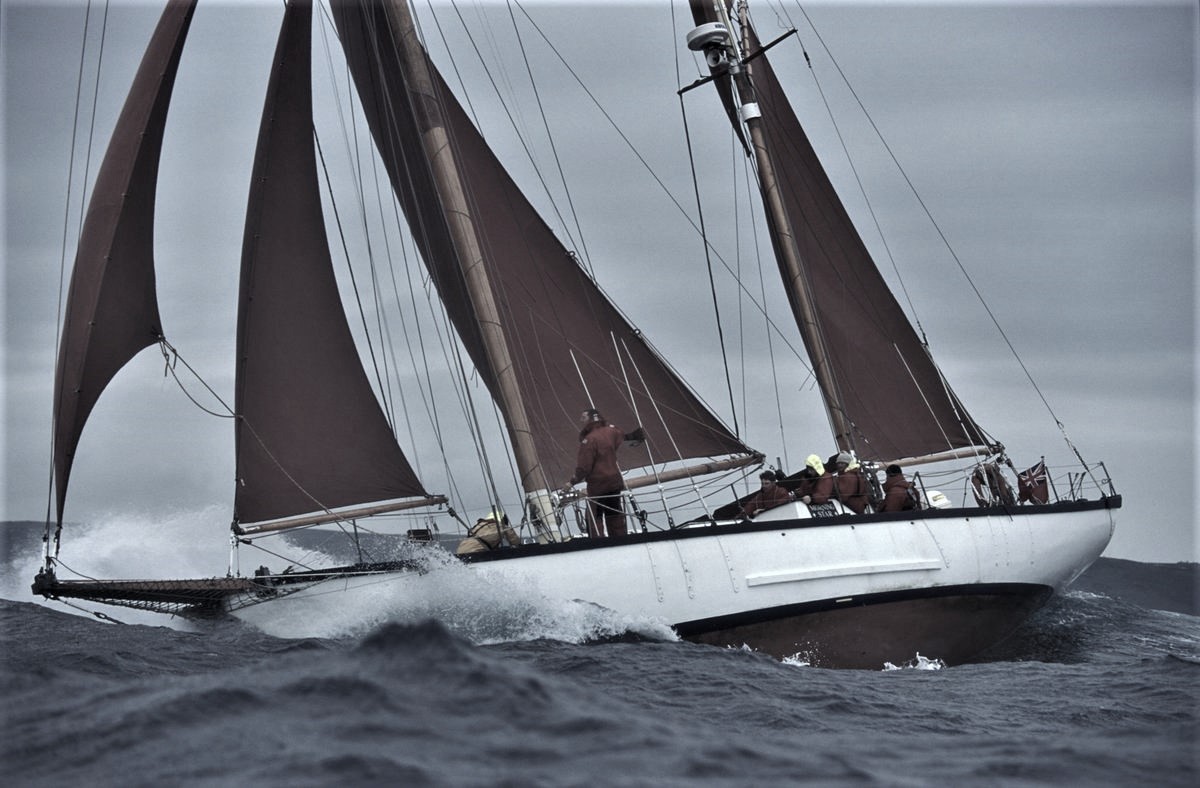
I was on a sailing boat in storm force winds when a mast fitting broke. We had to get the sail down whilst being tossed in the massive waves, with wind and rain and spray.  It was exciting, we felt alive and ‘present’, …. and yet safe.  Our skipper was completely calm, and so we were confident that we would come to no harm; and we didn’t.  It was a joyful and exhilarating shared experience which we will all remember and which is a bond between us; so much more than flat seas and a gentle breeze.

So I think that instead of offering calm seas in our lives, Jesus is saying ‘I am in your boat, you are perfectly safe.  Go and enjoy the adventure.’ And it is with sadness that he has to calm our storm because we have so little faith.

Do you want adventure?  ‘Safe’ adventure?  Feel free to get in touch…

The universe is so big and has been here so long …

Big Bang was about 14 billion years ago; the universe is older and bigger than we can possibly imagine.  Dinosaurs were on the earth for over a hundred million of years, a thousand times longer than the humans have been around. And looking at the population of the world today, as an individual among 9 billion people alive, In comparison with the totality of space and time, each individual is surely completely insignificant.

But… there is an alternative.

If God exists they must be bigger than all this, and older than all this and they must have had a reason to bring the universe into being and sustain it, and to wait while the stars and planets formed and reformed, life began and evolved, and  mankind emerged and developed.  And if, as many of us believe, they sent their son to teach us and to die for us then we move from being completely insignificant to enormously significant.

But perhaps it still seems an awful lot of effort for God, too much to believe perhaps. But think about the effort that we put in to the smallest of things used for enrich a very short period of time.  Think of how much time, energy and space goes into making a simple gold ring with a diamond on it, and getting it to a shop so that someone can buy it to propose an engagement.  Just compare the size of the gold and diamond mines with the end product – let alone all the work needed to refine, shape and manufacture the ring, and to transport it to the shop.  We are pleased to do all that, God’s work just takes things to a bigger scale…

Jesus teaching on workers pay

Jesus taught about the kingdom of God. In one example a wealthy man ensured that the workers all received enough pay for their needs, although it cost him more than it needed to. He knew that he would still have sufficient for himself.

If you are wealthy then this might be a good example to follow.

And if you are a worker, take heed too: if you are lucky enough to have a job, your needs are no different from the one who doesn’t.

The story is recorded in Matthew 20:

“For the Kingdom of Heaven is like the landowner who went out early one morning to hire workers for his vineyard. He agreed to pay the normal daily wage and sent them out to work.

“At nine o’clock in the morning he was passing through the marketplace and saw some people standing around doing nothing. So he hired them, telling them he would pay them whatever was right at the end of the day. So they went to work in the vineyard. At noon and again at three o’clock he did the same thing.

“At five o’clock that afternoon he was in town again and saw some more people standing around. He asked them, ‘Why haven’t you been working today?’

“They replied, ‘Because no one hired us.’

“The landowner told them, ‘Then go out and join the others in my vineyard.’

“That evening he told the foreman to call the workers in and pay them, beginning with the last workers first. When those hired at five o’clock were paid, each received a full day’s wage. 10 When those hired first came to get their pay, they assumed they would receive more. But they, too, were paid a day’s wage. 11 When they received their pay, they protested to the owner, 12 ‘Those people worked only one hour, and yet you’ve paid them just as much as you paid us who worked all day in the scorching heat.’

13 “He answered one of them, ‘Friend, I haven’t been unfair! Didn’t you agree to work all day for the usual wage? 14 Take your money and go. I wanted to pay this last worker the same as you. 15 Is it against the law for me to do what I want with my money? Should you be jealous because I am kind to others?’

16 “So those who are last now will be first then, and those who are first will be last.”

Excerpt from The Big Picture: “Am I Open Minded?”

As we start out ask yourself the question, “Am I open minded, ready to follow where evidence leads, with no preconceptions?”

Now I’m sure you’ve answered “yes” because none of us would like to admit otherwise, but actually, it may be impossible to start any investigation without preconceptions.   They are the motivation behind many investigations … the desire to obtain proof of what we already think about something.

Preconceptions are almost inherent in the scientific approach – we think of a theory, and then we investigate to test it.  If we are honest, we will admit that we like our theories and feel good when they are proved right.

Perhaps there is one preconception that I will allow at this stage; that each one of us matters. I matter. You matter.  Our friends and neighbours all matter.  If we don’t matter then there is no point in anything and it’s best not to think any deeper.  That road leads to despair.

If we are going to explore these questions fully we are going to have to consider questions of God, science, reason, history and more.  We are going to have to include objective data and subjective experience; objectivity keeps us from being deluded but it is the subjective that really matters to us.

Even if we try to think about an issue with an open mind, we nevertheless carry many assumptions that we don’t realise.  Speaking personally, my scientific education and engineering career have both instilled a basic assumption of materialism: the fabric of the universe is all there is.  When people talk about a spiritual dimension, is it just another material dimension that we can’t see?  And if there is a spiritual dimension, how can it interact with the physical universe?  Or if there isn’t a separate spiritual dimension then where does God exist?  These are not straightforward questions, but I’ve come to realise that they are valid.   I have had to challenge a lot of what I took simply as common sense and to open my mind to new possibilities.

It can be difficult to refresh our way of thinking, particularly if we are surrounded by others who have a similar outlook to ourselves.  In a recent discussion on European history with a university student he mentioned that such and such country was fascist.  It led me to ask what it is that makes the people there fascist.  Is it genetically programmed into each individual there?  If you took any one of them and brought them up elsewhere would they be fascist?  I think it likely that they wouldn’t.  They are fascist because everyone around them is fascist.  They are unconsciously trained to be fascists.

So what are we doing in our country?  What are we training ourselves to think like?  What assumptions do we hold, and are they valid?  Books such as The Science Delusion by Rupert Sheldrake[i] challenge many of the assumptions of the day.  He asks us to challenge our scientific dogmas, our blind assumptions.  Even if we end up thinking the same as we did before, we have a more solid basis for our beliefs if we go through the process of challenging our assumptions.

Implications

Whenever anyone is presenting a case we might ask ourselves, “If I were to accept what is being presented and agree with the author, what would be the implications for me?  How willing would I be to accept those implications?  Do I need to understand the implications before I start?”

Many parents choose not to have their babies tested for Down’s syndrome because they would not be willing to accept a termination of the pregnancy and so feel that there is no point in knowing before the child is born.  Others might need to understand all the implications before deciding; how accurate is the test, and what are the options available if the child tests positive? Still others might insist that they must have the test because they are not prepared to risk having a child with Down’s syndrome and would terminate the pregnancy if that were shown to be likely by the test.

This is a book that deals with questions of God.  This may worry some people. If they were to be convinced that God is real they would have to become the sort of bigoted judgemental fanatic that represents the worst face of religion.  They may think that they would need to join a religion and accept all that they are told without thinking, and be associated with all the religious atrocities of the past. Or that they will have to give up their Sunday morning lie-in and trot off to church with a bunch of hypocrites. If these thoughts resonate with you, take courage – it doesn’t have to be like that.

Fear

People can be frightened by the prospect of change, but often change is beneficial.  For instance, when redundancies are announced, there is a lot of fear in the workforce.  Some may have been in the same job for thirty years, and they simply don’t know anything else – how will they cope if they have to find another job?  And yet being forced to change jobs can be a most liberating and life-changing experience.  I recall hearing a report that those who remain behind after a round of redundancies are likely to be more stressed than those who have been made redundant.  They are still in the same job, but with increased fear of losing it and still in fear of change, whereas those who have left are now busy rebuilding their new lives and careers.  That’s not to say it’s easy to change, but a change in a job or a worldview can be very liberating.

Peer Pressure

Perhaps we don’t want to change our views because of what others might think of us.  We’ve probably aired our opinions sufficiently to our friends that any major change would be an embarrassment.   Or perhaps we live or work in a culture where there is only one accepted way of thinking.  We might find that we have to live a double life, adopting one attitude at work and another in private.  For instance, to progress a career as a scientist it is necessary to publish papers and learned articles.  Such articles are subject to peer review.  This process is in place to ensure that sound scientific information is published and that mistakes do not get propagated.  But the process inherently risks that only those papers that conform to the present scientific way of thinking are published.  If a scientist becomes too free thinking, then the peer review process may prevent his papers being published and his career may come to a grinding halt.  Reputation is essential, and doing anything that might lose it is risky.

An ambitious scientist may be fearful of embracing religion.  Religion allows that God might interfere with the workings of the world.  That might mean that the universe is not completely predictable, which would seem to undermine the basis of all the work of science.  Allowing the existence of God might mean that it will be impossible to have a complete scientific theory that predicts everything – which is challenging to anyone who invests their life in seeking it.

Similarly, in religious circles it can be damaging not only to one’s career but also to one’s life to challenge the current way of thinking.  Men and women have been labelled heretics and have been burnt at the stake for holding different religious beliefs.

Religious people may have a deep fear of science.  Apart from the vocal assertions made by some atheists that science has done away with God, there can be fear that science might undermine or even disprove certain traditions or beliefs that the given religion may hold dear, or even sacred.  A religious man may have invested so much in his religion that he’s lost the desire, and maybe even the ability, to be open to learning that some of what he’s been taught is incorrect.  Yet surely a truly godly man would be desperate to be corrected if he were misunderstanding God?  In her book Awesome God, Sara Maitland encourages religious people to embrace what can be learned from science:

Start with “God exists” and everything we can learn will tell us more about God.[ii]

So returning to the question, “Am I open minded, ready to follow where evidence leads, with no preconceptions?” we can see that it is almost impossible not to have preconceptions or preconditions.  A first step in challenging them is to consider how we came to believe them in the first place. How did we come to really know what we know?

[i] Rupert Sheldrake: The Science Delusion ISBN 978-1444727944

[ii] Sara Maitland: Awesome God: Creation, Commitment and Joy ISBN: 978-0281054190
Foreword to The Big Picture

Scientific discovery has brought material benefits and physical comfort to mankind.  The predictability of matter leads us to assume that it behaves according to fixed laws, and this belief has led engineers to develop tools and machinery to manipulate the environment, doctors to develop cures for many diseases, and farmers to grow crops with greatly increased yields.  Many of the scourges of previous times have been overcome leading, in the Western world at least, to longer lifetimes and better health.  However, this has also led to the belief that everything is predictable and controllable. If anything goes wrong (by which we mean it causes us distress or discomfort) then it must be fixable, and if it hasn’t been fixed it must be someone else’s fault.

Personal rights have grown, but personal responsibility has diminished.  Laws to protect the weak have bred the belief that it is the state’s job and not our individual duty to help out those less fortunate than ourselves.  Mechanisation that was supposed to give more leisure time has led to lost jobs and loss of purpose.  Competition and the shrinking of the geographical world has meant that there is someone, somewhere who will work harder or longer hours than we do, and the pressure grows to produce more for less.  The availability of loans means that goods can be obtained now if we promise to pay later.  To pay the loan we need a job.  Fear of job loss drives us to work longer hours and accept less pay. The purpose of life becomes to produce.  The mechanism which fuels demand and production is the economy.  The economy becomes the measure of the health of a nation.

Is that what it’s all about?

Is my value simply what I can produce?

Am I measured just by what I can earn?

If I retain the worldview that the economy is king then the implication is yes, but that doesn’t feel right.  I want to be valued and loved as a person.  I want a worldview that speaks to my heart and my mind and not just my wallet, and I want it to be based on sound thinking and evidence.

Science has brought great technological and medical benefits to mankind; cars, televisions, fridges, telephones, electricity and so on.  But science has also brought guns and bullets, pollution, global drug trafficking and job losses.  Science seems to dominate my life, telling me what I should or shouldn’t do to keep healthy, avoid risk and live longer, but it doesn’t tell me why I would want to live longer.  Science doesn’t give any purpose to my life.

Religion offers purpose, but it too seems to want to control me and dominate me.  Religion has been used as justification for many great atrocities: the Spanish Inquisition, child sacrifices, the Crusades.  Religious people seem to want to tell me how to behave, and to judge and criticise me, claiming to represent the will of God.

I want to know the truth.  I want to know what science can tell me about how the universe works, and perhaps where I came from.  I want the benefits that science can bring, but not at the cost of becoming a slave to its dictates.  I want to know why I am here, what my purpose in life is, or even if there is one.  If there is a God I want to know what He thinks. I want the benefit of knowing that I have a purpose, but not at the cost of becoming a slave to rules from another human being.

And so I investigate, weigh up evidence in all forms and seek a holistic worldview that works.  I have explored what we know from the physical and biological sciences, and I have researched historical evidence for God. I have tested what is actually known, and what is speculation, extrapolation or personal opinion and rhetoric.

This book presents my conclusions, and some of the evidence that brought me to draw them.  I offer what I believe is a consistent, healthy and constructive worldview based on sound evidence.  I’ve called it Minimalist Christianity.  Whether you agree with my conclusion or not, I hope that many of the myths that currently inhibit so many of us will have been weakened or dispelled.  I hope that a step can be taken towards finding purpose and experiencing life in abundance.

The trampled poppy

It is 14th November 2018, just three days after the Remembrance Sunday where we promise not to forget the loss of lives in the 1914-18 and other wars.

I am woken by Radio 3:

“The headlines today …

  • Half of the nation of Yemen is on the verge of starvation due to war.
  • Melania Trump is upset at where she sat on an aircraft.

And now some Mozart.”

Unusually I have noticed the incongruity and am prompted to draw attention to it in a blog post.  Normally, like you, I would just get on with my day, not sparing another thought to the fact that half of a nation is on the verge of starvation.

It seems that the poppies have already been trampled in the dirt.

How can any of us claim to be without sin?  Isn’t the correct response to our  hard-heartedness that we humbly admit that we are grossly selfish and undeserving?

Yet despite this, we are still given the opportunity to live purposeful lives.  We believe there is some purpose in life, and in death; we have just remembered millions of deaths.  And if there is eternal life we want part of it.

On that day when we die and are asked whether we have led a good enough life to deserve heaven, none of us can say yes. None of us.  Yet heaven will be full.  It will be full because of the person who we celebrate on another day of remembrance – Christmas Day.

Jesus Christ, son of God, crucified.  A single act in history which allows anyone who in their hearts wishes for it to repent and receive forgiveness.  Our active and passive selfish, greedy, hard-hearted and unloving actions deserve death, but we are allowed eternal life because of that one great sacrifice made on our behalf.  It is our choice – death, or humble acceptance of the sacrifice that Jesus made on the cross and life. To trample the cross, or to embrace it.