An affordable net zero house retrofit

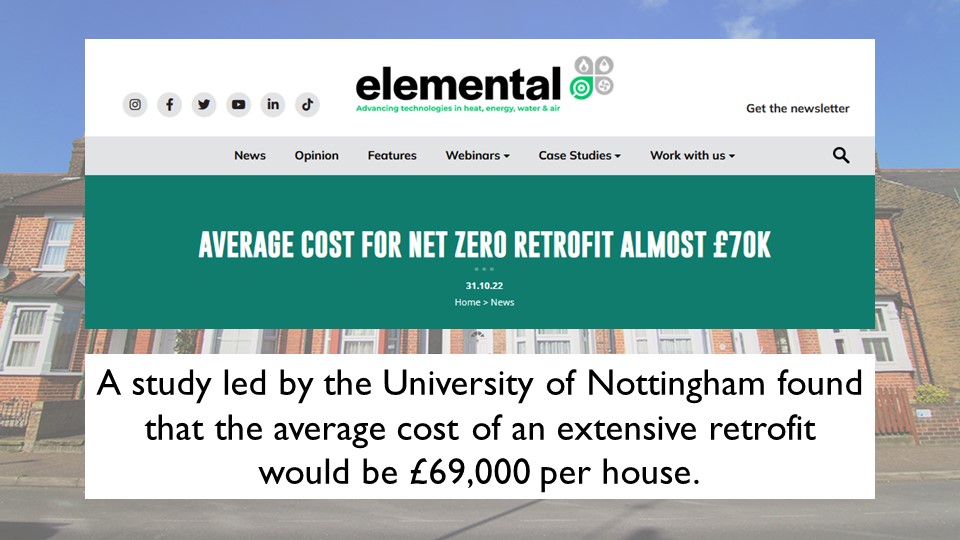
Headlines such as “Average cost for net zero retrofit almost £70k” make the task of CO2 reduction seem daunting or unaffordable.  It doesn’t have to be that way.  I describe affordable and available technologies that allowed me to make my home carbon neutral for around £10k, verified by detailed energy measurements over several years.  The solutions also make living through increasingly frequent heat waves bearable and even comfortable. 

Conventional wisdom and solutions suggest that cutting emissions is a hobby for the wealthy. Technological solutions are too expensive for the majority of householders. This is not true.

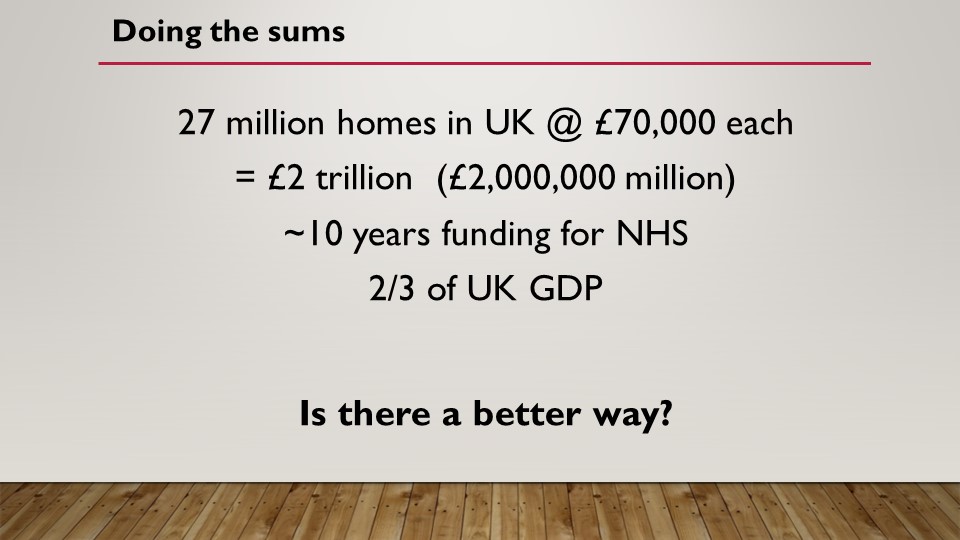
‘Conventional’ solutions are simply too expensive for individuals or the country to afford, but there is a better way.
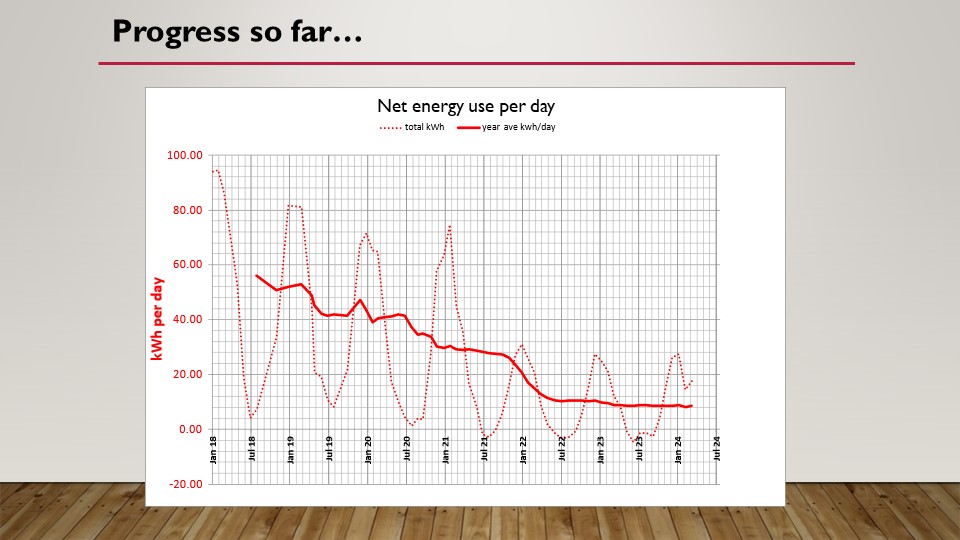
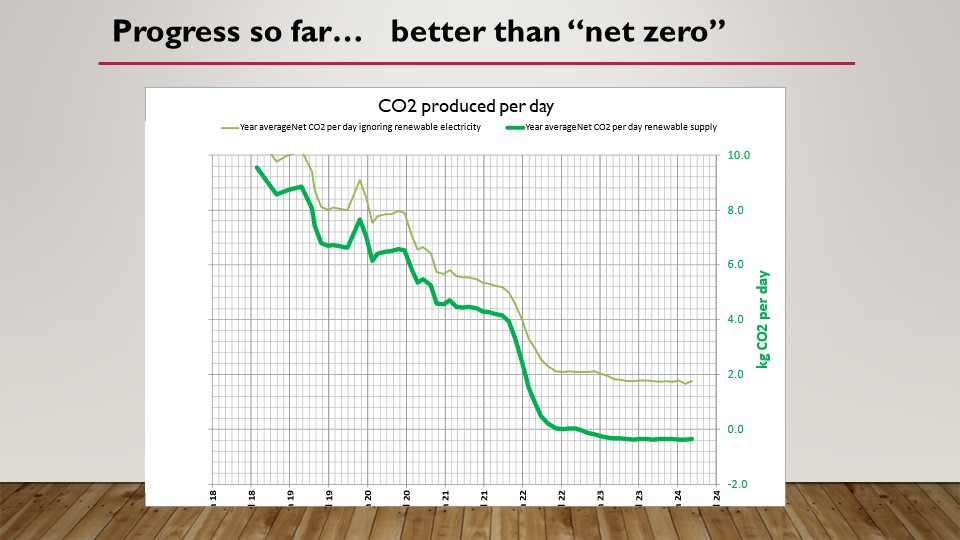
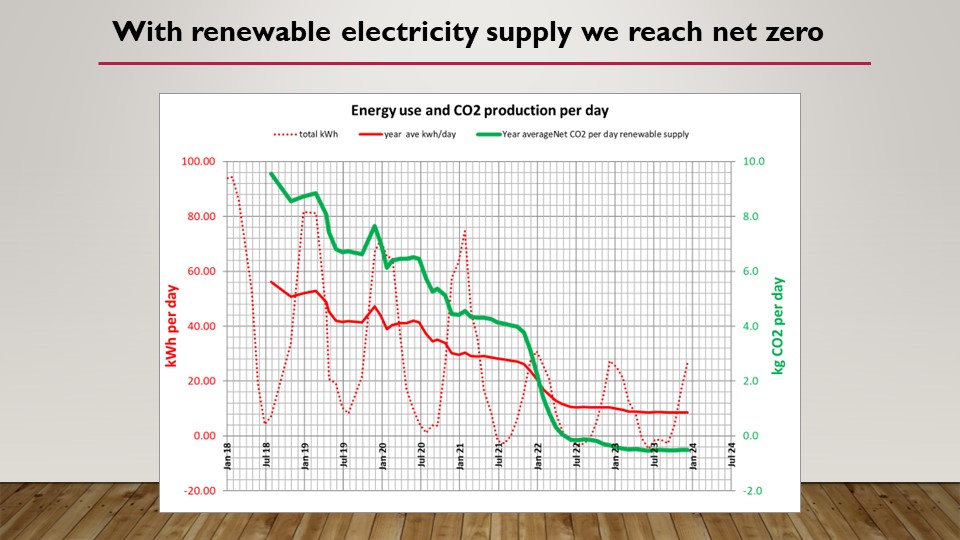
The chart below shows that if we count electricity from a renewable energy supply as zero emissions then we are better than net zero. If we count the carbon intensity of electricity at grid average then we have reduced our CO2 by 80%.
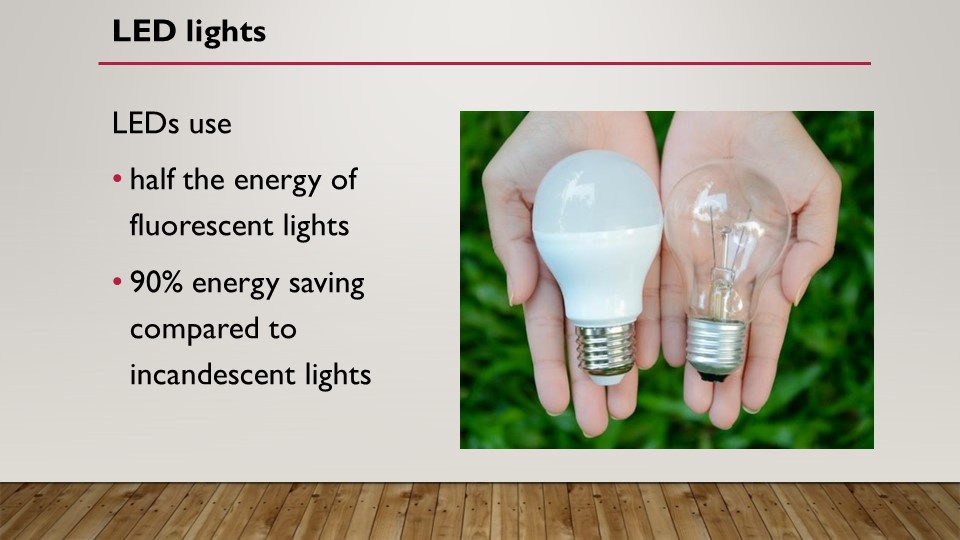
A quick win is to replace all lights by LED.
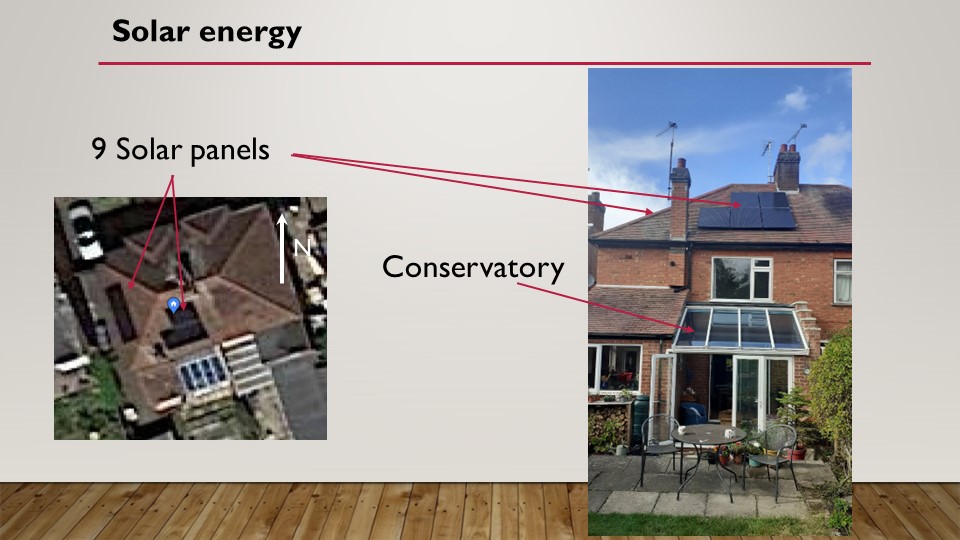
We installed solar panels without a battery early on, and the conservatory also captures solar energy (not included in the £10k as it was built for the space rather than energy reduction).
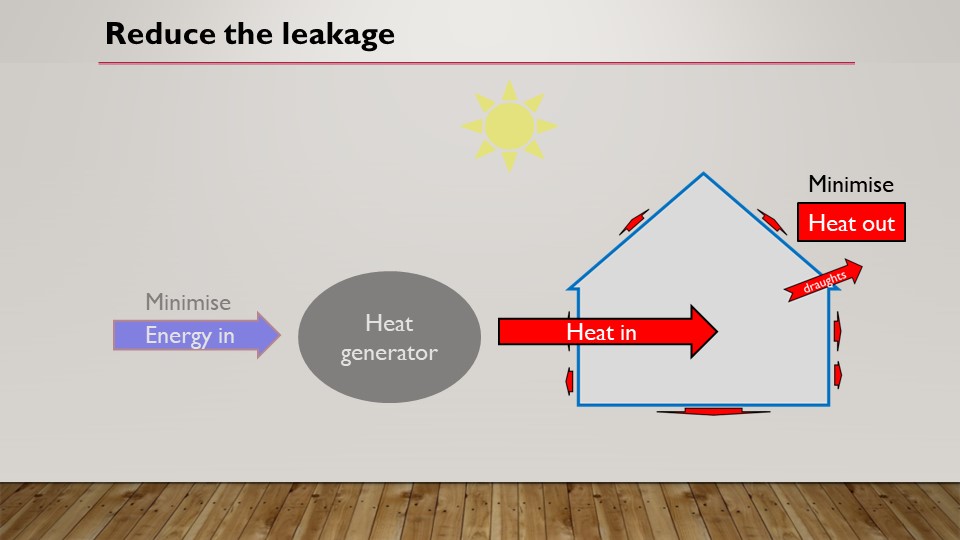
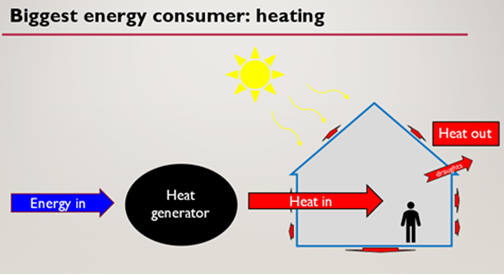
By far the biggest part of the energy footprint of a house is the heating. We need to minimise the energy in. We can do this by minimising the heat out and by optimising the efficiency of the heat generator (conventionally a boiler).

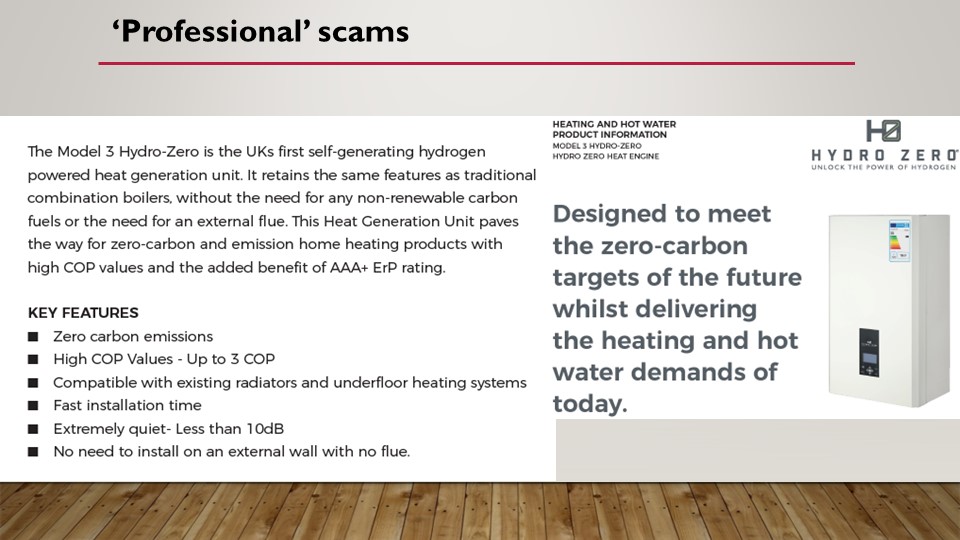
Lots of companies offer ‘wonder solutions’ online, but don’t be caught out by scams such as these:

Professionals have been ‘duped’ by rogue products such as the one below whose claims broke the first law of thermodynamics.
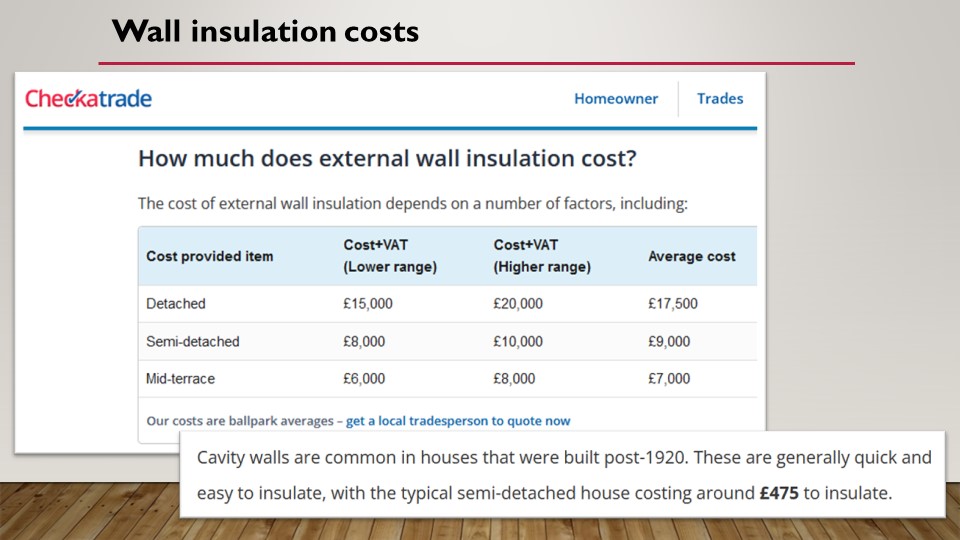
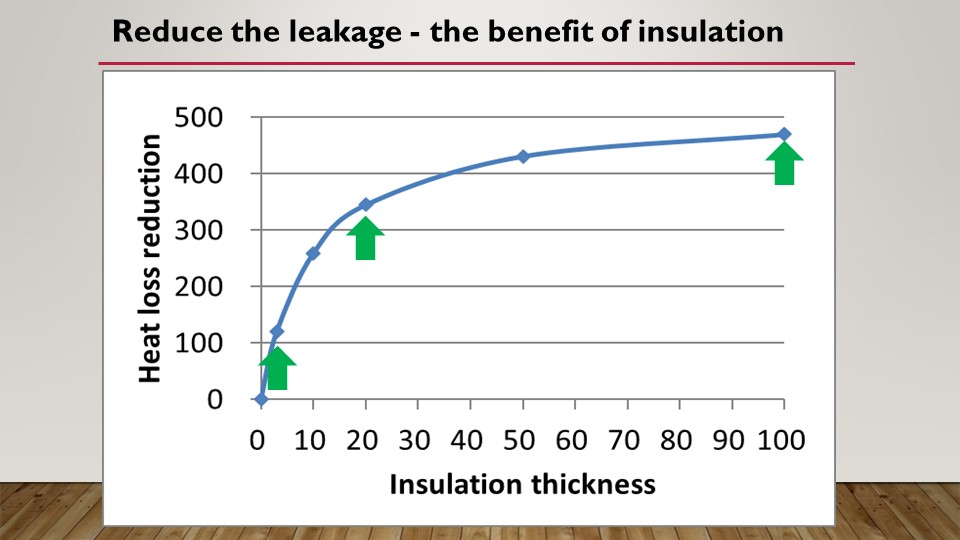
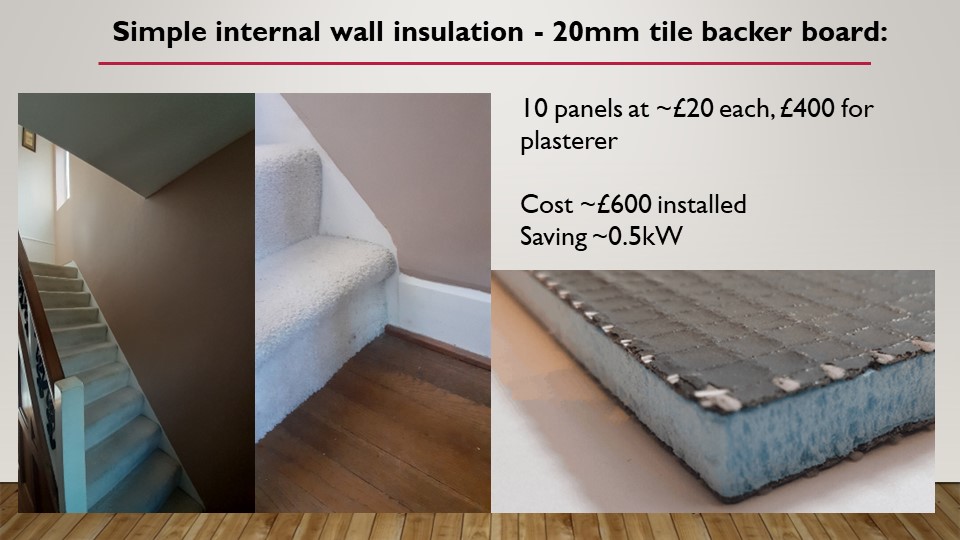
External wall insulation is just too expensive! Cavity wall insulation is great, and affordable, but a better solution is needed for solid walls. Physics tells us that there are decreasing returns from increasing the thickness of insulation. Just 20mm can be very effective.
Underfloor insulation is cheap from a material point of view, but disruptive and labour intensive. We needed to replace our joists and floorboards anyway so it was a cheap and obvious improvement. We tried two different insulation approaches – the solid insulation board was simplest and is the way I’d do it again.

The biggest benefit from double or triple glazing is the poor heat transfer between air and the surface of the glass, rather than the insulating property of glass or the air gap. We achieved this by a simple improvement to the original door glass and windows.

Curtains also reduce heat loss by the same mechanism. The thickness of the curtain material is less important than simply preventing the air passing from one side to another. The following temperature measurements either side of the curtain show the benefit when they are closed.

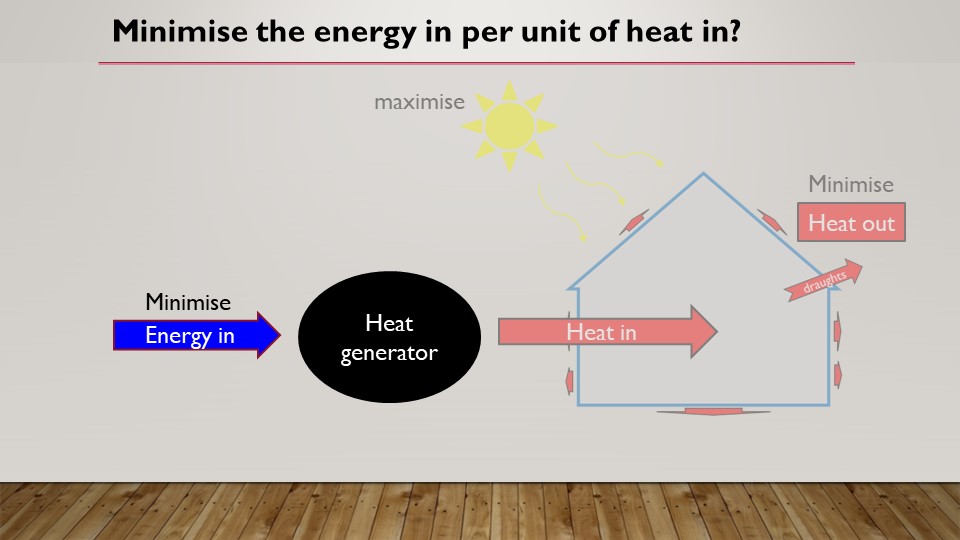
The biggest benefit in energy saving can come from choosing the best heat generator. The traditional approach is to use a gas boiler:

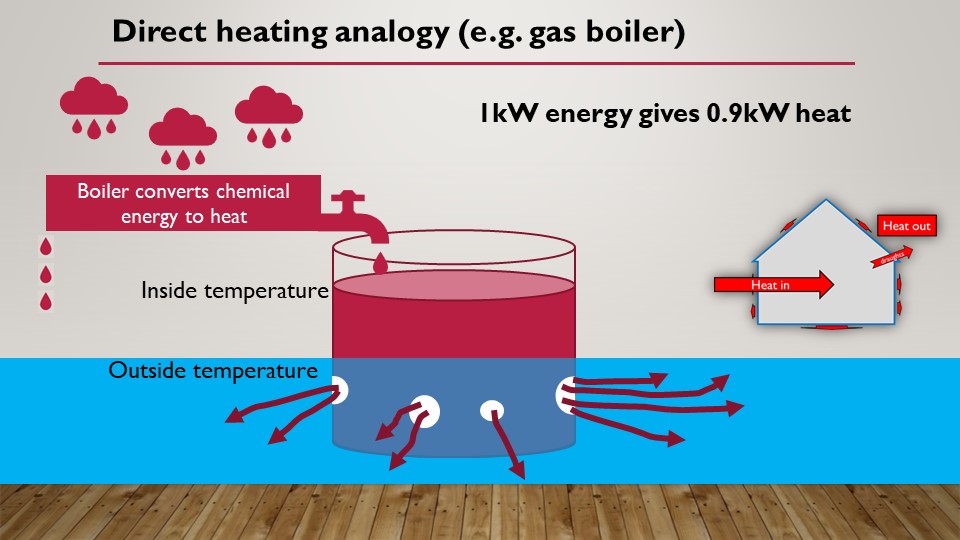
In contrast to converting chemical energy in the boiler to heat, a heat pump uses electrical energy to pump heat from the cold outside to the warm inside using the same thermodynamic process that cools the fridge and freezer in our kitchens.

Government promoted air to water heat pumps have a LOT of disadvantages, and will probably cost a little more to run than a gas boiler. No wonder they are not taking off!

A far better alternative is a traditional air conditioning unit, which is an air to air heat pump – warming the air in the house directly and efficiently. It can be installed without touching the existing boiler and radiator system, which can be retained as a back-up.
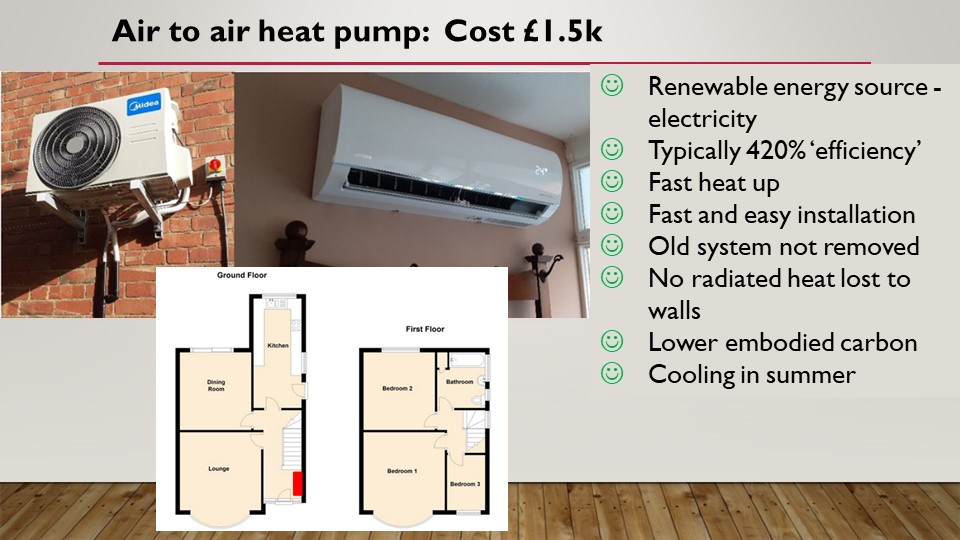
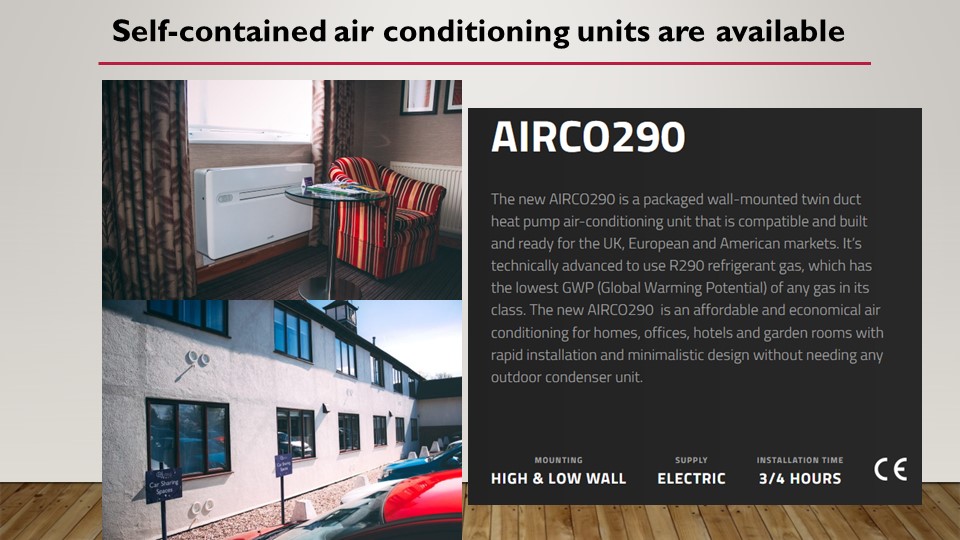
If you have nowhere to fit the outside unit of the heat pump, there are self contained units available that might solve the problem. They are slightly less efficient but are worth considering.
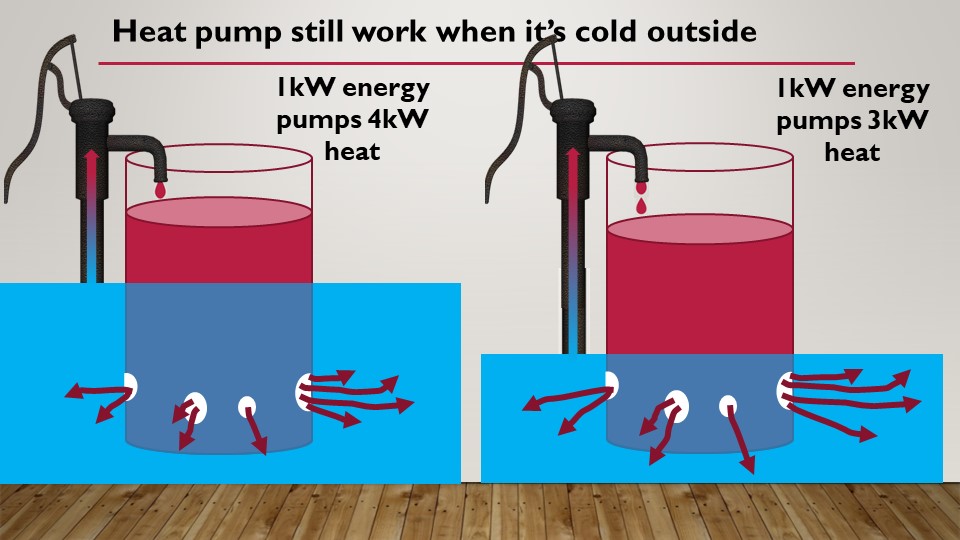
Don’t be misled by people who say heat pumps don’t work in cold weather. They do – although they will pump slightly less heat than in warm weather.
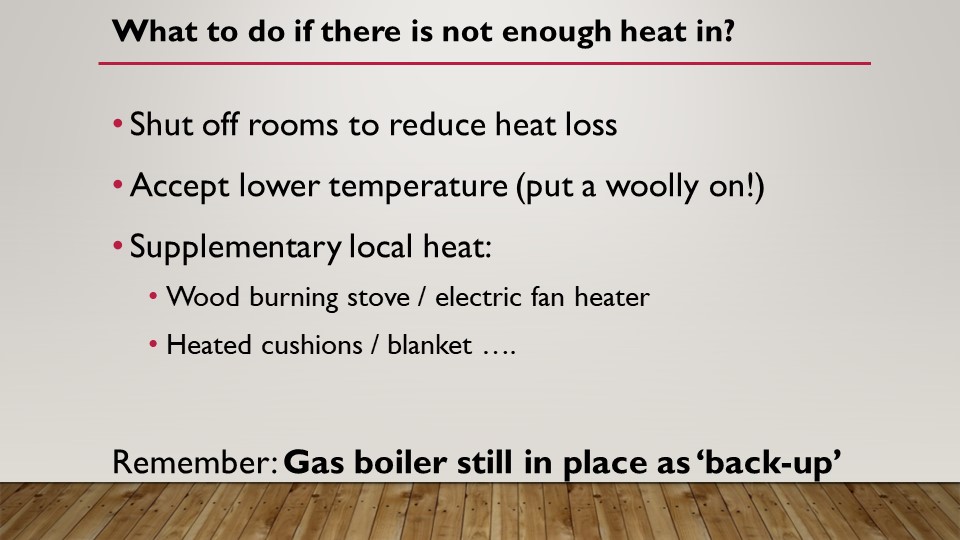
With any heating system, you will reach a point where you can’t get enough heat into the house to maintain the temperature.
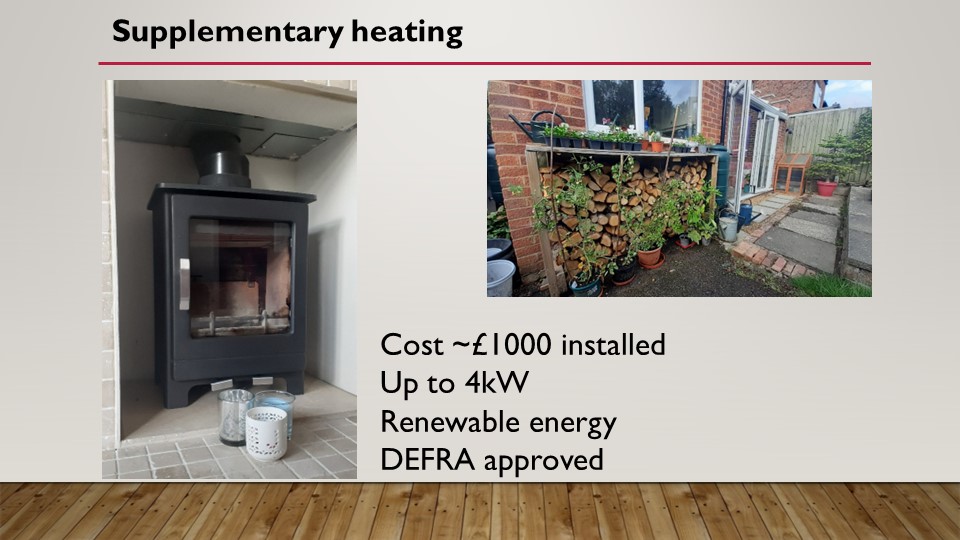
We fitted a DEFRA wood burning stove, and use waste wood that we season as fuel. This is carbon neutral as the wood would rot and give off it’s CO2 anyway.
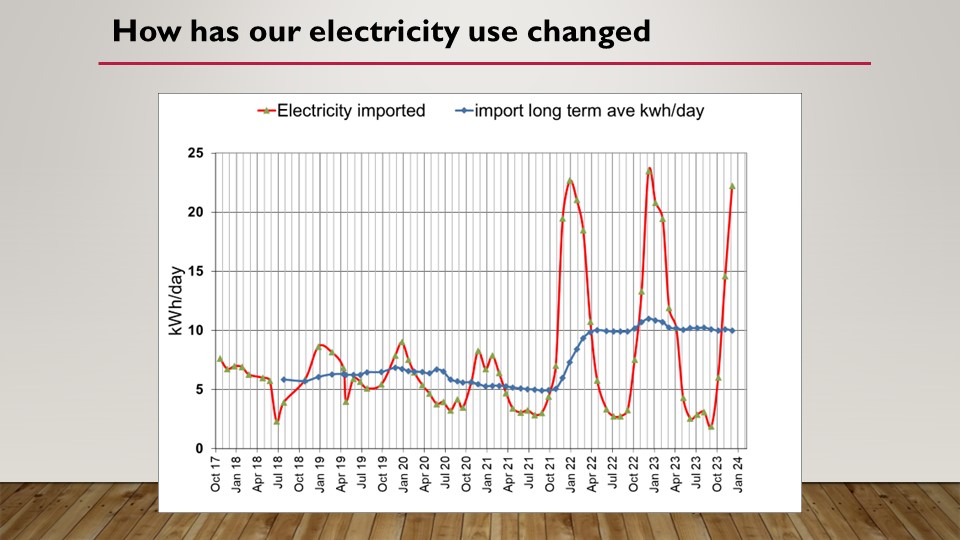
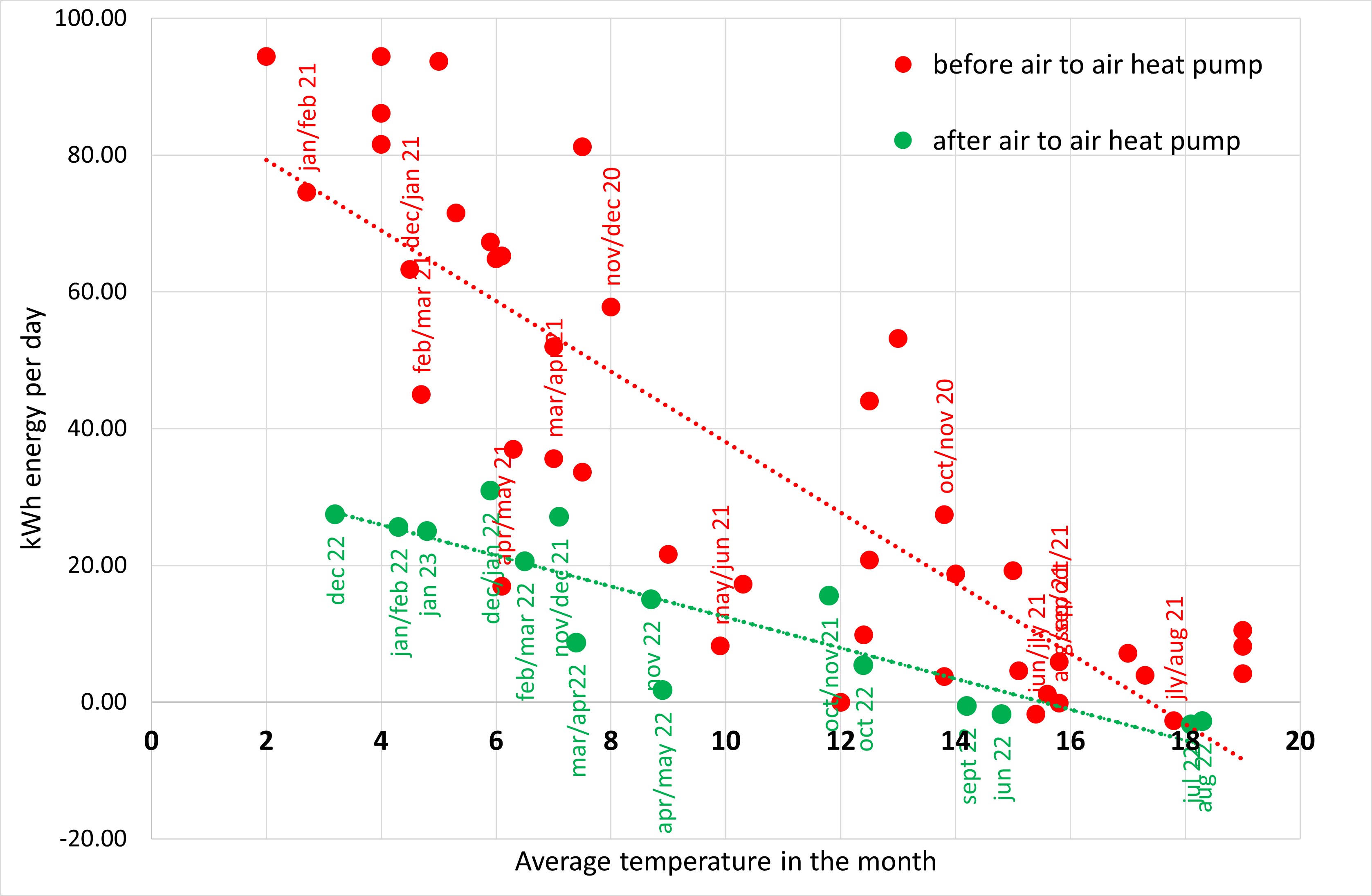
Energy measurements show that for the same heating demand (average outside temperature) the heat pump saves a large proportion of our energy – even when it is very cold. The total energy below includes heating, water heating, cooking, washing, TV etc. i.e. everything!
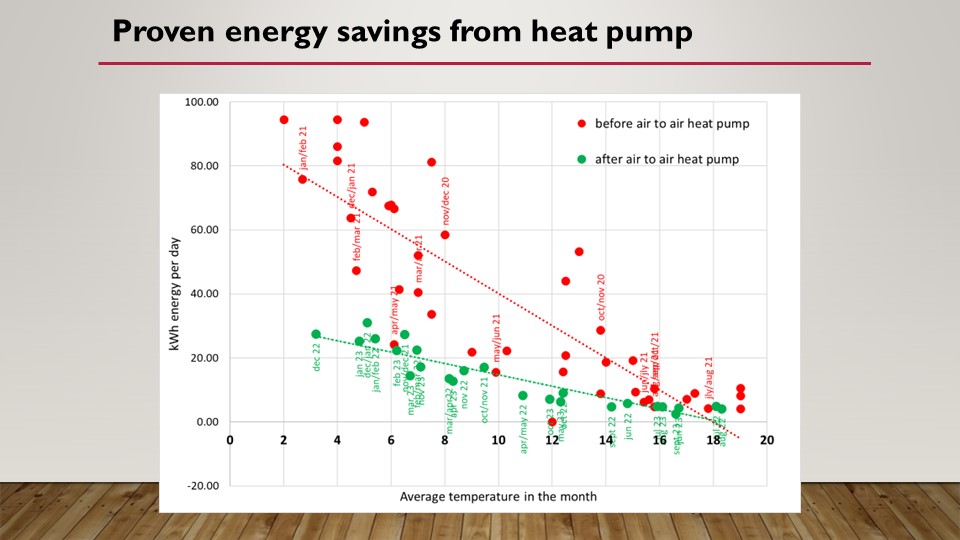
From the average daily gas and electricity use before and after the heat pump we can work out how much we have saved by fitting the air to air heat pump:

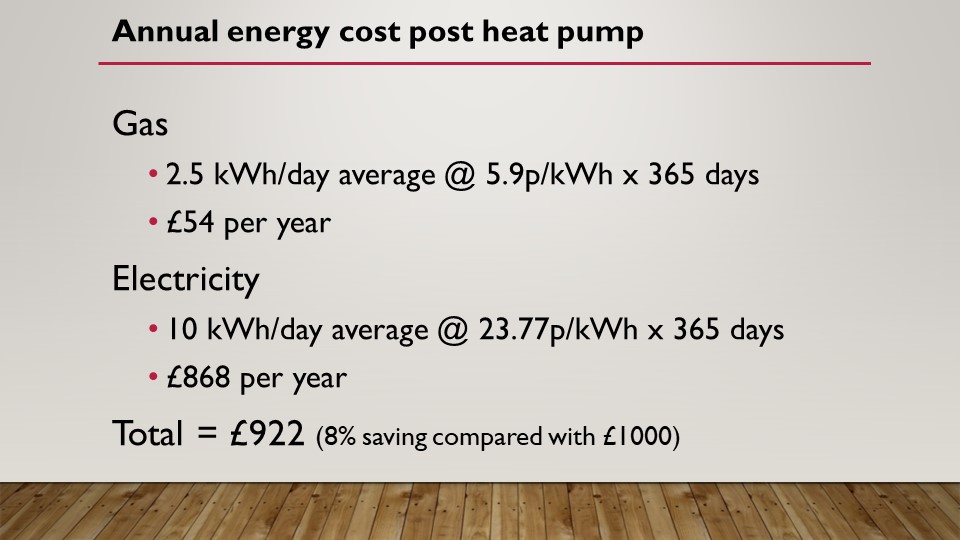
When buying a heat pump, it’s important to get the most efficient model. The cost difference will quickly pay back in energy savings, and the CO2 saving will be biggest.

Just a reminder of what can be done:

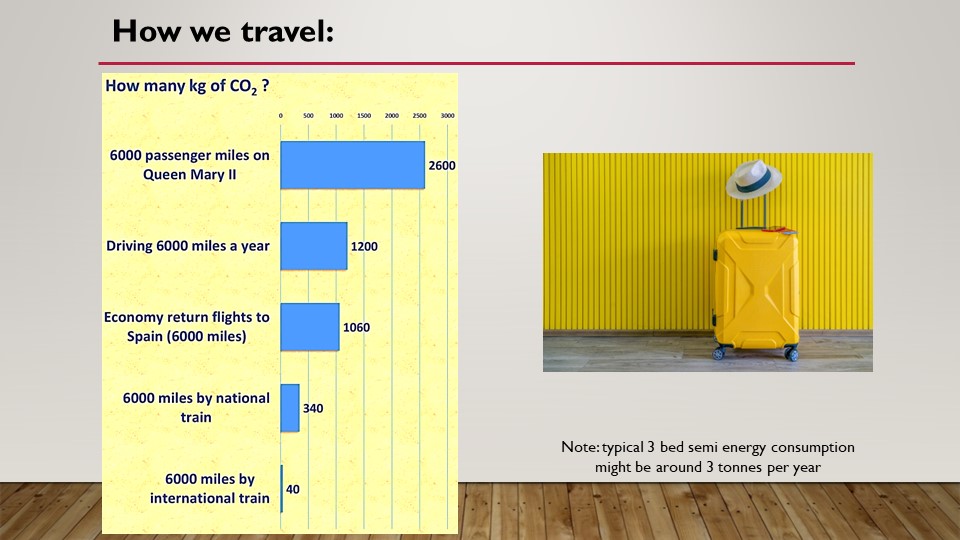
Housing is only a proportion of our CO2 footprint. The data below allows us to consider the benefit of changes to our life choices.
It’s a stark fact that those who are suffering most from our high CO2 production are those who produce least themselves and who are least able to bear the consequences. My wife and I run a small charity that sends funds to help some of the most vulnerable in Mozambique. A simple breeze block house can be life-changing, but will only cost around £1300. If you would like to join us in helping those in greatest need, or if you have simply found this helpful then please donate to the account below.

What is the best heating approach for CO2 reduction and cost effectiveness?

In this post I share some of what I have learnt and worked out about how to reduce the carbon footprint of heating a house. There is an awful lot of misinformation and misleading advertising out there, and very few have reached the most sensible solution, particularly for fitting in older houses. I hope that this post will help you choose the best approach. I hope I have achieved the right balance between technical detail and simple explanation, and I would welcome feedback on that. Clarity may improve over time!

The biggest use of energy in housing is heating.  The amount of heat required to maintain a temperature depends on the loss of heat from the building (e.g. heat loss through the walls). The energy required to provide that heat depends on the efficiency of the heat generator (e.g. boiler). The amount of carbon dioxide to heat the house depends on the CO2 released to produce the energy.

 The majority of a house’s carbon footprint is through heating and so having the most efficient way of generating heat is essential.  There are many different heat generation technologies. Some burn fuel and some use electricity to either directly converting it to heat (e.g. fan heater, storage heater) or by using the electricity to pump heat into the house from the environment.

Technical and economic comparison of different heat generation technologies

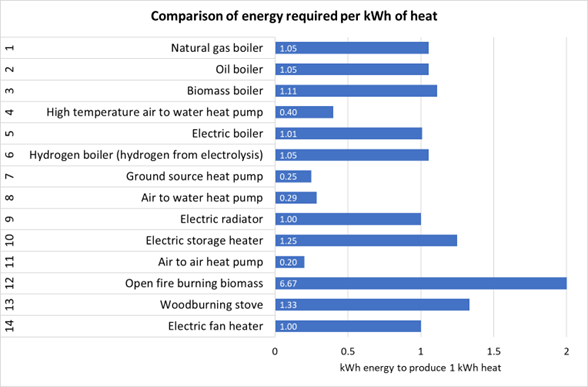
The following chart compares the heat generation efficiency of different heat generators, it shows how much energy is needed to provide 1kWh of heat. The best technology has the lowest value:

Most houses are currently heated via gas or oil-fired boilers. With that assumption, how easy are the different technologies to install?

1-6: can be considered as straight boiler replacements and offer the potential for relatively low disruption

7-8: can connect to an existing radiator system but would not provide the same heat input as the system they replace due to lower water temperatures.  They will need additional measures such as increased insulation, or increasing radiator size. Installation will be disruptive, taking several days at least.

9-10:  replace the present system and would need existing radiators to be removed to make space for the new heaters. Additional electrical wiring might be needed too. There would be some disruption.

11: can be installed quickly and with little disruption, perhaps in less than a day.  Existing heating systems can be left in place.

12-14: are supplementary heating options which may be valuable to ‘top up’ in cold weather or are suitable for infrequently used areas.

From an efficiency point of view all of the heat pumps are very attractive, although from a disruption point of view the water systems are quite disruptive to install.  The low disruption of fitting air to air heat pumps is very attractive.

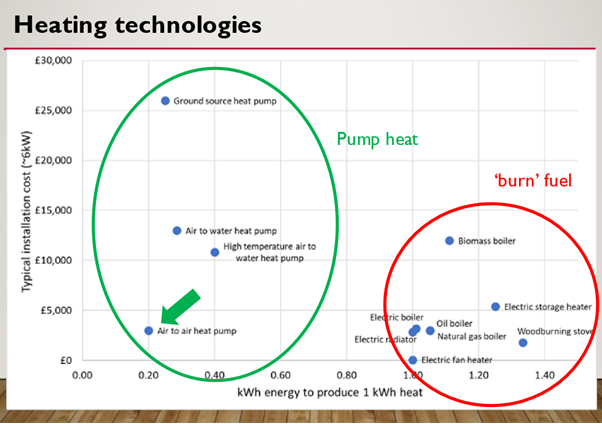
I have compiled some typical installation costs of the different technologies:

The water heat pump options are much more expensive than straight boiler replacement.  However, air to air heat pumps offer not only the highest efficiency but at a comparable installation cost to traditional boiler replacement.

The government is currently offering £5000 off the cost and installation of an air source heat pump (ASHP systems must be hydronic (air-to-water) to be eligible under BUS.  Air-to-air systems are not eligible.), £5000 off the cost and installation of a biomass boiler and £6000 off the cost and installation of a ground source heat pump, including water source heat pumps. This subsidy brings the costs closer, but they are still more costly and disruptive – perhaps explaining why uptake has been poor.

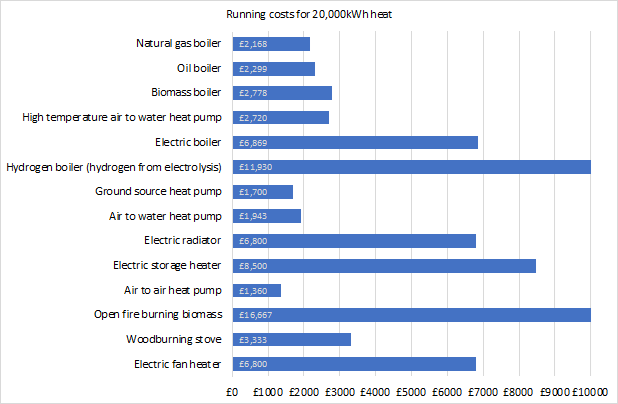
But what about running costs?  The following chart shows the comparative running costs to provide 20MWh of heat, based on energy prices of:

Electricity 34.0p/kWh (government price cap value)

Gas 10.3p/kWh (government price cap value)

Oil 10.9p/kWh

Biomass 12.5p/kWh (price paid by a friend with a biomass boiler)

Hydrogen 56.7p/kWh (cost of electricity / 60% electrolysis efficiency)

Although energy prices are rather unstable, this shows that the efficiency benefit of electrically driven heat pumps outweighs the price premium of the fuel.  If electricity is generated ‘for free’ on site by solar panels perhaps, then the benefit will be larger.

Based on the data above, it is clear that heat pump technology must form the basis of the net zero heating approach, and that air-to-air heat pumps are by far the most attractive having the lowest installation and running costs and the highest efficiency. Additionally air to air heat pumps (air conditioning units) offer the benefit of being reversible and being able to cool the home in summer heat waves.

Heat pumps don’t work the same way as boilers

We need to understand the behaviour of heat pumps, because they don’t provide heat in the same way as burning fuel.   Instead, they use a refrigerant cycle (just like on a fridge or freezer) to pump heat from a cold temperature to a hot temperature. 

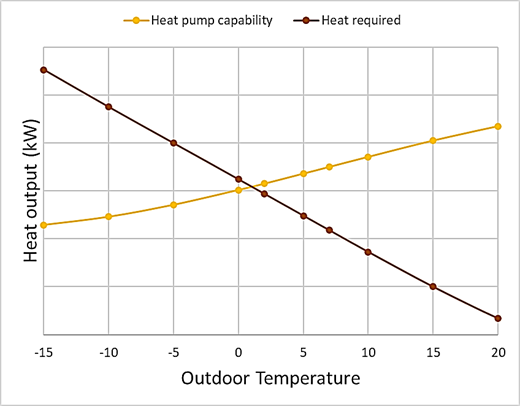
A heat pump has a certain amount of power. If you are pushing a car up a steep hill you can’t push such a heavy car as you could on the flat, and similarly a heat pump can’t pump so much heat when there is a big temperature rise between outside and inside. At cold outside temperatures, the heat pump capability reduces – they still pump heat, but just not quite so much.

However, as the outside temperature reduces the amount of heat leaking out of a building increases; at cold outside temperatures the amount of heat needed increases. 

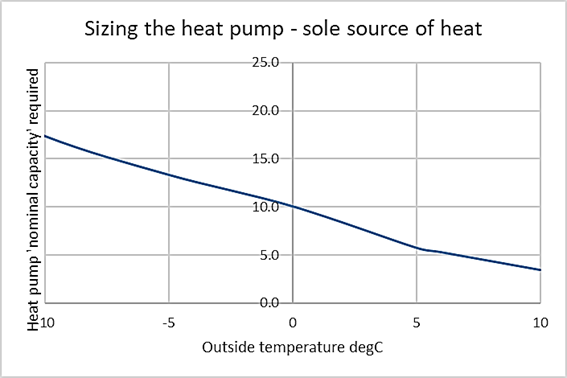
These two factors mean that the increase in design size of the heat pump for satisfactory heat in cold climates is rather bigger than for a conventional boiler. This is shown graphically here:

The following chart shows an example of how the heat pump rated output needs to increase as the design external temperature decreases, taking into account the need for more heat at lower temperature and the reduction in heat pump output at lower temperature.

If we choose a heat pumps size that can cope with a very low outside temperature, then we need a big heat pump.  So if we decide we must rely only on the heat pump at minus 10C then the heat pump will need to be 3.5 times bigger (and more expensive) than if we design the heat pump down to plus 5C. 

If we were to design for 5C, then what do we do when the outside temperature drops to -15C? In simple terms we need to provide some additional supplementary heat. There are many ways of supplementing the heat from the heat pump, perhaps by using a wood-burning stove, or electric fans. 

However, for the air to air heat pump solution, and attractive option in a ‘retrofit’ situation is to retain at least part of the current heating system as a ‘backup’ – for use only in the coldest weather.  In other words: if you fit an air to air heat pump, don’t rip out the current central heating system – just avoid using it unless absolutely necessary. 

This is not an option if the boiler is being replaced by an air to water system or a ground source heat pump system.

How many units, and where to put them?

In a traditional radiator based heating system, you can work out the heat needed for each room and put in a suitably sized radiator – each room having at least one radiator. Many radiators are only 1kW or less. If you are retrofitting air to air heat pumps you may want to economise significantly on that option, not least because the smallest internal unit is typically over 2kW.

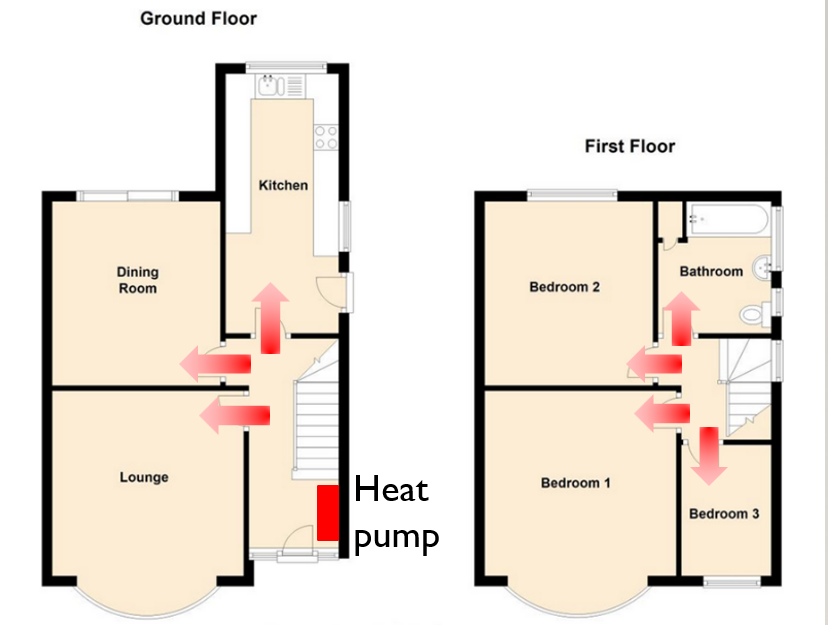
In my own home, a traditional 3 bed semi, we have 8 rooms and had 8 radiators. We chose to fit a single internal unit in the hallway and our experience shows that we could heat all the rooms adequately simply by allowing the heat to dissipate through open doors into the occupied rooms. The temperature in the hallway needs to be higher than the temperature required in the other rooms – so if you follow a similar approach you will need to experiment with the ideal temperature setting on the air-con unit to sufficiently heat the other rooms. We also find that this approach does not heat the bedrooms to such a high temperature as the downstairs rooms. This suits us, but to avoid this, fit an internal unit on each level in the house.

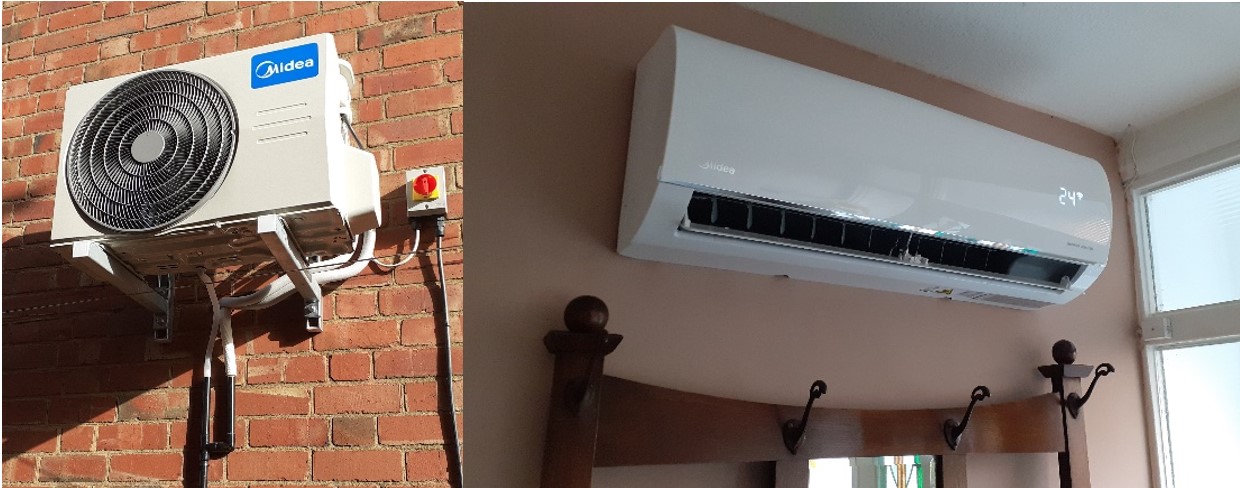
The picture below shows our internal and external units.

A single unit may not be sufficient for a larger our more complex house, but it is very likely that two or perhaps three internal units would be enough for most houses. There is perhaps as much art a science to where to put them, but think about where you would put a fan heater to best circulate the heat – that is in effect what these units are.

Note too that the internal unit does not need to be mounted on an external wall. Indeed, the most effective position may be in the middle of the house so that for the heat to finally escape it will pass through all the other rooms.

Often there is a single external unit for each internal unit, but a ‘multi-split’ system can provide many internal units run from a single external unit.

Our heat pump is size matches the steady state heat loss at around zero degrees outside temperature. In comparison, our boiler heat capability is perhaps five times as big. This high capacity is needed because traditionally the boiler would be turned off to save energy at night or when the house is unoccupied, and so a very high heat input would be needed to bring the temperature back up to comfort level. Since the heat pump is so efficient it can be run 24 hours a day, maintaining the temperature and avoiding the need for a short burst of high energy consumption. So, unlike a central heating boiler, the total heat pump capacity needs to be selected to match the steady heat loss from the house.

If you want an idea of how big a heat pump you might need, you could use an online radiator size calculator such as https://www.bestheating.com/btu-calculator for each room, and then add up the total for the house. This is likely to be rather higher than the steady state required, as the radiators need to be able to heat the house quickly from cold perhaps twice a day and to deal with the very coldest outside weather. I developed my own calculator to work out the heat loss, and taking into account the characteristics of a typical heat pump I can work out a heat pump size.

In conclusion – I hope that this is helpful, but it is a quite abbreviated summary of my experience and it may not be written as clearly as it should. If you have any comments or feedback, please get in touch. Thanks.

The secret heat pump that doesn’t cost the earth

There is a lot of noise about air source heat pumps at the moment, and in particular air to water heat pumps that replace the gas boiler in your house and feed the radiators. Heat pumps are extremely energy efficient, because instead of generating heat (from gas or electricity) they pump heat from outside a building to the inside. They might pump 3 – 4kW of heat for every 1kW of electricity that they use.  But systems that replace your gas boiler are costly, according to the Energy Saving Trust “Typical costs are around £7,000 to £13,000” https://energysavingtrust.org.uk/advice/air-to-water-heat-pumps/

An air to water heat pump system typically heats the water to 50 degrees C. This is lower than a normal central heating boiler, and so you might need bigger radiators for the system to provide enough heat to each room, or expensive additional insulation to reduce the heat demand. Air to water heat pump systems need space for the internal plant, and installation will take days and be very intrusive. This is probably why the government has little take up of the Boiler Upgrade Scheme.

There is an alternative to these expensive air to water heat pumps, namely air to air heat pumps – commonly called air conditioning units.

In an air to air system, instead of the heat pump being used to heat the water for your central heating radiators, it heats the air directly in a fan unit inside the house – hence the term “air to air”.  In effect, it is an extremely efficient fan heater. Air to air heat pumps are better known as air conditioning units because they have the additional advantage of being able to provide cooling in summer, making life bearable when outside temperatures are 40+ degrees.

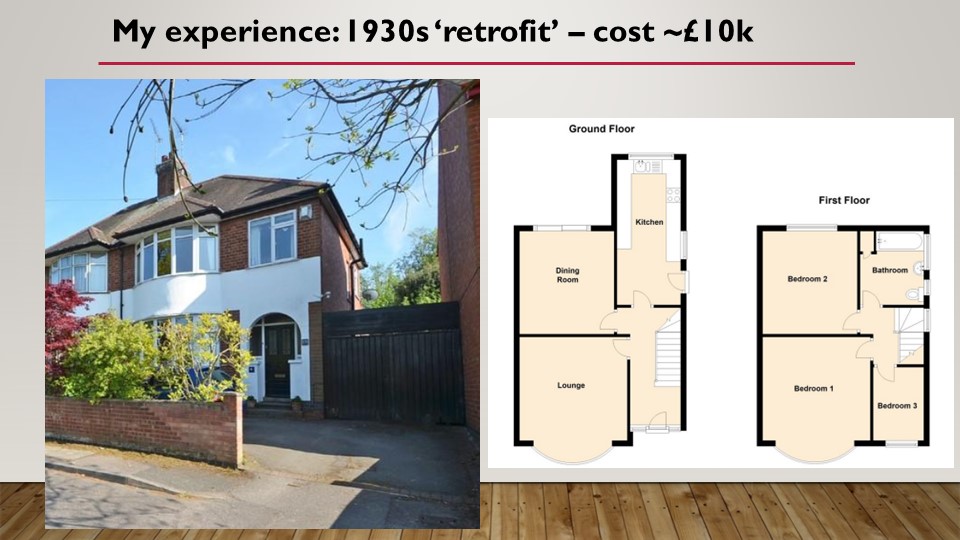
We live in a typical 1930s 3 bedroom semi-detatched house with solid walls. We paid around £1500 for a 4kW air conditioning unit. It was installed in less than a day and sited in the hallway it provides heat to all the rooms in the house.  There is none of the ‘plant’ associated with air-to-water heat pump systems and so no loss of space.   Because the unit pumps heat, it only takes 1kW of electricity to provide 4kW heat – the most efficient heating technology on the market.

These pictures show the internal and external units.

We have been delighted with the performance.  The heat from the hall dissipates throughout the house through open doorways (both upstairs and downstairs), and we can avoid heating rooms that we don’t use simply by closing the doors. 

We have retained our gas boiler to heat our water, but have removed several radiators. We have kept a few as backup but have not had to use them. We have a wood burning stove to lift the living room temperature in the evenings and provide supplementary heat in the very coldest weather. Our only ‘regret’ is that we didn’t fit a slightly bigger unit, which would be better when temperature outside reached -5 to -7 degrees.

The chart below shows how much our energy consumption has changed as a result of the heat pump. Combined with our solar panels and renewable electricity supply, our house is now net zero.

In summary, there is a readily available, low cost, low disruption, extremely high efficiency heat pump available which you can install straight away without having to make your radiators bigger or spend thousands on insulation, and which will also provide cooling in summer.

So why haven’t we heard of this before? I don’t know – but you are in on the secret now.

A heat pump strategy that works.

The government heat pump strategy is on the rocks.  I present an alternative, with data to prove that it would work.

The government is offering a ‘boiler upgrade scheme’ whereby the present boiler is replaced by a heat pump.  This is failing because the cost of the heat pump are typically over £7000[i].  And on top of that, radiators may need to be increased in size in order to provide the same heat as the boiler that is being replaced.  Installation would be disruptive and take many days.  People are unfamiliar with the technology (although it is in their fridge) and don’t want to risk it not working properly, or the efficiency gains not being as high as expected.  The approach is an ‘all or nothing’ approach, whereby the existing heat source is scrapped and fully replaced – there is no going back if it doesn’t work.

An approach that would work, and which I have demonstrated successfully in my own home, is to provide a high efficiency heat source that provides a base load of heat in addition to the present boiler system

The high efficiency heat source uses heat pump technology, but without the complication of integrating with a water radiator system.  The ratio of heat out to electricity in is around 4 to 1, which is better than that of the boiler replacement heat pump which in practice only offers around 2.7 times as much heat as the electricity it consumes[ii].

The technology is air conditioning air to air heat pumps. It is well proven, and we encounter it every day without realising it in shops, offices, and hotel rooms.  It works.  It is many times cheaper, simpler, and faster to instal.  And in addition it can provide cooling to make life tolerable in heat waves – something that will be more important in the future.

Let me describe our application.  We have a traditional 3-bedroom semi-detached house built around 1930.  we have fitted an air-to-air heat pump in our hallway, which provides around 4kW heat for around 1kW electricity.   Installation took half a day, with minimal disruption.  The outdoor unit is on the wall back-to-back with the internal unit, with no pipe runs inside the house.  The cost was under £1500, a fraction of what we were quoted for air to water systems.

We retained our gas combi-boiler to provide hot water, and to allow us to top up the heat if needed.

For every kilowatt hour (kWh) electricity to the heat pump, the gas usage reduces by 4 kWh.  The question is how many kWh the heat pump can provide.  Our house needs around 7000kWh heat per year, using up to 60kWh gas per day in mid-winter.  A 4kW heat pump running flat out could provide 4kW x 24hr = 96kWh of heat per day – more than enough to eliminate the need for the gas boiler, and offering the possibility to reduce our energy use by 75%.

But how did it perform in practice?  It performed well! 

The chart below shows our total energy use, which includes heating, cooking, washing up, showering, watching TV – everything.  As you can see achieved big energy savings.  Not quite 75% each month, but dramatic.  Over the heating season we saved 5500kWh of energy.  Since the cost of electricity is much higher than gas, at today’s tariffs you won’t expect to save a lot of money (we saved less than £50 over the winter) UPDATE – WITH THE NEW ENERGY CAP RATES THIS WILL SAVE US £180 PER YEAR . 

In order for the heat to spread around the house we set the heat pump temperature to maximum, and to maximise the heat into the house we left it running overnight in the coldest weather.  Both of these reduced the real saving compared to the theoretical, but both made the house warmer and more comfortable.  Remember that this approach still leaves the opportunity of using the gas boiler.

Although it is important not to use the cooling function unless really necessary, the technology makes life manageable in the ten or so days of extreme temperature in the summer.

So what’s the way forward?

If you are willing to spend £1500 to cut drastically cut your carbon footprint and save you £1200 each year then why not just go for it. 

Or perhaps the government might adopt a strategy to encourage roll-out.

The government has set aside £450 million for the boiler upgrade scheme, offering £5000 per installation[iii]. If successful, that would provide the less efficient heat pump solution to 90,000 homes – and only in households that can afford the difference between the grant and the actual cost.

Instead, it could channel the same budget into air conditioning heat pumps as described above, offering perhaps £1000 per home, that would provide highly efficient heat pump solutions to 450,000 homes – including those who are less well off. 

We have found that several friends and acquaintances have followed our example, having seen how the technology works, and so the 450,000 homes might well encourage another two homes each, giving a total of nearly one and a half million homes saving 5000kWh each per year. Now that would be a heat pump strategy that worked.


[i] https://energysavingtrust.org.uk/advice/air-source-heat-pumps/

[ii] https://assets.publishing.service.gov.uk/government/uploads/system/uploads/attachment_data/file/606818/DECC_RHPP_161214_Final_Report_v1-13.pdf

[iii] https://www.greenmatch.co.uk/blog/clean-heat-grant

The secret heat pump that doesn’t cost the earth

There is a lot of noise about air source heat pumps at the moment, and in particular air to water heat pumps that replace the gas boiler in your house and feed the radiators. Heat pumps are extremely energy efficient, because instead of generating heat (from gas or electricity) they pump heat from outside a building to the inside. They might pump 3 – 4kW of heat for every 1kW of electricity that they use.  But systems that replace your gas boiler are costly, according to the Energy Saving Trust “Typical costs are around £7,000 to £13,000” https://energysavingtrust.org.uk/advice/air-to-water-heat-pumps/

An air to water heat pump system typically heats the water to 50 degrees C. This is lower than a normal central heating boiler, and so you might need bigger radiators for the system to provide enough heat to each room, or expensive additional insulation to reduce the heat demand. Air to water heat pump systems need space for the internal plant, and installation will take days and be very intrusive. This is probably why the government has little take up of the Boiler Upgrade Scheme.

There is an alternative to these expensive air to water heat pumps, namely air to air heat pumps – commonly called air conditioning units.

In an air to air system, instead of the heat pump being used to heat the water for your central heating radiators, it heats the air directly in a fan unit inside the house – hence the term “air to air”.  In effect, it is an extremely efficient fan heater. Air to air heat pumps are better known as air conditioning units because they have the additional advantage of being able to provide cooling in summer, making life bearable when outside temperatures are 40+ degrees.

We live in a typical 1930s 3 bedroom semi-detatched house with solid walls. We paid around £1500 for a 4kW air conditioning unit. It was installed in less than a day and sited in the hallway it provides heat to all the rooms in the house.  There is none of the ‘plant’ associated with air-to-water heat pump systems and so no loss of space.   Because the unit pumps heat, it only takes 1kW of electricity to provide 4kW heat – the most efficient heating technology on the market.

These pictures show the internal and external units.

We have been delighted with the performance.  The heat from the hall dissipates throughout the house through open doorways (both upstairs and downstairs), and we can avoid heating rooms that we don’t use simply by closing the doors. 

We have retained our gas boiler to heat our water, but have removed several radiators. We have kept a few as backup but have not had to use them. We have a wood burning stove to lift the living room temperature in the evenings and provide supplementary heat in the very coldest weather. Our only ‘regret’ is that we didn’t fit a slightly bigger unit, which would be better when temperature outside reached -5 to -7 degrees.

The chart below shows how much our energy consumption has changed as a result of the heat pump. Combined with our solar panels and renewable electricity supply, our house is now net zero.

In summary, there is a readily available, low cost, low disruption, extremely high efficiency heat pump available which you can install straight away without having to make your radiators bigger or spend thousands on insulation, and which will also provide cooling in summer.

So why haven’t we heard of this before? I don’t know – but you are in on the secret now.