Four things to check in manifesto costings

During an election all parties make commitments to do things which cost money.  Voters expect them to put a cost against each item.  Commentators then add up the costs and say that this is what each party is going to spend.  This process is way too simplistic to make meaningful comparisons.

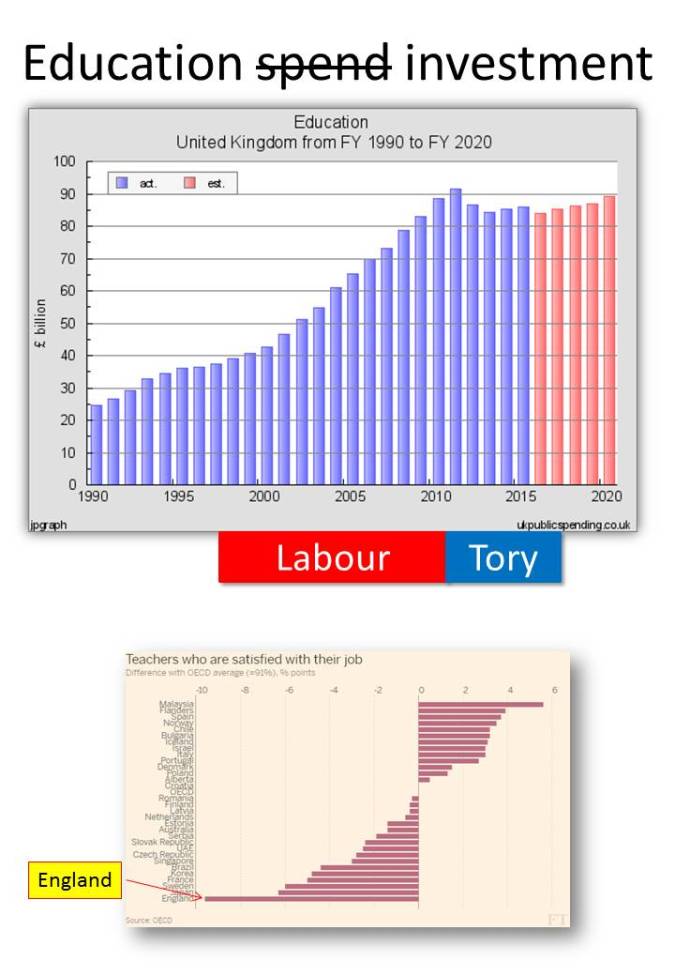
Spend v invest

 If I spend £5000 on a holiday, when I get home all I have left are the memories.  If I spend £5000 on a car I have both the asset of the car and the cost saving of reduced bus fares.  I have ‘invested’ in the car, instead of ‘spending’ on the holiday

If a government ‘spends’ on purchasing assets, particularly those which will generate revenue, then this is investment – and a saving for the future.  The assets of the nation will have increased.

Similarly, if a government sells off assets and then spends the money it is really a ‘spend’ and should be reported as such – spending our savings.

The cost of unemployment

As a civilised society we provide a safety net for those who are unable to work at a given time.  If a government ‘spends’ money on something that allows them to work then there is an immediate saving in benefit payments.  Plus there is an increase in government income from tax and NI contributions, and VAT on whatever the person purchases with their income.

Maintaining health and Correcting past shortfalls

A household could cut down on their spending by stopping eating.  This is clearly a crazy thing to do, leading to wasting and death.

Similarly certain basics of infrastructure of society need maintaining, without which society becomes sick and will eventually fall apart.  Making ‘savings’ in these areas are extremely costly on the health of the nation, and correcting past shortfalls takes more time and effort to remedy than if the ‘saving’ was not made in the first place.

The cost of impatience

If you want something immediately it always costs more than if you are ready to wait.  We can pay a high price for ‘same day delivery’ or we can get free delivery in a few days time.

A government can also make expensive choices from impatience.  Setting a deadline by which a deal has to be done significantly weakens the negotiators hand and will always lead to a more costly deal

So when we look at election costings we must not simply look at a totaled up figure.  We really need to think about what category they are in.  Are they investment,  are they too high due to impatience,  are they compensating for past under-investment,  are they allowing people to contribute usefully to society through good jobs?
Great Britain? I hope so.

Eighty years ago this nation was at a crisis.  Politicians of the day worked together for the good of Britain and Europe.  The monarch was respected and brought hope to the people suffering – visiting Coventry after the horrific bombings, addressing our nation and urging us to pull together to fight against fascist powers that were oppressing the poor, the weak and the scapegoat Jews.  It was a time where national values and pride meant doing the right thing for our neighbours.

Fast forward to today.  We have in power an unelected leader who is treating our Queen with contempt, as a tool to be used as he sees fit.  We see those in high office treat our honourable institution of parliament with utter disrespect – lounging on the front benches. New scapegoats are created.  Our traditions are trampled.  Unelected oligarchs and manipulators hold powerful positions.  The similarities with the fascist regimes that “Great” Britain united to defeat are startling.

We will have a general election soon.  It will be a test.  Has our nation abandoned the values that we once held dear, and for which men and women gave their lives in our finest hour?  Or will truth and goodness prevail?  This will not be an election about Brexit, but it will be a test of what we are as a nation.  It will be a test of our values.  I hope and pray that we will choose truth, justice and honour.

More than a General Election

8th June 2017 was so much more than just a General Election.  I am writing this on June 9th with a joyful heart.  I give thanks that Love, Joy, Peace, Kindness, Gentleness, Faithfulness, Patience, Goodness and Self Control are not dead. But I am also aware that neither are hatred, anguish, fear, selfishness, aggression, betrayal, impatience, evil and knee-jerk responses.

The things on the first list are “the fruit of the spirit”, those on the second list are natural human responses to situations.  We have all experienced both lists – giving and receiving – and we know that the first list brings life, the second brings despair.

I have learned that the first list is not just fruit of the spirit, it is God within us– whether we recognise it as him or not.  God is love, and love is God.  God is joy and joy is God….  When we experience love, we are experiencing God.

The second list describes the absence of God.  Hatred is the absence of love, anguish is the absence of peace…

Yesterday showed that God is still present in us.  But it also showed that we can behave in very selfish ways. Many of us have selfish habits and responses that we cannot control, and think that we cannot get rid of.  Believe me, we can conquer them! Talk to me privately if you want to know more.

Politics is important, but much of politics is about making the best of a bad job.  It is about managing a dysfunctional society which tends to the natural human response.  But I have a great hope.  I hope that we can bring transformation to society.  Let us strive to exercise and experience Love, Joy, Peace, Kindness, Gentleness, Faithfulness, Patience, Goodness and Self Control.  Let us choose God within us.

How to create the society that we deserve.

As a society, we decide what we value. Where do we want our work to generate value?  Do we value our transport infrastructure, do we value our children’s education, do we value our police force, our armed forces, caring for the elderly, the weak and the sick?  If we do, then our work has to be generating value in those areas.

Every hour we work generates more value than we receive as pay.  But who decides where the value that we create goes?  Clearly we can decide where we spend the value that we earn, but the extra value is retained by our employer, often private sector companies.

Businesses are responsible to their owners (shareholders) and have the responsibility to maximise income for the owners.  Their goal is to channel the value that we create to the owners.  Businesses do not have souls. Businesses are only interested in caring for the sick if it generates more income for the owners.  They are purely financially driven.  That is not a criticism but a fact.  It keeps things simple, and can produce very efficient and focussed activities.

In order to create the nation that the people want, we need a regulatory environment that directs value where we want it and allows the businesses to operate within that environment.   That is the role of government, through the tax and regulatory systems.

There is plenty of value generated in this country, we just need to see it allocated to the right areas.  At the moment, too much is allocated to a small number of people.  The activities that benefit us all are not valued enough by the few who decide where to ‘spend’ the value that they acquire.

As a society, we have the right to decide what we value and a right to ensure that our work creates value in areas that are important to us.  If we want to be cared for when we are old, we need people working to care for us.  If we want safe streets we need our police force.  If we want our children taught well we need teachers.

If more people work in these areas, it may mean less people working in other areas.  We may have to accept less people working in the finance industry, or the retail industry for example.  But surely a civilised society values caring for its people higher than moving money around, or selling more stuff?

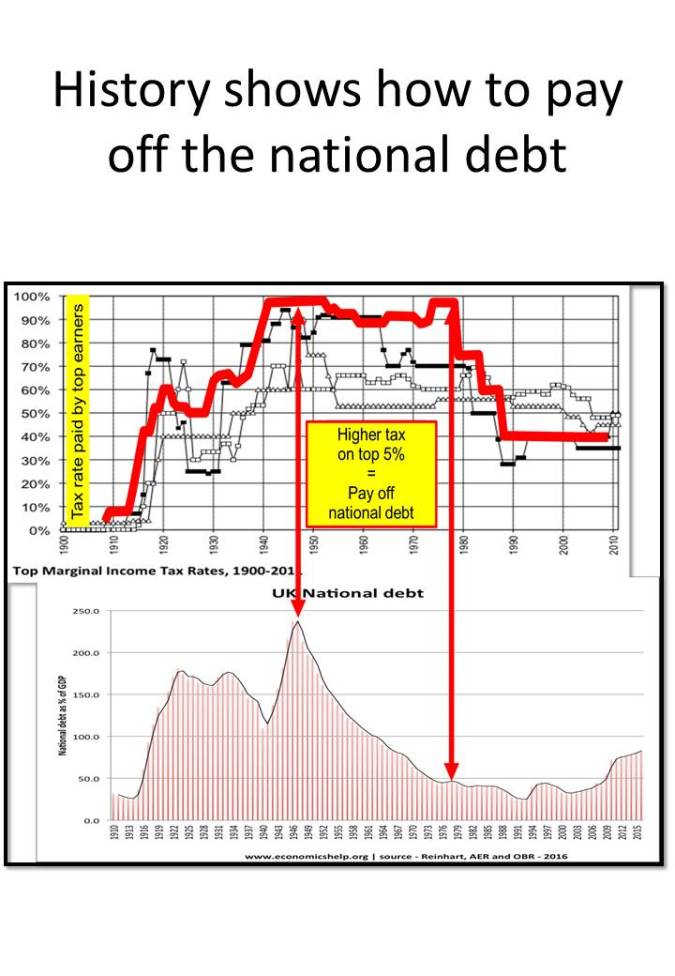
So, we need a taxation system that allows the society that we deserve to be funded.  That is why it is important to regain more control of the allocation of value.  Government needs to take back control from businesses, and from the top 5% of earners.

But what about the argument that ‘they will just go somewhere else’.  The value that is currently channelled to the wealthy is being created here.  It will still be created here.  All that will happen if the owner of a company decides to emigrate is that they will be harvesting the value created in the country that they go to.  The value created in our country will stay here for the benefit of our citizens.

So when we get the chance , let’s vote for the society that we deserve.  Let’s grasp our future with excitement and hope, and not shrink from the opportunity to make this nation great.

Draw your own conclusions

Here is some data.  It should be more powerful than rhetoric.  Draw your own conclusions…

Full employment at any cost?

It should be very rewarding to be in employment.  There should be dignity to providing for yourself, and knowing that you are making a contribution to society.  There should be wellbeing associated with the knowledge of where the next meal is coming from.  There should be the camaraderie of working with others, the team spirit and banter can lift the soul.  There should be the shared bonds of a community gathering around a common cause.

But I fear that these benefits count for little these days.  The goal of full employment under the present government is for economic purposes only.  Zero hours contracts and removal of workers rights support the economic goal …. but the human benefit is lost.

There are historical examples of full employment driven purely by economic reasons.  Slavery provided full employment for the benefits of the slave owners and the government of the time.  Labour camps provided full employment.

When Labour talk about full employment, they are talking about the benefit to each person. “We will create a million good quality jobs across our regions and nations, and guarantee a decent job for all….”

I long to see our nation turn from the god of ‘The Economy’ to the instruction of God to ‘love one another’.  That is why Labour will be getting my vote.

Full employment

Brexit … the great divorce

I have been married for 36 years.  Others are not that lucky, and unfortunately many marriages end in divorce.  Britain’s attachment to the EU is one such case.

Our government is launching into negotiations with the EU.  Let’s see if they are taking good advice.

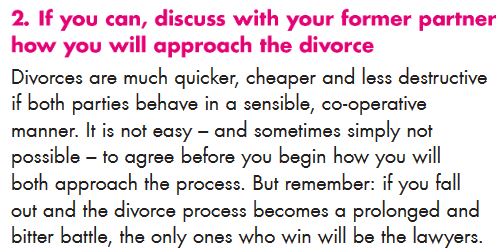
Clearly it is best to negotiate Brexit in a “sensible, co-operative manner”.   It does not do anyone any good to start by making unrealistic demands and expecting to get your own way on everything.

So far all I have seen is uncompromising posturing for the UK press.

I would prefer our negotiations to be led by a government that is “Fair and Reasonable” rather than one which prides itself on pretending to be “Strong and Stable”.

That is another reason that I will be voting Labour on June 8th.

PS – here is advice on negotiating with the EU, which backs up the above http://www.independent.co.uk/news/world/europe/theresa-may-brexit-tactics-wrong-eu-former-greek-finance-minister-yanis-varoufakis-a7721151.html


Why it is right to reverse the increase in Inheritance Tax threshold.

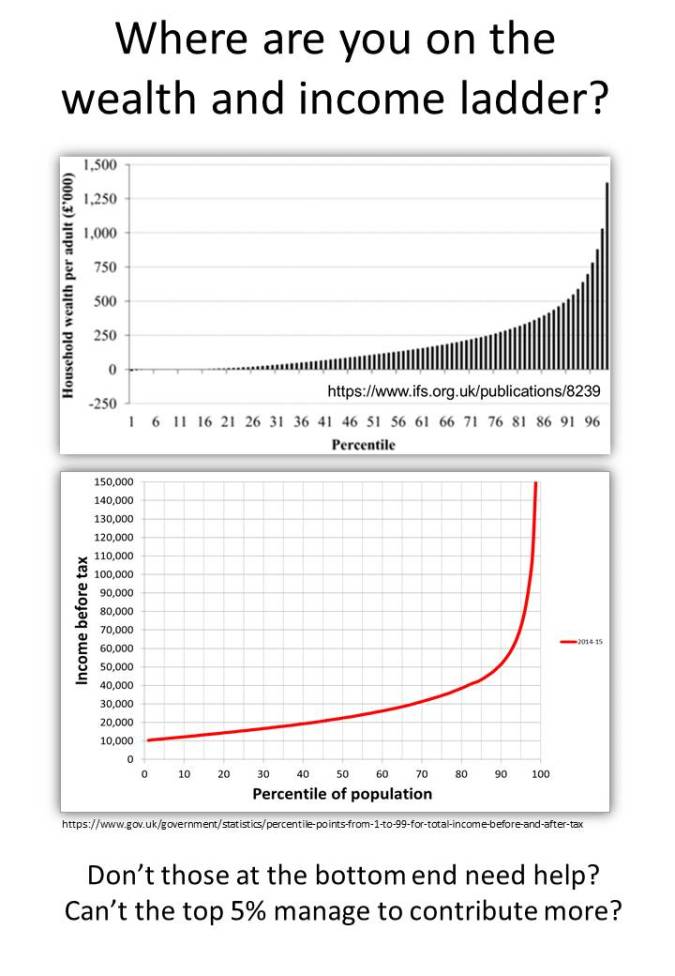
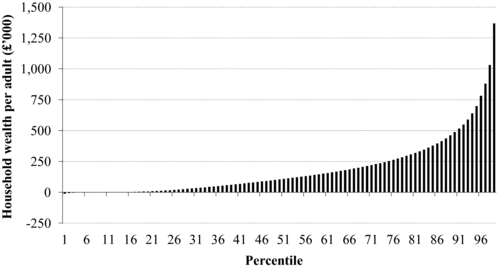
The Institute of Fiscal Studies says that “..wealth is distributed very unequally. One per cent of households have negative net wealth of greater than £12,000 per adult (the 1st percentile), while the 9th percentile is £0 so 9 per cent of households have no positive net wealth. Wealth at the median is £104,000 per adult. Wealth at the very top increases dramatically across a small number of percentiles – the 95th and 99th percentiles are £0.7 million and £1.4 million per adult respectively. In fact, the estimates of wealth held at the very highest percentiles could be underestimates;”

There is no problem with saving your income to increase your wealth.  But there is a problem when inherited wealth means that those who have not had the good fortune to have wealthy parents or ancestors are denied the chance to ‘better’ themselves.

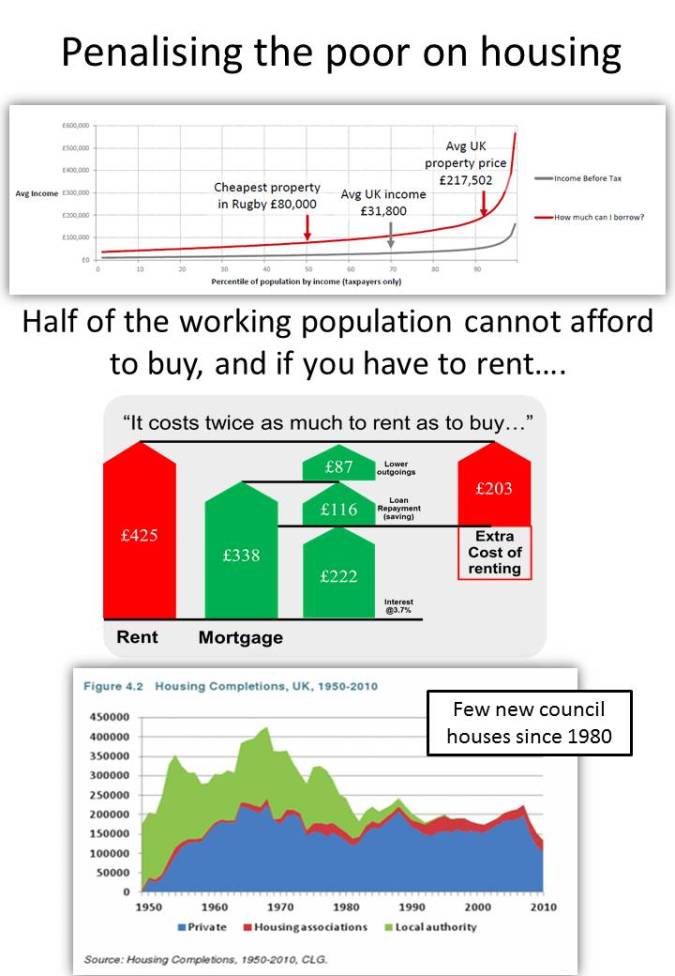
This is more than an academic problem.  For example, for most people, the biggest expenditure is housing.  If you look at how much you can borrow, and at typical house prices then two-thirds of people cannot buy a home without help from someone who has wealth.  The graph above shows that perhaps a third of the population have insufficient wealth to avoid the having to enter the private rental market.  The high cost of renting means they have less chance of building themselves a better future – the rules are stacked against them.

That is why it is right to reverse the increase in Inheritance Tax threshold, we need to even out the playing field.

It is time to cut VAT.

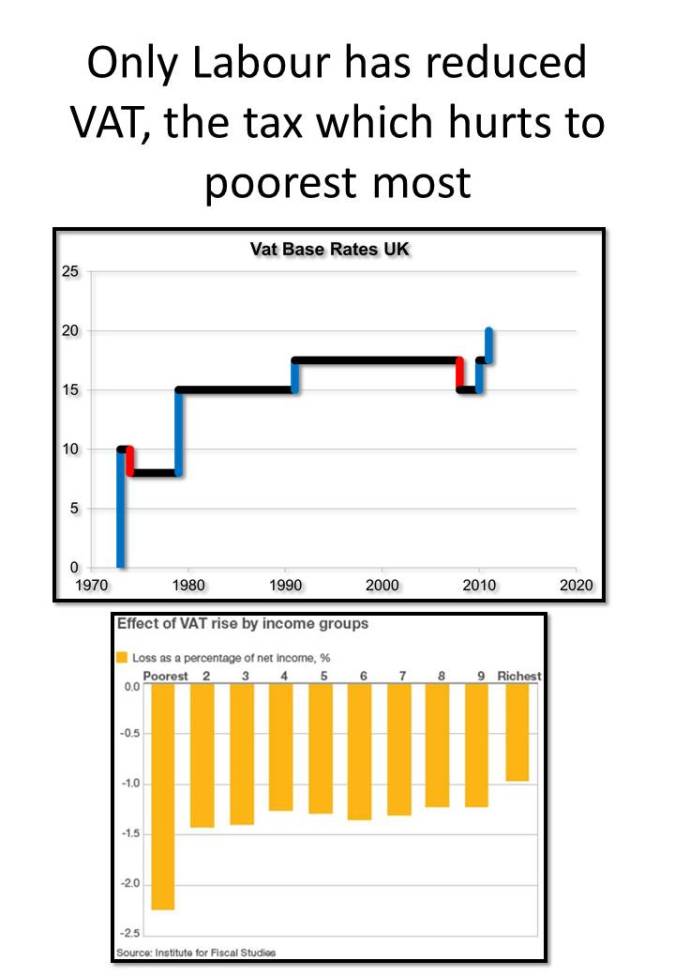
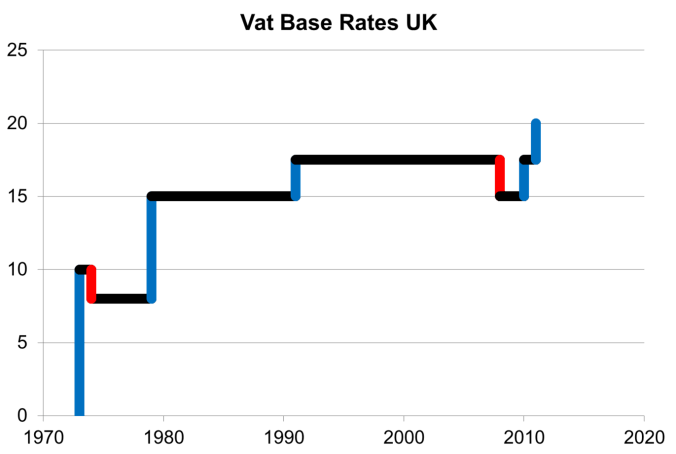
VAT is a tax on what we spend.  Everybody has to pay VAT at the same rate, rich and poor alike.  The following chart shows which parties have changed the basic rate of VAT since its introduction by the Conservative government on 1973.

VAT rate changes

Increasing VAT puts a bigger burden on the poor than the rich, as shown by the following analysis of the most recent VAT risk from 17.5% to 20%:

Reducing the rate of VAT will ease life for the less well off, increase sales, increase business activity and lead to higher employment.  That will increase income and corporation tax revenues and reduce the cost benefit payments as there will be less people out of work.

It is time to cut VAT, not to consider increasing it.

Why public ownership makes sense

If I need some basic repairs carrying out on my car or my house, I know that the cheapest way to get the repairs done is to do it myself.  It is faster and easier and cheaper.

Why should it be any different for the nation?  If we want cost-effective roads, railways and other essential infrastructure, it is common sense for us to own and maintain them ourselves.  It’s faster and easier and because we are not paying someone else’s profits it is far cheaper.  Public ownership simply makes sense.

Other nations make a success of it. They are even running our rail services and taking the profits for their governments.

Keolis is 70% owned by the French government’s national rail service SNCF. It owns 35% of Govia, which runs the Govia Thameslink, Southern, Southeastern and London Midland franchises.

Arriva UK Trains, which operates a string of services including Chiltern, CrossCountry, Grand Central, Northern, Arriva Rail London and Arriva Trains Wales, is owned by Deutsche Bahn – whose sole shareholder is the Federal Republic of Germany.

Abellio is the international arm of the state-owned Dutch national rail operator Nederlandse Spoorwegen.

If you really want to upset yourself about this, watch the video: https://www.youtube.com/watch?v=gvagsSOlAy4

Do we think so little of ourselves that we can’t do the same?  Isn’t it time to bring essential public services back into public ownership?