The wonder of life: a slipped disc can heal itself!

I have just about recovered from damaging my back twice in succession.  Two lots of 6 weeks out of action and on constant painkillers has not been fun.  These days one expects that the doctors will just be able to fix stuff, but the ‘treatment’ available was basically take painkillers and when it’s feeling well enough do some exercises to strengthen it.

So it was down to me, or at least my body to fix itself.  Although I don’t think I had a slipped disc, with nothing much to do I spent some time on the internet to understand more about back problems and found that “The body’s defense mechanism can spontaneously retract, shrink, or eliminate disc herniation.” https://www.spine-health.com/blog/can-herniated-discs-heal-their-own

Just let that sink in for a moment. 

If my car has a worn joint, there is no way that it can heal itself.

If a computer program has a fault there is no way it can heal itself.

There is nothing that I personally can do to cause my back to heal.  It is ‘simply’ that my body has the ability to heal itself.  And if you look at how our bodies heal themselves, and how our immune systems work you will be astounded by the complexity of the processes.

Now I don’t want to question the process of evolution, but it is beyond me (or I believe beyond anyone) to explain how a completely unguided or undesigned process would lead to a mechanism within the body to heal a slipped disc.

And even if that’s not a challenge enough, isn’t it astonishing that the fabric of the universe; the raw elements (Hydrogen, Carbon, Oxygen etc) can combine together to create a living organism that contains within it the power to heal itself of a slipped disc?

We take these things for granted every day and grumble when our bodies don’t function as ‘normal’.  Isn’t it more appropriate to take a step back and let the wonder of what our bodies do do just sink in?  And maybe to thank the creator of the universe for the amazing gift of our lives?

Have a blessed day.

https://www.instagram.com/pixvalen/

How do we manage the pressure to worry and despair about what is going on in the world?

There is so much that we can see that is worrying, and that we can do nothing about.  (As I write this Los Angeles is suffering intense wildfires, Trump is threatening to take over Greenland, the wars in Ukraine and Gaza are still taking lives, global temperatures continue to rise…)  Yet if we didn’t look at our TVs, papers or phones we would know nothing of this – and surprisingly little is ‘in our face’ – we are not directly affected by most of the list above.

The secret is to realise that we are not God.  These things are beyond our power to control, but we are not helpless or hopeless – we can play our part using the prayer that Jesus taught us:

“May Your kingdom come; may Your will be done on earth – as it is in heaven”

We might reflect that what is going on actually is God’s will; his permissive will.  Throughout history greedy, power hungry bullies have oppressed ordinary people and we have ransacked the natural world.  Jesus was fully aware of the brutal Roman regime, but he didn’t overthrow it.  He healed people, focusing on the individuals around him – and we can do that too.  We can pray the Lord’s prayer and leave the state of the world in his hands, but then get on with interacting with those around us according to his will.  We don’t care less about the global situation, but we can worry less. And we can use our energy to influence our local communities instead.

After putting the world’s troubles in God’s hands, the Lord’s prayer allows us to ask for God’s heap meeting our own needs:  give us our food for the day, forgive our sins (as we forgive), don’t let us yield to temptation, save us from evil.  All of which do personally affect us day by day, and which will allow us to fulfil our daily purpose.

Jesus’ prayer is a powerful gift from God.

Excerpt from The Big Picture: “Am I Open Minded?”

As we start out ask yourself the question, “Am I open minded, ready to follow where evidence leads, with no preconceptions?”

Now I’m sure you’ve answered “yes” because none of us would like to admit otherwise, but actually, it may be impossible to start any investigation without preconceptions.   They are the motivation behind many investigations … the desire to obtain proof of what we already think about something.

Preconceptions are almost inherent in the scientific approach – we think of a theory, and then we investigate to test it.  If we are honest, we will admit that we like our theories and feel good when they are proved right.

Perhaps there is one preconception that I will allow at this stage; that each one of us matters. I matter. You matter.  Our friends and neighbours all matter.  If we don’t matter then there is no point in anything and it’s best not to think any deeper.  That road leads to despair.

If we are going to explore these questions fully we are going to have to consider questions of God, science, reason, history and more.  We are going to have to include objective data and subjective experience; objectivity keeps us from being deluded but it is the subjective that really matters to us.

Even if we try to think about an issue with an open mind, we nevertheless carry many assumptions that we don’t realise.  Speaking personally, my scientific education and engineering career have both instilled a basic assumption of materialism: the fabric of the universe is all there is.  When people talk about a spiritual dimension, is it just another material dimension that we can’t see?  And if there is a spiritual dimension, how can it interact with the physical universe?  Or if there isn’t a separate spiritual dimension then where does God exist?  These are not straightforward questions, but I’ve come to realise that they are valid.   I have had to challenge a lot of what I took simply as common sense and to open my mind to new possibilities.

It can be difficult to refresh our way of thinking, particularly if we are surrounded by others who have a similar outlook to ourselves.  In a recent discussion on European history with a university student he mentioned that such and such country was fascist.  It led me to ask what it is that makes the people there fascist.  Is it genetically programmed into each individual there?  If you took any one of them and brought them up elsewhere would they be fascist?  I think it likely that they wouldn’t.  They are fascist because everyone around them is fascist.  They are unconsciously trained to be fascists.

So what are we doing in our country?  What are we training ourselves to think like?  What assumptions do we hold, and are they valid?  Books such as The Science Delusion by Rupert Sheldrake[i] challenge many of the assumptions of the day.  He asks us to challenge our scientific dogmas, our blind assumptions.  Even if we end up thinking the same as we did before, we have a more solid basis for our beliefs if we go through the process of challenging our assumptions.

Implications

Whenever anyone is presenting a case we might ask ourselves, “If I were to accept what is being presented and agree with the author, what would be the implications for me?  How willing would I be to accept those implications?  Do I need to understand the implications before I start?”

Many parents choose not to have their babies tested for Down’s syndrome because they would not be willing to accept a termination of the pregnancy and so feel that there is no point in knowing before the child is born.  Others might need to understand all the implications before deciding; how accurate is the test, and what are the options available if the child tests positive? Still others might insist that they must have the test because they are not prepared to risk having a child with Down’s syndrome and would terminate the pregnancy if that were shown to be likely by the test.

This is a book that deals with questions of God.  This may worry some people. If they were to be convinced that God is real they would have to become the sort of bigoted judgemental fanatic that represents the worst face of religion.  They may think that they would need to join a religion and accept all that they are told without thinking, and be associated with all the religious atrocities of the past. Or that they will have to give up their Sunday morning lie-in and trot off to church with a bunch of hypocrites. If these thoughts resonate with you, take courage – it doesn’t have to be like that.

Fear

People can be frightened by the prospect of change, but often change is beneficial.  For instance, when redundancies are announced, there is a lot of fear in the workforce.  Some may have been in the same job for thirty years, and they simply don’t know anything else – how will they cope if they have to find another job?  And yet being forced to change jobs can be a most liberating and life-changing experience.  I recall hearing a report that those who remain behind after a round of redundancies are likely to be more stressed than those who have been made redundant.  They are still in the same job, but with increased fear of losing it and still in fear of change, whereas those who have left are now busy rebuilding their new lives and careers.  That’s not to say it’s easy to change, but a change in a job or a worldview can be very liberating.

Peer Pressure

Perhaps we don’t want to change our views because of what others might think of us.  We’ve probably aired our opinions sufficiently to our friends that any major change would be an embarrassment.   Or perhaps we live or work in a culture where there is only one accepted way of thinking.  We might find that we have to live a double life, adopting one attitude at work and another in private.  For instance, to progress a career as a scientist it is necessary to publish papers and learned articles.  Such articles are subject to peer review.  This process is in place to ensure that sound scientific information is published and that mistakes do not get propagated.  But the process inherently risks that only those papers that conform to the present scientific way of thinking are published.  If a scientist becomes too free thinking, then the peer review process may prevent his papers being published and his career may come to a grinding halt.  Reputation is essential, and doing anything that might lose it is risky.

An ambitious scientist may be fearful of embracing religion.  Religion allows that God might interfere with the workings of the world.  That might mean that the universe is not completely predictable, which would seem to undermine the basis of all the work of science.  Allowing the existence of God might mean that it will be impossible to have a complete scientific theory that predicts everything – which is challenging to anyone who invests their life in seeking it.

Similarly, in religious circles it can be damaging not only to one’s career but also to one’s life to challenge the current way of thinking.  Men and women have been labelled heretics and have been burnt at the stake for holding different religious beliefs.

Religious people may have a deep fear of science.  Apart from the vocal assertions made by some atheists that science has done away with God, there can be fear that science might undermine or even disprove certain traditions or beliefs that the given religion may hold dear, or even sacred.  A religious man may have invested so much in his religion that he’s lost the desire, and maybe even the ability, to be open to learning that some of what he’s been taught is incorrect.  Yet surely a truly godly man would be desperate to be corrected if he were misunderstanding God?  In her book Awesome God, Sara Maitland encourages religious people to embrace what can be learned from science:

Start with “God exists” and everything we can learn will tell us more about God.[ii]

So returning to the question, “Am I open minded, ready to follow where evidence leads, with no preconceptions?” we can see that it is almost impossible not to have preconceptions or preconditions.  A first step in challenging them is to consider how we came to believe them in the first place. How did we come to really know what we know?

[i] Rupert Sheldrake: The Science Delusion ISBN 978-1444727944

[ii] Sara Maitland: Awesome God: Creation, Commitment and Joy ISBN: 978-0281054190
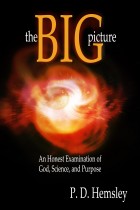
Foreword to The Big Picture

Scientific discovery has brought material benefits and physical comfort to mankind.  The predictability of matter leads us to assume that it behaves according to fixed laws, and this belief has led engineers to develop tools and machinery to manipulate the environment, doctors to develop cures for many diseases, and farmers to grow crops with greatly increased yields.  Many of the scourges of previous times have been overcome leading, in the Western world at least, to longer lifetimes and better health.  However, this has also led to the belief that everything is predictable and controllable. If anything goes wrong (by which we mean it causes us distress or discomfort) then it must be fixable, and if it hasn’t been fixed it must be someone else’s fault.

Personal rights have grown, but personal responsibility has diminished.  Laws to protect the weak have bred the belief that it is the state’s job and not our individual duty to help out those less fortunate than ourselves.  Mechanisation that was supposed to give more leisure time has led to lost jobs and loss of purpose.  Competition and the shrinking of the geographical world has meant that there is someone, somewhere who will work harder or longer hours than we do, and the pressure grows to produce more for less.  The availability of loans means that goods can be obtained now if we promise to pay later.  To pay the loan we need a job.  Fear of job loss drives us to work longer hours and accept less pay. The purpose of life becomes to produce.  The mechanism which fuels demand and production is the economy.  The economy becomes the measure of the health of a nation.

Is that what it’s all about?

Is my value simply what I can produce?

Am I measured just by what I can earn?

If I retain the worldview that the economy is king then the implication is yes, but that doesn’t feel right.  I want to be valued and loved as a person.  I want a worldview that speaks to my heart and my mind and not just my wallet, and I want it to be based on sound thinking and evidence.

Science has brought great technological and medical benefits to mankind; cars, televisions, fridges, telephones, electricity and so on.  But science has also brought guns and bullets, pollution, global drug trafficking and job losses.  Science seems to dominate my life, telling me what I should or shouldn’t do to keep healthy, avoid risk and live longer, but it doesn’t tell me why I would want to live longer.  Science doesn’t give any purpose to my life.

Religion offers purpose, but it too seems to want to control me and dominate me.  Religion has been used as justification for many great atrocities: the Spanish Inquisition, child sacrifices, the Crusades.  Religious people seem to want to tell me how to behave, and to judge and criticise me, claiming to represent the will of God.

I want to know the truth.  I want to know what science can tell me about how the universe works, and perhaps where I came from.  I want the benefits that science can bring, but not at the cost of becoming a slave to its dictates.  I want to know why I am here, what my purpose in life is, or even if there is one.  If there is a God I want to know what He thinks. I want the benefit of knowing that I have a purpose, but not at the cost of becoming a slave to rules from another human being.

And so I investigate, weigh up evidence in all forms and seek a holistic worldview that works.  I have explored what we know from the physical and biological sciences, and I have researched historical evidence for God. I have tested what is actually known, and what is speculation, extrapolation or personal opinion and rhetoric.

This book presents my conclusions, and some of the evidence that brought me to draw them.  I offer what I believe is a consistent, healthy and constructive worldview based on sound evidence.  I’ve called it Minimalist Christianity.  Whether you agree with my conclusion or not, I hope that many of the myths that currently inhibit so many of us will have been weakened or dispelled.  I hope that a step can be taken towards finding purpose and experiencing life in abundance.

The trampled poppy

It is 14th November 2018, just three days after the Remembrance Sunday where we promise not to forget the loss of lives in the 1914-18 and other wars.

I am woken by Radio 3:

“The headlines today …

  • Half of the nation of Yemen is on the verge of starvation due to war.
  • Melania Trump is upset at where she sat on an aircraft.

And now some Mozart.”

Unusually I have noticed the incongruity and am prompted to draw attention to it in a blog post.  Normally, like you, I would just get on with my day, not sparing another thought to the fact that half of a nation is on the verge of starvation.

It seems that the poppies have already been trampled in the dirt.

How can any of us claim to be without sin?  Isn’t the correct response to our  hard-heartedness that we humbly admit that we are grossly selfish and undeserving?

Yet despite this, we are still given the opportunity to live purposeful lives.  We believe there is some purpose in life, and in death; we have just remembered millions of deaths.  And if there is eternal life we want part of it.

On that day when we die and are asked whether we have led a good enough life to deserve heaven, none of us can say yes. None of us.  Yet heaven will be full.  It will be full because of the person who we celebrate on another day of remembrance – Christmas Day.

Jesus Christ, son of God, crucified.  A single act in history which allows anyone who in their hearts wishes for it to repent and receive forgiveness.  Our active and passive selfish, greedy, hard-hearted and unloving actions deserve death, but we are allowed eternal life because of that one great sacrifice made on our behalf.  It is our choice – death, or humble acceptance of the sacrifice that Jesus made on the cross and life. To trample the cross, or to embrace it.

How to really make Britain great again.

The headline tells us “Brexit to send UK tumbling down world economic league table…”.  and we ask “Is this making Britain great again?”

But the headline, indeed the whole question of where Britain ranks in the world economy has absolutely NOTHING to do with whether Britain is great.  What matters is whether Britain is becoming more human.

Being human has nothing to do with the economy or wealth, but everything to do with values. It is about valuing everybody equally, irrespective of colour, class, wealth or religion. It is about selfless behaviour for the good of others. It is about acting with integrity and speaking truth. It is about doing what is right, irrespective of the consequences.

Britain will become great when those who are well off are willing to contribute enough to ensure the wellbeing of those who are not well off,  when we are willing to give up our own comforts for those who have nothing,  when we are willing to give sanctuary to those fleeing war dispite the risk of personal harm.

Britain will become great when we stop expecting a political system that gives everyone all the rights that they demand, but encourages us all to self-centredness. We cannot demand perfection from public services that we are not prepared to fund. We need to stop demanding perfect treatment from others, when we cannot give it ourselves.  We need to stop demanding that teachers work until midnight to keep up.  We need to stop expecting to be treated in A&E within minutes when we have drunkenly staggered into a lamppost.  We need to stop abandoning our personal responsibility for our own circumstances.

Britain will become great only when we choose to love one another; when we learn to contribute what we can, and to keep our expectations of others reasonable.  That is my hope for 2017.  Make it yours.

“Sorry Jesus, you got it wrong”

Two children are in a fight, and when we separate them both point at the other and shout “well he started it”.  We might respond “well even if he did, you carried it on!”

But as we grow older we forget to apply Christ’s simple but profound wisdom to our own lives.

 “You have heard the law that says, ‘Love your neighbour and hate your enemy. But I say, love your enemies!  Pray for those who persecute you! In that way, you will be acting as true children of your Father in heaven. For he gives his sunlight to both the evil and the good, and he sends rain on the just and the unjust alike. If you love only those who love you, what reward is there for that? Even corrupt tax collectors do that much. If you are kind only to your friends, how are you different from anyone else? Even pagans do that.

 But you are to be perfect, even as your Father in heaven is perfect.”

Of course, as we become adults our disputes are less likely to be over schoolboy issues.  We might have a ‘neighbour from hell’ who takes advantage of us and tramples over our ‘rights’.  And when we respond in kind, and when the conflict escalates we say ‘well he started it’.  And perhaps ‘who are you to criticise what I do?’.

When,  was a Christian,e find ourselves in this sort of situation, do we respond by justifying our actions? Do we argue that Jesus’ teaching is wrong and doesn’t apply to our case?  Or do we admit that we are in the wrong, perhaps too tired or weak to do what we should.  Do we accept that we are falling short of his instruction to be ‘perfect’ (i.e. do we repent) and humbly ask him to work with us to correct this flaw in our character?

If we look elsewhere at Jesus’ wisdom we find that he has already given guidance on how to love our enemy.  Again, we have a choice of arguing that he must have got it wrong, or we can choose to work with him to try to follow his words:

“You have heard the law that says the punishment must match the injury: ‘An eye for an eye, and a tooth for a tooth.’ But I say, do not resist an evil person! If someone slaps you on the right cheek, offer the other cheek also. If you are sued in court and your shirt is taken from you, give your coat, too.  If a soldier demands that you carry his gear for a mile, carry it two miles. Give to those who ask, and don’t turn away from those who want to borrow.”

 “But I say, if you are even angry with someone, you are subject to judgment! If you call someone an idiot, you are in danger of being brought before the court. And if you curse someone, you are in danger of the fires of hell.  “So if you are presenting a sacrifice at the altar in the Temple and you suddenly remember that someone has something against you, leave your sacrifice there at the altar. Go and be reconciled to that person. Then come and offer your sacrifice to God.”

None of us are yet perfect and we all fall short of Jesus standard.  But the critical question is, do we want to be perfect?  Do we want to change and allow Jesus sacrifice and grace wash us clean.

If we want to hold on to our hatred, anger and right to hit back at our neighbour then Jesus cannot help us.  A pastor often told me “Sin cannot get into heaven” … if we want to hold on to our sin, we can do – but we could not be allowed into heaven; we would spoil it for everyone else.  If we choose to hold on to our hatred then we are choosing to separate ourselves from the infinite goodness that is God.

To be clear, I am not judging or criticising anyone who finds themselves in a difficult situation with an enemy. None of us know how we would respond if we were in someone else’s shoes.  None of us can tell another to remove the speck from their eye!  Judgement is for God alone.  But hopefully this post points out simply and lovingly what Jesus tells us.

“the Lord has told you what is good, and this is what he requires of you: to do what is right, to love mercy, and to walk humbly with your God.”

A contemporary Genesis

One morning I felt the inspiration to write a modern version of the Genesis account of creation, incorporating and alluding to the scientific discoveries of recent times.  I hope that nobody chooses to take offence:

Before the beginning of time and matter in our universe, there was God.  Of his works other than our universe we know nothing, but of his works in this universe we have learned much through the gift of our intellect. Of all his purpose in our universe we can know only what he has chosen to reveal to us, and he has revealed that we were his purpose.  One purpose alone or one purpose among many is not for us to know.

God chose to create this universe.  He created time, and then he tore nothingness into matter and antimatter, and in that great explosion from nothing he caused there to be an excess of matter over antimatter.  And he causes matter to interact with matter through invisible forces acting across nothingness. And ripples of that rending apart of nothing remain until this day for us to observe with wonder.

Since God knows his plans, he chooses to cause matter to behave in a consistent way. He allows the tiniest particles to behave in individually unpredictable ways, but in community he causes them to follow his chosen laws.  In the presence of spirit, whether God’s own or that of humans or other spiritual beings, God allows his laws to be suspended.  God continues to sustain and guide his creation, acting as and when he chooses and allowing individuals to choose how to act.

And so for billions of years, although years were yet to be invented, the universe unrolled according to the laws that God had chosen.  Particles formed into atoms, atoms formed into great stars and stars drew together into galaxies.  The first stars grew to such a size that the interaction between the matter and the forces caused great energy and the explosion of the stars, and in those explosions new atoms were formed.  God was making the building blocks of life, the carbon and the oxygen atoms.  Out of those explosions, and according to God’s laws of interaction new stars formed, and planets were formed around those stars.

One of those planets, the earth, had the right conditions for the next phase in God’s plan.  The planet was at first a molten mass, bombarded from space by asteroids and meteors as the turmoil of the formation of the particular sun and galaxy subsided.  A crust was formed on the molten mass, and a gaseous atmosphere formed above the crust.  In that atmosphere and on the crust, the carbon, hydrogen and oxygen atoms joined to form more complex short molecules.  When the time was right, these short molecules formed into long chain molecules.  These very special molecules continued to work according to the laws that God had chosen for the atoms and particles.  The molecules had different purposes, some formed into cell membranes, some formed into little molecular machines, and some formed into very long instruction chains.  And God caused them to be combined into what we today would call cells, and God had given them the mechanism to multiply in number.

To the first cells he gave the task of changing the atmosphere of the earth.  Using the energy of the nearest star, the sun, the cells separated oxygen from carbon dioxide and pumped the oxygen into the atmosphere.  For more than a billion years the cells carried out their task of preparing the atmosphere of the earth, getting ready for the more complex organisms that were next on his plan.

When conditions were right, the individual cells formed into groups or communities that were dependant on each other, where each cell in the group performed slightly different functions and so the new organism was able to both become larger but also to perform more complex functions.  God gave the individual cells the means to evolve a mechanism that would carry the instructions for each cell in the group to perform its function, and to respond to the communications from other cells within the group.  And so, multicellular organisms were formed.

The instructions embedded in each of these cells ran to billions of characters in length.  The mechanisms of the cell and these instructions were both necessary for the cells to operate and grow, and to reproduce from generation to generation.  God didn’t plan to make all organisms identical, so he designed ways and means of bringing variation to the offspring of the organisms.  He allowed “random” variations due to inaccurate copying, and he caused deliberate mixing of the instructions in one organism with another, requiring separate organisms to come together in order to create the next generation.  The organisms themselves thus had to live in partnership and community to survive.

So God had established a process of growing a wide diversity of organisms of increasing functionality that relied on each other to survive and thrive.  Whilst each individual organism would be allowed to behave in an individual way, only those that were successful in progressing God’s plan survived and reproduced.  God chose to allow a process of competition to develop the organisms as he wanted; a process which required individual capability and cooperation between individual cells within an organism, and between organisms of the same type.  Through this phase of God’s plan he used the law of “survival of the fittest” to perfect each organism, and to select which organisms to perfect.  The organisms didn’t know anything of right and wrong.

But that was not the end of God’s purpose, although it took billions of years to accomplish.  His plans were greater than that, for there to be beings in his likeness; beings that would design and create, but more than that, beings that would know right from wrong, beings that would love, spiritual beings that would know and seek God himself.

So he selected one of the organisms and he planted his spirit in that organism and gave it an awareness of God himself, and he gave that organism the ability to know what is right and what is wrong, and he gave that organism the ability to choose to do what is right or what is wrong.  That organism is mankind, the pinnacle of God’s creation. 

You might not be ready to accept this new account. Certainly it is not literally correct, but maybe it is more relevant to today’s society in the same way that the original Genesis was relevant to the society of its day.  It conveys that all of us are spiritual and material beings, willed by God as the culmination of a creative process of unimaginable complexity spanning billions of years, following the creation of time itself.  Mankind: created with the opportunity to know God and to relate to him, but allowed the alternative of rejecting and ignoring him.

Excerpt from “The Big Picture – an honest examination of God, Science and Purpose”

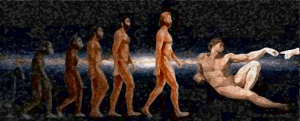
evolution

I think I might be a panentheist – I hope it’s catching!

The ancient Celts knew a thing or two. They were not the wild fighters who the Sheriff of Nottingham brought in to drive Kevin Costner’s Robin Hood from his idyllic woodland village. They had a special understanding of the nature of things. According to “The Celtic Way” by Ian Bradley they held “a conviction that the presence of God was to be found throughout creation – in the physical elements of earth, rock and water, in plants trees and animals and in the wayward forces of wind and storm.”

Bradley goes on to say that “We are not in the world of pantheism here but in the much more subtle and suggestive realm of panentheism – the sense that God is found both within creation and outside it.”

Elsewhere I have written that God is ‘the laws of physics’ – it’s just another name for the thing which causes matter to behave in the way that it does. Without God/’the laws of physics’ there can be no matter – God and matter are not independent, and so matter is (part of) God. (see “Proof of God?”)

I have also noted that there are non-material things: love, justice, purpose etc. These must similarly be part of God – reflected in the Biblical passages which state that God is love. (see “An argument for, and definition of God”)

This understanding of the nature of God leads us to realise that you don’t need to go somewhere to meet God – he doesn’t live in church or a monastery – he is all around us, and within us, sustaining our physical bodies and our environment: “we are what we are through and within God”. (see “The God of Science”)

The Celts understood this. Not within the scientific context that I have described, but in the practical day-to-day knowledge of God. Perhaps we need to refresh our view and understanding of science to reflect this Celtic wisdom: science is simply the study of God!
There is no separate sacred / secular division, no God / nature division, no heaven / earth division; they are all part of God who is God of everything.


A robust intellectual basis for Christianity is not enough.

I like to understand why things are like they are. As a child I was taught that science provides the answers that I needed.

When in later life I became a Christian I thought that there was a conflict between science and God, but for a while reconciled this with the idea that ‘God can do anything’. A simple idea, but science and faith was not an area that I really wanted to explore.

We are given the impression that ‘science knows’, but we just haven’t been told yet. About five years ago I decided to find out. What does science know? What does it still not know? Are there things it can never know? Taking everything into account, what story best fits all the facts, a godless universe or one with a God?

I adopted an analytical approach, but avoided the temptation to dig too deeply into details of each field. I just tried to understand the underlying principles sufficiently to see what they contribute to the big picture. I found that most people feel uncomfortable outside of their specialist field, that few seem willing to take the necessary overview.

Having read a couple of books like ‘The Edge of Evolution” by the Intelligent Design proponents I began thinking that it may be possible to prove God exists. But then I read secular books on the origins of life and realised that everyone accepts the remarkable unlikelihood of life but that it doesn’t provide irrefutable proof – there are alternative explanations such as the multiverse theory.

I needed to find out where the Bible came from; could I trust it, and if so, why? I researched the source of the NT documents in particular, and some of the gospel accounts that are excluded from the Bible (the Da Vinci code stuff). I realised that the gospel accounts are not trying to prove who Jesus was and what he did, but that they wouldn’t have been written if he hadn’t done some amazing things. The accounts are simply people trying to capture what happened for future generations. The Bible is not a spells book: “Do this and God will do that for you”.

I reached a number of conclusions about how to understand and respond to the big picture of what’s going on. Realising that everything requires a level of faith (including science of course), I suggest a response which recognises that many religious and scientific dogmas are unproven and unprovable – but unnecessary. I call the response “Minimalist Christianity”. I wrote up what I found in “The Big Picture”, found a publisher and then set about marketing my masterpiece.

There is a robust intellectual basis for Christianity, and I would commend it to others, but I recently realised that in exploring it I was falling into a bit of a trap. Because I have necessarily spent several years testing and probing, viewing things sceptically, I let my personal spiritual life become analytical too. My reasoning has shown that God exists, and that he must have a ‘personality’ and want to interact with each of us, but I have not really been responding to the real God – just developing an intellectual one.

We need to ‘get to know God’ as more than an idea; I need to follow my own advice! It is from the integrity of that relationship that the power to fulfil our purpose will flow. We need analysis to know that we can trust, but then we need to act on that trust to complete the experience. Having determined that the rock exists, we need to actively build the house of our life on it!

“Anyone who listens to my teaching and follows it is wise, like a person who builds a house on solid rock. Though the rain comes in torrents and the floodwaters rise and the winds beat against that house, it won’t collapse because it is built on bedrock.” Jesus circa 30AD