The government heat pump strategy is on the rocks. I present an alternative, with data to prove that it would work.
The government is offering a ‘boiler upgrade scheme’ whereby the present boiler is replaced by a heat pump. This is failing because the cost of the heat pump are typically over £7000[i]. And on top of that, radiators may need to be increased in size in order to provide the same heat as the boiler that is being replaced. Installation would be disruptive and take many days. People are unfamiliar with the technology (although it is in their fridge) and don’t want to risk it not working properly, or the efficiency gains not being as high as expected. The approach is an ‘all or nothing’ approach, whereby the existing heat source is scrapped and fully replaced – there is no going back if it doesn’t work.
An approach that would work, and which I have demonstrated successfully in my own home, is to provide a high efficiency heat source that provides a base load of heat in addition to the present boiler system.
The high efficiency heat source uses heat pump technology, but without the complication of integrating with a water radiator system. The ratio of heat out to electricity in is around 4 to 1, which is better than that of the boiler replacement heat pump which in practice only offers around 2.7 times as much heat as the electricity it consumes[ii].
The technology is air conditioning air to air heat pumps. It is well proven, and we encounter it every day without realising it in shops, offices, and hotel rooms. It works. It is many times cheaper, simpler, and faster to instal. And in addition it can provide cooling to make life tolerable in heat waves – something that will be more important in the future.
Let me describe our application. We have a traditional 3-bedroom semi-detached house built around 1930. we have fitted an air-to-air heat pump in our hallway, which provides around 4kW heat for around 1kW electricity. Installation took half a day, with minimal disruption. The outdoor unit is on the wall back-to-back with the internal unit, with no pipe runs inside the house. The cost was under £1500, a fraction of what we were quoted for air to water systems.
We retained our gas combi-boiler to provide hot water, and to allow us to top up the heat if needed.
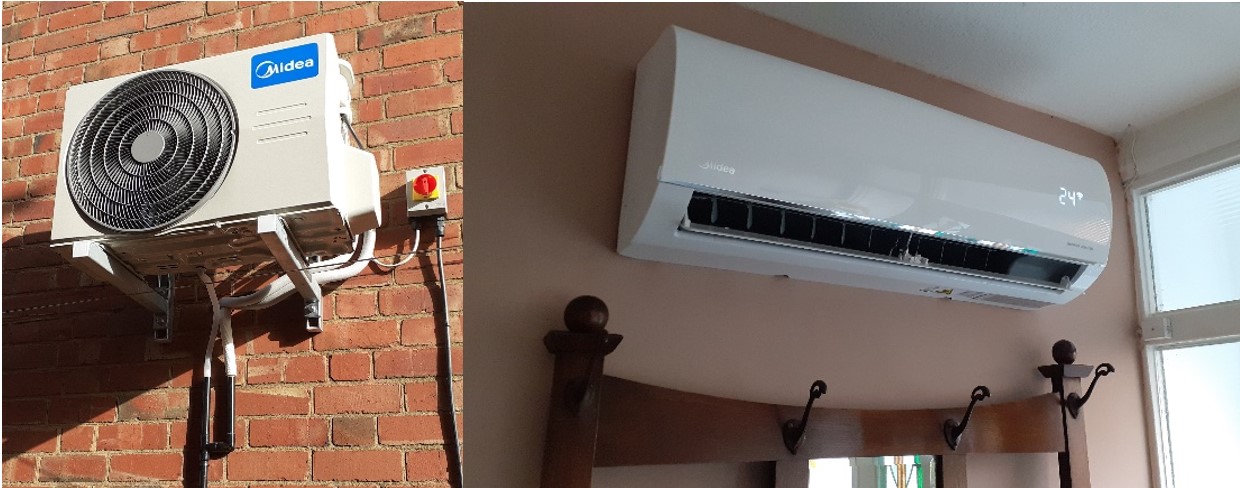
For every kilowatt hour (kWh) electricity to the heat pump, the gas usage reduces by 4 kWh. The question is how many kWh the heat pump can provide. Our house needs around 7000kWh heat per year, using up to 60kWh gas per day in mid-winter. A 4kW heat pump running flat out could provide 4kW x 24hr = 96kWh of heat per day – more than enough to eliminate the need for the gas boiler, and offering the possibility to reduce our energy use by 75%.
But how did it perform in practice? It performed well!
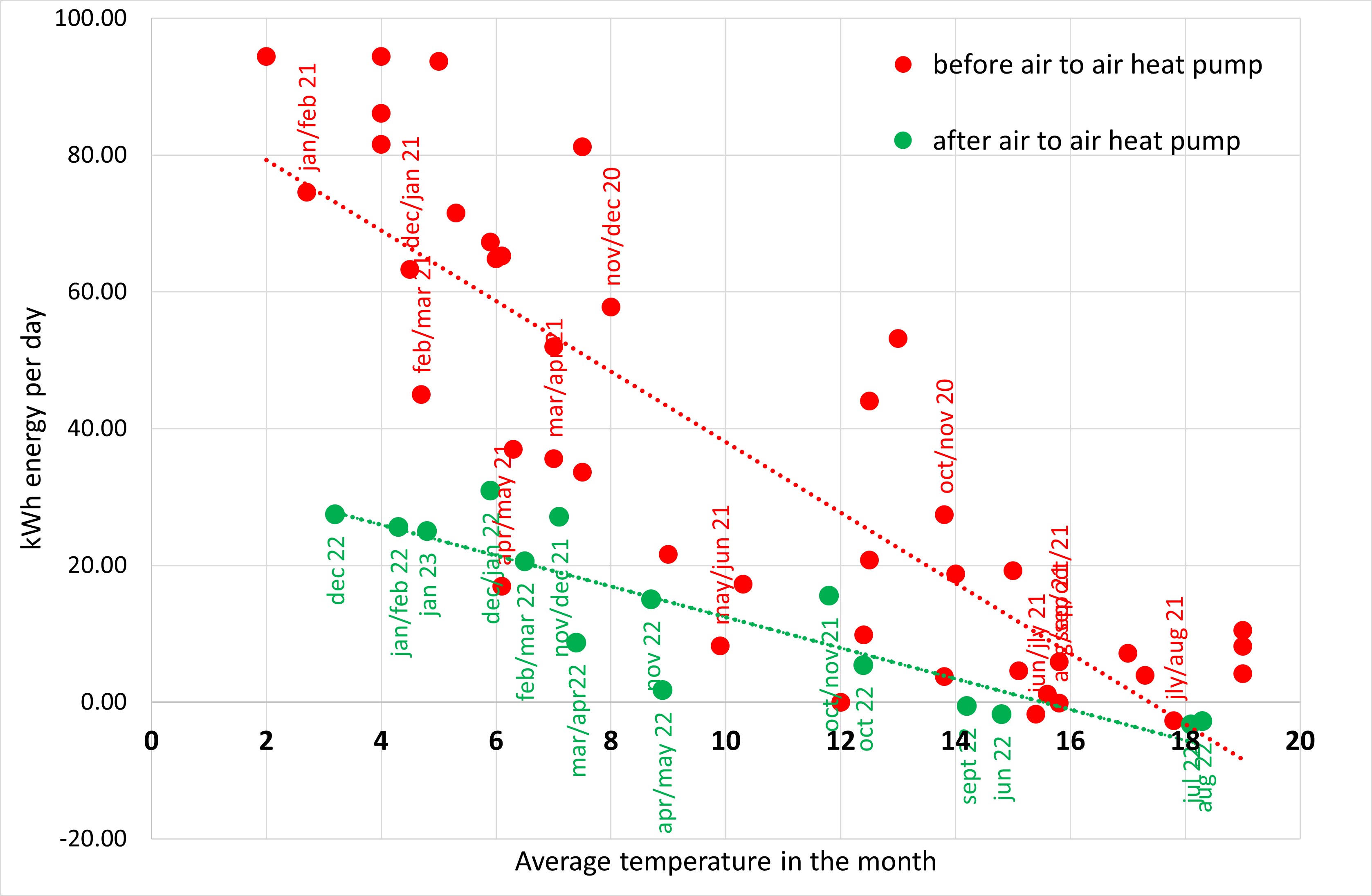
The chart below shows our total energy use, which includes heating, cooking, washing up, showering, watching TV – everything. As you can see achieved big energy savings. Not quite 75% each month, but dramatic. Over the heating season we saved 5500kWh of energy. Since the cost of electricity is much higher than gas, at today’s tariffs you won’t expect to save a lot of money (we saved less than £50 over the winter) UPDATE – WITH THE NEW ENERGY CAP RATES THIS WILL SAVE US £180 PER YEAR .
In order for the heat to spread around the house we set the heat pump temperature to maximum, and to maximise the heat into the house we left it running overnight in the coldest weather. Both of these reduced the real saving compared to the theoretical, but both made the house warmer and more comfortable. Remember that this approach still leaves the opportunity of using the gas boiler.
Although it is important not to use the cooling function unless really necessary, the technology makes life manageable in the ten or so days of extreme temperature in the summer.

So what’s the way forward?
If you are willing to spend £1500 to cut drastically cut your carbon footprint and save you £1200 each year then why not just go for it.
Or perhaps the government might adopt a strategy to encourage roll-out.
The government has set aside £450 million for the boiler upgrade scheme, offering £5000 per installation[iii]. If successful, that would provide the less efficient heat pump solution to 90,000 homes – and only in households that can afford the difference between the grant and the actual cost.
Instead, it could channel the same budget into air conditioning heat pumps as described above, offering perhaps £1000 per home, that would provide highly efficient heat pump solutions to 450,000 homes – including those who are less well off.
We have found that several friends and acquaintances have followed our example, having seen how the technology works, and so the 450,000 homes might well encourage another two homes each, giving a total of nearly one and a half million homes saving 5000kWh each per year. Now that would be a heat pump strategy that worked.
[i] https://energysavingtrust.org.uk/advice/air-source-heat-pumps/
[ii] https://assets.publishing.service.gov.uk/government/uploads/system/uploads/attachment_data/file/606818/DECC_RHPP_161214_Final_Report_v1-13.pdf
 Thoughts from a Minimalist Christian