Why we still need the pandemic.

As I listened to the news this morning, I began to realise that we are not yet ready for this pandemic to end.  We still haven’t learned what we need to learn.

We still haven’t learned that one person is just as valuable and important as another.

We haven’t learned that money and economic systems must be our servant and not our master.

Can you believe that as a nation we are debating whether it is necessary to ensure that children should be fed?  Of course it is!  We would not contemplate not feeding our own children, so the question betrays that we think ‘our’ children are more valuable than ‘their’ children. 

We are debating whether, if we do have to help, is it better to give food vouchers or food parcels to the poor.  Why would we not simply give the money? Because ‘they’ are not to be trusted to spend it wisely, whilst ‘we’ have so much money that we can spend it frivolously and still have full bellies.

Within this nation, within this world, we don’t value one person as much as another .  The pandemic is forcing us to see this and learn our lesson – but we are not there yet.

Money is a man-made invention; a tool that should allow everyone to contribute what they are able to society and to receive what they need from society.  Yet an alien would see that although there is food in supermarkets, there are people who have no food but are not allowed to eat it.   The alien would see that whilst some people are contributing according to their abilities, others are not permitted to – those same people who are not allowed to eat.  The alien would see that – for instance – there are those who have no homes but that those with building skills are building bigger houses for those who already have them. 

The alien would ask why.  Why is this person allowed to eat, but that one is not?  Why are people building this person a bigger house when that person has nowhere to live?  The alien would conclude that ‘this’ person must be different from ‘that’ person; a superior being, more valuable and important.

Our actions show that we do not believe that one person is just as valuable and important as another.

We might say ‘everyone matters’ and ‘everyone is equally important’. And if we really mean it, then we have become subservient to an economic system that does not allow us to express that belief.  We have sacrificed our beliefs in fundamental  morality and truth to an artificially generated concept – money – that is supposed to be our servant but that has become our master.

We have become slaves to an economic situation where two equally important human beings receive grossly unequal shares of the fruits of the labour of society, and where two equally important human beings are given vastly different opportunities to use their skills and abilities to contribute to society.

The Nazis outwardly claimed superiority over other races – but don’t our actions show that we hold those beliefs in our hearts?  

That is one lesson of this pandemic. Have we learned it yet? If we have learned it, are we not ashamed?  If so, we can repent and amend our thinking and our actions. 

And have we learned yet from that pandemic that we have become slaves to our economic system?  That we have sacrificed our morality, our humanity to a man-made mechanism?  When we have learnt that lesson we need to decide what we are going to do about it:  Individually, and as a nation.

So perhaps we are not yet ready for this pandemic to end.  Perhaps we still haven’t learned what we need to learn.  But I hope it won’t take us too long!

Christmas Joy?

Christmas is supposed to be a time of joy, yet my heart is torn by so much that is wrong in our world that it can be hard to find joy. 

I was privileged to have visited Mozambique some years ago.  Having experienced a tiny glimpse of life there, I now regularly send money to help some of the poorest who live there.   This picture shows one lady with all that she has to live on for the next month:

Is she any less valuable human being than me, or you?  Does she matter less because she happens to have been born in a poor country?  Or because she’s black?  Isn’t that what we think deep down if we deny help to people in this situation?

It’s not just our government cutting back that matters.  What about each of us as individuals?  There is a line in a song “my Chinese take away would pay for someone’s drugs”  (medicines) – that is so true.   I know many people, quite a few now retired or close to retiring – university professors, doctors, professional engineers, teachers, civil servants – who have amassed significant amounts of money, own big houses, take expensive holidays.  Healthy pension funds and investments have secured a comfortable retirement – as our culture tells us that that is what we have to do.  

And yet this old lady has no such ‘essentials’.   She lives day to day in accommodation that we would not give space to in our garden, and is desperately grateful for a sack of rice and some cooking oil:

We in the ‘developed’ world are not deliberately evil, but we are ignorant.  We are ignorant of the life of the majority of the world.  We have money but are fearful of losing it.  We are taught to save for our rainy day, but we do that when so many others are already being flooded out by a deluge. 

It would be hypocritical of me to say we should sell all we have and give to the poor – although since Jesus said it, it is probably right.  But we can start to move in that direction.  It does not cause any discomfort if the total of our investments drop by (say) 10% when we still don’t think twice before having our Chinese takeaway – and yet I have found that joy comes from seeing the images of those who I have been able to help.  This person has something to eat because I chose to send some money.  That person can now put a tin sheet over the hole in the roof of their house because I chose to send some money.  When I  give, I feel no pain, only gain.  And yet it is still not ‘easy’ – still the pressures of sixty years of western capitalist propaganda take effort to resist.  It takes an act of will sometimes to give, but it is worth it.

Try it this Christmas?

May God bless us all.

Jesus teaching on workers pay

Jesus taught about the kingdom of God. In one example a wealthy man ensured that the workers all received enough pay for their needs, although it cost him more than it needed to. He knew that he would still have sufficient for himself.

If you are wealthy then this might be a good example to follow.

And if you are a worker, take heed too: if you are lucky enough to have a job, your needs are no different from the one who doesn’t.

The story is recorded in Matthew 20:

“For the Kingdom of Heaven is like the landowner who went out early one morning to hire workers for his vineyard. He agreed to pay the normal daily wage and sent them out to work.

“At nine o’clock in the morning he was passing through the marketplace and saw some people standing around doing nothing. So he hired them, telling them he would pay them whatever was right at the end of the day. So they went to work in the vineyard. At noon and again at three o’clock he did the same thing.

“At five o’clock that afternoon he was in town again and saw some more people standing around. He asked them, ‘Why haven’t you been working today?’

“They replied, ‘Because no one hired us.’

“The landowner told them, ‘Then go out and join the others in my vineyard.’

“That evening he told the foreman to call the workers in and pay them, beginning with the last workers first. When those hired at five o’clock were paid, each received a full day’s wage. 10 When those hired first came to get their pay, they assumed they would receive more. But they, too, were paid a day’s wage. 11 When they received their pay, they protested to the owner, 12 ‘Those people worked only one hour, and yet you’ve paid them just as much as you paid us who worked all day in the scorching heat.’

13 “He answered one of them, ‘Friend, I haven’t been unfair! Didn’t you agree to work all day for the usual wage? 14 Take your money and go. I wanted to pay this last worker the same as you. 15 Is it against the law for me to do what I want with my money? Should you be jealous because I am kind to others?’

16 “So those who are last now will be first then, and those who are first will be last.”

How to create the society that we deserve.

As a society, we decide what we value. Where do we want our work to generate value?  Do we value our transport infrastructure, do we value our children’s education, do we value our police force, our armed forces, caring for the elderly, the weak and the sick?  If we do, then our work has to be generating value in those areas.

Every hour we work generates more value than we receive as pay.  But who decides where the value that we create goes?  Clearly we can decide where we spend the value that we earn, but the extra value is retained by our employer, often private sector companies.

Businesses are responsible to their owners (shareholders) and have the responsibility to maximise income for the owners.  Their goal is to channel the value that we create to the owners.  Businesses do not have souls. Businesses are only interested in caring for the sick if it generates more income for the owners.  They are purely financially driven.  That is not a criticism but a fact.  It keeps things simple, and can produce very efficient and focussed activities.

In order to create the nation that the people want, we need a regulatory environment that directs value where we want it and allows the businesses to operate within that environment.   That is the role of government, through the tax and regulatory systems.

There is plenty of value generated in this country, we just need to see it allocated to the right areas.  At the moment, too much is allocated to a small number of people.  The activities that benefit us all are not valued enough by the few who decide where to ‘spend’ the value that they acquire.

As a society, we have the right to decide what we value and a right to ensure that our work creates value in areas that are important to us.  If we want to be cared for when we are old, we need people working to care for us.  If we want safe streets we need our police force.  If we want our children taught well we need teachers.

If more people work in these areas, it may mean less people working in other areas.  We may have to accept less people working in the finance industry, or the retail industry for example.  But surely a civilised society values caring for its people higher than moving money around, or selling more stuff?

So, we need a taxation system that allows the society that we deserve to be funded.  That is why it is important to regain more control of the allocation of value.  Government needs to take back control from businesses, and from the top 5% of earners.

But what about the argument that ‘they will just go somewhere else’.  The value that is currently channelled to the wealthy is being created here.  It will still be created here.  All that will happen if the owner of a company decides to emigrate is that they will be harvesting the value created in the country that they go to.  The value created in our country will stay here for the benefit of our citizens.

So when we get the chance , let’s vote for the society that we deserve.  Let’s grasp our future with excitement and hope, and not shrink from the opportunity to make this nation great.

Why it is right to reverse the increase in Inheritance Tax threshold.

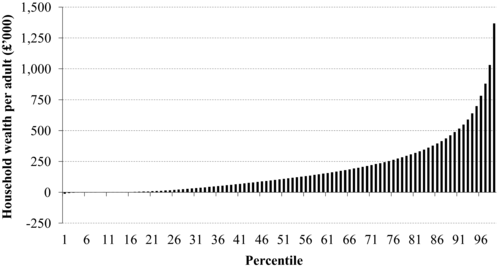
The Institute of Fiscal Studies says that “..wealth is distributed very unequally. One per cent of households have negative net wealth of greater than £12,000 per adult (the 1st percentile), while the 9th percentile is £0 so 9 per cent of households have no positive net wealth. Wealth at the median is £104,000 per adult. Wealth at the very top increases dramatically across a small number of percentiles – the 95th and 99th percentiles are £0.7 million and £1.4 million per adult respectively. In fact, the estimates of wealth held at the very highest percentiles could be underestimates;”

There is no problem with saving your income to increase your wealth.  But there is a problem when inherited wealth means that those who have not had the good fortune to have wealthy parents or ancestors are denied the chance to ‘better’ themselves.

This is more than an academic problem.  For example, for most people, the biggest expenditure is housing.  If you look at how much you can borrow, and at typical house prices then two-thirds of people cannot buy a home without help from someone who has wealth.  The graph above shows that perhaps a third of the population have insufficient wealth to avoid the having to enter the private rental market.  The high cost of renting means they have less chance of building themselves a better future – the rules are stacked against them.

That is why it is right to reverse the increase in Inheritance Tax threshold, we need to even out the playing field.

It is time to cut VAT.

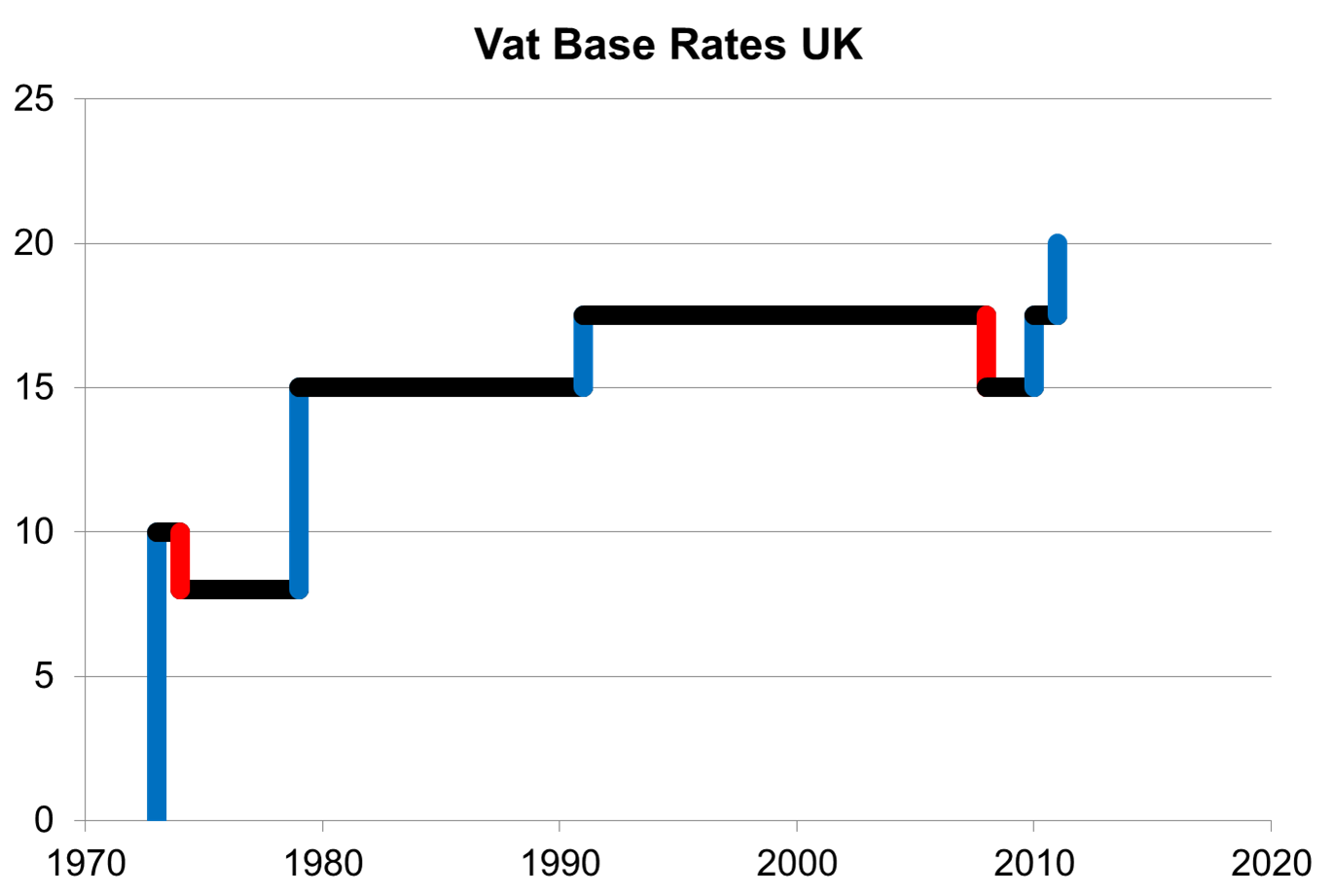
VAT is a tax on what we spend.  Everybody has to pay VAT at the same rate, rich and poor alike.  The following chart shows which parties have changed the basic rate of VAT since its introduction by the Conservative government on 1973.

VAT rate changes

Increasing VAT puts a bigger burden on the poor than the rich, as shown by the following analysis of the most recent VAT risk from 17.5% to 20%:

Reducing the rate of VAT will ease life for the less well off, increase sales, increase business activity and lead to higher employment.  That will increase income and corporation tax revenues and reduce the cost benefit payments as there will be less people out of work.

It is time to cut VAT, not to consider increasing it.

How to really make Britain great again.

The headline tells us “Brexit to send UK tumbling down world economic league table…”.  and we ask “Is this making Britain great again?”

But the headline, indeed the whole question of where Britain ranks in the world economy has absolutely NOTHING to do with whether Britain is great.  What matters is whether Britain is becoming more human.

Being human has nothing to do with the economy or wealth, but everything to do with values. It is about valuing everybody equally, irrespective of colour, class, wealth or religion. It is about selfless behaviour for the good of others. It is about acting with integrity and speaking truth. It is about doing what is right, irrespective of the consequences.

Britain will become great when those who are well off are willing to contribute enough to ensure the wellbeing of those who are not well off,  when we are willing to give up our own comforts for those who have nothing,  when we are willing to give sanctuary to those fleeing war dispite the risk of personal harm.

Britain will become great when we stop expecting a political system that gives everyone all the rights that they demand, but encourages us all to self-centredness. We cannot demand perfection from public services that we are not prepared to fund. We need to stop demanding perfect treatment from others, when we cannot give it ourselves.  We need to stop demanding that teachers work until midnight to keep up.  We need to stop expecting to be treated in A&E within minutes when we have drunkenly staggered into a lamppost.  We need to stop abandoning our personal responsibility for our own circumstances.

Britain will become great only when we choose to love one another; when we learn to contribute what we can, and to keep our expectations of others reasonable.  That is my hope for 2017.  Make it yours.

The ethical way to balance the books

If the government makes ‘savings’ of £1million, what does it actually save?  Well, by savings we mean job cuts, and almost all of the job cuts are from lowly paid workers.

A person on (say) £12000 a year will pay £673 in tax and NI contribution.  They now do not have a job and so will receive (at least) jobseekers allowance of £73.1 a week, or the equivalent of £3801 a year.  So the immediate saving is not £12000 but £7525 a year.

But someone on a low income will not be saving, but spending their money to live.  The government will therefore lose VAT on their spending, let’s say on average 15%.  Applied to £7525 a year this reduces the saving to £6397.

On top of that, anything that they buy will add to the profits of the business who sell them the product – and the business will be paying tax on the profit. The business will employ someone to get the product to them and serve them – and that person is paying tax too.

So for every £1million that the government claims to cut the saving is probably only half at best.

In terms of human suffering this seems to me to be a very cruel and inefficient way of balancing the books.  Surely it is better to increase the contributions from the wealthy who will not suffer any hardship, but simply see a reduction in the amount of money that they squirrel away?

Is it possible to be a Christian and right wing?

It’s not complicated.  Jesus said “Those who accept my commandments and obey them are the ones who love me.”

And what are His commandments?

“‘You must love the Lord your God with all your heart, all your soul, and all your mind.’ This is the first and greatest commandment. A second is equally important: ‘Love your neighbor as yourself.’ The entire law and all the demands of the prophets are based on these two commandments.”

and here are some more details:

“If you lend only to those who can repay you, why should you get credit? …  Lend to them without expecting to be repaid”

“Give to those who ask, and don’t turn away from those who want to borrow”

How does this square with austerity measures imposed by the wealthy on the poor?

Just asking…..

“Back in the day …” But why not now?

There was a time when it was wrong to tell a lie.

There was a time when we were taught that “if you can’t say something nice, don’t say anything at all.”

There was a time when we were taught that it was good to share.

There was a time when we were taught to “do as you would be done by”; to treat others as you would like them to treat you.  That every person was our neighbour, irrespective of where they came from, or which ‘tribe’ they belonged to.

All of these were accepted fundamental truths: words of Christ which spoke to our conscience and were proved correct by our experience.

Look at the papers, with the lies and attitudes of politicians in the US election and the Brexit campaign, the inequality, the refugee situation, the callous treatment of the poor, and we can see that we do not live in such a time.

I miss when human beings cared about each other, when decency was valued and we respected each other.  I want to see our nation, our world return to those values.

Do you?

Let it start with you and me.  Let’s vote knowingly, and act selflessly to change society back to what it should be.