Money, Church, Jesus and me.

There is a church which has assets of £8,700,000,000 at the start 2020, at the start of the pandemic.  The nation struggled and many were in financial despair.  What might Jesus have hoped that the church would do?

The church did not ‘hide their gold in the ground’, or put it in a deposit account earning perhaps 1% return. Instead it invested its assets and achieved a growth of 10.4% in the year.  Would Jesus have been happy with that stewardship of the money?

The church spent some of the money that they received, but at the end of 2020 the assets of the church had grown by £500,000,000 to £9,200,000,000.  Is God blessing that church with growth?

“You say, ‘I am rich; I have acquired wealth and do not need a thing.’ But you do not realize that you are wretched, pitiful, poor, blind and naked. I counsel you to buy from me gold refined in the fire, so you can become rich; and white clothes to wear, so you can cover your shameful nakedness; and salve to put on your eyes, so you can see.”

Over Christmas, a small church agreed to spend £1000 to make up food hampers for those on Free School Meals.  As a result, fifty families were blessed.  People were inspired to donate towards the cost of the parcels, which meant that it actually cost the church nothing.  Was God rewarding their generous spirit?

I saw a Facebook post recently that made me think:

It is so easy to criticize those who have more money than us.  But we could equally say:

There is a charity, set up by a Christian pastor, which buys and builds houses that are loaned to local churches to house and support vulnerable homeless people.  So far they have housed 1226 people.  They raise the money through people investing in their project rather than by donating money.  They offer a 5% financial return on investment so that investors have the twin benefit of knowing that a homeless person is being housed and loved, and getting an above average return on investment. (https://www.greenpastures.net/)   The charity is growing; does that make Jesus smile?

We may worry about money; it is natural.  Everything today is described by its economic value, or the cost to do it; phrases and a culture used to justified austerity.  In such an environment it is hard not to put a financial value on everything, and to be thrifty.  Consider another quote that I came across said:

“The smart way to keep people passive and obedient is to strictly limit the spectrum of acceptable opinion, but allow very lively debate within that spectrum. That gives people the sense that there’s free thinking going on, while all the time the presuppositions of the system are being reinforced by the limits put on the range of the debate.”  Noam Chomsky

That is today’s truth. Greed is now accepted as good in this country. People simply debate how much greed. But we don’t call it greed, we use phrases like ‘reserves’, ‘savings’, ‘retirement plan’ to avoid confronting whether we should be keeping our money to ourselves.  Jesus said:

“Do not store up for yourselves treasures on earth, where moths and vermin destroy, and where thieves break in and steal.  But store up for yourselves treasures in heaven, where moths and vermin do not destroy, and where thieves do not break in and steal.  For where your treasure is, there your heart will be also.”

Dealing with money is not easy, but it is SO important.  It must not become our treasure, but it is certainly a tool.  It allows us to be a blessing to others in as little time as writing a cheque – and time is a stress for many. It blesses us to bless others, but if we agonise about the smallest financial decision then our worrying steals our time, our energy, and can lead to conflict!  We need to train ourselves to be instinctively generous.  We might reflect on these phrases of Jesus, remembering that he spoke them because he loves us; because they are good for us:

“Therefore I tell you, do not worry about your life, what you will eat or what you will drink, or about your body, what you will wear. Is not life more than food, and the body more than clothing?”

“Give to everyone who asks you, and if anyone takes what belongs to you, do not demand it back.”

“None of you can become my disciple if you do not give up all your possessions.”

And as St Paul wrote:

“Remember this: Whoever sows sparingly will also reap sparingly, and whoever sows generously will also reap generously. Each of you should give what you have decided in your heart to give, not reluctantly or under compulsion, for God loves a cheerful giver.  And God is able to bless you abundantly, so that in all things at all times, having all that you need, you will abound in every good work.”


The universe is so big and has been here so long …

Big Bang was about 14 billion years ago; the universe is older and bigger than we can possibly imagine.  Dinosaurs were on the earth for over a hundred million of years, a thousand times longer than the humans have been around. And looking at the population of the world today, as an individual among 9 billion people alive, In comparison with the totality of space and time, each individual is surely completely insignificant.

But… there is an alternative.

If God exists they must be bigger than all this, and older than all this and they must have had a reason to bring the universe into being and sustain it, and to wait while the stars and planets formed and reformed, life began and evolved, and  mankind emerged and developed.  And if, as many of us believe, they sent their son to teach us and to die for us then we move from being completely insignificant to enormously significant.

But perhaps it still seems an awful lot of effort for God, too much to believe perhaps. But think about the effort that we put in to the smallest of things used for enrich a very short period of time.  Think of how much time, energy and space goes into making a simple gold ring with a diamond on it, and getting it to a shop so that someone can buy it to propose an engagement.  Just compare the size of the gold and diamond mines with the end product – let alone all the work needed to refine, shape and manufacture the ring, and to transport it to the shop.  We are pleased to do all that, God’s work just takes things to a bigger scale…

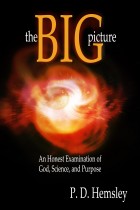
Foreword to The Big Picture

Scientific discovery has brought material benefits and physical comfort to mankind.  The predictability of matter leads us to assume that it behaves according to fixed laws, and this belief has led engineers to develop tools and machinery to manipulate the environment, doctors to develop cures for many diseases, and farmers to grow crops with greatly increased yields.  Many of the scourges of previous times have been overcome leading, in the Western world at least, to longer lifetimes and better health.  However, this has also led to the belief that everything is predictable and controllable. If anything goes wrong (by which we mean it causes us distress or discomfort) then it must be fixable, and if it hasn’t been fixed it must be someone else’s fault.

Personal rights have grown, but personal responsibility has diminished.  Laws to protect the weak have bred the belief that it is the state’s job and not our individual duty to help out those less fortunate than ourselves.  Mechanisation that was supposed to give more leisure time has led to lost jobs and loss of purpose.  Competition and the shrinking of the geographical world has meant that there is someone, somewhere who will work harder or longer hours than we do, and the pressure grows to produce more for less.  The availability of loans means that goods can be obtained now if we promise to pay later.  To pay the loan we need a job.  Fear of job loss drives us to work longer hours and accept less pay. The purpose of life becomes to produce.  The mechanism which fuels demand and production is the economy.  The economy becomes the measure of the health of a nation.

Is that what it’s all about?

Is my value simply what I can produce?

Am I measured just by what I can earn?

If I retain the worldview that the economy is king then the implication is yes, but that doesn’t feel right.  I want to be valued and loved as a person.  I want a worldview that speaks to my heart and my mind and not just my wallet, and I want it to be based on sound thinking and evidence.

Science has brought great technological and medical benefits to mankind; cars, televisions, fridges, telephones, electricity and so on.  But science has also brought guns and bullets, pollution, global drug trafficking and job losses.  Science seems to dominate my life, telling me what I should or shouldn’t do to keep healthy, avoid risk and live longer, but it doesn’t tell me why I would want to live longer.  Science doesn’t give any purpose to my life.

Religion offers purpose, but it too seems to want to control me and dominate me.  Religion has been used as justification for many great atrocities: the Spanish Inquisition, child sacrifices, the Crusades.  Religious people seem to want to tell me how to behave, and to judge and criticise me, claiming to represent the will of God.

I want to know the truth.  I want to know what science can tell me about how the universe works, and perhaps where I came from.  I want the benefits that science can bring, but not at the cost of becoming a slave to its dictates.  I want to know why I am here, what my purpose in life is, or even if there is one.  If there is a God I want to know what He thinks. I want the benefit of knowing that I have a purpose, but not at the cost of becoming a slave to rules from another human being.

And so I investigate, weigh up evidence in all forms and seek a holistic worldview that works.  I have explored what we know from the physical and biological sciences, and I have researched historical evidence for God. I have tested what is actually known, and what is speculation, extrapolation or personal opinion and rhetoric.

This book presents my conclusions, and some of the evidence that brought me to draw them.  I offer what I believe is a consistent, healthy and constructive worldview based on sound evidence.  I’ve called it Minimalist Christianity.  Whether you agree with my conclusion or not, I hope that many of the myths that currently inhibit so many of us will have been weakened or dispelled.  I hope that a step can be taken towards finding purpose and experiencing life in abundance.

Making decisions as a community

Often we have to make decisions as a community; a family, a nation, a team.  How do we go about it?  Usually we will simply ask “what do you think we should do?”  And then we will argue against the other person’s proposal.   When the decision is finally made there is conflict and resentment from those who suggested doing something else.  The results of this approach can be extremely damaging.

For instance, the government ask “do you want to leave the EU?”  Half of us say yes and half of us say no, and so half of us are very upset that we have not been listened to.  The nation is split in two.

Or a local authority will make a proposal to close Children’s Centres and then ask people’s opinion on the proposal, calling it a consultation.  But it is simply a consultation on whether you like the proposal or not.  The consultation doesn’t lead to a better solution, but just to anger from those who will be harmed by the proposal.

The steps we go through, probably unconsciously, when we decide something for ourselves can be summarised as:

  1. What is a the problem
  2. What are the alternative solutions
  3. What are the advantages and disadvantages of each
  4. What do we want to do

But when we try to make decisions as a community our normal approach is:

  1. What do you want to do?
  2. I don’t want to do that, but this.

We end up arguing, simply because trying to decide something without even knowing what problem we are trying to solve.

In both of the examples above, the process could have been different.

For example, the question could have been “What factors are important in deciding whether to remain in the EU, and how important do you think each factor is?”

With the results of this consultation, the government could have framed a proposal for how to deal with the different issues, explained the proposal and the reasoning used to get to it, and then (if necessary) asked for agreement to proceed.  In essence this is requiring the government to carry out ‘completed staff work’ (http://govleaders.org/completed-staff-work.htm) before submitting a proposal for approval.  If they have done their work well, the conclusion would simply need our approval.

Try this approach in your community.  Let me know if it helps.

Immigrants!

“A business man was coming back from a sales trip overseas.  His flight was delayed and he managed only to get the last train back to where his car was parked at the station.  It was late at night, and as he took his keys to open his car he was set upon by robbers.  They beat him up, stole his keys, wallet and computer, and left him lying there in the station car park.

The car park was quiet, for it was late at night and he lay there, hunched up and groaning in pain.

Another late train drew in. The first into the car park was a wealthy land owner and landlord.  He saw the man lying there and muttered under his breath about how drug addicts were spreading everywhere.  As he clicked the central locking on his 4×4 he made a mental not to write to the leader of the council about cleaning addicts out of the area.

The next person into the car park was a middle classed lady coming back from a day shopping.  She looked across at the man, and in the dark assumed that he was one of the homeless, turning to drink to drown his sorrows.  She kept her distance; she was worried for her own safety.  Why doesn’t the government do something to help these people she thought to herself.  I might have to think about voting for one of the other parties next time.

No more trains came in, but later that night an immigrant was walking by on his way to his night shift at an out of town warehouse and distribution centre.  He saw the man still slumped there, and went across to him.  He saw the state of the man, and tried his best to bandage the wounds and make him comfortable, wrapping his own coat around him and giving him a sip from the hot drink he’d brought with him to keep out the cold on the walk home.  He called the emergency services and waited with the man for the two hours until they came.  Finally some paramedics arrived and told the immigrant that they would now look after the business man and that he should go on his way.

He walked the two miles to his warehouse job, but when he arrived the supervisor berated him for lateness and summarily dismissed him.  His story of helping the injured man was treated as such – a story made up to cover his laziness, and he was told that he was a shirker who should go back to his own country.  He sadly walked back to his shared room, wondering how to break the news to his family, and worrying about how he would now be able to afford this month’s rent.”

Which of these people was making our nation great again?

A morning prayer for the wealthy

Dear Lord,

Father, Son and Holy Spirit,

Thank you for bringing me safely through another night and for the promise of a new day.
Thank you for blessing me with health, wealth and good friends, and thank you for my family.

Thank you for the blessings that I can bring to others. Forgive me please for the times when I have not acted as you would wish, and please strengthen and encourage me to carry out your will in the future. Guide my steps to places and people who I can bless, and form in my heart the desire and will to be that blessing. Let me feel joy at the good that I have been able to do in your name.

It is hard to be joyful when there is evil confronting us each day, sustained by misguided beliefs and the cold hard hearts of so many.

Yet all good things come from you and are part of you, so please help me to know you, love you and enjoy your presence. Please lift my spirit to worship and praise you, and to appreciate your gifts to me. Please be present with me every moment of the day and night, filling me with your goodness and keeping me from harm. Please protect those who I love, and heal those who are suffering in body, mind and spirit.

In this cruel and selfish world, I ask that you work in all people to draw us to love you with all our heart, mind, soul and strength, and to love our neighbour as ourselves.

Please correct the growing culture of inequality where we, your children, believe others to be less important and valuable than we are. Help us to see each human being as our brother or sister, parent or child, and to love them as such.

Father, let your spirit drench this land as the wind and rain of winter. Convince the people in this nation of your existence, bring us to see our sin, and to repentance and forgiveness. Draw us close to you.

And please mould your church to feed us with the bread of life and to help us praise you as you deserve. Please remove the barriers that we put in the way of people who would follow you, forgive our mistakes and guide our actions to properly serve you and those we live among.

I ask all this in Jesus’ name, for I believe and trust that this is your will.

Amen

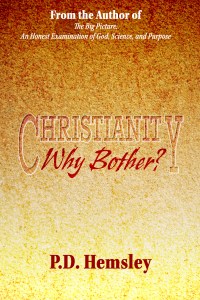
“Christianity – Why Bother?” … out now

Belief in God is claimed to be on the decline, and many cannot see a reason to question whether God might exist. What would be the point? Why make the effort? That is why “Christianity, Why Bother?” deserves a read. It answers the question that its title asks.

The book discusses some of the misconceptions of Christianity, and then moves on to examine the basis for belief and explains some of the practical and day-to-day benefits of being a Christian. The author shares some of his experiences since he became a Christian at the age of forty. The aim is simply to address the question, “why bother?”

Christianity why bother cover

Click here to buy on Amazon.

“Here, there be dragons”

Centuries ago many people used to live their entire lives within a few miles of where they were born. Occasionally travellers would pass through with tales of far-away places which held wonders, treasures and maybe ‘dragons’. But few would dare cross the borders surrounding their small world of familiarity.

Dragon-Linda_BlackWin24_JanssonNowadays many people again live their entire lives within a relatively small environment. Maybe it is not physical, since modern transportation puts the whole world within reach, but I’m speaking of relationships, culture and spirituality.

Our sphere of friends is gathered through encounters where we like to pass our time: work, the sports club, the toddler group or school, the pub. We meet like-minded people in comfortable environments and put down roots there. Occasional travellers pass through with tales of other lifestyles: we get peeps at them on the TV reality shows, a foreigner might join our band, or a tragedy might move us out of our comfortable world. But “few dare cross the borders of their small world of familiarity”, and most will lobby to maintain their personal utopia.

We understand how the world works through what we have learned through personal experience, the media and common sense.  With our Western worldview glasses we know such things as: the economy has to be healthy, everyone should be educated and democracy is the only system that works. And of course we should all have rights, to health, happiness and freedom, particularly freedom of speech. We seldom stop to question the basis on which we have decided that all of these ‘truths’ are correct. When we hear tales of other cultures we are fearful that they will invade our territory and bring unimaginable horrors and suffering.

But perhaps we are most fearful of uncharted spiritual seas. England used to be a Christian nation, although deeply divided between Protestant and Catholic, but has largely come to believe in Scientism; the religion that science can explain everything. It can be comforting to think that science can tell us why Grandma died, and to hope that in the future cancer will be conquered. Occasionally we will hear tales of a spiritual realm, something that is not simply made of ‘stuff’, and strangers will speak of God and tell us that we have a ‘soul’. A frequent response is to ignore such ramblings, or to accept that such things may be ‘okay’ for them, but I’m quite happy in my own ideas thank you very much.

Secretly, if we are bold enough to ask ourselves, we will admit that our small-world outlook is largely driven by fear. We are afraid that we will lose our basis for life, even if it doesn’t seem to be working too well for us at the moment. We would love to befriend those in different circles, experience different cultures, and reach a satisfying understanding of who we are spiritually; we yearn to find our soul and our purpose.

It is the beginning of a new year: 2015. Two thousand and fifteen years after a special baby was born. Who as a man spoke strange tales of a spiritual realm and a God. A man whose words gave us a rock to build our lives on. A man who willingly allowed himself to be crucified to show that death could not hold him – or us. A man who Christians call God. Perhaps it is time to take our courage in our hands and explore this strange new land? Many have gone there before, but few have returned with tales of dragons! Instead, they come back with stories of hope and fulfilled purpose; the promised land. Shall we go?

Do we worship the same God?

There is and can only be one God.

I am not going to defend that statement but to take it as read and see where it leads in the context of different religions.  If you don’t want to accept the statement, this post is not for you so please don’t waste your time and energy reading further.

There is and can only be one God.

That one God is love.  Without God there can be no love.  And so each and every act of love is an act of God.  If a Christian loves, that is God within them.  If a Moslem loves then that is God within them.  If an atheist loves that is God within them.

That one God created and sustained the universe. He sends the rain on the good and the bad.  His laws of science knit us together in our mother’s womb, allow us to experience the world, and present us with the alternatives of love or hate, good or evil.

That one God has made each of us as an individual.  Each of us is a ‘me’.  He has given us freedom to choose to love or hate, to be good or evil.  As individuals we choose.  If we choose to love we choose God whether we know it or not, whether we are Christian, Moslem, Hindu, atheist, agnostic or Jedi.

If someone prays to the single God, creator and sustainer of the universe, to the God who is love, the God who is goodness and power, does it matter what religion they are in?

If someone chooses love and goodness, does it matter what religion they are in?

What is religion? According to the Oxford dictionary it is:

“The belief in and worship of a superhuman controlling power, especially a personal God or gods”

and

“A particular system of faith and worship”

http://www.oxforddictionaries.com/definition/english/religion

A follower of one religion can challenge whether the “system of faith and worship” of another religion is accurate.  A Christian can reasonably challenge whether what Islam teaches about what is right and wrong is right – but can a Christian challenge which God a Moslem is praying to? Or vice versa?

Can a Christian say that a Moslem worships a different God?  Or can the Christian only say to the Moslem that “you don’t know God like I do”?

I don’t need to use Christians and Moslems for the example.  I could have used Evangelical and Liberal Christians, Protestants and Catholics.

I believe that the teaching of Christ is the best description of what God intends for each of us, and that Jesus life and death are the greatest demonstration of how God loves each and every one of us.  I can guide others to the same source of love and goodness that I have found, but am I to criticise and judge them if they do not understand the Bible in the same way that I do?  Isn’t my job to love, and aren’t I supposed to leave the judgement up to God?

Isn’t religions job to help me do my job?  Surely religion is not there to put obstacles in the way of me loving others?

What does God think of all the conflict that is caused by religious dogmatism about what he is like?  Does he simply want us to get on with loving Him, and loving our neighbour as ourselves?

Grace and love to you all.

Painful lessons on worship, thanks to Bach

It had been a busy period approaching Easter, but Good Friday had arrived with the promise of a short break.  We decided to start the weekend with a treat – to listen to St Matthew’s Passion by Bach in Coventry Cathedral.  An amazing piece of music that has formed an act of worship for many people over hundreds of years, we were looking forward to it.  We shared a lift with friends, one of whom was performing in the choir.

I knew nothing of the piece, but was a little alarmed to hear that it lasted three hours – I know what cathedral chairs can be like, and I was feeling somewhat worn down by some stressful meetings at work.  We had well placed seats, although the gentleman who sat next to me wore ‘fragrance of smoker’, and I noticed when the music began that his breathing was rather loud.  I prepared myself to be ‘wowed’ by the wonderful music.

Fifteen minutes into the performance I realised that the music and I spoke different languages of worship.

Thirty minutes in and I prepared myself for the ordeal as I do for the discomfort of a long flight in cramped uncomfortable airline seats; try not to wriggle too much so as not to disturb others,  focus on trying to doze and calm oneself to patiently endure the flight, listen to some nice music through headphones – not something I could do here of course.

It was not an un-spiritual experience.  It reminded me that Christ had suffered intently on the cross, that it had gone dark for three hours, that he’d willingly submitted himself to the pain, but that it would not have been an enjoyable experience.  And finally, thank God, it was finished.

The friends that I went with loved it, talking excitedly about different parts of the performance and how moved they were by it.  I was emotionally exhausted and felt excluded from the party – there was nothing positive I could think of to say, and I didn’t want to spoil their enjoyment of the evening so I was silent.  It was working until over dinner one of them mentioned I’d been quiet and asked what I’d thought of it.  After a few moments silence someone else spared me with ‘not your cup of tea then’, and the evening moved on.

Having had time to reflect a little, there are some lessons to learn from the experience.

  • Even the most brilliant worship music will not appeal to everyone, and will drive some people away.  If you want to help everyone ‘worship’, then you need a variety of approaches (not all musical!)
  • It feels very lonely and friendless being in an environment where others are enthusing about a method of worship that leaves you cold.  You can be left feeling ‘what’s wrong with me?’, and spiritually drained.  Don’t ‘demand’ that everyone enthuses about what you find uplifting, and don’t judge them if they don’t ‘connect’.
  • If you are feeling low, then a worship event may not be the best remedy.  You may end up worse that when you began.
  • Even if you are experiencing something painful, there are lessons to learn from it.

I don’t regret going, but I don’t suppose I will quickly repeat the experience.  Nobody wants to be the spectre at the feast.