Is there place for God and religion in today’s world?

The first thing to realise is that we are all living in a computer generated world, and that we are living in the past.  Nothing exists in the form that we perceive it, and by the time we perceive it, it has already happened.

That steaming cup of coffee that you see is just the result of your eyes, optic nerves and brain processing photons that hit the back of your retina.  You are experiencing a brain (computer) generated model of what you now understand to be a cup of coffee.

Your brain’s processing inherently includes a delay to allow all of the bits of information to ‘catch up’.  It takes longer for visual stimuli to be processed than it does for sounds. When you experience the crash of your cup on the floor your brain has had to delay presenting the event to your consciousness until the signals from both your ears and your eyes have arrived.  Our reaction time is evidence of this, and the fact that we react faster to sounds than to lights.  If you start a sprint race with a gun then the sprinters set off faster than if you start it with a flash of light – although the speed of sound is much slower than the speed of light.

So we do not experience the world as it is, but we experience a three dimensional model created within our brain. 

As a child I used to wonder ‘does the colour green look the same to me as it does to you?’  Today I would answer almost certainly ‘no’.  First of all, we know that some people are colour-blind, and so all colours must be perceived differently by them.  And our eyes all have different sensitivities to shades of colours, and so the raw data that our brain has to process must be different between individuals.

But would we have the same ‘experience’ of the colour of our coffee cup if our brains received identical signals?  That is a hard one, because we can’t really explain what it means to ‘experience’ a colour. (Google ‘qualia’ to find out more).

So although our bodies live in real time, we ‘experience’ a computer generated world that has already happened.

Weird.

But weirder perhaps is to ask what we mean by ‘we’.  What is the ‘me’ that experiences this computer generated world?  Warning – science cannot answer this, it’s the meat and drink of philosophy; the discussion of abstract ideas by bright people who build arguments on certain basic assumptions that they continually disagree about.

My subjective view is that there is a ‘me’ that experiences things.  I interact with my brain (and hence body, and hence world) and can influence but not control what my brain and body does.  I can influence what my consciousness presents to me (ignoring distractions when focused on a task for instance), and I can influence how my body responds to things – but I am not really in control.  Just think of a tennis player returning a 140mph serve; there is no time for them to get directly involved in the process of selecting which direction to go, or what shot to play.  They have to leave the action up to their body. But they can influence what their body’s reaction will be by training, by giving it a strategy such as “don’t try to hit a winner off every shot”, and then they need to get out of the way!  Sportsmen know that consciousness gets in the way of winning; thinking too carefully about how to play a shot at best slows things down and at worst causes us to make a mess of it.

When we think about it we realise that ‘we’ have relatively little influence on what our minds and bodies do, and yet ‘we’ get to experience it all! 

And yet ‘we’ are unexplainable. To try to understand the unexplainable ‘we’, and much to the chagrin of materialistic scientists, we use terms like ‘soul’ and ‘spirit’ to define ‘us’. And we believe that other people have souls and spirit too.  And we spend a lot of time and money trying to find ways to interact with our brain/bodies that will lead to our soul’s wellbeing.  So much advertising money is spent on encouraging us to buy products to bring us ‘peace of mind’ or other palliatives for the soul.

It is natural, and not at all illogical, to imagine that in the same way that you and I are tiny individual souls (that happen to inhabit a bunch of chemicals that we had nothing to do with initiating) there is an overarching bigger ‘soul’ who initiated the material universe of space and time (God).  And if our individual soul ‘experiences’ interaction with this bigger soul then there is all the more reason to believe in its existence.  But of course, this can be frustrating to those souls who have not had similar experience…

So yes, there is a place for God in today’s world.  There is good intellectual reason to believe that there is a God, and this is reinforced by the experience and evidence of many witnesses who report interaction with and experience of God.  These interactions have been documented for millennia and continue today.  And there are many who feel that they have directly experienced such an ‘interaction’ yet believe that there is a larger ‘soul’, or God.   

In response to concluding that there is a God and recognising that our very existence is a gift, it is also natural to want to give thanks for that gift and to want to make best use of the gift.  Hence there is a place for religion too in today’s world.

How about you?  If you haven’t recognised them yet – why not start seeking God for yourself?

Have a blessed day.

“A good robot is hard to find”

I came across this article, and it reminded me how amazing the animal world is, and in particular human beings.  It only took  250 million generations since the first fossil evidence of animals to evolve a human, and each one is built from a single fertilised egg.

http://www.computerworld.com/s/article/9249079/A_good_robot_is_hard_to_find_or_build?pageNumber=1


Am I just a computer simulation?

Research suggests that human brain has more switches than the entire internet.  Each of the 125 trillion synapses that connect our 200 billion brain cells appears to have perhaps 1000 molecular scale switches. (ref 1)

Some areas of our brain take the input from our nerve cells and begin to process them.  They pass through other processing areas that start to interpret the signals; this sequence of signals from an eye might show us that an object is moving for instance.  Other areas deal with hearing or touch or smell.  Most of these areas carry out their functions without imposing on our consciousness.  At the top level, our brain presents a model of our environment to our conscious self.  The conclusion of this would seem to be that we are living within a computer simulation: generated by our brains based on input from the senses around our bodies interacting with our environment.  The question is, are we interacting with the computer simulation or are we the simulation itself?

Back in 2001 the Nick Bostrom speculated that scientific knowledge and computer power would at some time in the future increase sufficiently to build a simulation of the human brain in a computer (ref 2).  That computer would also be able to build a sufficiently complete model of the universe that an individual simulated human brain would not be able to distinguish it from the real thing.  The model would include not only one simulated person, but many, so that each ‘person’ had the true ‘experience’ of interacting with other ‘people’.

He reasoned that since the people who created this simulation would be likely to run a number of simulations (like our kids run lots of ‘Sims’ scenarios)  “Then it could be the case that the vast majority of minds like ours do not belong to the original race but rather to people simulated by the advanced descendants of an original race.”

There are inherent assumptions that Bostom builds on:  that our consciousness and ‘me-ness’ are simply emerging characteristics of the complex computer circuitry within our brain, and that science and technology will continue to advance until we understand and can model the brain operation.  The reasoned conclusion is that if these assumptions are correct then you and I are simulated beings in a computer simulation.

If that is the case, then we might conclude that it is of little consequence to switch off a particular simulation, in the same way that we are quite happy to switch off our computer.

But what if an alternative view is correct, that ‘we’ are not the simulation itself?  What if there is something about us that is more than an emergent property of a highly complex computer? What if there is a ‘me’ that transcends the ‘matter’ that makes up the computer in my head?  What happens then if the computer is switched off?  Do I cease to exist, or do I simply cease to interact with this particular computer?

The answer to that question lies beyond science and technology. We will have to look elsewhere for guidance.

———————————

References:

1) http://www.cnet.com/uk/news/human-brain-has-more-switches-than-all-computers-on-earth/

2) Are you living in a computer simulation? Philosophical Quarterly (2003) Vol. 53, No 211, pp.243-255. (First Version: 2001)) Nick Bostrom

———————————

For more on this topic and others see The Big Picture- an honest examination of God, Science and Purpose

———————————

A Masterpiece of Engineering

We think that we design pretty neat things these days.  We laugh at the man who said that the world would probably only need four or five computers.  Those of us who are old enough can remember when we did a sum on the newly invented pocket calculator that gave us the answer 0.7734, which said “hello” when we turned the calculator upside down.

But whilst researching my latest book I came across some pretty amazing statistics about a design that we all treat as commonplace – each and every human being.

Our 1.5kg brain comprises around 100 billion neurons, of 10,000 different types. Each neuron can have thousands of synapses (input connections from other neurons) and each synapse has perhaps a thousand molecular scale switches.  A single human brain is estimated to contain more switches than the entire internet.

Contained within our skin are around 650 muscles attached to over 200 bones, which vary in size from the femur in our thigh to the stirrup bone in the ear.  The muscle/bone combination is precise enough to paint a masterpiece, or to putt a golf ball twenty feet into a hole.

We have around 60,000 miles of veins and arteries and 1500 miles of pipes in our lungs.

Within our lymph nodes we have billions of B cells, each of which is different and each one defends against a particular very specific infection.

The list goes on – but you get the point.

Yet this whole complex organism is built from a single cell.

We begin as one single cell.  Within the cell is our DNA, the supposed blueprint for our manufacture.  We have a massive 3 billion base pairs (characters in the ‘code’) in our DNA. Yet there are around 50,000 billion different cells in the body.  Each cell is different, in function and in position – some nerve cells can be several feet long.  How can we imagine that there is enough information contained within our DNA to define our fully functioning body?

But we do start from just one cell.  And each cell only responds to the signals that cross the cell membrane.   As we develop, the cell is what it is as a result of its history – its ancestor cells.  And each of those cells only responded to the signals that crossed it’s membrane.  It’s like a massive pyramid, built the wrong way up – with the apex at the bottom.  The process is incredibly robust.  Look at identical twins.  Most of their development is as separate human beings and yet the final ‘product’ is identical.

A human being is truly a masterpiece of engineering.

Is it reasonable to state with certainty that this happened by chance?  Is it reasonable to assert that the properties of the sub-atomic particles in the universe are such that they behave in precisely the right way to manufacture you or I from a single cell by sheer luck? Or would that be a blind leap of faith?


See also:

https://philhemsley.wordpress.com/2013/03/03/information-dna-and-evolution/

https://philhemsley.wordpress.com/2012/09/17/the-dna-enigma/


The God of Science

Neuroscientist Michael Graziano has speculated on the connection between the material and the spirit world.  His book “God Soul Mind Brain” has the stated aim to describe ‘the mechanistic understanding of the spirit world’.  With is background he makes the assumption that ‘mechanism’ is the reality and perception is the illusion.

“we do not perceive the world as it is, the brain constructs a simulated world”

“colour is not actually out there…. The same set of wavelengths may look green to you in a different context or grey or blue”

“We experience the model rather than the reality”

The statements are fascinating reminders of what the brain does: it constructs a simulated world, it provides the stimulus to allow the experience of colours, it somehow appears to create a model in our brains.

However, it is a false assumption that the mechanism is the reality and the perception is the illusion.   Accepting the assumption is like saying that the material pages of a book and the printed ink are the reality, and the story that the book tells or the information that it contains is not the reality.  Whist nobody would disagree that the book is the material and the story is not, which of them is the reality?

In a book, we read the words rather than perceiving the paper and letters and we construct in our imagination a picture and an experience based on the words and story within the book.  In the only scale of importance that matters to a human being, the book is the words, not the paper and ink.  War and Peace is a famous story, the paper that it was written on was just the framework for holding it. The story is eternal although the paper decays. To a human being, the story is the reality.

Consider a work of art; the material is not the masterpiece, it is merely a framework which holds the masterpiece.  The canvas and paint is meaningless, the picture is the meaning.

If we can free ourselves of the dogma of materialism then we can perhaps begin to consider that in the universe created from nothing, where particles are only potentialities until they are observed the reality is the experience, the qualia, the ‘I’, and that the material is just the skeleton for holding the reality.

The material universe is meaningless until it is perceived, the perception of it gives it meaning.

The butterfly nebula is beautiful when it is observed; without observation it is meaningless.

Two bags of chemicals are meaningless, but the intimate relationship between two people who are in love has immense meaning and purpose.

Is this so strange?  When we look at the quantum level of the material, there is no such thing as paper or ink.  There are particles and forces that we cannot understand.  They are outside of our ability to perceive, so we think of them as miniature versions of ping pong balls and sticks.  They are only potentialities until they are observed.  What we consider material reality is not really real, it performs its function only when it is perceived and observed.  So perhaps what we perceive as real day to day, the material world, is similarly non-material. Perhaps the only reality is our perception, our model.

So what of God in this?  Jesus spoke of God living in us and us in him.  Perhaps our material framework that holds us is part of God.  As Anselm wrote, everything is what it is through extreme goodness, through God, so we are what we are through and within God.  We are told that God is love, and that we are made in his image.  Jesus said that ‘if you have seen me, you have seen the father’; I don’t think he was talking about his flesh, but his ‘being’ – his ‘spirit’.  Our framework (our body and brain) is a small part of a material universe that is created and sustained by God.  If that universe is within God, part of God, then we too are ‘in him’, as he is ‘in us’.

And what of laws of physics, of evolution and biology?  We can create mathematical models of inanimate physical objects, and we can observe the behaviour of molecules and cells which seems to be beyond the possibility of simply responding to those physical laws – yet seems to be consistent, predictable, and purposeful. Within the framework where the universe is within and part of God there may be causes other than the laws of physics for the astonishing growth and development of the human being from the single cell; a God whose will ‘knits us together in our mother’s womb’. In the same way that our ‘will’ causes our hands to move, makes our choices, interacts with others, so God’s will can cause our bodies to grow and develop, to form our brain, to manufacture us as the masterpiece we are, our body being the receptacle for our spirit.

It is the non-material that motivates us, the non-material that leads to change, the non-material that makes our world like it is rather than a desolate moonscape.  The non-material is master over matter.  The non-material is the meaning, the meaning is the reality.

Who would disagree that there is a ‘spirit of Christmas’, all of society embracing a season of joy and giving.  People speak of the true spirit of Christmas; we know that there is something that transcends each of us as individuals.  It is part of the sprit that is God.

When we observe a beautiful woodland track, sunlight shining through the leaves to create a dappled light settling on a trickling stream, that beauty is part of the essence that is God.

When we listen to a sublime piece of music that moves us to tears, or an energising rock ballad that lifts our hearts with passion, that is part of God.

When we love someone, our love is part of the supreme love that is God.

When we meet friends in a party, in a community, that spirit of community is part of God’s spirit of community.

If we can appreciate that the greater reality is the spirit, and the material is just the framework then we can see God and the universe in a whole new light.  The universe can be considered the canvas for a cosmic work of art, a magnificent symphony of action and awe.  Life is a molecular dance of astonishing intricacy and beauty.  We are permitted to explore and understand through science.  We are permitted to glimpse the canvas and participate in the dance; characters created by the dance emerging as individual caring, loving, interacting beings partaking of some of the glory that is the story; individual masterpieces beyond the beautiful, whose reality is our character, our choices, our nature, our soul.  Creatures of purpose and with purpose.  Creatures honoured with the possibility of relating to our creator, the master artist, engineer, scientist, musician, teacher, parent, friend, but never are we his equal.

So this is the God of Science:  A God who was there before the universe began.  An un-created, creator God who gave ‘nothing’ the ability to become ‘something’.  A God who sustains, and maybe actually is, the very fabric of the universe. A God who actually is the laws of physics, who benevolently guides providence to bring life out of a set of chemicals.   A God who imbues the chemical dance that is us with the ability to feel, to taste, to see, to experience: love, joy, peace, fulfilment, intellectual challenge, selflessness, forgiveness, anger, hate, disgust, bitterness.  Perhaps even a God who is love, joy, peace, fulfilment…. But a God who allows us to experience both the good and the bad, and who allows us to choose to pursue that which is good, or that which is not.

Add to this the God revealed to us by Jesus Christ and we begin to understand the complete context.

butterfly nebula

The DNA enigma

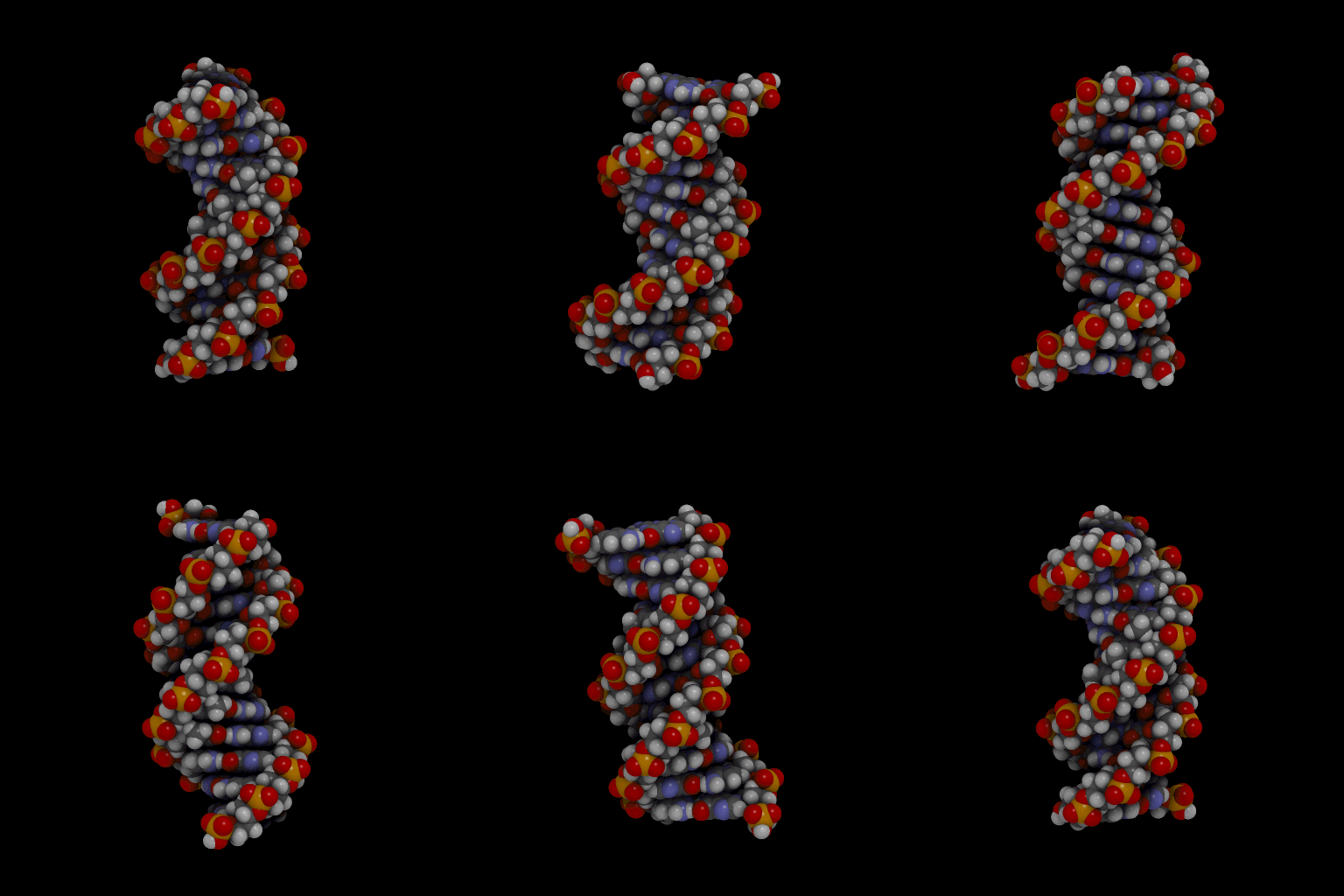
DNA is amazing stuff.  A precisely structured sequence of base pairs that is unique to each of us as an individual.  A record of our ancestral history.  A template for the manufacture of our proteins.  The blueprint for each of us.

The human DNA chain of around 3 billion characters has been assembled over perhaps the last billion and a half years (from the first evidence of cells with a nucleus), and has changed with the changing animals that carried it, through perhaps a billion generations.

DNA appears to be the mechanism of inheritance, the instruction set that ensures that beneficial features from parents are transmitted to the offspring.  It appears to be the key that defines a naturalistic explanation of how we have come to be here.  But is it?

Is there enough information within DNA to define each of us?  Or is something more needed?

As we remember that each of us begins as a single fertilised cell containing the combined DNA from our father’s sperm and our mother’s egg, then let’s remind ourselves of what the information in the DNA is being asked to define.

  1. The precise geometric construction of our bodies:
    1. The position, shape, type and interconnection of each of our fifty trillion cells
    2. The complete development cycle, that is robust enough to cope with different environments and with physical damage.  A development cycle which maintains the living organism as a functional entity at each stage in the process
    3. Major systems, fully functioning and cooperating with each other
      1. Circulatory System
      2. Respiratory System
      3. Immune System
      4. Skeletal System
      5. Excretory System
      6. Urinary System
      7. Muscular System
      8. Endocrine System
      9. Digestive System
      10. Nervous System
      11. Reproductive System
      12. A fully programmed brain that can control the operation of the body, but that can also think, conceptualise, communicate, empathise, create works of art, music, appreciate beauty, love, hate, choose.  A brain that appears to have, and for all practical purposes has free will.

This is weighty stuff to place onto DNA.

Indeed, the functionality does not seem to match the information capacity of the DNA; the DNA of an amoeba is ten times longer than that of a human, yet the functionality is minimal in comparison.

Has familiarity bred contempt?  Do we see ourselves too superficially?  Have we lost our awe at our own construction?  Have we deluded ourselves into thinking that we understand?

Have we forgotten that all that we are physically began with that one cell?  One cell and its DNA, is it really sufficient to make a human?

Image