How do we manage the pressure to worry and despair about what is going on in the world?

There is so much that we can see that is worrying, and that we can do nothing about.  (As I write this Los Angeles is suffering intense wildfires, Trump is threatening to take over Greenland, the wars in Ukraine and Gaza are still taking lives, global temperatures continue to rise…)  Yet if we didn’t look at our TVs, papers or phones we would know nothing of this – and surprisingly little is ‘in our face’ – we are not directly affected by most of the list above.

The secret is to realise that we are not God.  These things are beyond our power to control, but we are not helpless or hopeless – we can play our part using the prayer that Jesus taught us:

“May Your kingdom come; may Your will be done on earth – as it is in heaven”

We might reflect that what is going on actually is God’s will; his permissive will.  Throughout history greedy, power hungry bullies have oppressed ordinary people and we have ransacked the natural world.  Jesus was fully aware of the brutal Roman regime, but he didn’t overthrow it.  He healed people, focusing on the individuals around him – and we can do that too.  We can pray the Lord’s prayer and leave the state of the world in his hands, but then get on with interacting with those around us according to his will.  We don’t care less about the global situation, but we can worry less. And we can use our energy to influence our local communities instead.

After putting the world’s troubles in God’s hands, the Lord’s prayer allows us to ask for God’s heap meeting our own needs:  give us our food for the day, forgive our sins (as we forgive), don’t let us yield to temptation, save us from evil.  All of which do personally affect us day by day, and which will allow us to fulfil our daily purpose.

Jesus’ prayer is a powerful gift from God.

Jesus teaching on workers pay

Jesus taught about the kingdom of God. In one example a wealthy man ensured that the workers all received enough pay for their needs, although it cost him more than it needed to. He knew that he would still have sufficient for himself.

If you are wealthy then this might be a good example to follow.

And if you are a worker, take heed too: if you are lucky enough to have a job, your needs are no different from the one who doesn’t.

The story is recorded in Matthew 20:

“For the Kingdom of Heaven is like the landowner who went out early one morning to hire workers for his vineyard. He agreed to pay the normal daily wage and sent them out to work.

“At nine o’clock in the morning he was passing through the marketplace and saw some people standing around doing nothing. So he hired them, telling them he would pay them whatever was right at the end of the day. So they went to work in the vineyard. At noon and again at three o’clock he did the same thing.

“At five o’clock that afternoon he was in town again and saw some more people standing around. He asked them, ‘Why haven’t you been working today?’

“They replied, ‘Because no one hired us.’

“The landowner told them, ‘Then go out and join the others in my vineyard.’

“That evening he told the foreman to call the workers in and pay them, beginning with the last workers first. When those hired at five o’clock were paid, each received a full day’s wage. 10 When those hired first came to get their pay, they assumed they would receive more. But they, too, were paid a day’s wage. 11 When they received their pay, they protested to the owner, 12 ‘Those people worked only one hour, and yet you’ve paid them just as much as you paid us who worked all day in the scorching heat.’

13 “He answered one of them, ‘Friend, I haven’t been unfair! Didn’t you agree to work all day for the usual wage? 14 Take your money and go. I wanted to pay this last worker the same as you. 15 Is it against the law for me to do what I want with my money? Should you be jealous because I am kind to others?’

16 “So those who are last now will be first then, and those who are first will be last.”

Foreword to The Big Picture

Scientific discovery has brought material benefits and physical comfort to mankind.  The predictability of matter leads us to assume that it behaves according to fixed laws, and this belief has led engineers to develop tools and machinery to manipulate the environment, doctors to develop cures for many diseases, and farmers to grow crops with greatly increased yields.  Many of the scourges of previous times have been overcome leading, in the Western world at least, to longer lifetimes and better health.  However, this has also led to the belief that everything is predictable and controllable. If anything goes wrong (by which we mean it causes us distress or discomfort) then it must be fixable, and if it hasn’t been fixed it must be someone else’s fault.

Personal rights have grown, but personal responsibility has diminished.  Laws to protect the weak have bred the belief that it is the state’s job and not our individual duty to help out those less fortunate than ourselves.  Mechanisation that was supposed to give more leisure time has led to lost jobs and loss of purpose.  Competition and the shrinking of the geographical world has meant that there is someone, somewhere who will work harder or longer hours than we do, and the pressure grows to produce more for less.  The availability of loans means that goods can be obtained now if we promise to pay later.  To pay the loan we need a job.  Fear of job loss drives us to work longer hours and accept less pay. The purpose of life becomes to produce.  The mechanism which fuels demand and production is the economy.  The economy becomes the measure of the health of a nation.

Is that what it’s all about?

Is my value simply what I can produce?

Am I measured just by what I can earn?

If I retain the worldview that the economy is king then the implication is yes, but that doesn’t feel right.  I want to be valued and loved as a person.  I want a worldview that speaks to my heart and my mind and not just my wallet, and I want it to be based on sound thinking and evidence.

Science has brought great technological and medical benefits to mankind; cars, televisions, fridges, telephones, electricity and so on.  But science has also brought guns and bullets, pollution, global drug trafficking and job losses.  Science seems to dominate my life, telling me what I should or shouldn’t do to keep healthy, avoid risk and live longer, but it doesn’t tell me why I would want to live longer.  Science doesn’t give any purpose to my life.

Religion offers purpose, but it too seems to want to control me and dominate me.  Religion has been used as justification for many great atrocities: the Spanish Inquisition, child sacrifices, the Crusades.  Religious people seem to want to tell me how to behave, and to judge and criticise me, claiming to represent the will of God.

I want to know the truth.  I want to know what science can tell me about how the universe works, and perhaps where I came from.  I want the benefits that science can bring, but not at the cost of becoming a slave to its dictates.  I want to know why I am here, what my purpose in life is, or even if there is one.  If there is a God I want to know what He thinks. I want the benefit of knowing that I have a purpose, but not at the cost of becoming a slave to rules from another human being.

And so I investigate, weigh up evidence in all forms and seek a holistic worldview that works.  I have explored what we know from the physical and biological sciences, and I have researched historical evidence for God. I have tested what is actually known, and what is speculation, extrapolation or personal opinion and rhetoric.

This book presents my conclusions, and some of the evidence that brought me to draw them.  I offer what I believe is a consistent, healthy and constructive worldview based on sound evidence.  I’ve called it Minimalist Christianity.  Whether you agree with my conclusion or not, I hope that many of the myths that currently inhibit so many of us will have been weakened or dispelled.  I hope that a step can be taken towards finding purpose and experiencing life in abundance.
Immigrants!

“A business man was coming back from a sales trip overseas.  His flight was delayed and he managed only to get the last train back to where his car was parked at the station.  It was late at night, and as he took his keys to open his car he was set upon by robbers.  They beat him up, stole his keys, wallet and computer, and left him lying there in the station car park.

The car park was quiet, for it was late at night and he lay there, hunched up and groaning in pain.

Another late train drew in. The first into the car park was a wealthy land owner and landlord.  He saw the man lying there and muttered under his breath about how drug addicts were spreading everywhere.  As he clicked the central locking on his 4×4 he made a mental not to write to the leader of the council about cleaning addicts out of the area.

The next person into the car park was a middle classed lady coming back from a day shopping.  She looked across at the man, and in the dark assumed that he was one of the homeless, turning to drink to drown his sorrows.  She kept her distance; she was worried for her own safety.  Why doesn’t the government do something to help these people she thought to herself.  I might have to think about voting for one of the other parties next time.

No more trains came in, but later that night an immigrant was walking by on his way to his night shift at an out of town warehouse and distribution centre.  He saw the man still slumped there, and went across to him.  He saw the state of the man, and tried his best to bandage the wounds and make him comfortable, wrapping his own coat around him and giving him a sip from the hot drink he’d brought with him to keep out the cold on the walk home.  He called the emergency services and waited with the man for the two hours until they came.  Finally some paramedics arrived and told the immigrant that they would now look after the business man and that he should go on his way.

He walked the two miles to his warehouse job, but when he arrived the supervisor berated him for lateness and summarily dismissed him.  His story of helping the injured man was treated as such – a story made up to cover his laziness, and he was told that he was a shirker who should go back to his own country.  He sadly walked back to his shared room, wondering how to break the news to his family, and worrying about how he would now be able to afford this month’s rent.”

Which of these people was making our nation great again?

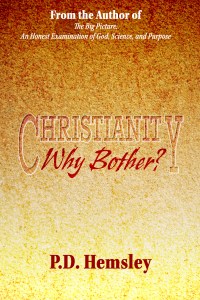
“Christianity – Why Bother?” … out now

Belief in God is claimed to be on the decline, and many cannot see a reason to question whether God might exist. What would be the point? Why make the effort? That is why “Christianity, Why Bother?” deserves a read. It answers the question that its title asks.

The book discusses some of the misconceptions of Christianity, and then moves on to examine the basis for belief and explains some of the practical and day-to-day benefits of being a Christian. The author shares some of his experiences since he became a Christian at the age of forty. The aim is simply to address the question, “why bother?”

Christianity why bother cover

Click here to buy on Amazon.

“You can’t support them all can you?”

Let me start by start by confessing that I am writing this to myself as much as to anyone else, and particularly to those of us who call ourselves Christians. It covers the challenging topic of giving money. Often we say, or hear others say something like, “I won’t give to that charity. You can’t support them all, can you?”  It sounds reasonable, but is it correct? Christians believe that Jesus Christ gave everything for us. He gave his life that we might have a rich and satisfying life. We believe that there is guidance in the Bible on how to live such a life. Here are some passages:

“Give to those who ask, and don’t turn away from those who want to borrow.” “If you have two shirts, give one to the poor. If you have food, share it with those who are hungry.” “When you give to someone in need, don’t let your left hand know what your right hand is doing. Give your gifts in private, and your Father, who sees everything, will reward you. Looking at the man, Jesus felt genuine love for him. “There is still one thing you haven’t done,” he told him. “Go and sell all your possessions and give the money to the poor, and you will have treasure in heaven. Then come, follow me.”

The message appears to be that yes, we can support them all. I was discussing this with my wife after looking at the distribution of income on an earlier post. When would it be OK to say no, we are giving enough? I suggested that perhaps it was OK when our income net of giving was that of the lowest on the curve – the bottom 10%. If we expect people on the bottom 10% to live full and satisfying lives on their income, shouldn’t we be willing to do the same? Elsewhere in the bible is states that:  “Each one must give as he has decided in his heart, not reluctantly or under compulsion, for God loves a cheerful giver.”  So how does that fit with “sell all you have and give the money to the poor”? Perhaps it means that if we are unable to give cheerfully to anyone who asks then we need to work on our heart. Maybe we need to teach ourselves to love more. As well as listening to the advice on how to maximise our income, invest in schemes to give high interest and avoid paying tax, we need to be hearing that we can manage on less. We can still maximise our income, but to give more away instead of saving it for ourselves.  See also my post “The Wealthy are Redeemable” Yes, I am sure I am being hypocritical in writing this. But that does not make what I have written wrong. Let’s all ponder this in our hearts and see what we decide to do.

………………………………………………………………………

If you want some ideas, try these links:

http://5quidforlife.org.uk/

Home

feel free to add your own in the comments.  I’ll add them here when I get time.

A robust intellectual basis for Christianity is not enough.

I like to understand why things are like they are. As a child I was taught that science provides the answers that I needed.

When in later life I became a Christian I thought that there was a conflict between science and God, but for a while reconciled this with the idea that ‘God can do anything’. A simple idea, but science and faith was not an area that I really wanted to explore.

We are given the impression that ‘science knows’, but we just haven’t been told yet. About five years ago I decided to find out. What does science know? What does it still not know? Are there things it can never know? Taking everything into account, what story best fits all the facts, a godless universe or one with a God?

I adopted an analytical approach, but avoided the temptation to dig too deeply into details of each field. I just tried to understand the underlying principles sufficiently to see what they contribute to the big picture. I found that most people feel uncomfortable outside of their specialist field, that few seem willing to take the necessary overview.

Having read a couple of books like ‘The Edge of Evolution” by the Intelligent Design proponents I began thinking that it may be possible to prove God exists. But then I read secular books on the origins of life and realised that everyone accepts the remarkable unlikelihood of life but that it doesn’t provide irrefutable proof – there are alternative explanations such as the multiverse theory.

I needed to find out where the Bible came from; could I trust it, and if so, why? I researched the source of the NT documents in particular, and some of the gospel accounts that are excluded from the Bible (the Da Vinci code stuff). I realised that the gospel accounts are not trying to prove who Jesus was and what he did, but that they wouldn’t have been written if he hadn’t done some amazing things. The accounts are simply people trying to capture what happened for future generations. The Bible is not a spells book: “Do this and God will do that for you”.

I reached a number of conclusions about how to understand and respond to the big picture of what’s going on. Realising that everything requires a level of faith (including science of course), I suggest a response which recognises that many religious and scientific dogmas are unproven and unprovable – but unnecessary. I call the response “Minimalist Christianity”. I wrote up what I found in “The Big Picture”, found a publisher and then set about marketing my masterpiece.

There is a robust intellectual basis for Christianity, and I would commend it to others, but I recently realised that in exploring it I was falling into a bit of a trap. Because I have necessarily spent several years testing and probing, viewing things sceptically, I let my personal spiritual life become analytical too. My reasoning has shown that God exists, and that he must have a ‘personality’ and want to interact with each of us, but I have not really been responding to the real God – just developing an intellectual one.

We need to ‘get to know God’ as more than an idea; I need to follow my own advice! It is from the integrity of that relationship that the power to fulfil our purpose will flow. We need analysis to know that we can trust, but then we need to act on that trust to complete the experience. Having determined that the rock exists, we need to actively build the house of our life on it!

“Anyone who listens to my teaching and follows it is wise, like a person who builds a house on solid rock. Though the rain comes in torrents and the floodwaters rise and the winds beat against that house, it won’t collapse because it is built on bedrock.” Jesus circa 30AD

Fear of science

There are millions of people spending their working life pushing forward scientific knowledge.  The breadth of knowledge discovered by the hands of so many scientists is beyond anyone’s comprehension.  Pronouncements by the scientific community have become almost the word of God.  Nobody has the evidence to question them. And yet…. sometimes they just don’t seem right.  They make us uneasy.  We fear that scientists have overstepped their knowledge, and often rightly so. We must not be afraid to voice our concerns, see for example https://philhemsley.wordpress.com/2013/11/22/mitochondrial-donation-some-concerns/

With so much knowledge out there, and so many people working on science, many in society have come to believe that science will eventually be able to answer every question.  “Eventually we will know everything about how the universe works. Science will allow us to live forever.  Technology will reverse global warming.  We will finally leave earth and colonise the solar system and universe.  Maybe we will even learn to travel through time itself, and finally we will be able to meet the maker of it all and ask why he made such a mess of things….”

Of course, many of these ideas come from science fiction, but literature influences our culture and outlook.  All of the ideas above seem reasonable extrapolations of where we have got to, and are often reinforced by the fantasizing of high profile scientists. http://www.dailymail.co.uk/sciencetech/article-1270531/Stephen-Hawking-backs-possibility-time-travel-millions-years-future.html

There is another group of people who have a different outlook. They believe that the literal explanation for everything that has happened, and prediction of everything that is going to happen in the future is written in a collection of books and manuscripts compiled from 2000-4000 years ago, called the Bible.  The first of these books describes how the world was created and populated with all the plants and animals as completely formed organisms. The whole process took just six days.  This literal interpretation of the book of Genesis will inevitably lead to a fear of science; “Will those millions of people prove my belief’s wrong?  Have I built my life on a lie?”

How can we overcome our fear of science?  How can we tame and control this beast, and stop it turning round and destroying us?

The only way to overcome our fears is to face them.  We need the courage to try to understand what science is and what it isn’t, what it can tell us and what it can’t.  We need to understand the assumptions behind all science.  We must not get lost in the detail, but we need to set the whole in context.  We need a guide.

Many of my posts on this blog are intended to help us think about scientific issues:

https://philhemsley.wordpress.com/2013/03/11/how-far-should-we-trust-scientific-prediction/

https://philhemsley.wordpress.com/2013/03/03/information-dna-and-evolution/

https://philhemsley.wordpress.com/2013/04/07/god-miracles-and-the-laws-of-physics/

and my book “The Big Picture” can equip the reader to begin to understand how to deal with science.  Reviewers seem to think it works:

https://www.goodreads.com/review/show/766354330

https://www.goodreads.com/review/show/767596412

There are other resources that help understand how we might deal with science, and I refer to many in the book.  But I hope that my years of spare time researching of these big questions will be of benefit to others, if only as a starting point for further discovery.

As I mentioned above,  if we are afraid of science, the best thing to do is to confront our fears.  And it’s best to confront them with a friendly guide.


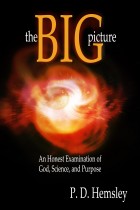
“The Big Picture” – an honest examination of God, science and purpose – OUT NOW

“I recommend this book to all thinking people – we might just change the world.” 

“This book will definitely make you think and then think again. Hemsley did his research for this book, and I received many answers to questions I’ve pondered over the years.”

“it is a welcome relief to come across a book that presents such a broad and balanced overview”

“This book covers an considerable amount of territory in its 253 pages.”

The Big Picture is a much-needed book that allows the reader to consider the big questions of life without feeling bludgeoned to adopt the author’s opinion. The book explains basics of science, philosophy and religion in a straightforward manner.

It will encourage all those who want to live a good and purposeful life and would like a sound basis for doing so. Such readers may find a resonance with the teaching of Jesus and this book will explore whether we can trust what has been recorded in the gospel accounts, and whether the findings of science and a reasoned understanding of the Bible are consistent or contradictory.

Many books in the arena of science and faith are hostile and adversarial. The authors set up straw men of their opponent’s arguments, dismantle them and then preach their own arguments to their disciples. The author of The Big Picture recognises that there are intelligent atheists and intelligent believers, and that a case can always be made for whatever someone wants to believe. The reader is therefore treated with respect

ebook

paperback

Amazon UK

The Big Picture - cover

Richard Miles – Archaeology: A Secret History

The description of this program on iPlayer is “Archaeologist Richard Miles presents a series charting the history of the breakthroughs and watersheds in our long quest to understand our ancient past. He begins by going back 2,000 years to explore how archaeology began by trying to prove a biblical truth – a quest that soon got archaeologists into dangerous water.”

Unfortunately the tone and style of presentation of the program was similar to the description.  The program frequently asserts that there is conflict between Archaeology and Biblical truth, and implies that Archaeology has proved the Bible to be wrong.  The church is presented as a dogma bound institution that can only consider that everything in the Bible is to be taken literally.  The church’s only contact with scientific methods was to use them to show that the world was created a few thousand years ago.  Isn’t he aware that different parts of the Bible are written in different genre’s?  Would he think that if archaeology could prove that there wasn’t a good Samaritan then that must show that Jesus was lying when he told the parable?  Does he think that Christians really believe that the Genesis account is to be taken literally?  As far back as the early fifth century St Augustine was forthright in his criticism of literal interpretation of Genesis.

The presenter, Dr Miles, frequently implies that archaeologists were ‘in dangerous water’ by thinking – thinking is something that is presumably not allowed by the church.  Doesn’t he know that many of the greatest minds have been and continue to be Christians?  Even the greatest secular scientists realize that questions of God are not trivial.

Dr Miles  appears dismissive of the approach of looking for evidence to support a theory (Empress Helena seeking for evidence of Jesus’ crucifixion) – isn’t he aware that this is precisely the scientific method – build a large Hadron collider to look for a Higgs bosun for instance?  

Dr Miles seems far happier to find something and then simply guess what it might mean.  He appeared disappointed that the speculations of John Frayre (sp?) who ‘instinctively knew’ that the triangular objects had been made by human hand were not immediately adopted.

So for me, the undercurrent of generating a false conflict between God and Archaeology/Science, and the implied rejection of ‘belief’ spoilt what could otherwise have been an interesting and enjoyable program.  I am disappointed that the BBC feel the need to generate some sort of conflict or controversy in so much of their programming.

Related posts:

https://philhemsley.wordpress.com/2012/04/29/things-that-a-minimalist-christian-does-not-have-to-believe-the-genesis-account-of-creation/

https://philhemsley.wordpress.com/2012/06/21/an-argument-for-and-definition-of-god/

https://philhemsley.wordpress.com/2013/03/11/how-far-should-we-trust-scientific-prediction/