Seeking adventure?

There is an account in the gospels of Jesus sleeping in a boat while a storm rages and seems about to sink it.  The disciples wake Jesus, he calms the storm and then says to his followers “Why are you so afraid? Do you still have no faith?”

Usually we take from this story that Jesus has the power to calm storms, and that we can ask him to calm the storms in our lives.  i.e. call out to Jesus so that we can live placid boring lives. But I think the message is different. 

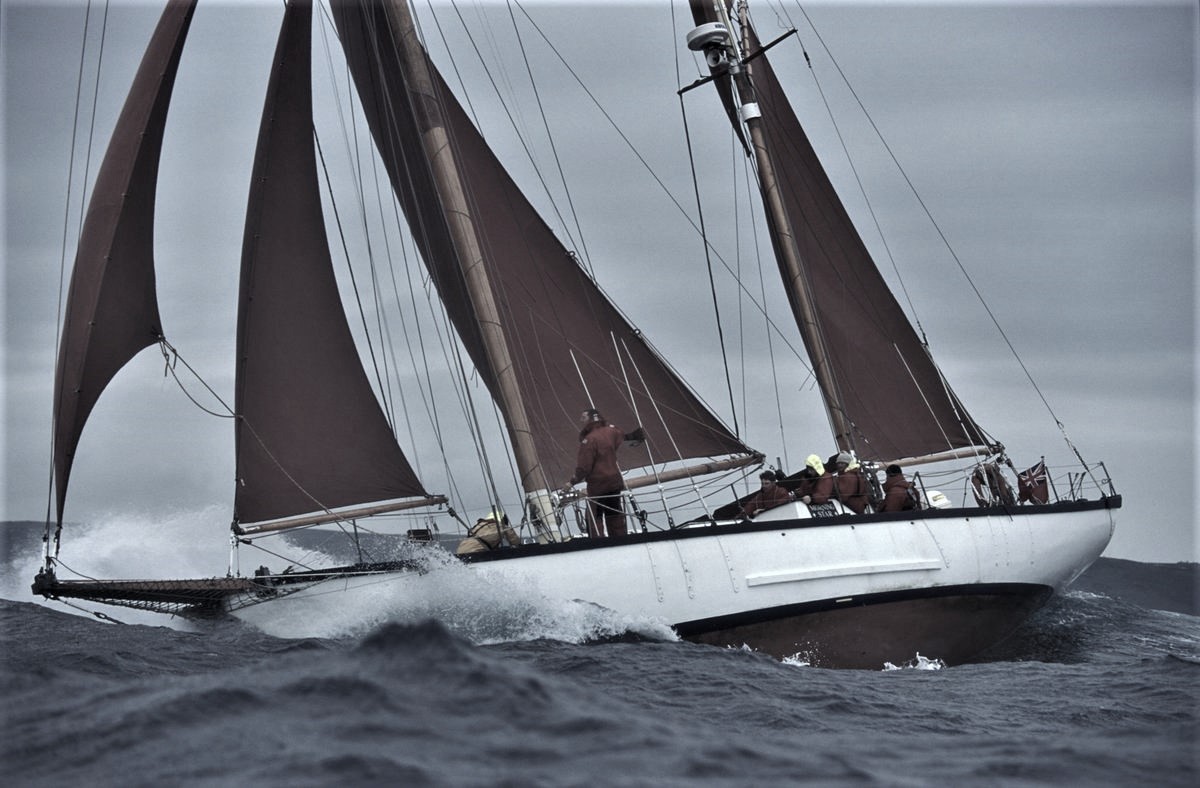
I was on a sailing boat in storm force winds when a mast fitting broke. We had to get the sail down whilst being tossed in the massive waves, with wind and rain and spray.  It was exciting, we felt alive and ‘present’, …. and yet safe.  Our skipper was completely calm, and so we were confident that we would come to no harm; and we didn’t.  It was a joyful and exhilarating shared experience which we will all remember and which is a bond between us; so much more than flat seas and a gentle breeze.

So I think that instead of offering calm seas in our lives, Jesus is saying ‘I am in your boat, you are perfectly safe.  Go and enjoy the adventure.’ And it is with sadness that he has to calm our storm because we have so little faith.

Do you want adventure?  ‘Safe’ adventure?  Feel free to get in touch…

Liberating repentance – Acts 10; 34-43

I’m going to draw out from Acts 10; 34-43 what makes the Gospel transformational, and suggest how we can engage it more fully.

The short speech by Peter was made after he’d been summoned to meet a Roman centurion.  Peter willingly went to meet him after having had a vision where Peter was being told to eat food that Jews considered unclean.  In the vision he was told “What God has made clean, you must not call profane.”

Peter is describing what he learnt from the event, and it efficiently describes why  I am a Christian.

First of all Peter declares “I truly understand that God shows no partiality, but in every nation anyone who fears him and does what is right is acceptable to him.”  In short, God loves you and me equally to the Jews.  We are ALL allowed to share in the life giving message of the good news of Christ.

Peter then describes that he personally was witness to the facts that:

  • John baptised Jesus, at which point God anointed Jesus with the Holy Spirit
  • Jesus went around doing good and healing people
  • Jesus was crucified
  • Jesus was raised to life on the third day, and appeared to those selected to be his witnesses
  • Jesus told them to preach that He is the one who will judge the living and the dead
  • And finally that everyone who believes in Jesus will have their sins forgiven

The first four points bear witness to who Jesus was.  But I want to focus on the last two points. That Jesus will judge the living and the dead, and that everyone who believes will have their sins forgiven.

If we are honest, we’d rather not be judged at all.  Perhaps we are living quiet lives, keeping our head below the parapet.  We come to church on Sunday and we just want to be left alone until we die when we hope to go to heaven.

If we are to be judged, we don’t want our neighbours or friends judging us.  And when we see what the Tabloids say about people, we certainly don’t want society to judge us.

We probably get angry at anyone who dares to criticise us – “who are they to judge?  They’re no better than me! Hypocrites!”

What about Jesus judging us?

Jesus – the human incarnation of infinite goodness.

The one who gave every moment of his life to heal, teach and serve.

The one who allowed himself to be sacrificed by crucifixion, and still forgave those who nailed him to the cross.

Jesus.  We can’t be angry with Him – he’s certainly no hypocrite.  We can probably accept that he has the right to judge us, but maybe we are still not happy with the idea.

Deep down we know that if Jesus were to judge us he would see SUCH shortcomings in our lives.

  • Our petty grievances with our neighbours, with our fellow Christians
  • Our contentment to live in comfort whilst we know that there are others who have nothing
  • Our consumerism, looking for the cheapest product that then keeps the poorest in poverty and makes those in work put in more hours at lower pay than they can manage
  • Our readiness to get in our car to go anywhere, to take cheap overseas holidays, to travel on a whim, leading to overheating of our planet and the mass extinction of so many species

And that’s before we get to more obvious ‘sins’…

And yet we probably don’t ‘feel’ like sinners.

When I was on the cusp of becoming a Christian I had been told that I needed to ‘pray the sinner’s prayer’.  This is what I wrote in my journal:

I sit down – I’m not ready for kneeling yet – and start to read the prayer…

 “Dear lord I have sinned…”

 The trouble is…I don’t feel like a sinner.  Yes, I know that I could be a lot better than I am, but I just don’t feel it at the moment.  So I start to pray that God will help me to make the step from logic to feeling.  At least I try to do what I think praying is ….  I wonder if I’m doing it right.

I didn’t ‘feel’ like a sinner – but I recognised that I needed to.

If we don’t ‘feel’ our sin, then we need help.  We can pray, like I did, for God to help us make the step from logic to feeling.

A little later in my journal I wrote:

My daughter had organised her own birthday party, with half a dozen friends coming round for a ‘scary party’.  It was impressive to see them all dressed up as witches and devils (and a cat!?).  However, for some reason I was rather grumpy.  I didn’t get into the party spirit and got rather short with all the mess, and split drinks and so on.  I wasn’t very sympathetic when my daughter got upset that no-one was listening to her, and tried to explain that they couldn’t help it if they got distracted.  At the end of it I felt that I had let her down.  I don’t know if she noticed particularly, since it was rather a busy affair, but that was how I felt.  I felt like a sinner.  Was someone trying to tell me something?

But if we can ‘feel’ our sin, if we can let the Holy Spirit show us our shortcomings then we will surely fear his judgement.  That is in part what it means to fear God.

And recognising our sin is the start of healing.  When recognise what we are, when we see through our masks of self-justification, and we don’t like what we see!  We want to be different, we want to change.  That is what repentance is – honest assessment followed by determination to change.

I recently watched a TED talk by Eve Ensler, and activist for women.  She was talking on the profound power of an authentic apology.  She describes how her father abused her, but that he’d never apologised – never repented.  She describes the process of repentance.  In her words:

Apology is a sacred commitment. It requires complete honesty. It demands deep self-interrogation and time. It cannot be rushed. I discovered an apology has four steps, and, if you would, I’d like to take you through them. 

 The first is you have to say what, in detail, you did. Your accounting cannot be vague. “I’m sorry if I hurt you” or “I’m sorry if I sexually abused you” doesn’t cut it. You have to say what actually happened. “I came into the room in the middle of the night, and I pulled your underpants down.” “I belittled you because I was jealous of you and I wanted you to feel less.” The liberation is in the details. An apology is a remembering. It connects the past with the present. It says that what occurred actually did occur. 

 The second step is you have to ask yourself why. Survivors are haunted by the why. Why? Why would my father want to sexually abuse his eldest daughter? Why would he take my head and smash it against a wall? …..  My father had to live up to this impossible ideal, and so he was never allowed to be himself. He was never allowed to express tenderness or vulnerability, curiosity, doubt. He was never allowed to cry. And so he was forced to push all those feelings underground…

 Those suppressed feelings later became Shadowman, and he was out of control, and he eventually unleashed his torrent on me. 

 The third step is you have to open your heart and feel what your victim felt …. You have to let your heart break. You have to feel the horror and betrayal and the long-term impacts of your action on your victim. You have to sit with the suffering you have caused. 

 And, of course, the fourth step is taking responsibility for what you have done and making amends. 

 So, why would anyone want to go through such a gruelling and humbling process? Why would you want to rip yourself open? Because it is the only thing that will set yourself free.”

This is SO important.  This is what Jesus is talking about when he says “Repent of your sins and turn to God”

When we repent we still feel the guilt of our past mistakes.  I still feel angst thinking about that party.  And this is where the final point is Paul’s speech brings such freedom:

“Anyone who believes in Jesus will have their sins forgiven.”

Perhaps this seems a little unfair – what about someone who doesn’t ‘believe in Jesus’.  Are they not forgiven?  Well clearly they will not be able to believe that they are forgiven.  We have to believe that Jesus has the authority to forgive our sins in order to accept that forgiveness.

Maybe it’s actually more serious if we claim to believe in Jesus. We know the theory, but have we really repented?  Do we really know that freedom that we are forgiven?  How can we tell?

I actually found the TED talk above when I was looking for a quote about activism:

“An activist is someone who cannot help but fight for something.  That person is not usually motivated by the need for power, or money or fame.  But in fact is driven slightly mad by some injustice, some cruelty, some unfairness, so much so that he or she is compelled by some internal moral engine to make it better.”

So my question is, are we activists for Christ?  Have we repented and turned to God with such deep honesty that we “cannot help but fight for Him”, such that we are “compelled by some internal moral engine to make it better”

And if not, it’s time we did something about it.

Let’s pray that God shows us our sin, that we can understand why we do it, that we can feel what our ‘victims’ feel, that we take responsibility for it and that we commit to making amends.

That is the only thing that will set us free.

(Delivered as a sermon – January 2020)
How should we respond to climate change? – A Christian perspective

The earth’s climate has seen dramatic change. Four and a half billion years ago, the earth was formed.  Its atmosphere had massively high levels of carbon dioxide, and there was very little oxygen.  Miraculously, life originated in this extremely hostile environment, and for the next one and a half billion years or so the cyanobacteria began cleaning up the atmosphere and enriching it with oxygen and allowing the formation of the protective ozone layer.

Over the next two billion years the beautifully designed process of evolution took those earliest forms of life and developed them into the staggering array of life that we take so readily for granted today.   Darwin hinted at the beauty of the process in the final paragraph of his book “the origin of species” when he wrote “There is grandeur in this view of life, with its several powers, having been originally breathed into a few forms or into one; and that, whilst this planet has gone cycling on according to the fixed law of gravity, from so simple a beginning endless forms most beautiful and most wonderful have been, and are being, evolved.”

So it is clear that man-made climate change will not destroy the planet, nor will it extinguish life.  But it will disrupt the extremely finely balanced ecosystem that sustains the human race.  That disruption will enlarge areas of local extinction of humans (desert regions), and in the extreme the whole planet could become unsuitable for human life.  Whilst wealthy countries are able to create local ‘microclimates’ with technology, for example air conditioning, people sentenced to live in the ‘natural’ local climate will inevitably suffer and may face extinction.  We already see an increase in suffering from natural disasters such as the cyclone Idai, and other increasingly destructive climactic events.

Greater parts of the world will become uninhabitable not just for humans, but for the cornucopia of other species who thrive in the environment that spawned us.  New species will emerge, but many of our present ‘friends’ will disappear.

The first book of the Bible describes how we were given the world to look after.  It is clear from the description above that if we don’t look after it then it will not be taken away from us, but we will be taken away from it.  This is reminiscent of the description of Adam and Eve being taken away from the Garden of Eden: the garden still thrives, but they were no longer in it.

God allows us to do things that harm us.  He doesn’t want us to, but he allows it.  Such action is called sin.  The basis of the Old Testament law was that God gave us rules that would bring us wellbeing, but our selfishness leads us to choose ways that harm ourselves and others.  Greed, lust, envy, and all the ‘sins’ damage both us and our neighbour.  Climate change is damaging to us and to our neighbour, and so the actions that leads to climate change are ‘sin’.  God permits us to damage the planet that sustains us, but it is not His will.  And disobeying the will of God is sin.  It is not good for us to do it!

There is not space here to fully discuss how we, through our actions are hurting God themselves, but we might empathise by imagining how we would feel if after giving a loved one a beautiful gift – perhaps a bunch of flowers,  we see them slowly trashing it, picking off one petal at a time.

So, how should we, as Christians, respond to the challenge of climate change?

First of all, we must recognise that it is real! (see for instance https://climate.nasa.gov/effects/)

Climate change is not the sin, but the consequence of our sin.  We need to reflect on what sins are the root cause of climate change.  Greed, selfishness, gluttony, envy will be high on our list, but a thorough examination of our lifestyle (in the context of and comparison with the other seven and a half billion people on the plant) must bring insight.

We then need to ‘repent of our sins and turn to God’.  There is surely enough evidence that we know that we are sinning, but we need to let the evidence sink into our hearts and truly convict us before we can honestly repent.  Until we reach that state then we might feel a little guilty but we will not have the power that comes from true repentance.  We need to be so convicted that we get on our knees, confess, and ask for forgiveness.

We must work with God to eliminate our sinful behaviour. We will need to be bold, counter-cultural and outrageously attractive in our approach.  We are Christ’s representatives, and our response has to mirror his character. And we must encourage our brothers and sisters to do the same.  Not only must we turn from our damaging practices, but we must do our utmost to relieve the suffering of those whose homes and livelihoods are ruined by the changing climate.  A radical change in our lifestyle must include loosening our grip on our wallets.

For example, we need to ask ourselves why we need to go to America, or China, or Australia for our holidays, for a speaking engagement, or for work.  99% of the world’s population cannot afford these luxuries – and yet many are closer to God than we are.  http://www.globalrichlist.com/

We have to challenge every decision of where we spend our money.  Should we always buy the cheapest, or should our buying decisions be made to minimise planetary damage?

We can make reparation for the damage caused by our personal sin.  We can ‘offset’ our carbon emissions, for example “Climate Stewards helps you to offset unavoidable carbon emissions by supporting community forestry, water filter and cookstove projects in the developing world”.  Some are beginning to do this for holidays or the odd long haul flight, but that is surely just lip-service.  Should we not examine our carbon emissions over our lifetime and offset them?  (see https://www.climatestewards.org/) At only £20 a tonne, many of us are in the privileged financial position to be able to do that.  There is real potential for tree planting projects to ‘buy some time’: https://www.sciencenews.org/article/planting-trees-could-buy-more-time-fight-climate-change-thought.  And churches can do the same, committing to offset past energy usage and adding carbon offset as a statutory spend each year.  It is much easier if we all make the commitment together.  Leadership from our Bishops can help here.

Those of us who live comfortably in brick houses in rural England can send financial assistance to those whose pole and dagga houses are swept away by floods or typhoon. (see https://www.christianaid.org.uk/emergencies/south-asia-floods-appeal)   As James says:  “Suppose you see a brother or sister who has no food or clothing, and you say, ‘Good-bye and have a good day; stay warm and eat well’—but then you don’t give that person any food or clothing. What good does that do?  So you see, faith by itself isn’t enough. Unless it produces good deeds, it is dead and useless.”  Communication is so good that we see our ‘brother or sister who has no food or clothing’ daily on our TV’s or computer screens.

We will of course fail to live up to our aspirations, but we can try. And when we fail, God’s grace will free us to try again.

And finally a thought about our legacy.  The younger generation are worried.  Environmental issues are at the top of their concerns.  And the younger generation tend not to know Christ.  We have a wonderful opportunity to bring them hope, both for a world to live in and from a God who loves them.  That is a far better legacy than bequeathing a scorching earth that is hardly able to sustain human life.

Let us be at the forefront of change, not dragging our feet but leading the way to a sustainable future.

Excerpt from The Big Picture: “Am I Open Minded?”

As we start out ask yourself the question, “Am I open minded, ready to follow where evidence leads, with no preconceptions?”

Now I’m sure you’ve answered “yes” because none of us would like to admit otherwise, but actually, it may be impossible to start any investigation without preconceptions.   They are the motivation behind many investigations … the desire to obtain proof of what we already think about something.

Preconceptions are almost inherent in the scientific approach – we think of a theory, and then we investigate to test it.  If we are honest, we will admit that we like our theories and feel good when they are proved right.

Perhaps there is one preconception that I will allow at this stage; that each one of us matters. I matter. You matter.  Our friends and neighbours all matter.  If we don’t matter then there is no point in anything and it’s best not to think any deeper.  That road leads to despair.

If we are going to explore these questions fully we are going to have to consider questions of God, science, reason, history and more.  We are going to have to include objective data and subjective experience; objectivity keeps us from being deluded but it is the subjective that really matters to us.

Even if we try to think about an issue with an open mind, we nevertheless carry many assumptions that we don’t realise.  Speaking personally, my scientific education and engineering career have both instilled a basic assumption of materialism: the fabric of the universe is all there is.  When people talk about a spiritual dimension, is it just another material dimension that we can’t see?  And if there is a spiritual dimension, how can it interact with the physical universe?  Or if there isn’t a separate spiritual dimension then where does God exist?  These are not straightforward questions, but I’ve come to realise that they are valid.   I have had to challenge a lot of what I took simply as common sense and to open my mind to new possibilities.

It can be difficult to refresh our way of thinking, particularly if we are surrounded by others who have a similar outlook to ourselves.  In a recent discussion on European history with a university student he mentioned that such and such country was fascist.  It led me to ask what it is that makes the people there fascist.  Is it genetically programmed into each individual there?  If you took any one of them and brought them up elsewhere would they be fascist?  I think it likely that they wouldn’t.  They are fascist because everyone around them is fascist.  They are unconsciously trained to be fascists.

So what are we doing in our country?  What are we training ourselves to think like?  What assumptions do we hold, and are they valid?  Books such as The Science Delusion by Rupert Sheldrake[i] challenge many of the assumptions of the day.  He asks us to challenge our scientific dogmas, our blind assumptions.  Even if we end up thinking the same as we did before, we have a more solid basis for our beliefs if we go through the process of challenging our assumptions.

Implications

Whenever anyone is presenting a case we might ask ourselves, “If I were to accept what is being presented and agree with the author, what would be the implications for me?  How willing would I be to accept those implications?  Do I need to understand the implications before I start?”

Many parents choose not to have their babies tested for Down’s syndrome because they would not be willing to accept a termination of the pregnancy and so feel that there is no point in knowing before the child is born.  Others might need to understand all the implications before deciding; how accurate is the test, and what are the options available if the child tests positive? Still others might insist that they must have the test because they are not prepared to risk having a child with Down’s syndrome and would terminate the pregnancy if that were shown to be likely by the test.

This is a book that deals with questions of God.  This may worry some people. If they were to be convinced that God is real they would have to become the sort of bigoted judgemental fanatic that represents the worst face of religion.  They may think that they would need to join a religion and accept all that they are told without thinking, and be associated with all the religious atrocities of the past. Or that they will have to give up their Sunday morning lie-in and trot off to church with a bunch of hypocrites. If these thoughts resonate with you, take courage – it doesn’t have to be like that.

Fear

People can be frightened by the prospect of change, but often change is beneficial.  For instance, when redundancies are announced, there is a lot of fear in the workforce.  Some may have been in the same job for thirty years, and they simply don’t know anything else – how will they cope if they have to find another job?  And yet being forced to change jobs can be a most liberating and life-changing experience.  I recall hearing a report that those who remain behind after a round of redundancies are likely to be more stressed than those who have been made redundant.  They are still in the same job, but with increased fear of losing it and still in fear of change, whereas those who have left are now busy rebuilding their new lives and careers.  That’s not to say it’s easy to change, but a change in a job or a worldview can be very liberating.

Peer Pressure

Perhaps we don’t want to change our views because of what others might think of us.  We’ve probably aired our opinions sufficiently to our friends that any major change would be an embarrassment.   Or perhaps we live or work in a culture where there is only one accepted way of thinking.  We might find that we have to live a double life, adopting one attitude at work and another in private.  For instance, to progress a career as a scientist it is necessary to publish papers and learned articles.  Such articles are subject to peer review.  This process is in place to ensure that sound scientific information is published and that mistakes do not get propagated.  But the process inherently risks that only those papers that conform to the present scientific way of thinking are published.  If a scientist becomes too free thinking, then the peer review process may prevent his papers being published and his career may come to a grinding halt.  Reputation is essential, and doing anything that might lose it is risky.

An ambitious scientist may be fearful of embracing religion.  Religion allows that God might interfere with the workings of the world.  That might mean that the universe is not completely predictable, which would seem to undermine the basis of all the work of science.  Allowing the existence of God might mean that it will be impossible to have a complete scientific theory that predicts everything – which is challenging to anyone who invests their life in seeking it.

Similarly, in religious circles it can be damaging not only to one’s career but also to one’s life to challenge the current way of thinking.  Men and women have been labelled heretics and have been burnt at the stake for holding different religious beliefs.

Religious people may have a deep fear of science.  Apart from the vocal assertions made by some atheists that science has done away with God, there can be fear that science might undermine or even disprove certain traditions or beliefs that the given religion may hold dear, or even sacred.  A religious man may have invested so much in his religion that he’s lost the desire, and maybe even the ability, to be open to learning that some of what he’s been taught is incorrect.  Yet surely a truly godly man would be desperate to be corrected if he were misunderstanding God?  In her book Awesome God, Sara Maitland encourages religious people to embrace what can be learned from science:

Start with “God exists” and everything we can learn will tell us more about God.[ii]

So returning to the question, “Am I open minded, ready to follow where evidence leads, with no preconceptions?” we can see that it is almost impossible not to have preconceptions or preconditions.  A first step in challenging them is to consider how we came to believe them in the first place. How did we come to really know what we know?

[i] Rupert Sheldrake: The Science Delusion ISBN 978-1444727944

[ii] Sara Maitland: Awesome God: Creation, Commitment and Joy ISBN: 978-0281054190

How can Theresa May call herself a Christian?

“If someone had enough money to live well and sees a brother in need but shows no compassion – how can God’s love be in that person?” 1 John 3:17

The Conservative party have overseen the rise in homelessness and food bank usage, hardship caused by severe sanctioning of benefits, zero hour contracts, deep cuts in public services.  Yet Mrs May has called herself a Christian.  I don’t understand how.  Jesus said “If you love me, obey my commandments” John 14:15 yet I see no sign of that.

Jesus calls us to love our neighbour, not to exploit them.  He noted that the widows offering of a few small coins was worth far more than the trumpeted gifts of the wealthy.  She gave all she had to live on.

Unfortunately the Conservative government have demanded all from the poorest in society.  There have been plenty of opportunities for a change of heart – now it is time for a change of government.

“Sorry Jesus, you got it wrong”

Two children are in a fight, and when we separate them both point at the other and shout “well he started it”.  We might respond “well even if he did, you carried it on!”

But as we grow older we forget to apply Christ’s simple but profound wisdom to our own lives.

 “You have heard the law that says, ‘Love your neighbour and hate your enemy. But I say, love your enemies!  Pray for those who persecute you! In that way, you will be acting as true children of your Father in heaven. For he gives his sunlight to both the evil and the good, and he sends rain on the just and the unjust alike. If you love only those who love you, what reward is there for that? Even corrupt tax collectors do that much. If you are kind only to your friends, how are you different from anyone else? Even pagans do that.

 But you are to be perfect, even as your Father in heaven is perfect.”

Of course, as we become adults our disputes are less likely to be over schoolboy issues.  We might have a ‘neighbour from hell’ who takes advantage of us and tramples over our ‘rights’.  And when we respond in kind, and when the conflict escalates we say ‘well he started it’.  And perhaps ‘who are you to criticise what I do?’.

When,  was a Christian,e find ourselves in this sort of situation, do we respond by justifying our actions? Do we argue that Jesus’ teaching is wrong and doesn’t apply to our case?  Or do we admit that we are in the wrong, perhaps too tired or weak to do what we should.  Do we accept that we are falling short of his instruction to be ‘perfect’ (i.e. do we repent) and humbly ask him to work with us to correct this flaw in our character?

If we look elsewhere at Jesus’ wisdom we find that he has already given guidance on how to love our enemy.  Again, we have a choice of arguing that he must have got it wrong, or we can choose to work with him to try to follow his words:

“You have heard the law that says the punishment must match the injury: ‘An eye for an eye, and a tooth for a tooth.’ But I say, do not resist an evil person! If someone slaps you on the right cheek, offer the other cheek also. If you are sued in court and your shirt is taken from you, give your coat, too.  If a soldier demands that you carry his gear for a mile, carry it two miles. Give to those who ask, and don’t turn away from those who want to borrow.”

 “But I say, if you are even angry with someone, you are subject to judgment! If you call someone an idiot, you are in danger of being brought before the court. And if you curse someone, you are in danger of the fires of hell.  “So if you are presenting a sacrifice at the altar in the Temple and you suddenly remember that someone has something against you, leave your sacrifice there at the altar. Go and be reconciled to that person. Then come and offer your sacrifice to God.”

None of us are yet perfect and we all fall short of Jesus standard.  But the critical question is, do we want to be perfect?  Do we want to change and allow Jesus sacrifice and grace wash us clean.

If we want to hold on to our hatred, anger and right to hit back at our neighbour then Jesus cannot help us.  A pastor often told me “Sin cannot get into heaven” … if we want to hold on to our sin, we can do – but we could not be allowed into heaven; we would spoil it for everyone else.  If we choose to hold on to our hatred then we are choosing to separate ourselves from the infinite goodness that is God.

To be clear, I am not judging or criticising anyone who finds themselves in a difficult situation with an enemy. None of us know how we would respond if we were in someone else’s shoes.  None of us can tell another to remove the speck from their eye!  Judgement is for God alone.  But hopefully this post points out simply and lovingly what Jesus tells us.

“the Lord has told you what is good, and this is what he requires of you: to do what is right, to love mercy, and to walk humbly with your God.”

Is it possible to be a Christian and right wing?

It’s not complicated.  Jesus said “Those who accept my commandments and obey them are the ones who love me.”

And what are His commandments?

“‘You must love the Lord your God with all your heart, all your soul, and all your mind.’ This is the first and greatest commandment. A second is equally important: ‘Love your neighbor as yourself.’ The entire law and all the demands of the prophets are based on these two commandments.”

and here are some more details:

“If you lend only to those who can repay you, why should you get credit? …  Lend to them without expecting to be repaid”

“Give to those who ask, and don’t turn away from those who want to borrow”

How does this square with austerity measures imposed by the wealthy on the poor?

Just asking…..

David Bowie – The Hysteria, the Sorrow, the Frustration and the Hope

A clear thinking article.

theweeflea's avatarTheWeeFlea.com

This is my article on David Bowie in Christian Today   – it is slightly amended because I wanted to tidy up a couple of things.  The article came as a result of a conversation with my wife, Annabel, as she gave me a lift down to the church.  And then all these ideas just popped into my head, so I wrote them down and quite surprizingly it has gone, as they say, ‘viral’.  There are so many ‘Bowies’ out there – who need to hear the Good News!  As always comments appreciated.

Its great that The Scotsman has put much of this on their website!

And The Herald

David Bowie’s death, grief, and the frustration of a society that has nothing to offer the lonely

It was a shock. Of course it was. Make your coffee, switch on the radio and you hear Life on Mars on Radio 4. What…

View original post 1,353 more words

God is fair, the economy isn’t, we can do our bit.

Mankind has established a system that breeds injustice. Wealth sucks money from the poor. Those with money enjoy luxury whilst those without struggle to survive.

God is not like that. He is just and fair. The Apostle Peter writes, “This faith was given to you because of the justice and fairness of God”. Faith is available to all, rich or poor.

God is fair. “He gives his sunlight to both the evil and the good, and he sends rain on the just and the unjust alike.” In God’s kingdom, rich and poor are treated fairly.

God is just. In God’s kingdom rich and poor will receive the justice they deserve.

The poor will receive justice for suffering under the unfair economic system of this world. But the actions of the rich sustain that system.

It is so ingrained in our culture to maximise our income that we forget that the more we gain we gain the more someone else loses. Let’s remember.

Let’s question each financial decision to make sure it will reduce the unfairness of the system:  Does it move money from the poor to the rich, or does it help the poor?

“Looking at the man, Jesus felt genuine love for him. “There is still one thing you haven’t done,” he told him. “Go and sell all your possessions and give the money to the poor, and you will have treasure in heaven. Then come, follow me.” At this the man’s face fell, and he went away sad, for he had many possessions. Jesus looked around and said to his disciples, “How hard it is for the rich to enter the Kingdom of God!”

It is hard to go against the flow, but if we choose to reinforce an unfair monetary system, why should we expect to escape justice?

“Christianity – Why Bother?” … out now

Belief in God is claimed to be on the decline, and many cannot see a reason to question whether God might exist. What would be the point? Why make the effort? That is why “Christianity, Why Bother?” deserves a read. It answers the question that its title asks.

The book discusses some of the misconceptions of Christianity, and then moves on to examine the basis for belief and explains some of the practical and day-to-day benefits of being a Christian. The author shares some of his experiences since he became a Christian at the age of forty. The aim is simply to address the question, “why bother?”

Christianity why bother cover

Click here to buy on Amazon.