The Secret £millions

Across the country, philanthropists in previous generations established charities to help the poor.  If you search the charity commission website for the name ‘poor’ you will find many of them.  Many have run their course and fulfilled their purpose, but others are sitting on literally £millions of assets, and generating income in excess of their giving.

From the charity commission published information, in my town alone there is one charity which has assets of £1.75 million, including £300 thousand in ‘cash’. In 2018 it had income of over £110 thousand, giving away just over half of that (£55 thousand) at a cost of running the charity of £23 thousand. Every year on record the income has exceeded what they have given away.

Another has current assets of £680 thousand, and an income of around £30 thousand per year. In 2019 it gave away £8 thousand.

Each of these charities has a board of trustees, and I’m sure that they are well-meaning people but surely it cannot be right that charities that are supposed to be helping the poor are year on year increasing their assets – particularly through years of deep austerity.  Why is nobody holding these charities to account?

Probably one problem is that few people know these charities exist; I’ve not seen any of them advertising, and so how does someone in need know that they are there to help?  And if someone is aware of them, do they know how to apply for help and is the process transparent and easy?

There is a line in a Pratchett film which runs something like “the thing about saving for a rainy day is that you have to recognise when it’s raining”.   Looking at the past ten years or more of austerity, I think we can say it’s been raining for some time now; and with the current Covid 19 crisis we might say that we have a torrential downpour.  Surely it’s time for such charities to proactively fulfill their purpose and give away their savings?

And who knows, if they begin to do a good job in really helping those in need they might find that those who have money to spare might actually donate to the charities to support their work?  But as things stand, this seems to be almost a scandal.

Can we do anything to help?  If nothing else, we can have a look at the charity commission list, see who operates in your area, and let people know that these charities exist.
How to create the society that we deserve.

As a society, we decide what we value. Where do we want our work to generate value?  Do we value our transport infrastructure, do we value our children’s education, do we value our police force, our armed forces, caring for the elderly, the weak and the sick?  If we do, then our work has to be generating value in those areas.

Every hour we work generates more value than we receive as pay.  But who decides where the value that we create goes?  Clearly we can decide where we spend the value that we earn, but the extra value is retained by our employer, often private sector companies.

Businesses are responsible to their owners (shareholders) and have the responsibility to maximise income for the owners.  Their goal is to channel the value that we create to the owners.  Businesses do not have souls. Businesses are only interested in caring for the sick if it generates more income for the owners.  They are purely financially driven.  That is not a criticism but a fact.  It keeps things simple, and can produce very efficient and focussed activities.

In order to create the nation that the people want, we need a regulatory environment that directs value where we want it and allows the businesses to operate within that environment.   That is the role of government, through the tax and regulatory systems.

There is plenty of value generated in this country, we just need to see it allocated to the right areas.  At the moment, too much is allocated to a small number of people.  The activities that benefit us all are not valued enough by the few who decide where to ‘spend’ the value that they acquire.

As a society, we have the right to decide what we value and a right to ensure that our work creates value in areas that are important to us.  If we want to be cared for when we are old, we need people working to care for us.  If we want safe streets we need our police force.  If we want our children taught well we need teachers.

If more people work in these areas, it may mean less people working in other areas.  We may have to accept less people working in the finance industry, or the retail industry for example.  But surely a civilised society values caring for its people higher than moving money around, or selling more stuff?

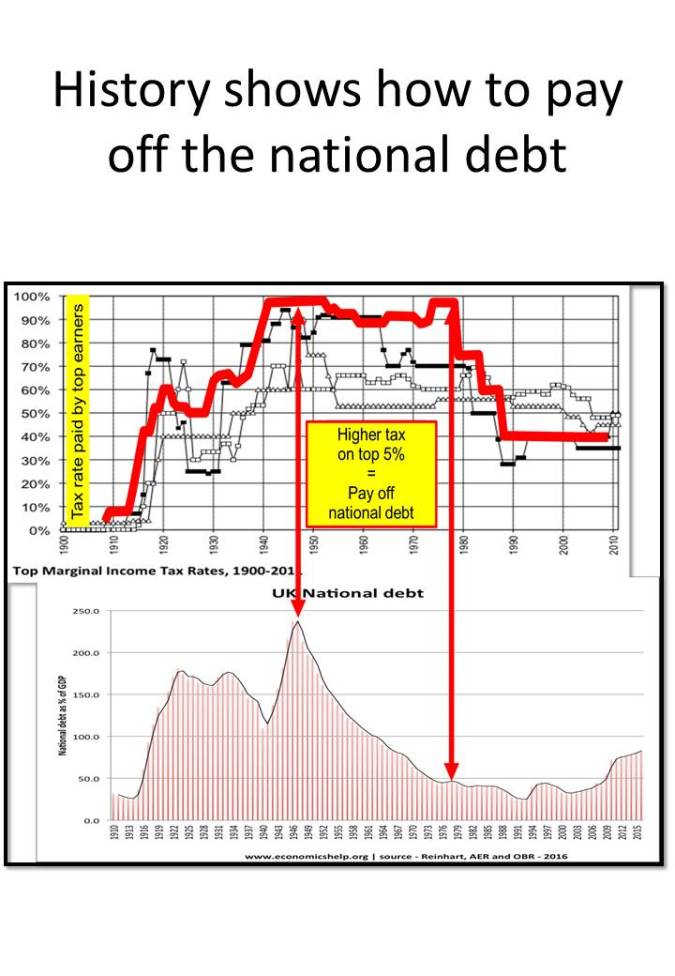
So, we need a taxation system that allows the society that we deserve to be funded.  That is why it is important to regain more control of the allocation of value.  Government needs to take back control from businesses, and from the top 5% of earners.

But what about the argument that ‘they will just go somewhere else’.  The value that is currently channelled to the wealthy is being created here.  It will still be created here.  All that will happen if the owner of a company decides to emigrate is that they will be harvesting the value created in the country that they go to.  The value created in our country will stay here for the benefit of our citizens.

So when we get the chance , let’s vote for the society that we deserve.  Let’s grasp our future with excitement and hope, and not shrink from the opportunity to make this nation great.

Draw your own conclusions

Here is some data.  It should be more powerful than rhetoric.  Draw your own conclusions…

The truth behind the Tory propaganda

I am not a politician.  I don’t know how to manipulate people to vote for me.  But I do know injustice when I see it, and I do know lies and deceit when I see it, and I have learnt to recognise logical fallacies when I read or hear them.  The Conservative government have taught me well.  Local election results show that the population has unfortunately not learnt the same lesson.

There is massive injustice in our nation.

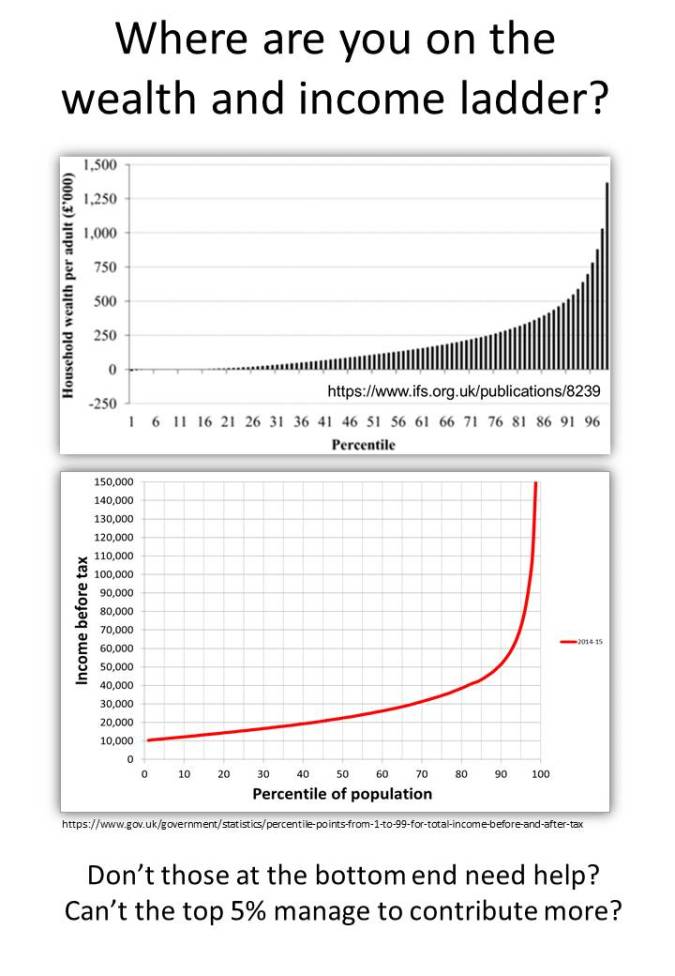
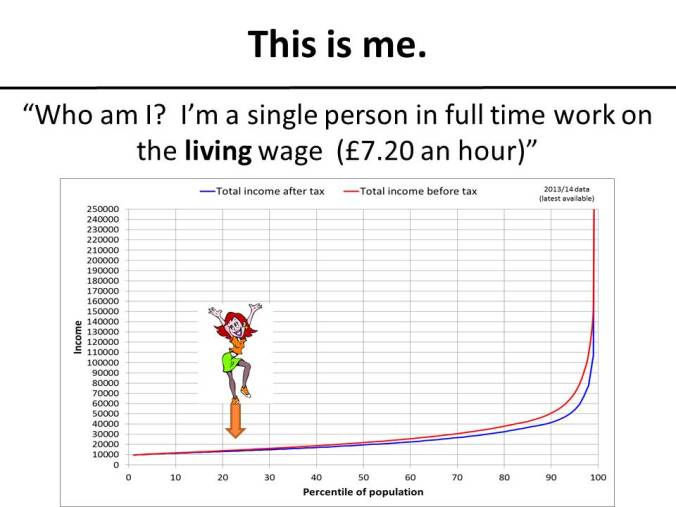
Look at the distribution of income (latest available figures)

What personal virtue led to the highest earners being paid ten or a hundred times more than those at the bottom?  It was all accident.  Accident of birth that gave them the attributes to succeed in business, or accident of birth that gave them the education and contacts that they needed.  But are they a hundred times more valuable people than the lower paid?  And as by accident they have more income, is it not right that they should give more money to the community? Yet the Conservative government wants them to pay less.  The Conservative government wants their wealth to increase, and wants to put control of our lives in their hands.

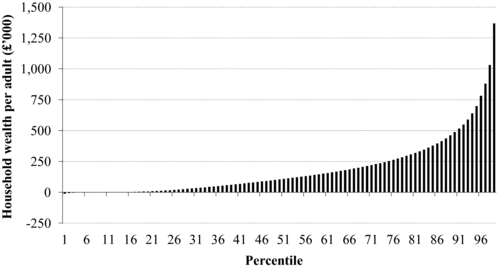
And look at the distribution of wealth.

What personal virtue led to the inheritance of wealth or debt? None, it was all accident of birth.  Without wealth you cannot buy your own home without having to borrow.  You cannot start a business without having borrow.  You cannot have a university education without having to borrow.  And when you borrow without wealth you have to pay high rates of interest.

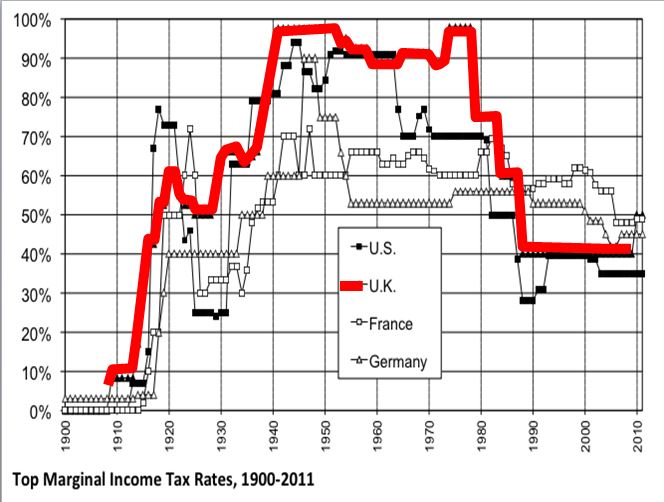
And look at the direction of taxes.

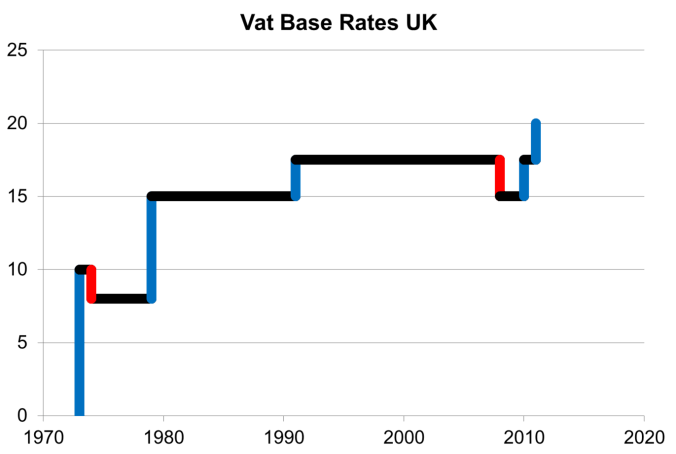
VAT rate changes


The Conservative governments have reduced tax on the highest earners, they have reduced inheritance tax on the wealthiest, they have increased VAT – tax that is paid by everyone – poor and rich alike.

Conservative values are to tax the poor and to increase the wealth of the wealthy.  And yet they manage to manipulate the press and the people to avoid these truths and focus on jingoistic slogans and false national pride.  Oh yes, they are very good politicians – but I have learnt to see though their smokescreen.  I have looked at the data instead of the rhetoric.  I have seen the unnecessary suffering that the Conservatives have caused.  And so I will vote for the party with compassionate and just policies.  Will you join me?

It is time to cut VAT.

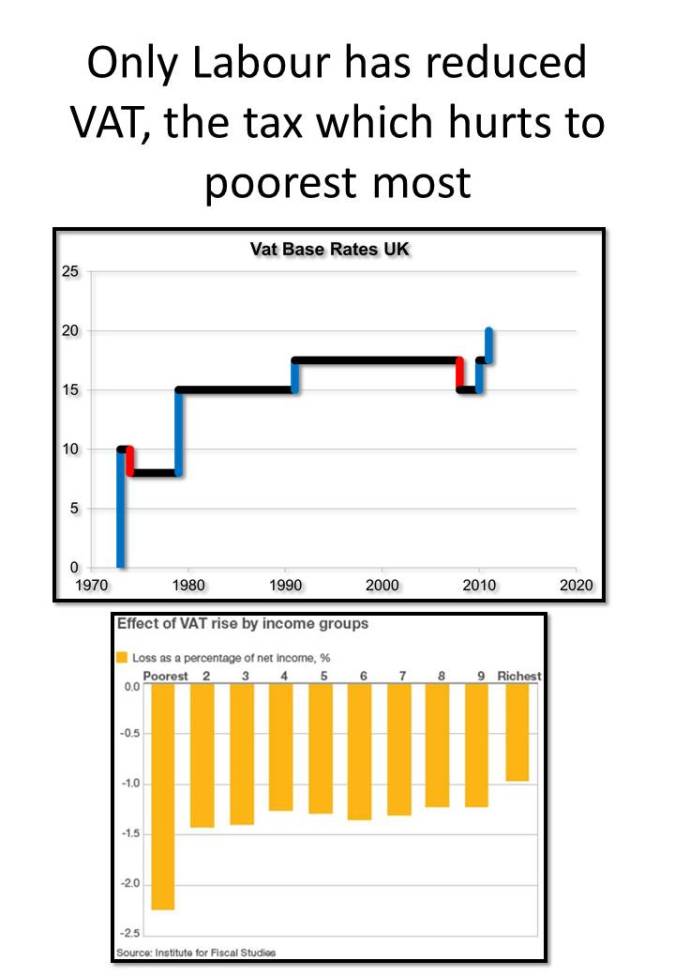
VAT is a tax on what we spend.  Everybody has to pay VAT at the same rate, rich and poor alike.  The following chart shows which parties have changed the basic rate of VAT since its introduction by the Conservative government on 1973.

VAT rate changes

Increasing VAT puts a bigger burden on the poor than the rich, as shown by the following analysis of the most recent VAT risk from 17.5% to 20%:

Reducing the rate of VAT will ease life for the less well off, increase sales, increase business activity and lead to higher employment.  That will increase income and corporation tax revenues and reduce the cost benefit payments as there will be less people out of work.

It is time to cut VAT, not to consider increasing it.

Why public ownership makes sense

If I need some basic repairs carrying out on my car or my house, I know that the cheapest way to get the repairs done is to do it myself.  It is faster and easier and cheaper.

Why should it be any different for the nation?  If we want cost-effective roads, railways and other essential infrastructure, it is common sense for us to own and maintain them ourselves.  It’s faster and easier and because we are not paying someone else’s profits it is far cheaper.  Public ownership simply makes sense.

Other nations make a success of it. They are even running our rail services and taking the profits for their governments.

Keolis is 70% owned by the French government’s national rail service SNCF. It owns 35% of Govia, which runs the Govia Thameslink, Southern, Southeastern and London Midland franchises.

Arriva UK Trains, which operates a string of services including Chiltern, CrossCountry, Grand Central, Northern, Arriva Rail London and Arriva Trains Wales, is owned by Deutsche Bahn – whose sole shareholder is the Federal Republic of Germany.

Abellio is the international arm of the state-owned Dutch national rail operator Nederlandse Spoorwegen.

If you really want to upset yourself about this, watch the video: https://www.youtube.com/watch?v=gvagsSOlAy4

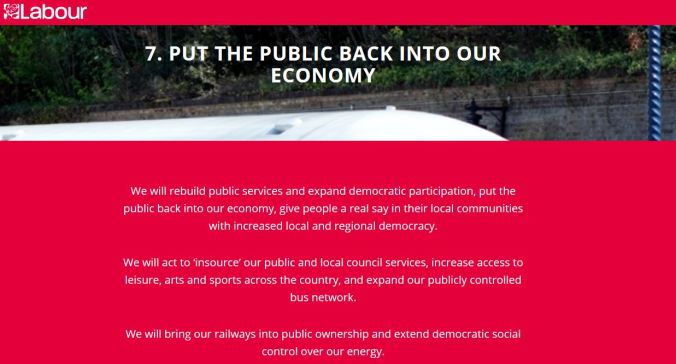
Do we think so little of ourselves that we can’t do the same?  Isn’t it time to bring essential public services back into public ownership?

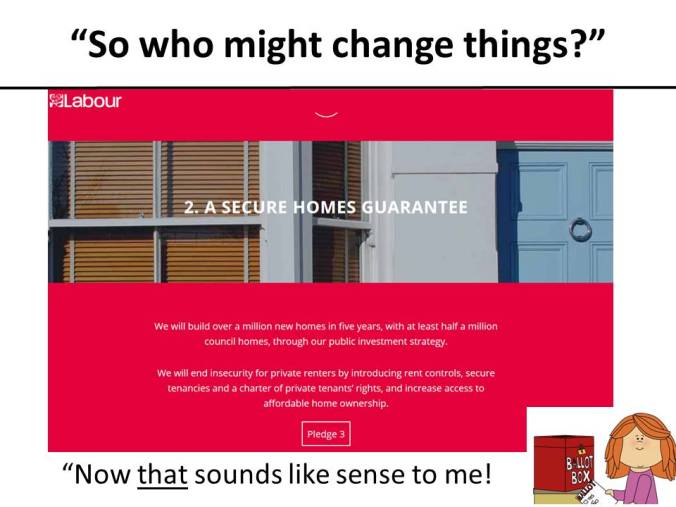
Why we need more council houses

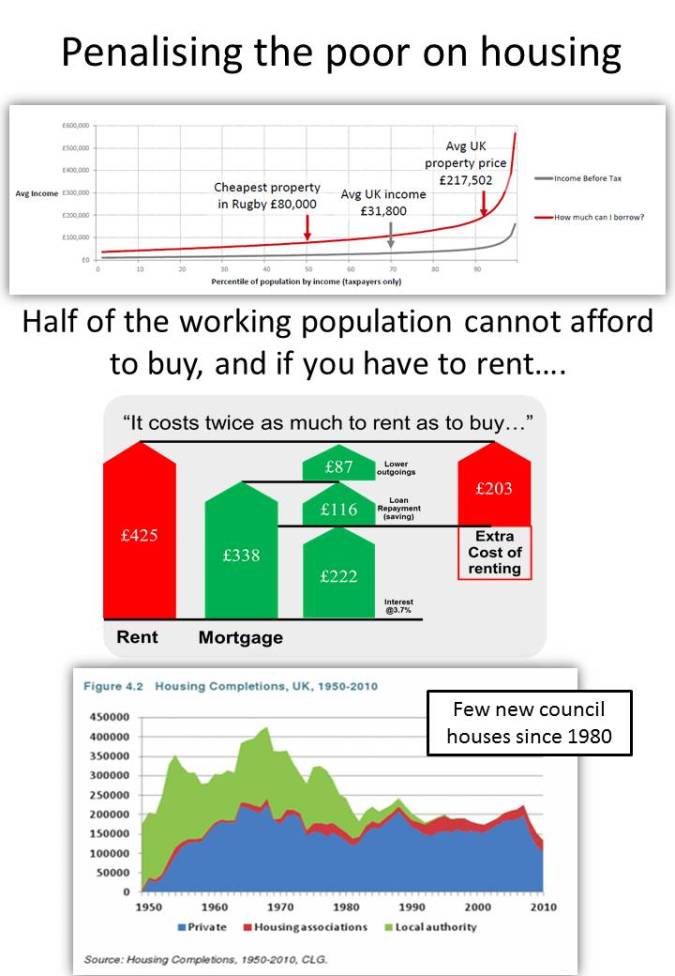
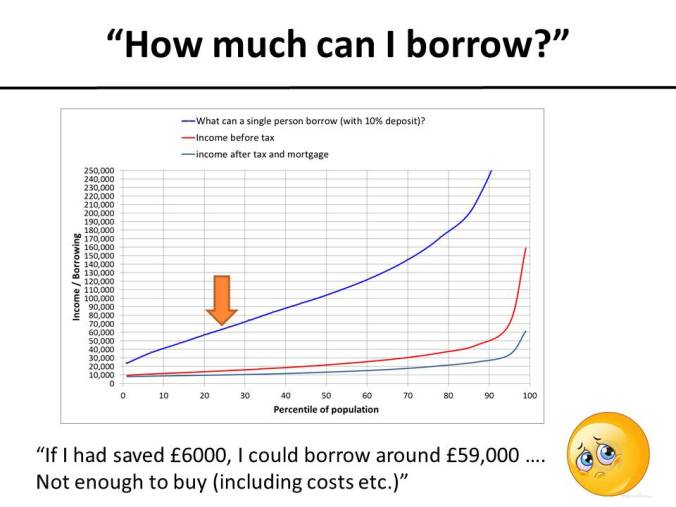
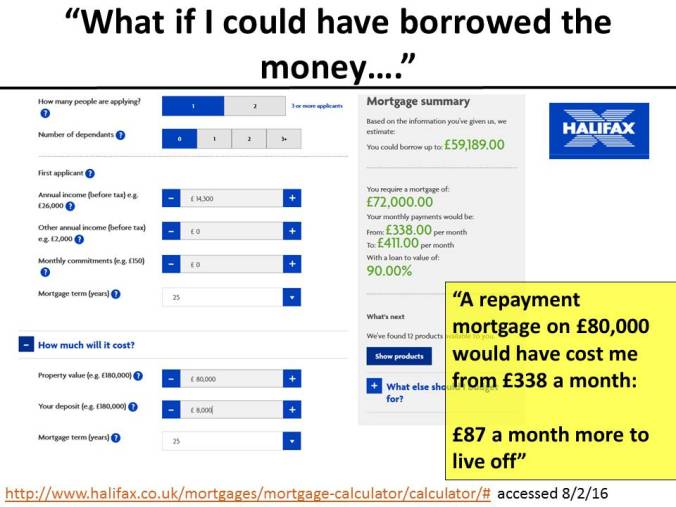
The chart below shows the income distribution in the UK (latest figures available from government statistics) and the corresponding amount that you can borrow if you have a 10% deposit (using the Halifax building society mortgage calculator).

Two thirds of the working population would be earning too little to buy a house for £150,000 by themselves. If you do not have the ‘bank of Mum and Dad’ then you have no chance.

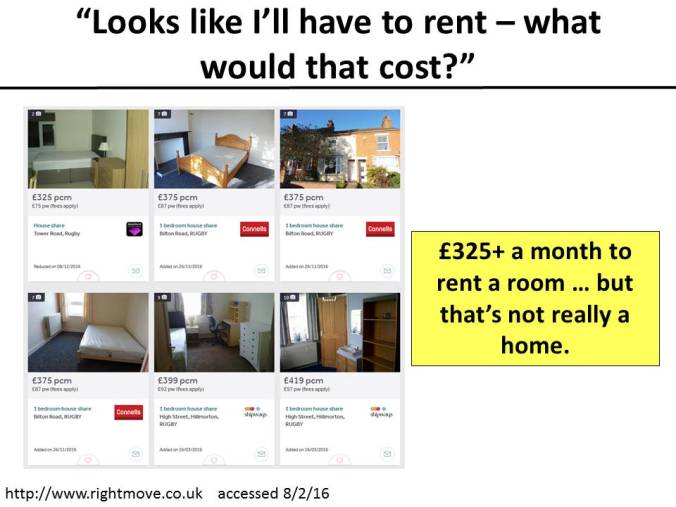
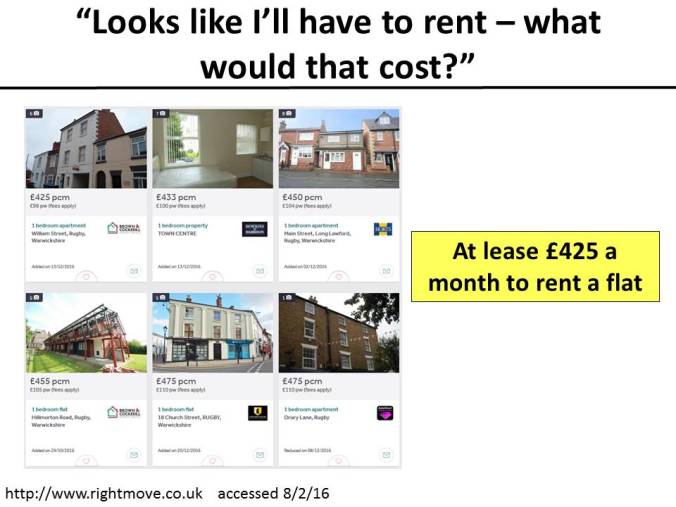
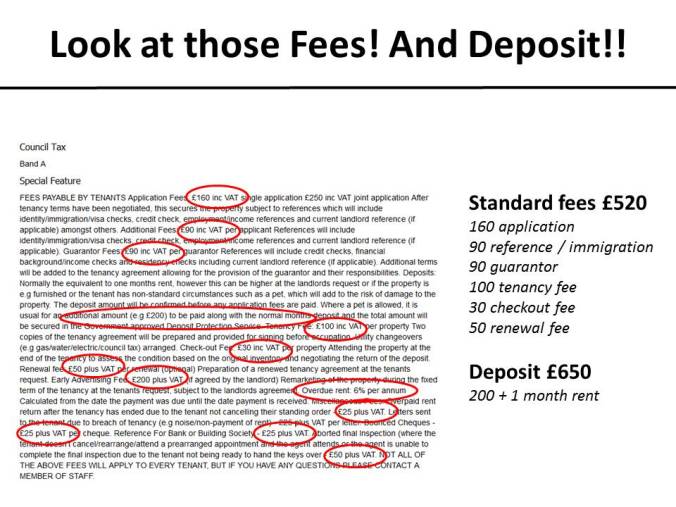
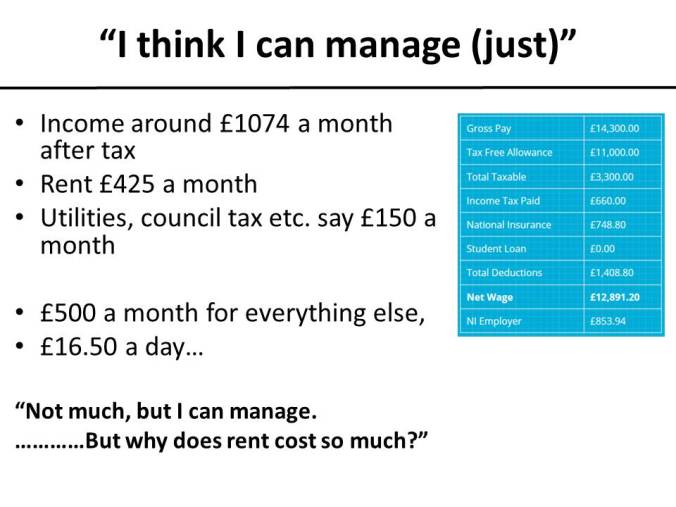
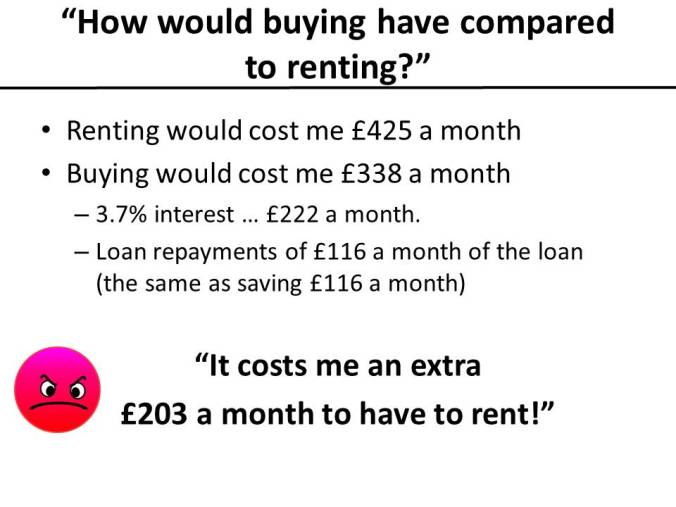
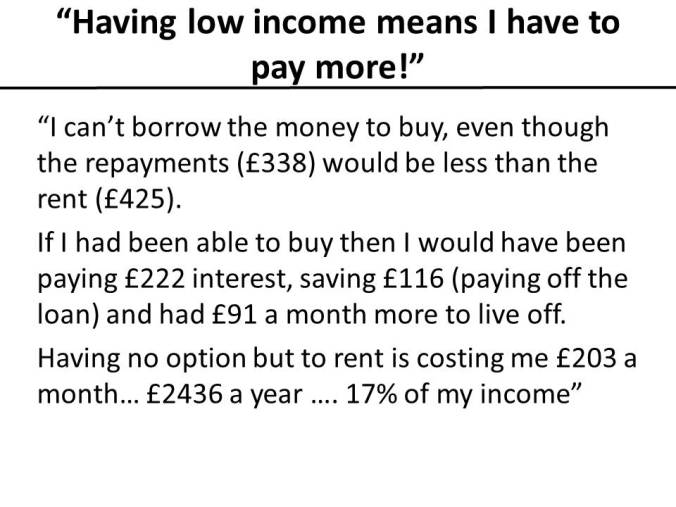
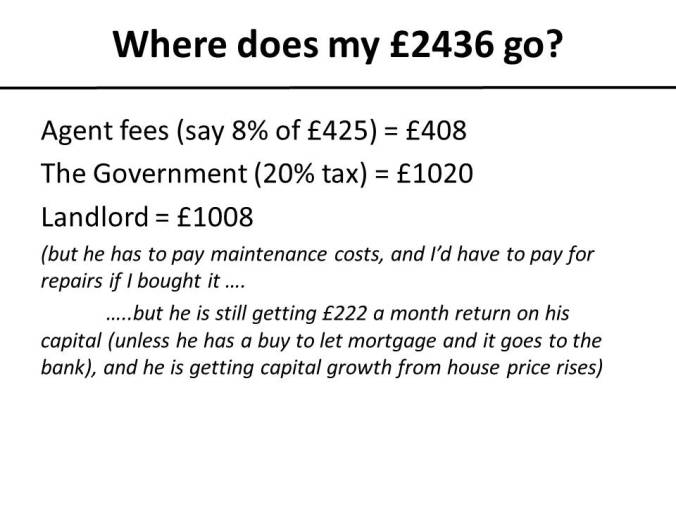
Your only option is to rent, from the private sector, at a cost that is higher than your mortgage repayments would be if you were able to get a loan.

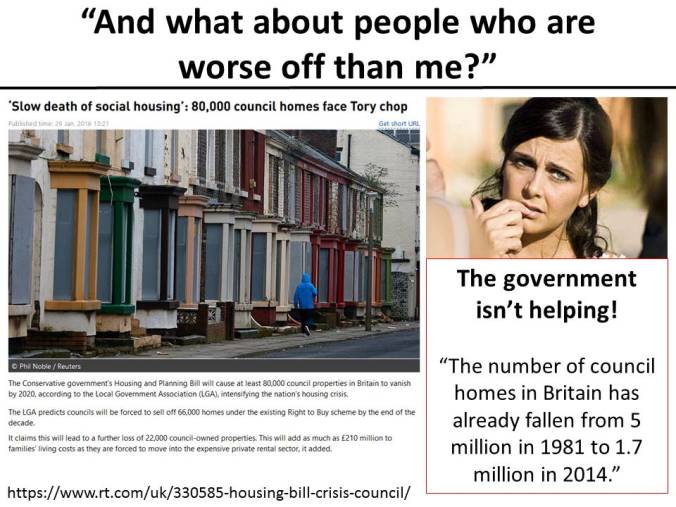
That is why we NEED more council houses.

That is why I’m voting for a Labour government. (see Pledge 2)

A tale of housing exploitation….

Here is a tale of the exploitation, told from the point of view of a young single girl trying to find a home.

slide2

slide3

  slide7

slide8

slide10

slide11

slide12

slide13

slide14

slide16

slide17

slide18

slide19

slide20

slide21

slide22


The ethical way to balance the books

If the government makes ‘savings’ of £1million, what does it actually save?  Well, by savings we mean job cuts, and almost all of the job cuts are from lowly paid workers.

A person on (say) £12000 a year will pay £673 in tax and NI contribution.  They now do not have a job and so will receive (at least) jobseekers allowance of £73.1 a week, or the equivalent of £3801 a year.  So the immediate saving is not £12000 but £7525 a year.

But someone on a low income will not be saving, but spending their money to live.  The government will therefore lose VAT on their spending, let’s say on average 15%.  Applied to £7525 a year this reduces the saving to £6397.

On top of that, anything that they buy will add to the profits of the business who sell them the product – and the business will be paying tax on the profit. The business will employ someone to get the product to them and serve them – and that person is paying tax too.

So for every £1million that the government claims to cut the saving is probably only half at best.

In terms of human suffering this seems to me to be a very cruel and inefficient way of balancing the books.  Surely it is better to increase the contributions from the wealthy who will not suffer any hardship, but simply see a reduction in the amount of money that they squirrel away?

Is it possible to be a Christian and right wing?

It’s not complicated.  Jesus said “Those who accept my commandments and obey them are the ones who love me.”

And what are His commandments?

“‘You must love the Lord your God with all your heart, all your soul, and all your mind.’ This is the first and greatest commandment. A second is equally important: ‘Love your neighbor as yourself.’ The entire law and all the demands of the prophets are based on these two commandments.”

and here are some more details:

“If you lend only to those who can repay you, why should you get credit? …  Lend to them without expecting to be repaid”

“Give to those who ask, and don’t turn away from those who want to borrow”

How does this square with austerity measures imposed by the wealthy on the poor?

Just asking…..