A robust intellectual basis for Christianity is not enough.

I like to understand why things are like they are. As a child I was taught that science provides the answers that I needed.

When in later life I became a Christian I thought that there was a conflict between science and God, but for a while reconciled this with the idea that ‘God can do anything’. A simple idea, but science and faith was not an area that I really wanted to explore.

We are given the impression that ‘science knows’, but we just haven’t been told yet. About five years ago I decided to find out. What does science know? What does it still not know? Are there things it can never know? Taking everything into account, what story best fits all the facts, a godless universe or one with a God?

I adopted an analytical approach, but avoided the temptation to dig too deeply into details of each field. I just tried to understand the underlying principles sufficiently to see what they contribute to the big picture. I found that most people feel uncomfortable outside of their specialist field, that few seem willing to take the necessary overview.

Having read a couple of books like ‘The Edge of Evolution” by the Intelligent Design proponents I began thinking that it may be possible to prove God exists. But then I read secular books on the origins of life and realised that everyone accepts the remarkable unlikelihood of life but that it doesn’t provide irrefutable proof – there are alternative explanations such as the multiverse theory.

I needed to find out where the Bible came from; could I trust it, and if so, why? I researched the source of the NT documents in particular, and some of the gospel accounts that are excluded from the Bible (the Da Vinci code stuff). I realised that the gospel accounts are not trying to prove who Jesus was and what he did, but that they wouldn’t have been written if he hadn’t done some amazing things. The accounts are simply people trying to capture what happened for future generations. The Bible is not a spells book: “Do this and God will do that for you”.

I reached a number of conclusions about how to understand and respond to the big picture of what’s going on. Realising that everything requires a level of faith (including science of course), I suggest a response which recognises that many religious and scientific dogmas are unproven and unprovable – but unnecessary. I call the response “Minimalist Christianity”. I wrote up what I found in “The Big Picture”, found a publisher and then set about marketing my masterpiece.

There is a robust intellectual basis for Christianity, and I would commend it to others, but I recently realised that in exploring it I was falling into a bit of a trap. Because I have necessarily spent several years testing and probing, viewing things sceptically, I let my personal spiritual life become analytical too. My reasoning has shown that God exists, and that he must have a ‘personality’ and want to interact with each of us, but I have not really been responding to the real God – just developing an intellectual one.

We need to ‘get to know God’ as more than an idea; I need to follow my own advice! It is from the integrity of that relationship that the power to fulfil our purpose will flow. We need analysis to know that we can trust, but then we need to act on that trust to complete the experience. Having determined that the rock exists, we need to actively build the house of our life on it!

“Anyone who listens to my teaching and follows it is wise, like a person who builds a house on solid rock. Though the rain comes in torrents and the floodwaters rise and the winds beat against that house, it won’t collapse because it is built on bedrock.” Jesus circa 30AD

“Je suis Nigerian”

They may not be white Europeans, and they may have done nothing to provoke the attack, but is it any less horrific?  Can the world do nothing to help?  Let us at least show that we care:  #jesuisnigerian

http://www.independent.co.uk/news/world/africa/nigerias-forgotten-massacre-2000-slaughtered-by-boko-haram-but-the-west-is-failing-to-help-9970355.html

http://www.vox.com/2015/1/10/7525199/nigeria-boko-haram-attack

http://www.aljazeera.com/news/africa/2015/01/boko-haram-massacre-toll-possibly-2000-201511004229409787.html

War, religion, God, and why I write

I remember a discussion soon after I became a Christian where I was asked “so what about all the other religions?”  My reply was that they were simply mistaken.  I think the remark was taken to be rather arrogant.

I read the news today. I see the conflict, anger and fear; fighting between Moslems of different sects.  I see forced imposition of religious dogma; conversion to another religion punishable by death.  We all know that this is not as it should be. And I am reminded of my reply.

Reason and evidence tells me there is a God, and my whole being tells me that love is our ultimate purpose.  And when I find that love underpins and is at the heart of Jesus teaching I begin to see how it all fits together; how we are meant to be.

If I were God and someone from another religion was praying to me, I would not ignore them because they think I have a different name, I would not condemn them because they don’t understand my intentions for them.  I would be saddened that they are misled, I would try to teach them, and I would restrain some of their actions, but I would still love them.

As a mere human trying to follow God’s purpose, I don’t hate the Muslims, or even the Westborough Baptists, but I believe they are misled and mistaken.  I hate what they do, and I want them to stop.  I want them to understand the truth, and find their real purpose.  I want that for everyone.

If we all really understood Christ’s teaching, if we really loved God with all our heart, and loved our neighbour as ourselves, if we really were ready to forgive others and restore broken relationships we know that the world would be a better place.

That is why I write.  That is why I follow Christ.  That is my purpose.

What is yours?

Time to ditch Jack Sparrow’s moral compass?

I read a headline this morning that the UK government is paying strip clubs and lap dancing bars thousands of pounds to employ young people.  http://www.thesundaytimes.co.uk/sto/news/uk_news/National/article1376579.ece What sort of moral compass are they travelling by.  It is Jack Sparrow’s compass: it points at whatever you feel like.

Many of the young people I meet today have already succumbed to the temptations of smoking (tobacco and weed), drinking (to excess), internet pornography and instant gratification sex.  Many have anger management problems, are bored easily, struggle to see any purpose in life, and find it hard to get and keep jobs.  And I live in ‘middle England’, I can’t imagine what it is like in the most deprived areas.

Who can blame them?

We have structured our society so that we take our children away from their parents and put them in schools where the only adult interaction is focused on learning facts that will help them pass exams.  We have structured our economy such that parents have to work long hours, often at weekends, so our less affluent families have little time for child parent interaction.  We have so regulated schools with ‘child protection’ that the few adults who do interact with children are not allowed even to touch them, and who live in fear of accusation of child molesting. We have done our best to mock and marginalise religious institutions who try to suggest that some form of restraint might be beneficial.

We have put our children in an institutional ‘Lord of the Flies’ scenario, and added the instant gratification of TV, internet, and readily available drugs (legal and illegal).

Surely it is time for a serious rethink.

Instead of sticking plaster politics and abdicating any vision of the future to ‘market forces’, let’s try to define what we want society to be like, and then see what needs to be done to get there.

Please share your ideas of what an ideal society would look like.

The wealthy are redeemable.

I read today that the plan to reintroduce a 50% tax band has ‘stoked fury’.

It is criticised as “penalising the business community, which is already hard-pressed.”  Yet “The 50p top rate, which affects the top 1% of earners..”  http://www.thesundaytimes.co.uk/sto/news/Politics/article1367969.ece

If I were cynical I would say that this looks like the wealthy lining up to protect their wealth.

With nobody pointing out the moral obligations of the wealthy as members of society, that we need them to be ready to help the millions who are really being penalised by austerity, and who are really  suffering, then who can blame them.  With government leaders like Boris Johnson telling them it is good to be greedy, then a selfish attitude to protecting their wealth is inevitable – but as a society such selfishness is not acceptable.

Research has shown that wealth in a moral vacuum will lead to selfishness, lack of empathy and self-justification.  However it also shows that with a little moral guidance, pointing out the difficulties being faced by those on very low incomes the attitude can change.(See http://www.ted.com/talks/paul_piff_does_money_make_you_mean.html?utm_source=email&source=email&utm_medium=social&utm_campaign=ios-share)

I don’t believe that the wealthy are irredeemably greedy, but please can we offer some moral guidance, and help them to understand that we are “all in this together”.

So please, politicians and media magnates, say to the wealthy, “There are millions of people in our country who are really suffering due to economic hardship.  They are not all scroungers.  Most would like to work and to contribute to society, but they cannot.  They need your help.  Will you help please?”

Thank you.

Scientific support for The Rainbow Economy

A link to a fascinating talk below.  The beginning is rather depressing, but the finish supports the solution proposed in The Rainbow Economy.

Do listen to it all.

http://www.ted.com/talks/paul_piff_does_money_make_you_mean.html?utm_source=email&source=email&utm_medium=social&utm_campaign=ios-share


Austerity is working? III

The world economy is in difficulty and has been for many years now.  Debt is embedded in the system: individuals owe money to banks (who live off lending them more), nations owe money to the financial markets. All measures of wealth show that the richest are getting richer and the poorest are getting poorer. (See Austerity is working II).

People agree that the ideal is not a flat distribution of wealth.  They think that the distribution of wealth favours the rich too much, but in reality it favours the rich much more than we realise:
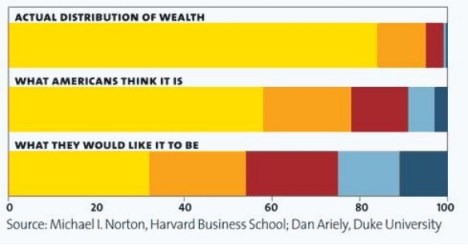
wealth distribution

But is there a problem with this? It depends on your personal philosophy.

For instance, if I think it is right that one human being, through no effort of its own (e.g as a result of who its parents are and where they happen to live) should be 1 million times richer than another, then this data in itself will not worry me.

Similarly, if instead of comparing myself to those who have more income than me I compare myself to those with less then I will not enjoy any feelings of being ‘hard done by’.

Opinions vary, but it seems that around $50000 is an ideal income for happiness. http://www.learnvest.com/knowledge-center/the-price-of-happiness-50000-123/ and a 2012 UK headline stated that “Families need £36,800 to live acceptably, study says” http://www.bbc.co.uk/news/uk-18770783  Anyone earning more than that is likely to feel very comfortable.

So, in the rich West, most people are basically happy most of the time, cocooned by an income where financial concern is limited to sustaining the present level of comfort rather than worrying where the next meal is coming from.  Most of the time the inequality of wealth doesn’t really impact, apart from leading to a few grumbles and jealous thoughts about those who earn more than we do. Passivity rules until or unless a crisis occurs which affects us as individuals, and then we get to see how difficult the situation really is for those who the system exploits and tramples… the poorest.

As I said in my earlier post (Austerity is working?) the current crisis has not noticeably affected the rich.  Maybe there has been some mild discomfort for the better off, but the brunt of the austerity is taken, as usual, by the poorest.

Most of us realise that this is profoundly unjust.

Most of us want something to be done about this, but we look at our politicians and realise that they simply don’t understand.  They are not even in the ‘mild discomfort’ bracket, and simply cannot empathise with those who have NO money at all to feed their family; those who have to get the basics for survival from the multiplying food banks.  The people want the politicians to understand, hence petitions challenging MPs to experience living on low income:  http://www.change.org/en-GB/petitions/iain-duncan-smith-iain-duncan-smith-to-live-on-53-a-week

The gulf in understanding is emphasised when the rich Mayor of London advocates greed:

Johnson called for the rich to be hailed for their contribution to paying for public services as he said that the top 1% of earners contribute 30% of income tax. “That is an awful lot of schools and roads and hospitals that are being paid for by the super-rich. So why, I asked innocently, are they so despicable in the eyes of all decent British people? Surely they should be hailed like the Stakhanovites of Stalin’s Russia, who half-killed themselves, in the name of the people, by mining record tonnages of coal?”

The mayor added: “It seems to me that though it would be wrong to persecute the rich…. http://www.theguardian.com/politics/2013/nov/27/boris-johnson-thatcher-greed-good

What exacerbates the injustice is the despair that there is no hope of changing the system.  Those who have the power are those who benefit from the present system, and they have no intention of changing it.  The democratic process which in theory would allow the people to choose honourable and just leaders offers no serious alternative.  The traditional parties are basically indistinguishable, and so people begin to jump at any possibly credible alternative, such as the right wing UKIP party – not realising that the basis of the policies of UKIP is as flawed as the traditional parties.

And here we approach the reason for our problem. Economics works by trying to predict the behaviour of the masses to different financial laws and environments. And behaviour of the masses responds to the moral climate generated by the media and politicians. Changing the moral climate is a necessary part of the solution, but at present there are few trying to instigate the essential global climate change.

Governments are afraid of doing anything to damage the economy.  They will only introduce humane policies if the pressure against the injustices of the system becomes too strong: if there is sufficient discomfort that we ordinary people are jogged out of our passivity; and when the politicians are at risk of losing their power.  Today, ordinary people are stirring, but as yet they don’t see any way of ousting the politicians.  In the past, these sorts of frustration have led to revolution and bloodbath.

Is there any alternative?

For an answer I look at the most recent success of humanity over greed and selfishness.  I look at the transition from an evil apartheid regime ruling South Africa to a Rainbow Nation.  I look to what made the difference between a bloody revolution and a peaceful change.

Mandela realised that trying to force a powerful opponent who had suppressed and oppressed millions of fellow human beings to hand over power by violence would lead to immense human tragedy.  The mind-set of all oppressors includes fear of retribution, indeed, doesn’t justice demand retribution on the oppressor?  Doesn’t justice demand an angry and violent response to injustice?  That is the response of human nature.  And if you are like me, you will have an inner core of anger at the injustice in our country today.  It would feel right to ‘persecute the rich’, and the frustration at not being able to do so makes the anger and bitterness deeper.  We are justified in feeling that – justice demands a fairer system.

But that is not the way.  “An eye for an eye makes everyone blind”.

Mandela changed the hearts and minds of those in power.

The first step was to jog the world out of passivity, to show the world the oppression and to campaign for justice.  The South African government could no longer claim ignorance about their unjust position.  They realised that apartheid was untenable and so the barrier to change moved to one of fear of retribution if they were to lose power.  We see the beginnings of that same fear in Boris Johnson’s comment that “it would be wrong to persecute the rich” – but I think we are in the situation where world leaders are still convincing themselves that the present system is OK.  “Economic Apartheid” is working just fine!

Mandela’s second step was to graciously talk with those in power.  He was willing to forgive their past injustice, and to lead his followers to forgive.  He was not prepared to accept future injustice, future oppression of either the blacks or whites by the other group.  He presented the vision of a rainbow nation, and inspired both blacks and whites to embrace that vision.  Mandela gave up justified bitterness for the sake of the people, and he taught his nation to do the same.  We need to learn from his approach.

So where are we today?  We know that Economic Apartheid is unjust, but too many people have adopted the Johnson mantra ‘greed is good’, or are not sufficiently discomfited to shift from passivity.  There is not yet enough voice crying out against economic injustice, and there are too many who justify it or ignore it.  That needs to change.  You and I need to change.  We need to speak out.

Then we need a vision for a “Rainbow Economy”, and a change in mind-set that underpins it.  That will be the topic of a future post.

………………………………………………..

Related links:

https://philhemsley.wordpress.com/2013/12/10/austerity-is-working/

https://philhemsley.wordpress.com/2013/12/27/austerity-is-working-ii/

To ensure that you hear about the Rainbow Economy, click the ‘follow’ button.


A vision and purpose for 2013

In the 2011 UK census, nearly 60% of the population want to be recognised as Christian.  Many other surveys show that the proportion of the population who regularly attend church services is between 5% and 15%.  (Tearfund report on churchgoing 2007, http://www.eauk.org/church/research-and-statistics/english-church-census.cfm, Religious Trends – Brieley)

This data shows that there are 45 – 55% of the UK population who want to be associated with Christianity but are not being supported by the various churches in the country.  To my mind this is not an acceptable situation.  Something must change.

The popular representation of Christians is that we are uncaring unloving people:  We are sexist, not allowing women bishops.  We are homophobic, not allowing gay marriage or gay clergy.  We are ignorant – ignoring scientific data and insisting that the world is 6000 years old and was created in six days.  We are hypocrites and child molesters.  We instantly jump to judge everyone else’s behaviour whilst being just as bad ourselves.  Our bottom line is that “you are going to Hell if you don’t believe what I believe”.  Of course, that’s complete b*****cks, but it certainly doesn’t encourage anyone to explore what Christianity is actually about.  I wrote my first book “The Leap” to address some of these issues.

So there is an image barrier that prevents the 55% exploring their spiritual roots.  But there are many other barriers. To name a few:

  • long working hours leave people exhausted (Nearly 20% of men and 6% of women work over 49 hours per week – 2011 census).  We want to relax and do something enjoyable at the weekend and the image of sitting in a cold uncomfortable church pew is not very attractive.
  • entertainment is at our fingertips in the comfort of our own homes, we don’t want to go to the trouble of going out.
  • nearly 50% of the population live alone (2011 census).  There’s all the housework to do. The barrier of going out alone can be immense, loneliness is a hard habit to break

Jesus came to bring life in abundance.  We are missing out!  We catch glimpses of what life in abundance might be in the spirit of the Olympics,  in the national celebrations and street parties of the Jubilee.  Neighbours got to know each other, perhaps speaking for the first time in years.  The hearts of the people in this nation are good – look at the response when Claire Squires died – nearly £1million donated. http://www.justgiving.com/Claire-Squires2

The church in the UK needs to provide opportunities for this spirit (which is a reflection of the spirit of God within all of us) to grow, for individuals to explore and develop their spiritual side, their humanity.

We need to fight against the materialist mindset that tells us we are simply a bunch of chemicals.

We need to fight against the economic mindset that tells use we are just consumers, human resources, a drain on the economy.

We need to free and inspire the hearts and minds of every man, woman and child to love one another, forgive one another, and love God – with all our hearts, minds and souls.

Let’s go for it! Let 2013 be a year we remember.

Christianity, rules and regulations

Christianity is about freedom, yet we keep tying ourselves up with rules and rituals, and then feeling guilty when we break them.

It seems to be in our nature to want rules.  We want to be told what we can do and what we can’t do.  We don’t want to have to think.  Take driving for example.  We know that we shouldn’t go at high speed in built up areas, so why do we need to be told that we mustn’t go above 30 miles per hour?  What’s special about 30, why not 29, or 33?

Setting a rule is a way of avoiding guilt.  We prefer to pretend that we are not guilty rather than that accept we are guilty and ask for forgiveness.  If I go at 29 miles per hour and knock someone over, then you can’t accuse me of going too fast – I was within the speed limit.  I can say “it wasn’t my fault – it was the person who set the speed limit.”

This is living the Old Testament way: “Thou shalt not exceed 30 miles per hour in a built up zone”.

If we were to ask Jesus then he would say “don’t go so fast that you knock someone over”.  It’s a much tougher requirement, and means that there is no way we can escape our personal responsibility.  If we knock someone over it’s our fault and that’s that.  All we can do is to ask for forgiveness, to which he would reply “Are you really sorry? Are you going to change your driving habits so that you don’t do it again? Yes? Then I forgive you.”

Tougher, isn’t it?  I have to take full responsibility, and I have to be humble enough to admit that I was wrong and to ask for forgiveness.

Christians, as anyone else would, find it difficult trying to live a life which is totally without laws, but where the standard is perfection. There is no speed limit, but you are responsible if your driving harms someone. So we make up our own laws.  Some are moral, some are conventions or traditions.  Although Christianity is about freedom, we have tied ourselves up in chains again.

Everybody does it without realising it.  Have you ever been to a conference or meeting that runs over a couple of days.  On day one, we look round the room, and then choose a seat.  Next day, that’s our seat – we go straight there.  It’s easiest, it worked yesterday, but we’ve just made up a little law: “that’s where I sit”.  It’s OK to make up rules, so long as we don’t let the rule become more important than the issue it’s solving.  We need to keep remembering the reason behind the law.  Going 30 miles an hour in itself is not important; avoiding running someone over is the issue.  Christians need to be wary of our natural love of rules and laws; Jesus looks at the heart; do we want to do what is right or do we want just to keep the law?

…………………………………………………………

If you enjoyed this and like to read reasoned thinking, buy my book The Big Picture

Time to come alive!

As you walk round this weekend, look at the faces of those you pass.  Look perhaps at the men pushing the trolleys in Aldi, Asda or Sainsbury’s.  How many of them are lifeless, pursuing the daily trudge?  Then look in the mirror – are we the same?

Life is not meant to be like that.  We are made for life in abundance, life in all its fullness.  A great man once said “I have come that they may have life, and have it to the full.”

What does life in abundance mean?  Perhaps we should see what the man said.  When asked he answered: “‘Love the Lord your God with all your heart and with all your soul and with all your strength and with all your mind’; and, ‘Love your neighbour as yourself.'”

It’s not so much what you do as how you live that brings life in abundance.  It’s not so much climbing the mountain or sailing the seas – although I recommend both – it’s about choosing to love, every moment of every day, even in the aisles in Asda.

It’s been said “Find out what makes you come alive, and go and do it.” If you are not alive today, you need to follow that advice.  Perhaps you feel you don’t have the energy to love at the moment, perhaps your work is just so draining that it deadens you.  If so then it is worth looking for a change.  Perhaps there’s an addiction that you need to break; it’s possible, you can break it!

But the key to coming alive is love; positive, hardworking, determined expending of ourselves for the benefit of others.

Does injustice make you angry?  Don’t just grumble, go and do something about it. Come alive fighting it.

Does poverty make you angry? Don’t just grumble, go and do something about it. Come alive fighting it.

Does child abuse make you angry? Don’t just grumble, go and do something about it. Come alive fighting it.

Does the sex trade make you angry? Don’t just grumble, go and do something about it. Come alive fighting it.

Does human trafficking make you angry? Don’t just grumble, go and do something about it. Come alive fighting it.

Does the hopeless plight of teenagers make you angry? Don’t just grumble, go and do something about it. Come alive fighting it.

The list goes on.

St. Irenaeus said that “Man Fully Alive is the Glory of God”

It is time to come alive.