How should we respond to climate change? – A Christian perspective

The earth’s climate has seen dramatic change. Four and a half billion years ago, the earth was formed.  Its atmosphere had massively high levels of carbon dioxide, and there was very little oxygen.  Miraculously, life originated in this extremely hostile environment, and for the next one and a half billion years or so the cyanobacteria began cleaning up the atmosphere and enriching it with oxygen and allowing the formation of the protective ozone layer.

Over the next two billion years the beautifully designed process of evolution took those earliest forms of life and developed them into the staggering array of life that we take so readily for granted today.   Darwin hinted at the beauty of the process in the final paragraph of his book “the origin of species” when he wrote “There is grandeur in this view of life, with its several powers, having been originally breathed into a few forms or into one; and that, whilst this planet has gone cycling on according to the fixed law of gravity, from so simple a beginning endless forms most beautiful and most wonderful have been, and are being, evolved.”

So it is clear that man-made climate change will not destroy the planet, nor will it extinguish life.  But it will disrupt the extremely finely balanced ecosystem that sustains the human race.  That disruption will enlarge areas of local extinction of humans (desert regions), and in the extreme the whole planet could become unsuitable for human life.  Whilst wealthy countries are able to create local ‘microclimates’ with technology, for example air conditioning, people sentenced to live in the ‘natural’ local climate will inevitably suffer and may face extinction.  We already see an increase in suffering from natural disasters such as the cyclone Idai, and other increasingly destructive climactic events.

Greater parts of the world will become uninhabitable not just for humans, but for the cornucopia of other species who thrive in the environment that spawned us.  New species will emerge, but many of our present ‘friends’ will disappear.

The first book of the Bible describes how we were given the world to look after.  It is clear from the description above that if we don’t look after it then it will not be taken away from us, but we will be taken away from it.  This is reminiscent of the description of Adam and Eve being taken away from the Garden of Eden: the garden still thrives, but they were no longer in it.

God allows us to do things that harm us.  He doesn’t want us to, but he allows it.  Such action is called sin.  The basis of the Old Testament law was that God gave us rules that would bring us wellbeing, but our selfishness leads us to choose ways that harm ourselves and others.  Greed, lust, envy, and all the ‘sins’ damage both us and our neighbour.  Climate change is damaging to us and to our neighbour, and so the actions that leads to climate change are ‘sin’.  God permits us to damage the planet that sustains us, but it is not His will.  And disobeying the will of God is sin.  It is not good for us to do it!

There is not space here to fully discuss how we, through our actions are hurting God themselves, but we might empathise by imagining how we would feel if after giving a loved one a beautiful gift – perhaps a bunch of flowers,  we see them slowly trashing it, picking off one petal at a time.

So, how should we, as Christians, respond to the challenge of climate change?

First of all, we must recognise that it is real! (see for instance https://climate.nasa.gov/effects/)

Climate change is not the sin, but the consequence of our sin.  We need to reflect on what sins are the root cause of climate change.  Greed, selfishness, gluttony, envy will be high on our list, but a thorough examination of our lifestyle (in the context of and comparison with the other seven and a half billion people on the plant) must bring insight.

We then need to ‘repent of our sins and turn to God’.  There is surely enough evidence that we know that we are sinning, but we need to let the evidence sink into our hearts and truly convict us before we can honestly repent.  Until we reach that state then we might feel a little guilty but we will not have the power that comes from true repentance.  We need to be so convicted that we get on our knees, confess, and ask for forgiveness.

We must work with God to eliminate our sinful behaviour. We will need to be bold, counter-cultural and outrageously attractive in our approach.  We are Christ’s representatives, and our response has to mirror his character. And we must encourage our brothers and sisters to do the same.  Not only must we turn from our damaging practices, but we must do our utmost to relieve the suffering of those whose homes and livelihoods are ruined by the changing climate.  A radical change in our lifestyle must include loosening our grip on our wallets.

For example, we need to ask ourselves why we need to go to America, or China, or Australia for our holidays, for a speaking engagement, or for work.  99% of the world’s population cannot afford these luxuries – and yet many are closer to God than we are.  http://www.globalrichlist.com/

We have to challenge every decision of where we spend our money.  Should we always buy the cheapest, or should our buying decisions be made to minimise planetary damage?

We can make reparation for the damage caused by our personal sin.  We can ‘offset’ our carbon emissions, for example “Climate Stewards helps you to offset unavoidable carbon emissions by supporting community forestry, water filter and cookstove projects in the developing world”.  Some are beginning to do this for holidays or the odd long haul flight, but that is surely just lip-service.  Should we not examine our carbon emissions over our lifetime and offset them?  (see https://www.climatestewards.org/) At only £20 a tonne, many of us are in the privileged financial position to be able to do that.  There is real potential for tree planting projects to ‘buy some time’: https://www.sciencenews.org/article/planting-trees-could-buy-more-time-fight-climate-change-thought.  And churches can do the same, committing to offset past energy usage and adding carbon offset as a statutory spend each year.  It is much easier if we all make the commitment together.  Leadership from our Bishops can help here.

Those of us who live comfortably in brick houses in rural England can send financial assistance to those whose pole and dagga houses are swept away by floods or typhoon. (see https://www.christianaid.org.uk/emergencies/south-asia-floods-appeal)   As James says:  “Suppose you see a brother or sister who has no food or clothing, and you say, ‘Good-bye and have a good day; stay warm and eat well’—but then you don’t give that person any food or clothing. What good does that do?  So you see, faith by itself isn’t enough. Unless it produces good deeds, it is dead and useless.”  Communication is so good that we see our ‘brother or sister who has no food or clothing’ daily on our TV’s or computer screens.

We will of course fail to live up to our aspirations, but we can try. And when we fail, God’s grace will free us to try again.

And finally a thought about our legacy.  The younger generation are worried.  Environmental issues are at the top of their concerns.  And the younger generation tend not to know Christ.  We have a wonderful opportunity to bring them hope, both for a world to live in and from a God who loves them.  That is a far better legacy than bequeathing a scorching earth that is hardly able to sustain human life.

Let us be at the forefront of change, not dragging our feet but leading the way to a sustainable future.

Draw your own conclusions

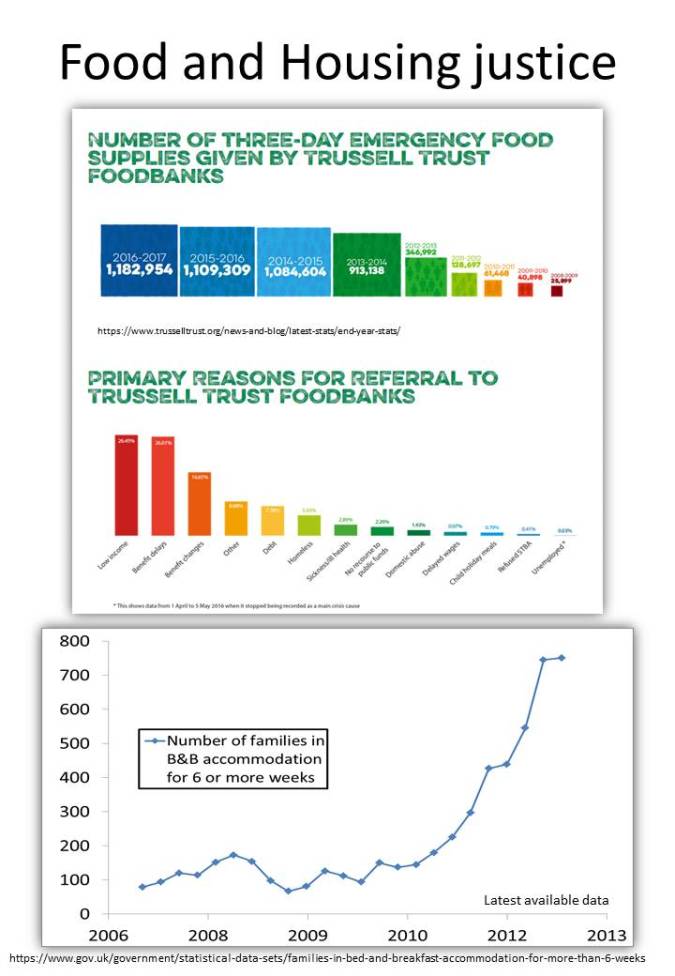
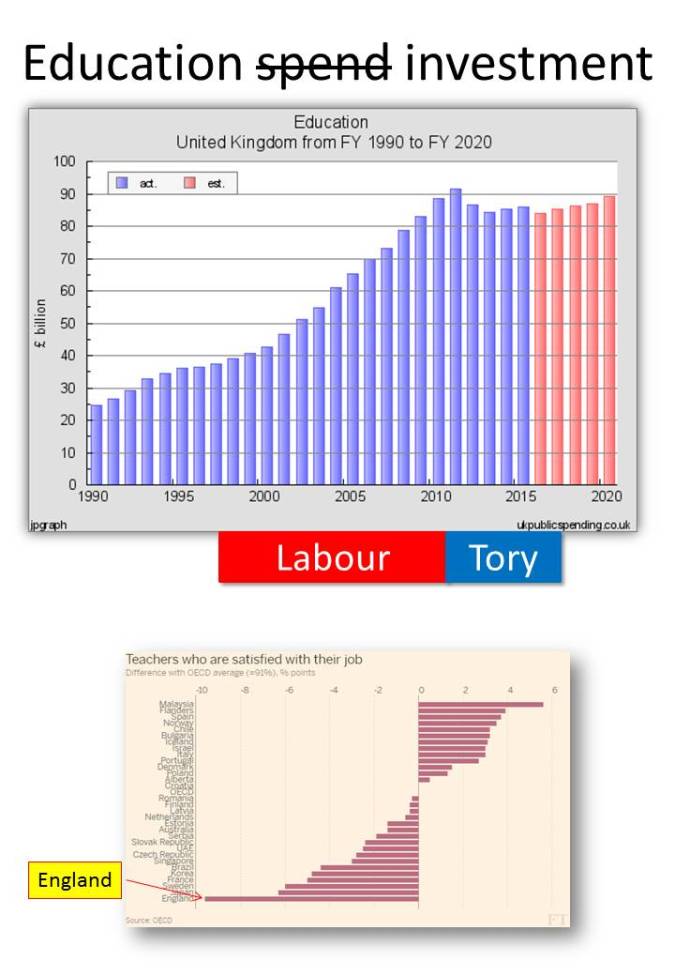
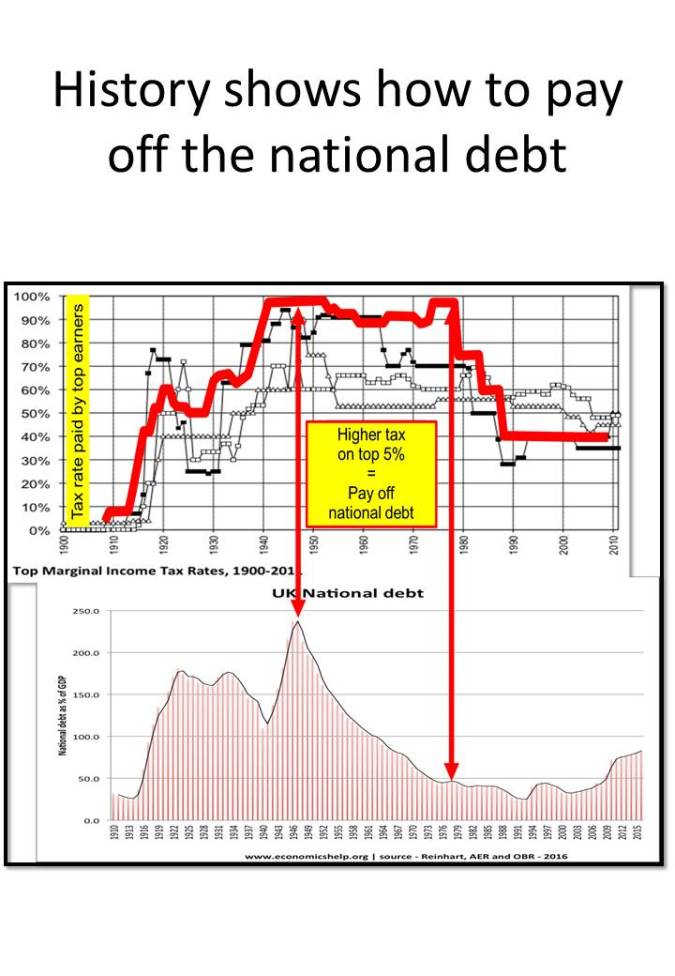
Here is some data.  It should be more powerful than rhetoric.  Draw your own conclusions…

Why public ownership makes sense

If I need some basic repairs carrying out on my car or my house, I know that the cheapest way to get the repairs done is to do it myself.  It is faster and easier and cheaper.

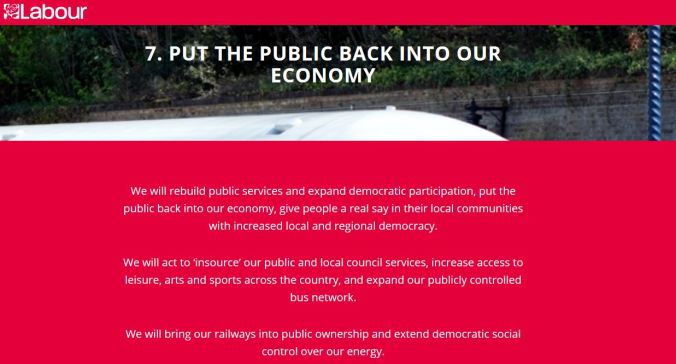
Why should it be any different for the nation?  If we want cost-effective roads, railways and other essential infrastructure, it is common sense for us to own and maintain them ourselves.  It’s faster and easier and because we are not paying someone else’s profits it is far cheaper.  Public ownership simply makes sense.

Other nations make a success of it. They are even running our rail services and taking the profits for their governments.

Keolis is 70% owned by the French government’s national rail service SNCF. It owns 35% of Govia, which runs the Govia Thameslink, Southern, Southeastern and London Midland franchises.

Arriva UK Trains, which operates a string of services including Chiltern, CrossCountry, Grand Central, Northern, Arriva Rail London and Arriva Trains Wales, is owned by Deutsche Bahn – whose sole shareholder is the Federal Republic of Germany.

Abellio is the international arm of the state-owned Dutch national rail operator Nederlandse Spoorwegen.

If you really want to upset yourself about this, watch the video: https://www.youtube.com/watch?v=gvagsSOlAy4

Do we think so little of ourselves that we can’t do the same?  Isn’t it time to bring essential public services back into public ownership?

Why we need more council houses

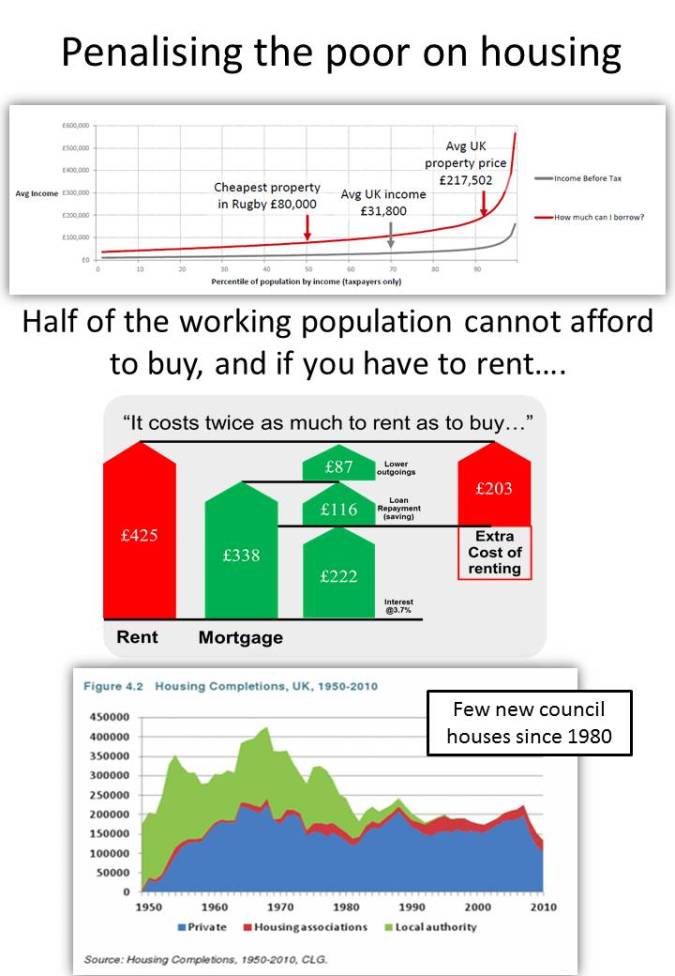
The chart below shows the income distribution in the UK (latest figures available from government statistics) and the corresponding amount that you can borrow if you have a 10% deposit (using the Halifax building society mortgage calculator).

Two thirds of the working population would be earning too little to buy a house for £150,000 by themselves. If you do not have the ‘bank of Mum and Dad’ then you have no chance.

Your only option is to rent, from the private sector, at a cost that is higher than your mortgage repayments would be if you were able to get a loan.

That is why we NEED more council houses.

That is why I’m voting for a Labour government. (see Pledge 2)

How to really make Britain great again.

The headline tells us “Brexit to send UK tumbling down world economic league table…”.  and we ask “Is this making Britain great again?”

But the headline, indeed the whole question of where Britain ranks in the world economy has absolutely NOTHING to do with whether Britain is great.  What matters is whether Britain is becoming more human.

Being human has nothing to do with the economy or wealth, but everything to do with values. It is about valuing everybody equally, irrespective of colour, class, wealth or religion. It is about selfless behaviour for the good of others. It is about acting with integrity and speaking truth. It is about doing what is right, irrespective of the consequences.

Britain will become great when those who are well off are willing to contribute enough to ensure the wellbeing of those who are not well off,  when we are willing to give up our own comforts for those who have nothing,  when we are willing to give sanctuary to those fleeing war dispite the risk of personal harm.

Britain will become great when we stop expecting a political system that gives everyone all the rights that they demand, but encourages us all to self-centredness. We cannot demand perfection from public services that we are not prepared to fund. We need to stop demanding perfect treatment from others, when we cannot give it ourselves.  We need to stop demanding that teachers work until midnight to keep up.  We need to stop expecting to be treated in A&E within minutes when we have drunkenly staggered into a lamppost.  We need to stop abandoning our personal responsibility for our own circumstances.

Britain will become great only when we choose to love one another; when we learn to contribute what we can, and to keep our expectations of others reasonable.  That is my hope for 2017.  Make it yours.

“Back in the day …” But why not now?

There was a time when it was wrong to tell a lie.

There was a time when we were taught that “if you can’t say something nice, don’t say anything at all.”

There was a time when we were taught that it was good to share.

There was a time when we were taught to “do as you would be done by”; to treat others as you would like them to treat you.  That every person was our neighbour, irrespective of where they came from, or which ‘tribe’ they belonged to.

All of these were accepted fundamental truths: words of Christ which spoke to our conscience and were proved correct by our experience.

Look at the papers, with the lies and attitudes of politicians in the US election and the Brexit campaign, the inequality, the refugee situation, the callous treatment of the poor, and we can see that we do not live in such a time.

I miss when human beings cared about each other, when decency was valued and we respected each other.  I want to see our nation, our world return to those values.

Do you?

Let it start with you and me.  Let’s vote knowingly, and act selflessly to change society back to what it should be.

God is fair, the economy isn’t, we can do our bit.

Mankind has established a system that breeds injustice. Wealth sucks money from the poor. Those with money enjoy luxury whilst those without struggle to survive.

God is not like that. He is just and fair. The Apostle Peter writes, “This faith was given to you because of the justice and fairness of God”. Faith is available to all, rich or poor.

God is fair. “He gives his sunlight to both the evil and the good, and he sends rain on the just and the unjust alike.” In God’s kingdom, rich and poor are treated fairly.

God is just. In God’s kingdom rich and poor will receive the justice they deserve.

The poor will receive justice for suffering under the unfair economic system of this world. But the actions of the rich sustain that system.

It is so ingrained in our culture to maximise our income that we forget that the more we gain we gain the more someone else loses. Let’s remember.

Let’s question each financial decision to make sure it will reduce the unfairness of the system:  Does it move money from the poor to the rich, or does it help the poor?

“Looking at the man, Jesus felt genuine love for him. “There is still one thing you haven’t done,” he told him. “Go and sell all your possessions and give the money to the poor, and you will have treasure in heaven. Then come, follow me.” At this the man’s face fell, and he went away sad, for he had many possessions. Jesus looked around and said to his disciples, “How hard it is for the rich to enter the Kingdom of God!”

It is hard to go against the flow, but if we choose to reinforce an unfair monetary system, why should we expect to escape justice?

Inequality between the richest and the poorest is man-made

Inequality between the richest and the poorest is a man-made thing. Men have put it in place. Men defend it. Men can dismantle it.

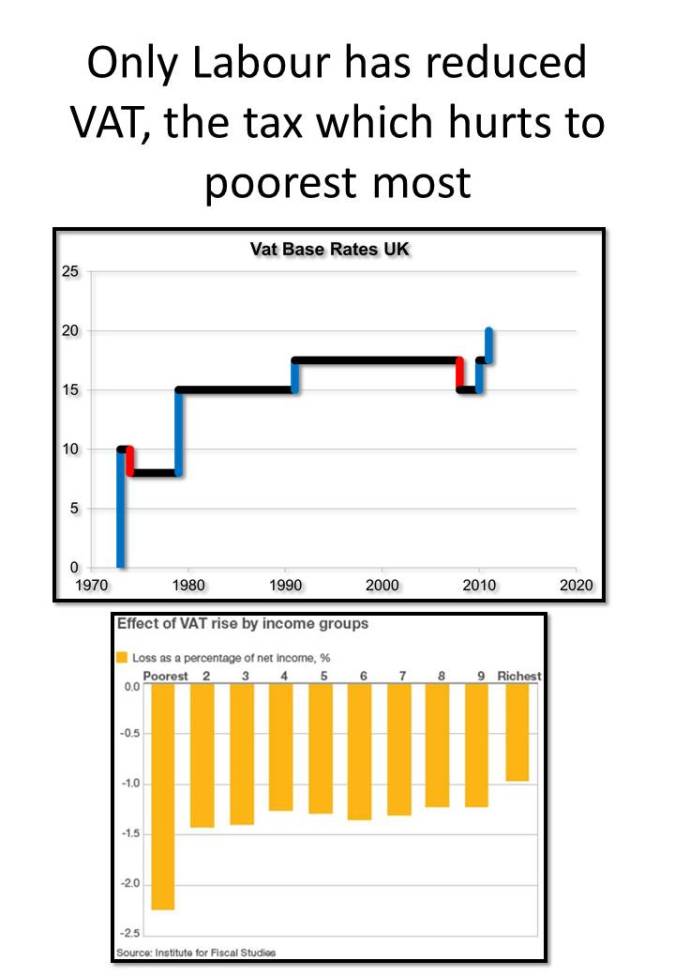
A young person on a modern-day apprenticeship (learning skills that will make a day-to-day difference in our lives) earns just £3.30 an hour, £6300 a year. The starting salary for a banker (who shuffles money around whilst taking a percentage) is in the range of £35000 a year? Is that just?

Is it good that “the rich are 64% richer than before the recession, while the poor are 57% poorer”?

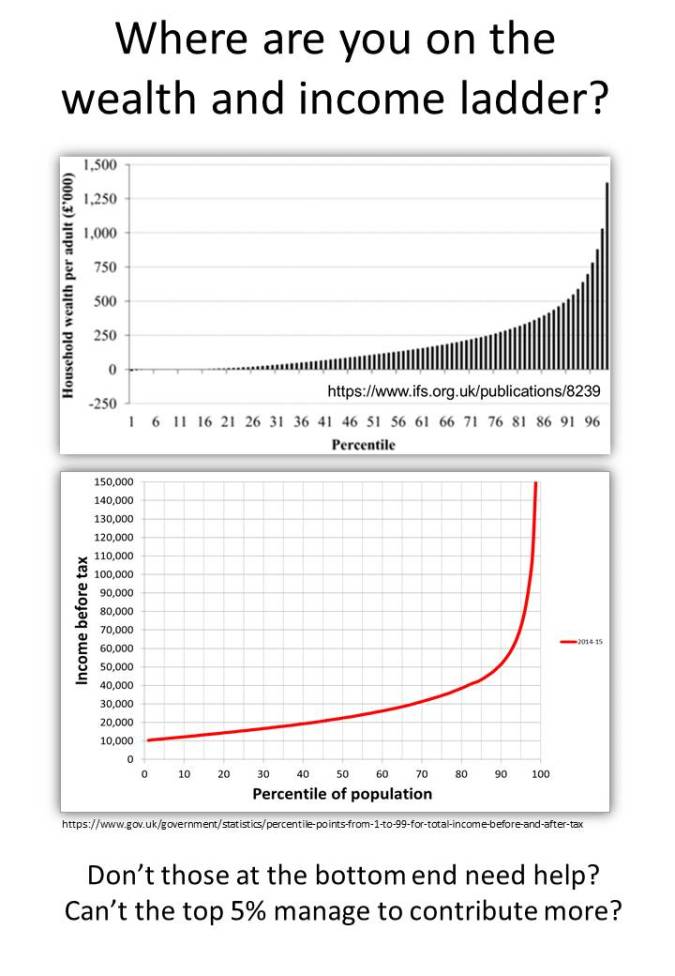
Where do you sit on the UK income scale?

  • If you earn less than £10000 you are in the bottom 5%
  • If you earn more than £21000 then you are in the top 50%.
  • If you earn more than £35000 (starting salary for a banker) then you are in the top 25%.
  • If you earn more than £68000 you are in the top 5%.

If it is right and just that the top 5% earn over ten times more than the lowest paid, then let’s enjoy our position.

If not, then let’s ask ourselves what we can do to make a difference.

And let’s make a new year’s resolution to start to make that difference.

References:
https://www.gov.uk/national-minimum-wage-rates
http://www.prospects.ac.uk/corporate_investment_banker_salary.htm
http://www.independent.co.uk/news/uk/home-news/britains-divided-decade-the-rich-are-64-richer-than-before-the-recession-while-the-poor-are-57-10097038.html
https://www.gov.uk/government/statistics/percentile-points-from-1-to-99-for-total-income-before-and-after-tax

How YOU can help achieve affordable rent

Rents are too high. A single person over the age of 21 on minimum wage of £6.50 an hour will earn around £1000 a month, less deductions. Even with the lowest rent prices, half of that will go on rent leaving around £120 a week for everything else.

Here’s a painless way to get rent down. It just needs some visionary people with a little capital to decide to do something about it.

Here is an example:
£60,000 invested in a building society or bank will be doing well to make 3% interest (although a ‘help to buy’ ISA can give 4%) e.g http://www.halifax.co.uk/savings/?WT.ac=SNCA1012

Therefore a good (4%) return on that £60,000 is £2400 a year, or £200 a month.
If we are happy with a 4% return on our savings, then why not but a property and rent it out at the same return?

The cheapest (1 bedroom) property available today is £395 a month. http://www.rightmove.co.uk/property-to-rent/property-56267795.html

There is a flat for sale in Rugby for £60,000. (http://www.rightmove.co.uk/property-for-sale/property-54091703.html?premiumA=true )

Using the £60,000 to buy the property, we could charge a very fair rent of (say) £250 a month, offering a low rental price and getting a very good return on the investment. (£250 instead of £200 to include an allowance for maintenance and fees)..

This represents a saving of a third on the lowest rental cost, and would give someone on low income the chance of an improved standard of living, and maybe even the chance to save enough to put down a deposit on a house of their own.

And all of this giving the same (or better) return that we get from the building society. Maybe there is a little more risk – but there is the benefit of doing something personally to help the current difficult situation for the poor in our town.

If enough of us do this, then it might even cut the overall rental market price (supply and demand!) with wider benefits.  I know that not everyone can help in this way, but some can, and it makes a difference to each person who is helped.

If you are interested and want to take it further, I’m happy to share my experience so far (I have made use of a legacy from when my mother died to do this). Please get in touch privately.

rent

Work and Pay

I think the world has become confused about work.

Instead of thinking that work is something to be endured to bring in the money we need to live, or a means of making us rich we should think of our work as our contribution to fulfilling the needs of society. We need to start thinking of it as ‘what can I give’ instead of ‘what do I get’.

And in a similar manner, society needs to think more clearly about the needs of the individual. All of us need to eat, sleep and live somewhere that we can call home. And the reciprocal side of the exchange is that when someone contributes to society, then society has a duty of love to meet the needs of that person.

Jesus told a parable of a man who hired workers for his vineyard. Some he hired in the morning, some in the afternoon, and some just before closing time. But he paid them all the same. He paid them what they needed to live. But of course, those who worked all day felt that this was not just and grumbled. Yet the vineyard owner pointed out that they were happy to work for their agreed wages, and they had received them. All the workers were willing to work. They were willing to make their contribution to society, even if there was no immediate work required. And they all had the same needs. The vineyard owner met their needs. Why can’t we follow this example?

Similarly, how do we decide how much someone should be paid? Is it according to the contribution that the job makes to society? How valuable is it to society when a person sits at a desk and manages our money? How valuable is it to society when a person removes the rubbish that we create during the week? How valuable is it to society when a person serves us a meal in a café or restaurant? I have to say that the most valued workman I’ve encountered is the one who came to clear our blocked drains when the raw sewerage was overflowing! Yet he is paid less than I am, when I spend much of my time sitting at a computer terminal.

It is not my aim to claim that job A is X times as valuable as job B, but to add into our thinking and actions that we need to be willing to pay each person sufficient to meet their needs.

Unfortunately the recent trend is that the rich are getting richer and the poor are getting poorer. I don’t have a problem with unequal pay, and with pay that reflects the value to society of the work. But I do take issue with a system that ignores the ‘need’ part of the equation.

Can you and I do anything? Yes we can. Even if it is only being willing to pay a fair price instead of the lowest price for goods and services.

But also, the reward for our work is more than just money. We all value the respect of our fellow human beings. One thing that we can all do is to treat everyone, in whatever job, with respect and with appreciation.

And similarly, when we are working, we can consider our work as more than just a job but as a contribution to society. The bricklayer can choose to be building a home instead of laying some bricks.

And we also need to respect those who are seeking work but unable to find it. Not only do they receive no wages, our benefit system disrespects them and prevents them making their contribution to the good of us all. Can’t we treat them like those in Jesus’ parable who were looking for work , and who at the end of the day were then paid what they needed to live.

Let’s think on these things as we go about or daily life of working, waiting, shopping and ‘consuming’.  Let’s change our attitudes.