Living with Hope in the Climate Tragedy

There are different phases as a tragedy unfolds.  Perhaps like when someone is diagnosed with terminal disease.

First of all, there is ignorance – the problem is not known about.  The tragedy is ‘undercover’ and waiting to unfold.

Then there is awareness – maybe a doctor’s diagnosis, or a smoke alarm going off in the middle of the night

Then there is anguish – the understanding of what is to come suddenly becomes real, and heart wrenching.

  • Reading up on the illness
  • Realising that flames have taken hold
  • First picture of the invasion of Ukraine
  • Seeing an ancient woodland being torn up for HS2, or the Amazon being burned down for cattle farming
  • The disciples seeing Jesus arrested, tied up and carried off by the mob

We are desperate to do something, we want the tragedy to stop and do all we can to prevent it.  Even if what we do will make no difference, we need to do it – mopping someone’s brow, sitting by their bedside.  Throwing buckets of water on the flames.  Striking off an ear.

We get frustrated and angry with others who get in the way – holding us back from putting out the flames.  Setting regulations preventing us from even seeing our child suffering in hospital, let alone hugging them tightly.

The anguish grows the more we care.  If we hear of a distant acquaintance getting cancer we might say ‘ah well, that’s sad’, but if it’s our child, or our spouse it is like a kick in the stomach.

The anguish gnaws our heart and becomes almost unbearable.

And when we are in the middle of a crisis and we realise there is no hope, anguish turns to despair:

No matter what we do, Russian troops are still pounding Ukrainian cities with artillery.  No matter what we do, the cancer is spreading.  And Jesus is bound, beaten, and nailed to a cross – and we are helpless to do anything.  But we continue to try. And we cry out in despair, even though hope is gone.

And then it is finished.  Grief takes hold as we look on the result – the dead child, the burnt house, the destroyed city, the body taken down from the cross.

The mourning for what was, for what has been lost, for what could have been.

The feeling of purposelessness – what is the point of anything anymore?  Why bother?

Hope has gone.

We are in a global climate tragedy.  Humanity is destroying life on this planet. We are condemning future generations to extreme climate and weather events, to suffering, to rising sea levels, maybe to extinction.

It’s actually a multitude of mini tragedies.  Each goes through the same stages, but they are relentless. At the grieving stage of one, another is waiting.  And they combine into one big tragedy.

In the past few of years I have become more and more aware of the desperate situation that the world is in.  The relentless rise in CO2 and average temperature.  The worsening climate disasters and weather events.  The melting of glaciers, Greenland ice and the poles.  The extinctions, and destruction of life.

That took me deep into the anguish phase – prompting me to do what I can!

My wife and I have invested our money and made changes in our lifestyle to radically reduce our CO2 footprint – almost meat free diet, using the train instead of flying, insulating our house, fitting solar panels and a heat pump – our house is now carbon neutral! 

I invest a lot of time and energy trying to put the message across to others, researching the facts and trying to put them into simple terms.  There is some encouragement when we see others doing the same, and when we see vegan burgers that taste like meat, plant-based butter, and other replacements for meat produce.

But people still don’t realise the scale of change needed, or the urgency: 

According to a poll carried out in G20 countries the vast majority – 83% – said they wanted to do more to protect and restore nature. However, when asked what actions they would take, they prioritised increasing recycling and avoiding excess packaging. ‘Higher impact changes like diet change and flying less are consistently bottom of their list,’ said Sophie Thompson, part of the Ipsos MORI team that carried out the survey.”

I can see that the technology is available, but action is too slow.  The world still wants to follow the rules of financial justification.  And poor countries rightly want to experience the same quality of life that rich countries do, and so don’t want to sign up to CO2 targets.   Time is running out – it has already run out for several mini-tragedies, but there is little sense of urgency. 

The steady stream of cars and trucks, the rush to book flights after covid, the meat-fest menus, people buying multi-packs of plastic bottled water, the waste …. You can’t get away from it, the relentless ‘in your face’ inaction that says, “I don’t care”, but that I realise may simply be “I don’t know”.

I moved beyond anguish to despair.  And sometimes I have felt I need to give up completely; get a log cabin on the coast in Northumberland and watch the sea.

And then I realised that whatever I do, much more climate change will happen.  Even with all the current government pledges, global temperatures will continue to increase.  And to imagine that our institutions will honour climate commitments, or that individuals will change enough to prevent further deterioration is to delude ourselves.  But also, for the majority world to be dragged out of poverty to share the lifestyle that I have enjoyed since I was born will need increased carbon emissions.  Population will grow as better sanitation, medicine and housing allows people to live longer – consuming more energy through their lifetime.  Reading the signs shows that CO2 emissions will rise further, and global warming will go beyond 2 towards 3 degrees – or higher!  It’s going to happen and nothing I can do will stop it.

And I entered the grief phase.  Do we ever leave that phase?  We recognise what is lost, or what is destined to be lost and it saddens us deeply.  Accepting the loss, the grief means the intensity of feeling fades.  The loss is still there, and we are no longer frustrated and angry at our helplessness.  And we are changed. 

And where is God in this?

“Father, in our despair, in our grief, bring us hope.  Show us the hope we can bring to others.  Tell us what you want us to do.  And give us the courage we need to act.  Amen”

God’s hope comes from where it has always come – but we have forgotten it.

There is nothing I can do that will prevent climate change.

There is nothing I can do that will prevent the powerful having their way.

There is nothing I can do that will make the world good.

These are things that are beyond the power of the individual.  It has always been so, and in a world where many choose selfishness over goodness it will always be so. 

My individual goodness does not make the world good.  The omnipresence of the spirit of goodness acting in all individuals could make things good, if each individual were to respond.  We can see this – if only everyone was good, then the world would be a good place; it would be heaven!  And it is because ‘they’ are not good (we are not either!) we find ourselves responding with anger and frustration and are tempted to despair.  

In the battle for good to prevail we have a great ally in ‘The Law’.   Laws, enforced by appointed guardians, codify what we understand to be good.  The law limits the power of the selfish, those who don’t respond to the spirit of goodness.  The law tries to teach what is good behaviour – but the law is made by human hands trying to define goodness.  Human hands can be wrong.  Human hands can corrupt the law.  And so the law does not reach goodness.  Although we say that nobody is above the law, the law is not above goodness.  We cannot be fully good by following the law.

The law is a powerful tool towards preventing climate change, and towards preventing the powerful having their way.  It is good and necessary to have good laws, but those who have the power to make the law are also those who have personal interests to serve, and so they do not always make good laws.  And people do not always keep the law.

So where is hope?

Christian hope comes from the power of the spirit of God; from a bigger picture that we have forgotten. People in the past understood that there was a life to come, that this world is not all there is.  The bigger picture is that we are offered everlasting life, against which this world fades into nothing.  Everlasting life in a new world where everyone chooses to be and is truly good, in the presence of the spirit of goodness and love.

My wife Cathy writes that:

“humanity has always been up to its chest in its own mire, mistakes, and sin. Because we live relatively fulfilled lives, we can forget that most people did, and still do, endure lives of fear, pain, hunger, death, and drudgery. Consider the slums of Victorian England, the lives of medieval peasants, the wars and diseases that have stained our history. It has always been thus. The Bible shows that this is the story of humanity: drowned in our self-inflicted suffering, with no hope that we can rescue ourselves, but that somehow, beyond anything that we can possibly understand, God has intervened to initiate a great rescue plan. That at some point, the mess will be tidied up and ‘every tear will be dried’.”

Many passages in the Bible describe this hope:

‘Look! God’s dwelling-place is now among the people, and he will dwell with them. They will be his people, and God himself will be with them and be their God.  “He will wipe every tear from their eyes. There will be no more death” or mourning or crying or pain, for the old order of things has passed away.’

He who was seated on the throne said, ‘I am making everything new!’ Then he said, ‘Write this down, for these words are trustworthy and true.’

He said to me: ‘It is done. I am the Alpha and the Omega, the Beginning and the End. To the thirsty I will give water without cost from the spring of the water of life.  Those who are victorious will inherit all this, and I will be their God and they will be my children.

And from the apostle Peter:

Praise be to the God and Father of our Lord Jesus Christ! In his great mercy he has given us new birth into a living hope through the resurrection of Jesus Christ from the dead, and into an inheritance that can never perish, spoil, or fade. This inheritance is kept in heaven for you, who through faith are shielded by God’s power until the coming of the salvation that is ready to be revealed in the last time.  In all this you greatly rejoice, though now for a little while you may have had to suffer grief in all kinds of trials.  These have come so that the proven genuineness of your faith – of greater worth than gold, which perishes even though refined by fire – may result in praise, glory, and honour when Jesus Christ is revealed.  Though you have not seen him, you love him; and even though you do not see him now, you believe in him and are filled with an inexpressible and glorious joy, for you are receiving the end result of your faith, the salvation of your souls.

Cathy continues

“I find hope in the belief that every person is unique, loved, precious.  That every person has something incredibly valuable to offer to others, whether teaching, engineering, dancing, poetry, cooking, listening, encouraging, smiling, gardening… and that God wants everyone to have the chance to grow into their own potential.  So, as part of His rescue plan, the child that drowns in Pakistan will – somehow – be restored, healed, and given the chance to become its full self.

Furthermore, I think that the earth itself, and all that lives on it, is also valued and precious to God.  That the koala bears that died in the fires in Australia, the glaciers that have disappeared, the animals hunted to extinction, the trees killed by drought, the hedges uprooted, may also be restored.

But this isn’t a ‘pie in the sky’ hope that gives me an excuse to do nothing now. I believe that I am called to take part in this great plan, and that my actions; not flying abroad but taking the train, moving to a more plant based diet, donating to charities to help feed the poor or plant trees, turning down my heating thermostat, biking more; are part of a great unnoticed movement of rescue.

I think and hope that the kingdom of heaven, a kingdom of fairness and wisdom, will be established in a restored, peaceful, green earth; bursting with life and enjoyed by loved, healed and beautiful people living their lives to the full.  And I believe that my efforts towards that are not wasted.”

So there is hope in the future, and purpose in what we do now.  But in the now there is more than just duty and hope for the future. We can and need to find happiness, peace, and joy. I have found some secrets to this in a short book called ‘Finding Happiness’ by Abbot Christopher Jamison.  And even if we do not accept the Christian hope we can benefit from the wisdom of the ancients.

Considering the ideas of the philosopher Plato, he describes that “contemplation of the good and the beautiful is Platonic happiness”.  Taking time to really observe and to absorb into ones immediate being that which is good and beautiful draws out joy and wonder.  A form of worship is appreciating the beauty of an ever-changing landscape, the journey of a piece of music, the wholeness of a novel.  Goodness and beauty contemplated in every diverse opportunity, fought for against the pressures of the rush of daily life, brings peace, joy, and happiness.

This is what the Apostle Paul said too, ‘brothers and sisters, whatever is true, whatever is noble, whatever is right, whatever is pure, whatever is lovely, whatever is admirable—if anything is excellent or praiseworthy—think about such things.’

Abbot Christopher also tells us that “Happiness for Aristotle is ‘the activity of the soul expressing virtue’.  So in essence where Plato sees happiness as contemplation, Aristotle sees happiness as living virtuously.”  The call to action that Cathy described is thus not just a call of duty, but a call to happiness.  Living virtuously brings happiness. It will take courage, and effort, and perseverance.  It will test our reserves and frustrate us.  But as we persist in scrupulously examining our actions and our motives and seeking to live virtuously then we will begin and grow happiness in our lives.

Again, Paul wrote “For we are God’s handiwork, created in Christ Jesus to do good works, which God prepared in advance for us to do.”  Doing good deeds is part to becoming who we are.

We are not responsible for anyone’s behaviour but our own. That’s why the world is in the state it is – many choose the selfish path to death.  And as a consequence, we will experience global warming way beyond where it is today.  It is a tragedy, but it is the same tragedy that has been unfolding since the world began – the tragedy that many choose the path of selfishness.  But let us choose to be a people of hope.
A heat pump strategy that works.

The government heat pump strategy is on the rocks.  I present an alternative, with data to prove that it would work.

The government is offering a ‘boiler upgrade scheme’ whereby the present boiler is replaced by a heat pump.  This is failing because the cost of the heat pump are typically over £7000[i].  And on top of that, radiators may need to be increased in size in order to provide the same heat as the boiler that is being replaced.  Installation would be disruptive and take many days.  People are unfamiliar with the technology (although it is in their fridge) and don’t want to risk it not working properly, or the efficiency gains not being as high as expected.  The approach is an ‘all or nothing’ approach, whereby the existing heat source is scrapped and fully replaced – there is no going back if it doesn’t work.

An approach that would work, and which I have demonstrated successfully in my own home, is to provide a high efficiency heat source that provides a base load of heat in addition to the present boiler system

The high efficiency heat source uses heat pump technology, but without the complication of integrating with a water radiator system.  The ratio of heat out to electricity in is around 4 to 1, which is better than that of the boiler replacement heat pump which in practice only offers around 2.7 times as much heat as the electricity it consumes[ii].

The technology is air conditioning air to air heat pumps. It is well proven, and we encounter it every day without realising it in shops, offices, and hotel rooms.  It works.  It is many times cheaper, simpler, and faster to instal.  And in addition it can provide cooling to make life tolerable in heat waves – something that will be more important in the future.

Let me describe our application.  We have a traditional 3-bedroom semi-detached house built around 1930.  we have fitted an air-to-air heat pump in our hallway, which provides around 4kW heat for around 1kW electricity.   Installation took half a day, with minimal disruption.  The outdoor unit is on the wall back-to-back with the internal unit, with no pipe runs inside the house.  The cost was under £1500, a fraction of what we were quoted for air to water systems.

We retained our gas combi-boiler to provide hot water, and to allow us to top up the heat if needed.

For every kilowatt hour (kWh) electricity to the heat pump, the gas usage reduces by 4 kWh.  The question is how many kWh the heat pump can provide.  Our house needs around 7000kWh heat per year, using up to 60kWh gas per day in mid-winter.  A 4kW heat pump running flat out could provide 4kW x 24hr = 96kWh of heat per day – more than enough to eliminate the need for the gas boiler, and offering the possibility to reduce our energy use by 75%.

But how did it perform in practice?  It performed well! 

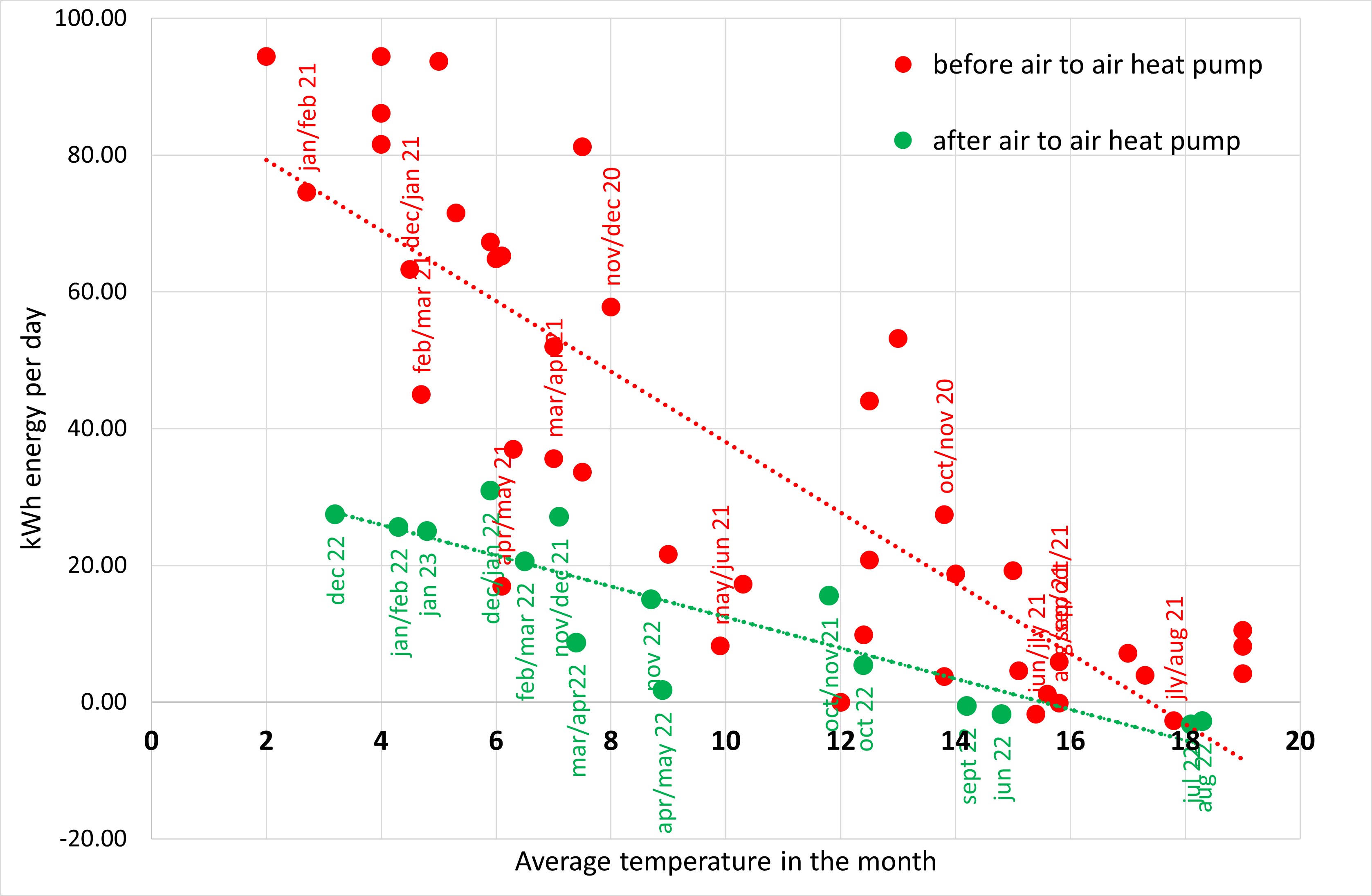
The chart below shows our total energy use, which includes heating, cooking, washing up, showering, watching TV – everything.  As you can see achieved big energy savings.  Not quite 75% each month, but dramatic.  Over the heating season we saved 5500kWh of energy.  Since the cost of electricity is much higher than gas, at today’s tariffs you won’t expect to save a lot of money (we saved less than £50 over the winter) UPDATE – WITH THE NEW ENERGY CAP RATES THIS WILL SAVE US £180 PER YEAR . 

In order for the heat to spread around the house we set the heat pump temperature to maximum, and to maximise the heat into the house we left it running overnight in the coldest weather.  Both of these reduced the real saving compared to the theoretical, but both made the house warmer and more comfortable.  Remember that this approach still leaves the opportunity of using the gas boiler.

Although it is important not to use the cooling function unless really necessary, the technology makes life manageable in the ten or so days of extreme temperature in the summer.

So what’s the way forward?

If you are willing to spend £1500 to cut drastically cut your carbon footprint and save you £1200 each year then why not just go for it. 

Or perhaps the government might adopt a strategy to encourage roll-out.

The government has set aside £450 million for the boiler upgrade scheme, offering £5000 per installation[iii]. If successful, that would provide the less efficient heat pump solution to 90,000 homes – and only in households that can afford the difference between the grant and the actual cost.

Instead, it could channel the same budget into air conditioning heat pumps as described above, offering perhaps £1000 per home, that would provide highly efficient heat pump solutions to 450,000 homes – including those who are less well off. 

We have found that several friends and acquaintances have followed our example, having seen how the technology works, and so the 450,000 homes might well encourage another two homes each, giving a total of nearly one and a half million homes saving 5000kWh each per year. Now that would be a heat pump strategy that worked.


[i] https://energysavingtrust.org.uk/advice/air-source-heat-pumps/

[ii] https://assets.publishing.service.gov.uk/government/uploads/system/uploads/attachment_data/file/606818/DECC_RHPP_161214_Final_Report_v1-13.pdf

[iii] https://www.greenmatch.co.uk/blog/clean-heat-grant

The City, the sequel to The Gifts, is published

The sequel is here…

cathyhemsley's avatarIs Narnia All There Is?

The City, the sequel to The Gifts, is published at last, and available on Amazon.

View original post

The secret heat pump that doesn’t cost the earth

There is a lot of noise about air source heat pumps at the moment, and in particular air to water heat pumps that replace the gas boiler in your house and feed the radiators. Heat pumps are extremely energy efficient, because instead of generating heat (from gas or electricity) they pump heat from outside a building to the inside. They might pump 3 – 4kW of heat for every 1kW of electricity that they use.  But systems that replace your gas boiler are costly, according to the Energy Saving Trust “Typical costs are around £7,000 to £13,000” https://energysavingtrust.org.uk/advice/air-to-water-heat-pumps/

An air to water heat pump system typically heats the water to 50 degrees C. This is lower than a normal central heating boiler, and so you might need bigger radiators for the system to provide enough heat to each room, or expensive additional insulation to reduce the heat demand. Air to water heat pump systems need space for the internal plant, and installation will take days and be very intrusive. This is probably why the government has little take up of the Boiler Upgrade Scheme.

There is an alternative to these expensive air to water heat pumps, namely air to air heat pumps – commonly called air conditioning units.

In an air to air system, instead of the heat pump being used to heat the water for your central heating radiators, it heats the air directly in a fan unit inside the house – hence the term “air to air”.  In effect, it is an extremely efficient fan heater. Air to air heat pumps are better known as air conditioning units because they have the additional advantage of being able to provide cooling in summer, making life bearable when outside temperatures are 40+ degrees.

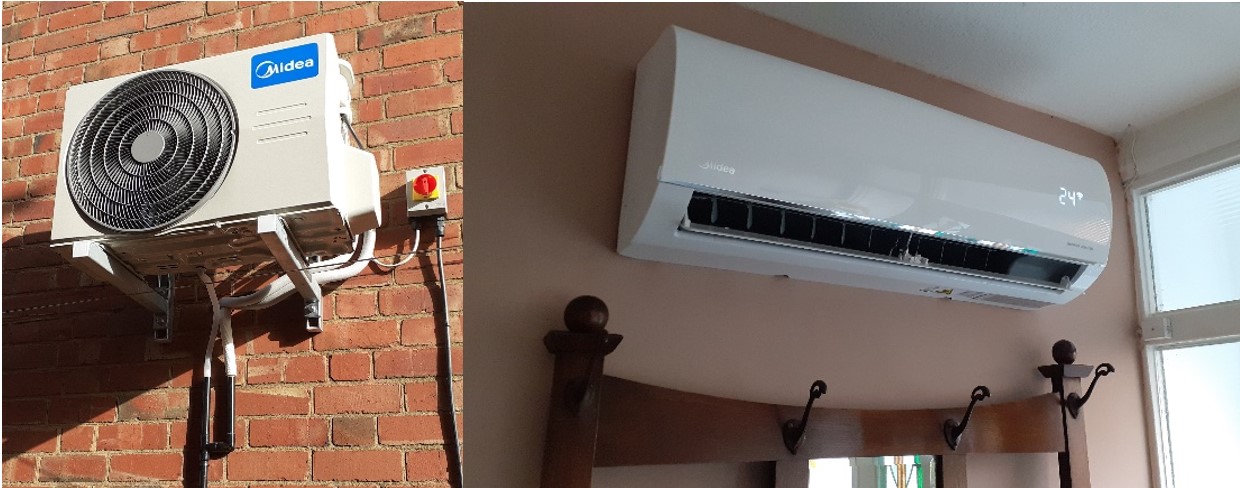
We live in a typical 1930s 3 bedroom semi-detatched house with solid walls. We paid around £1500 for a 4kW air conditioning unit. It was installed in less than a day and sited in the hallway it provides heat to all the rooms in the house.  There is none of the ‘plant’ associated with air-to-water heat pump systems and so no loss of space.   Because the unit pumps heat, it only takes 1kW of electricity to provide 4kW heat – the most efficient heating technology on the market.

These pictures show the internal and external units.

We have been delighted with the performance.  The heat from the hall dissipates throughout the house through open doorways (both upstairs and downstairs), and we can avoid heating rooms that we don’t use simply by closing the doors. 

We have retained our gas boiler to heat our water, but have removed several radiators. We have kept a few as backup but have not had to use them. We have a wood burning stove to lift the living room temperature in the evenings and provide supplementary heat in the very coldest weather. Our only ‘regret’ is that we didn’t fit a slightly bigger unit, which would be better when temperature outside reached -5 to -7 degrees.

The chart below shows how much our energy consumption has changed as a result of the heat pump. Combined with our solar panels and renewable electricity supply, our house is now net zero.

In summary, there is a readily available, low cost, low disruption, extremely high efficiency heat pump available which you can install straight away without having to make your radiators bigger or spend thousands on insulation, and which will also provide cooling in summer.

So why haven’t we heard of this before? I don’t know – but you are in on the secret now.

Good news!

Deep inside each of us we know that we ought to be good.  Perhaps it’s stronger than that, and we want to be good.  But we aren’t as good as we’d like to be, and we often disappoint ourselves and perhaps give up trying, and ignore our shortcomings – burying them in a busy and ‘important’ life.

Millions of years of ‘survival of the fittest’ evolution has honed our human nature to make sure that we thrive physically and materially, even if it is at the expense of others.  We want a better house, a better car, more money.  We want our country to be richer and have a better healthcare system than others.  We recognise that there are laws that we must obey, but we will find ways round them if we can if it improves our lot.  We might get angry about world situations; the dreadful behaviour of the Taliban, or Trump, or Putin, or global warming, or social injustice; demanding action from governments but perhaps being unwilling to actually do much, if anything ourselves.

In this environment, what is the relevance of and role of religion?  And what about God? And do They have anything to do with religion, or us?

Reliable historical texts describe that Jesus brought ‘good news’ to the people of Israel, and that he told his followers to take that good news to all nations.  The people he brought the good news to were probably not that different to us, although with less technology and material possessions; they had the same drives and motivations.  They felt the same disillusionments.  Yet many people were changed by the message he brought, transforming their lives and motivated to take his message to the world. 

So what was this ‘good news’ that Jesus brought, and why don’t we hear it today?

Basically, the good news was (and still is) that ‘You can be good, and this is what being good looks like.’

On top of that simple message, he brought us tools and techniques to help us, the primary one being the tool to free us from the ‘badness’ of our past.  Using his tools we can look forward to what we can become rather than being dragged back by our past mistakes. 

The tool that he offered was repentance; sincere regret and remorse.  But repentance alone is clearly not enough and might simply add a feeling of extreme guilt and worthlessness (who would want to subject themselves to that).  The ‘magic’ that Jesus brought was, and still is authoritative forgiveness.

Forgiveness only works if it is offered by someone with the authority to forgive; it doesn’t mean a thing if I forgive you for stealing, it needs a judge to do so.  In Jesus day the religious leaders recognised that ‘only God can forgive sins’ and so were angry that Jesus did so. 

Today, we don’t have the same understanding of God, and perhaps for us it is better to think of ‘infinite love’ or ‘infinite goodness’ instead of the God.  But how ever we look at it, the magic of Jesus clearly worked at the time and has continued to work ever since – if we repent and ask Jesus to forgive us then he does.

As I wrote in my book “Christianity – why bother?”:

“To live a rich and satisfying life in the future we have to accept that we made mistakes in the past.  We have to want to change for the better.  We have to want to wipe the slate clean and start again. And we do that by accepting God’s forgiveness.

It’s about accepting God’s unconditional love, and then working with Him to become who we are meant to be. And it starts with a decision to submit leadership of our life to Christ.

And this is freedom.

Freedom from the guilt of past sins.

Freedom to love God.

Freedom to love one another.

Freedom to stop sinning and to do what is right without worrying about the future.

Freedom to trust Jesus when he tells us that he has come to bring life in abundance.

Freedom from religious ritual.

In essence, that is the Good News of Christianity; that is the Gospel.”

And what is the role of religion?  Well religion should help us find this truth.  Religion should help us to understand who and what God is, and to help us see what ‘good’ looks like.  Unfortunately, much religion today seems to want to show what is good by living the opposite – a perverse sort of reverse psychology.  Nevertheless, there are many good and solid leaders and grass roots members of religions who are simply trying to tread a good path, trying to live graciously with one another.  Being part of such a community can be a great help and encouragement, and can bring companionship on our journey.  Spending an hour or two of ‘spiritual’ reflection once a week helps us maintain focus and direction.  So yes, there is still a role for religion.

Money, Church, Jesus and me.

There is a church which has assets of £8,700,000,000 at the start 2020, at the start of the pandemic.  The nation struggled and many were in financial despair.  What might Jesus have hoped that the church would do?

The church did not ‘hide their gold in the ground’, or put it in a deposit account earning perhaps 1% return. Instead it invested its assets and achieved a growth of 10.4% in the year.  Would Jesus have been happy with that stewardship of the money?

The church spent some of the money that they received, but at the end of 2020 the assets of the church had grown by £500,000,000 to £9,200,000,000.  Is God blessing that church with growth?

“You say, ‘I am rich; I have acquired wealth and do not need a thing.’ But you do not realize that you are wretched, pitiful, poor, blind and naked. I counsel you to buy from me gold refined in the fire, so you can become rich; and white clothes to wear, so you can cover your shameful nakedness; and salve to put on your eyes, so you can see.”

Over Christmas, a small church agreed to spend £1000 to make up food hampers for those on Free School Meals.  As a result, fifty families were blessed.  People were inspired to donate towards the cost of the parcels, which meant that it actually cost the church nothing.  Was God rewarding their generous spirit?

I saw a Facebook post recently that made me think:

It is so easy to criticize those who have more money than us.  But we could equally say:

There is a charity, set up by a Christian pastor, which buys and builds houses that are loaned to local churches to house and support vulnerable homeless people.  So far they have housed 1226 people.  They raise the money through people investing in their project rather than by donating money.  They offer a 5% financial return on investment so that investors have the twin benefit of knowing that a homeless person is being housed and loved, and getting an above average return on investment. (https://www.greenpastures.net/)   The charity is growing; does that make Jesus smile?

We may worry about money; it is natural.  Everything today is described by its economic value, or the cost to do it; phrases and a culture used to justified austerity.  In such an environment it is hard not to put a financial value on everything, and to be thrifty.  Consider another quote that I came across said:

“The smart way to keep people passive and obedient is to strictly limit the spectrum of acceptable opinion, but allow very lively debate within that spectrum. That gives people the sense that there’s free thinking going on, while all the time the presuppositions of the system are being reinforced by the limits put on the range of the debate.”  Noam Chomsky

That is today’s truth. Greed is now accepted as good in this country. People simply debate how much greed. But we don’t call it greed, we use phrases like ‘reserves’, ‘savings’, ‘retirement plan’ to avoid confronting whether we should be keeping our money to ourselves.  Jesus said:

“Do not store up for yourselves treasures on earth, where moths and vermin destroy, and where thieves break in and steal.  But store up for yourselves treasures in heaven, where moths and vermin do not destroy, and where thieves do not break in and steal.  For where your treasure is, there your heart will be also.”

Dealing with money is not easy, but it is SO important.  It must not become our treasure, but it is certainly a tool.  It allows us to be a blessing to others in as little time as writing a cheque – and time is a stress for many. It blesses us to bless others, but if we agonise about the smallest financial decision then our worrying steals our time, our energy, and can lead to conflict!  We need to train ourselves to be instinctively generous.  We might reflect on these phrases of Jesus, remembering that he spoke them because he loves us; because they are good for us:

“Therefore I tell you, do not worry about your life, what you will eat or what you will drink, or about your body, what you will wear. Is not life more than food, and the body more than clothing?”

“Give to everyone who asks you, and if anyone takes what belongs to you, do not demand it back.”

“None of you can become my disciple if you do not give up all your possessions.”

And as St Paul wrote:

“Remember this: Whoever sows sparingly will also reap sparingly, and whoever sows generously will also reap generously. Each of you should give what you have decided in your heart to give, not reluctantly or under compulsion, for God loves a cheerful giver.  And God is able to bless you abundantly, so that in all things at all times, having all that you need, you will abound in every good work.”

Seeking adventure?

There is an account in the gospels of Jesus sleeping in a boat while a storm rages and seems about to sink it.  The disciples wake Jesus, he calms the storm and then says to his followers “Why are you so afraid? Do you still have no faith?”

Usually we take from this story that Jesus has the power to calm storms, and that we can ask him to calm the storms in our lives.  i.e. call out to Jesus so that we can live placid boring lives. But I think the message is different. 

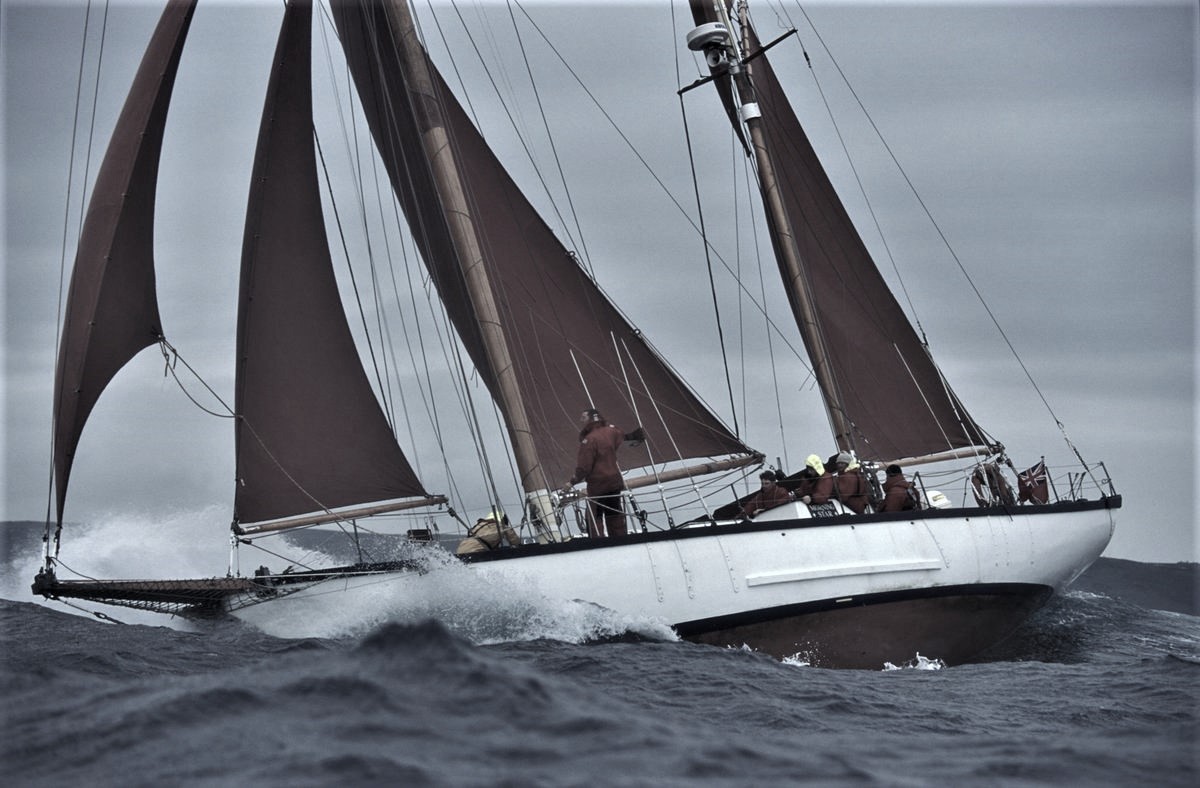
I was on a sailing boat in storm force winds when a mast fitting broke. We had to get the sail down whilst being tossed in the massive waves, with wind and rain and spray.  It was exciting, we felt alive and ‘present’, …. and yet safe.  Our skipper was completely calm, and so we were confident that we would come to no harm; and we didn’t.  It was a joyful and exhilarating shared experience which we will all remember and which is a bond between us; so much more than flat seas and a gentle breeze.

So I think that instead of offering calm seas in our lives, Jesus is saying ‘I am in your boat, you are perfectly safe.  Go and enjoy the adventure.’ And it is with sadness that he has to calm our storm because we have so little faith.

Do you want adventure?  ‘Safe’ adventure?  Feel free to get in touch…

The Gifts

An enjoyable, thought provoking adventure. If you like this after reading it, please leave a positive review and rating.

cathyhemsley's avatarIs Narnia All There Is?

Gifts that are wasted, plans that fail, a world on the brink of war………

The Gifts is now published! With a beautiful, perfect cover designed by Beck Hemsley. Worth buying for the cover alone. Thanks to all those who helped along the way: there are too many of you to mention, but especial thanks go to Edwina Mohtady, all the writers in Rugby, Beck Hemsley and Izzy Jarvis.

I am so happy – and slightly scared…

Available on Amazon as a paperback for £8.99 of the Kindle version for £1.99

View original post

1 John 3:17-18 Beira

In March 2019 Cyclone Idai devastated much of Mozambique.  Local contacts identified that despite humanitarian relief being provided by major aid agencies many people were missing out – particularly the elderly – and in desperate need of help.  Privately sent funds were used by the team in Beira to provide emergency food hampers and water, and then to help repair and rebuild houses. This work highlighted the ongoing need for financial help.

In view of the clear and ongoing need and opportunity, and to build on this initial successful partnership, in the UK we established the charity “1 John 3:17-18 Beira”, and in Mozambique our partners have registered their project with the government: “Associacao Esperanca Aos Vulneravies” (Hope Association for the Vulnerable).

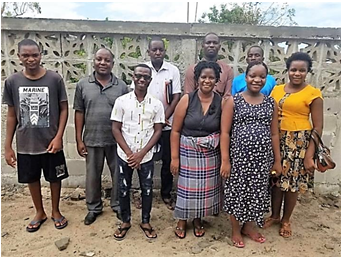
Each month a list of needs is created by the local team of volunteers in Beira (see photo), and those needs which can be funded are agreed.  1 John 3:17-18 Beira then sends the money.  At the end of each month a report is received confirming how the funds were used, and providing photographs of the work, ensuring accountability.

The charity currently supports around seventy of the poorest people with food and fuel.  We have built more than ten houses for those whose homes were demolished, and repaired many more. We support nursing students, apprentices, and those doing short term courses (IT, electrician, baking). We have provided business loans to around ten people. We have provided nearly a hundred fuel efficient stoves and planted over fifty trees.

Members of Associacao Esperanca Aos Vulneravies

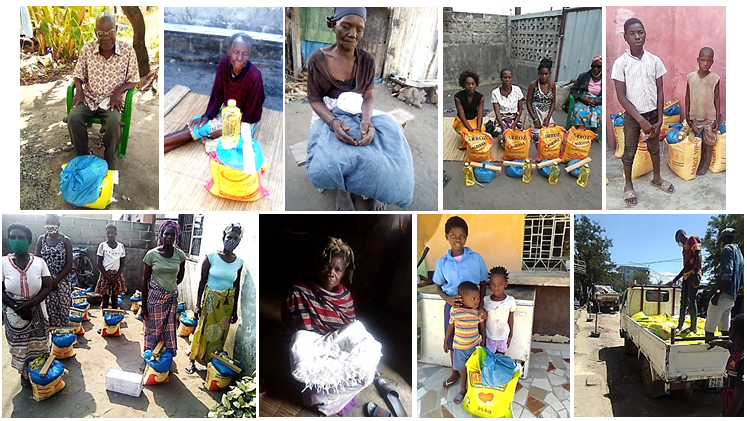
The local team are passionate to improve the chances for the poor.  At the most immediate level this involves providing food, fuel and medication for those who simply have no income. Blankets have been given to help keep warm at night in winter. Mosquito nets have been given out too.

Some of the beneficiaries receiving food, oil, soap and blankets

Materials and where necessary labour are provided for repairing houses, adding cyclone protection measures and building new houses where homes have been destroyed.  Innovative and environmentally friendly approaches to construction are being investigated, such as using waste plastic bottles as building material.

Education and training, and earning a living

In addition the project is able to make grants for school fees and uniforms, and for training and apprenticeships. These often cost less than £50 each, but give the beneficiary a future. 

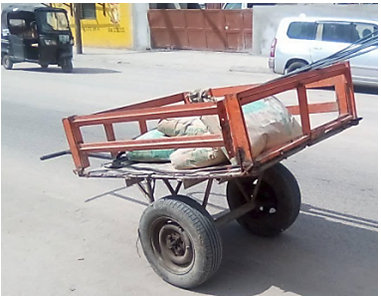
Small start-up business loans are made to pay for initial stock or in one case to buy a small cart to transport goods.  Again these loans are often less than £50, and the recipients pay back as they can so that funds can be used for future loans.

Environmental projects that help the community

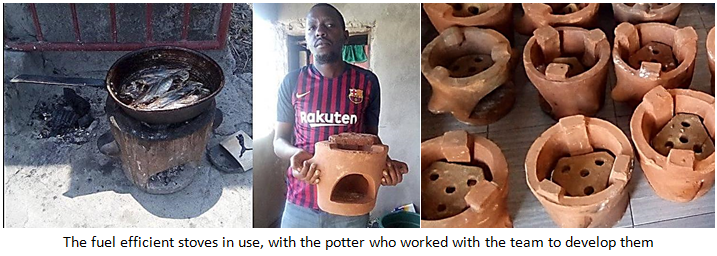
The team have worked with a local potter to design and manufacture efficient cooking stoves which not only save the user money by needing less charcoal, but also reduce CO2 emissions.  These cost under £3 each, and are sold to those who can afford them or given freely to those who cannot.

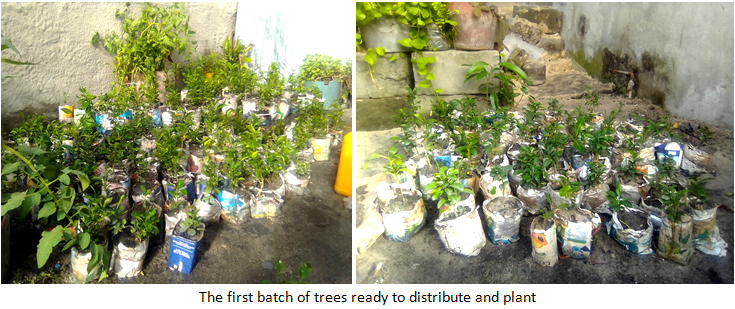
A tree planting project is just beginning, with a first batch of fifty five trees being planted costing a little over £1 each.  The local team would love to launch a programme of planting a million trees in Mozambique, in Beira and outside, and engaging pastors to encourage their members to plant trees.

The future

The Associacao Esperanca Aos Vulneravies members continue to identify people with needs, and since the registration of the project there are more people able to help in the work. 

In addition to continuing and growing the current work, we would like to provide toilets and drill wells for poorer communities.  Many living with HIV refuse to take medication, and so we would like to establish counselling support.

We have reached a state where the funding that we are providing needs to increase to keep pace with the project opportunities, and so we are asking people of goodwill to join us in sending funds to support projects which are making a real difference in the lives of fellow human beings in one of the poorest countries in the world.

If you wish to support the project, please contact us at 1john31718beira@gmail.com

Thank you.

Phil and Cathy Hemsley, and John McCoach.  Trustees, 1 John 3: 17-18 Beira

Our role in tackling climate change

Tackling climate change is not just the job of government.  We all have to do our bit. We all have to change our habits, particularly today when renewable energy is insufficient to meet demand and when demand is growing.

Demand is us.  Growth in demand is us.

Yes, government can offer grants and subsidies for insulation, for improved heating and for solar panels but we have to take up those offers.  And this is one area where the government can and should do more, with pubic information advertising.  We need a culture change.

We need to choose low energy foods, locally sources, less meat, less waste.

We need to think before we drive.  Every mile we drive causes global warming of ten square metres – is that an incentive to walk, or cycle, or take a train?

We need to think before we fly.  Do we really need to go half way round the planet on holiday?  Or to that meeting (I know one example of a business trip comprising a flight to Australia, a one hour meeting, a flight straight back.  And I was summoned to Brussels for a meeting but was bumped off the agenda).  Can we use the train instead, and make that part of the ‘adventure’?

Do we really need to wash our clothes so often, on such a high temperature? Do we really need to wash ourselves so often, on such a high temperature, for such long showers?

Do we really need to heat all of our houses for so long, to such a high temperature?

These are but a few examples.

There is so much that we can do without any detriment to our joy of life, but which will make such a difference.  But we need to accept low energy decisions as the ‘norm’.