A doctor has the resources to help those who are injured or unwell, to make them comfortable and to set them on the path to healing and recovery. Would it be wrong for a doctor to walk past a person injured and dying on the street and do nothing to help, even if the doctor didn’t know them or like them?
We know it would be wrong for a doctor to not do what they were able to help someone who is suffering severely or dying through sickness or injury. Yet doctors are only people like us so it must also be wrong too for us not to help someone who is dying through – for instance – malnutrition, or lack of clean water, or military oppression even if they are not on our doorstep. It would be wrong of us not to make room in our country for those who would die from war or persecution in their home country.
Let’s not shirk our responsibilities to our fellow human beings. Let’s remember that every single person is equally valuable and worthy of our love and care and do what we can to help and accommodate them. When we fall short of doing all we can, let’s recognise that that is our shortcoming. Let’s not justify our inaction by claiming that they are somehow inferior to us, and that we ‘don’t want them here’.
I have just about recovered from damaging my back twice in succession. Two lots of 6 weeks out of action and on constant painkillers has not been fun. These days one expects that the doctors will just be able to fix stuff, but the ‘treatment’ available was basically take painkillers and when it’s feeling well enough do some exercises to strengthen it.
So it was down to me, or at least my body to fix itself. Although I don’t think I had a slipped disc, with nothing much to do I spent some time on the internet to understand more about back problems and found that “The body’s defense mechanism can spontaneously retract, shrink, or eliminate disc herniation.” https://www.spine-health.com/blog/can-herniated-discs-heal-their-own
Just let that sink in for a moment.
If my car has a worn joint, there is no way that it can heal itself.
If a computer program has a fault there is no way it can heal itself.
There is nothing that I personally can do to cause my back to heal. It is ‘simply’ that my body has the ability to heal itself. And if you look at how our bodies heal themselves, and how our immune systems work you will be astounded by the complexity of the processes.
Now I don’t want to question the process of evolution, but it is beyond me (or I believe beyond anyone) to explain how a completely unguided or undesigned process would lead to a mechanism within the body to heal a slipped disc.
And even if that’s not a challenge enough, isn’t it astonishing that the fabric of the universe; the raw elements (Hydrogen, Carbon, Oxygen etc) can combine together to create a living organism that contains within it the power to heal itself of a slipped disc?
We take these things for granted every day and grumble when our bodies don’t function as ‘normal’. Isn’t it more appropriate to take a step back and let the wonder of what our bodies do do just sink in? And maybe to thank the creator of the universe for the amazing gift of our lives?
There is so much that we can see that is worrying, and that we can do nothing about. (As I write this Los Angeles is suffering intense wildfires, Trump is threatening to take over Greenland, the wars in Ukraine and Gaza are still taking lives, global temperatures continue to rise…) Yet if we didn’t look at our TVs, papers or phones we would know nothing of this – and surprisingly little is ‘in our face’ – we are not directly affected by most of the list above.
The secret is to realise that we are not God. These things are beyond our power to control, but we are not helpless or hopeless – we can play our part using the prayer that Jesus taught us:
“May Your kingdom come; may Your will be done on earth – as it is in heaven”
We might reflect that what is going on actually is God’s will; his permissive will. Throughout history greedy, power hungry bullies have oppressed ordinary people and we have ransacked the natural world. Jesus was fully aware of the brutal Roman regime, but he didn’t overthrow it. He healed people, focusing on the individuals around him – and we can do that too. We can pray the Lord’s prayer and leave the state of the world in his hands, but then get on with interacting with those around us according to his will. We don’t care less about the global situation, but we can worry less. And we can use our energy to influence our local communities instead.
After putting the world’s troubles in God’s hands, the Lord’s prayer allows us to ask for God’s heap meeting our own needs: give us our food for the day, forgive our sins (as we forgive), don’t let us yield to temptation, save us from evil. All of which do personally affect us day by day, and which will allow us to fulfil our daily purpose.
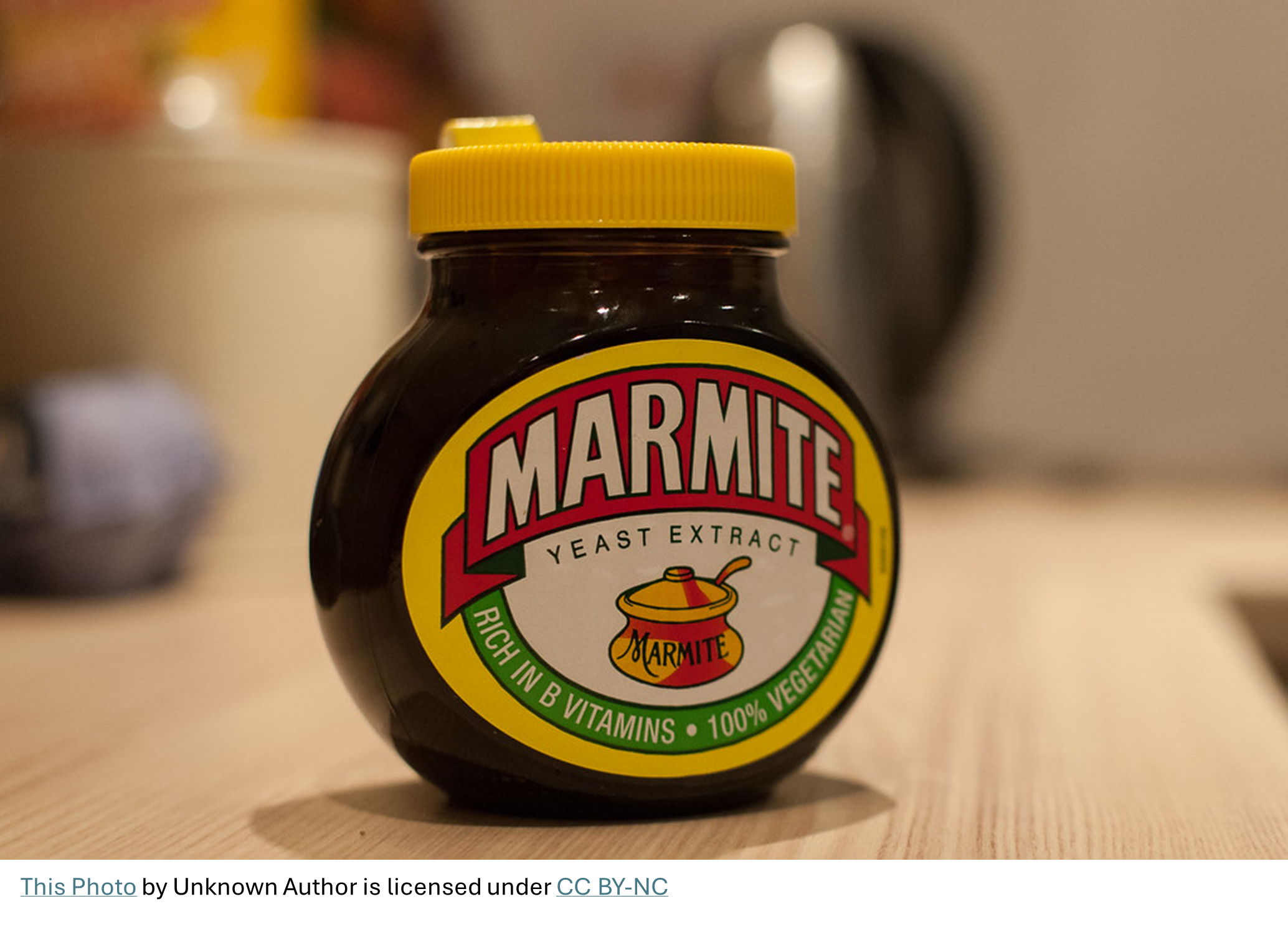
As decent human beings we accept that there are people who have different taste from ourselves. Society agrees that it would be wrong to hate someone because they liked (or disliked) Marmite for instance. We know that we should not shout abuse at them because of something that they have no control about. Much of what we are is a result of our genes which have been honed through the process of evolution to provide a successful species, and it is generally accepted that it is not appropriate to judge someone on that basis. Unfortunately, this is not a universal truth as we see for example when people consider other races to be ‘inferior’ – i.e. racist behaviour. But society has agreed that this is unacceptable, and laws are drawn up in an effort to eliminate it.
And yet we seem to think it’s acceptable to mock, at best feel angry with and at worst hate those who hold different values to ourselves; the ‘left’ hates and mocks the ‘right’, and vice versa. Just look at some of the memes that populate your social media stream.
I recently discovered that there is a strong genetic basis for our political leaning (left / right), and our ‘moral’ make-up. We cannot help our ‘gut reaction’ to different actions or situations; it is largely defined by our genes. And there are profound differences between the gut reaction of different people.
If we were to think about another person’s moral matrix in the same way that we think of someone who doesn’t like Marmite then might we start to treat them more considerately?
The book ‘The Righteous Mind’ by Jonathan Haidt describes how our gut reaction defines our response to a situation, and that we then use our reasoning to justify our gut reaction; rather than the other way round. It takes a conscious effort for our reasoning to ‘train’ or change our response. If we want to persuade someone else to our point of view, we have to earn their trust before explaining how things look to us. It doesn’t help just criticising their ‘genetic’ opinion.
And it’s also worth considering whether they might just have a point, and that there is a blind spot in our own thinking. Maybe, we can reach a compromise or consensus on the best approach to an issue, combining the different viewpoints to get a full picture of a situation. Maybe the diversity of points of view that evolved in successful societies and served us well for thousands of years might be worth resurrecting, rather than the present approach of division into ‘Marmite lovers’ and ‘Marmite haters’? Think about that when you are about to ‘repost’ the latest mocking meme…
When China introduced their strict lock-down I remember saying ‘That could never happen here’. And when people on social media were saying ‘we’ve got to lock-down immediately’ I didn’t think it should – imprisoning the elderly in their homes for 3 months for no offense!
When my father died of prostate cancer after several years of suffering and treatment, I was relieved. I was desperately sad and sat alone and cried to mourn the loss, but he was never going to be young and healthy again and his suffering was over.
Before my mother died I used to cry coming home from visiting her at the pointlessness of her days, she had no joy anymore and would sit on her bed looking out the window. She would often say that she was ready to die, but her body kept holding on. When she fell with a broken hip and was taken to hospital she signed a DNR. She didn’t want to eat and only did when pressed by the kindly nurses. When she died it was a relief but again desperately sad – but she was never going to be young and healthy again, and she had fulfilled her purpose.
The Covid inquiry is asking how many more lives could have been ‘saved’ by earlier lock-downs. Would my mother or father’s lives have been ‘saved’ by extending them further?
In “Screwtape Letters” – letters from one demon to another CS Lewis writes “They, of course, do tend to regard death as the prime evil and survival as the greatest good. But that is because we (the demons) have taught them to do so.” In his non-fictional writing Lewis points out that we have lost sight of the ‘true reality’ of God and the spiritual life. In our earthly, material world everyone dies; it is just a question of when.
In reality, it is not the length of our days but what we have striven to become on earth that matters – our character, or values, our loves. Of course the death of a loved one is sad, but let’s have less of this ‘saving lives’ when we simply mean ‘extending lives’ and let’s focus more on reality.
——————————————
““Reality, in fact, is usually something you could not have guessed. That is one of the reasons I believe Christianity. It is a religion you could not have guessed. If it offered us just the kind of universe we had always expected, I should feel we were making it up. But, in fact, it is not the sort of thing anyone would have made up. It has just that queer twist about it that real things have. So let us leave behind all these boys’ philosophies–these over simple answers. The problem is not simple and the answer is not going to be simple either.”” ― C.S. Lewis
Christian doctrine tells us that Jesus is God, that the Holy Spirit is God and that ‘the Father’ is God. And that Jesus is not the Father, who is not the Holy Spirit, who is not Jesus. And that there is only one God.
Doesn’t it defy common sense and logic? How might we think about this mystery?
Consider an analogy: what is War and Peace? It is a novel by Leo Tolstoy of course. And of course, we all know what a novel is. Or do we?
It is of course the book that you buy in a bookshop? But is it the paper and ink? No, it’s more than that. Is it the pattern made by the dark ink on the white paper? No, the same words can be written in different fonts? And what about different translations? And what if the book is read out loud?
Is it the precise set of words that Tolstoy wrote? – were early drafts not War and Peace?
Is it the precise story? – then what of screenplays, are they not War and Peace?
War and Peace is the book, it’s the film, it’s the spoken word, it’s all the translations. The book is not the film, which is not the spoken word. The Chinese translation is War and Peace, the English translation is War and Peace, but the English translation is not the Chinese translation – there is only one War and Peace.
Something which we think is simple is actually much more complex!
And so it is with God. We might think we know who or what God is, but most certainly we don’t. They are far more complex! But perhaps thinking about the analogy of War and Peace we will understand a little more.
And here’s a bonus question – did the story exist before Tolstoy wrote it? Would it cease to exist if humanity was wiped out and there was nobody to remember it? (Isn’t memory just another medium for recording the story anyway). If another civilisation emerged ten thousand years after humanity died out and were able to read the book, would War and Peace come into existence again? Or did it continue to exist throughout that period. Did the tale exist before it was written down, in the same way that 1 + 1 has always equalled 2 – even before there was intelligent life to discover it. Has War and Peace always existed? Does this help us understand how Jesus always existed, how ‘in the beginning was the word’?
There is a church which has assets of £8,700,000,000 at the start 2020, at the start of the pandemic. The nation struggled and many were in financial despair. What might Jesus have hoped that the church would do?
The church did not ‘hide their gold in the ground’, or put it in a deposit account earning perhaps 1% return. Instead it invested its assets and achieved a growth of 10.4% in the year. Would Jesus have been happy with that stewardship of the money?
The church spent some of the money that they received, but at the end of 2020 the assets of the church had grown by £500,000,000 to £9,200,000,000. Is God blessing that church with growth?
“You say, ‘I am rich; I have acquired wealth and do not need a thing.’ But you do not realize that you are wretched, pitiful, poor, blind and naked. I counsel you to buy from me gold refined in the fire, so you can become rich; and white clothes to wear, so you can cover your shameful nakedness; and salve to put on your eyes, so you can see.”
Over Christmas, a small church agreed to spend £1000 to make up food hampers for those on Free School Meals. As a result, fifty families were blessed. People were inspired to donate towards the cost of the parcels, which meant that it actually cost the church nothing. Was God rewarding their generous spirit?
I saw a Facebook post recently that made me think:
It is so easy to criticize those who have more money than us. But we could equally say:
There is a charity, set up by a Christian pastor, which buys and builds houses that are loaned to local churches to house and support vulnerable homeless people. So far they have housed 1226 people. They raise the money through people investing in their project rather than by donating money. They offer a 5% financial return on investment so that investors have the twin benefit of knowing that a homeless person is being housed and loved, and getting an above average return on investment. (https://www.greenpastures.net/) The charity is growing; does that make Jesus smile?
We may worry about money; it is natural. Everything today is described by its economic value, or the cost to do it; phrases and a culture used to justified austerity. In such an environment it is hard not to put a financial value on everything, and to be thrifty. Consider another quote that I came across said:
“The smart way to keep people passive and obedient is to strictly limit the spectrum of acceptable opinion, but allow very lively debate within that spectrum. That gives people the sense that there’s free thinking going on, while all the time the presuppositions of the system are being reinforced by the limits put on the range of the debate.” Noam Chomsky
That is today’s truth. Greed is now accepted as good in this country. People simply debate how much greed. But we don’t call it greed, we use phrases like ‘reserves’, ‘savings’, ‘retirement plan’ to avoid confronting whether we should be keeping our money to ourselves. Jesus said:
“Do not store up for yourselves treasures on earth, where moths and vermin destroy, and where thieves break in and steal. But store up for yourselves treasures in heaven, where moths and vermin do not destroy, and where thieves do not break in and steal. For where your treasure is, there your heart will be also.”
Dealing with money is not easy, but it is SO important. It must not become our treasure, but it is certainly a tool. It allows us to be a blessing to others in as little time as writing a cheque – and time is a stress for many. It blesses us to bless others, but if we agonise about the smallest financial decision then our worrying steals our time, our energy, and can lead to conflict! We need to train ourselves to be instinctively generous. We might reflect on these phrases of Jesus, remembering that he spoke them because he loves us; because they are good for us:
“Therefore I tell you, do not worry about your life, what you will eat or what you will drink, or about your body, what you will wear. Is not life more than food, and the body more than clothing?”
“Give to everyone who asks you, and if anyone takes what belongs to you, do not demand it back.”
“None of you can become my disciple if you do not give up all your possessions.”
And as St Paul wrote:
“Remember this: Whoever sows sparingly will also reap sparingly, and whoever sows generously will also reap generously. Each of you should give what you have decided in your heart to give, not reluctantly or under compulsion, for God loves a cheerful giver. And God is able to bless you abundantly, so that in all things at all times, having all that you need, you will abound in every good work.”
We live in an age of information. I know there is fake news, but there is a vast wealth of knowledge. You can find almost anything you need to know on-line. Yet just a few decades ago nobody could even conceive of the internet.
It didn’t happen spontaneously. We got here through the hard work and inspiration of highly intelligent designers and visionaries.
Imagine now a vast cloud of molecules in space, the debris perhaps of an exploded star. Just a collection of atoms and molecules: hydrogen, iron, oxygen, beryllium, carbon, nitrogen, silicone … a little bit of everything perhaps. But a vast, lifeless, formless cloud drifting in space.
Imagine that there are no influences acting on the cloud of molecules apart from the forces of physics; gravity, weak and strong nuclear interaction, and electromagnetic forces.
We can imagine that those inanimate forces are sufficient to cause the molecule cloud to collapse into a star and some planets. Over billions of years, gravity slowly pulls the gases together to form a solar system.
But can we imagine that those basic forces are sufficient to organise the lifeless cloud into a butterfly, a magnolia tree or a human being?
Can we imagine that those basic forces are sufficient to organise the matter that they act on into the internet? That the molecules organise themselves unaided into a smartphone, or the Mona Lisa, or a performance of Beethoven’s seventh symphony?
Take a molecule cloud, leave it completely alone for ten billion years, come back and you will find fitbits, contraceptive pills and life-forms intent on destroying themselves and each other.
Just through the laws of physics?
Intelligence creating itself, life with all its complexity spontaneously initiating and evolving.
Just through the laws of physics?
Love, joy, purpose existing without any material form that you can touch or measure. Great stories and legends; “The Lord of the Rings” expressed in a myriad of forms…
All of these, with the only ingredients of a molecule cloud and the laws of physics. Really?
Or is there something more?
Something which indwells all of space and time, sustaining matter and the forces that act on it, imbuing form on the formless, bestowing intelligence and ‘self’ on lifeforms, giving purpose to material and non-material reality. Intelligence that gives intelligence. Life that gives life? An eternal ‘something’, or ‘someone’ without cause but within everything?
If I put my pride aside, it seems to me that the universe, life, and love point to there being a supreme and eternal, creating, sustaining and loving God.
Can I really buy renewable electricity, or is the whole renewable tariff thing just a political stunt?
It is to an extent political, and it is to an extent how capitalism works.
Starting with how the grid and distribution system works:
Imagine instead of electrons, the grid is a big water reservoir (the power pool). It is essential that the amount of water in the reservoir stays constant. We are on the south side taking out water, so someone needs to put in water to cover what we take out. We used to just buy water from the ‘pool’, but today we have to buy from someone who is putting water into the reservoir. Say we agree with someone on the north side that they will put in what we use. It’s clear that we won’t actually take out the water molecules that they put in. In fact, if someone next to us is putting in water, we will probably actually take out their molecules. But one molecule is the same as another and so it doesn’t make any difference. The point is, we have made an agreement, outside of the reservoir, with someone who is putting water into it. So we might choose a ‘renewable water’ provider (e.g. a rainwater collector) to put water into it, and then we claim that we are using renewable water – it is as if we had a direct pipe from them to us.
But, if we didn’t make that agreement with the rainwater collector, he would still put his rainwater into the reservoir! So what’s the benefit of us making the agreement to buy electricity from him?
Well, he had to invest in his rainwater capture system, and he needs to know that he’s going to get his investment back. If he doesn’t have a specific agreement for the water he captures then he will only be able to sell his water at the price anyone will pay – which may be close to zero! So by choosing to buy ‘renewable water’ we would be allowing him to know that he can safely invest in his new plant and get his money back.
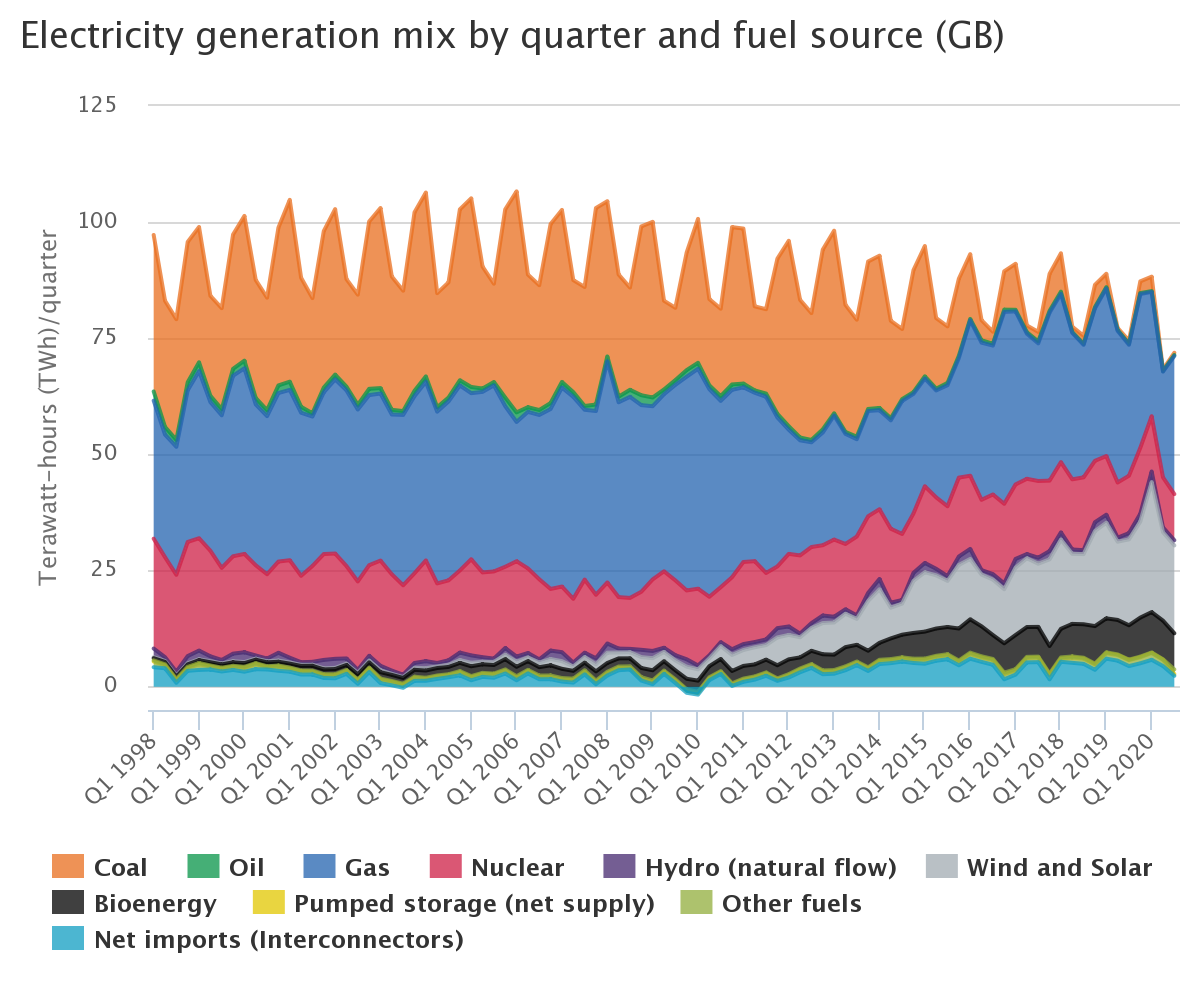
Buying from a renewable tariff is the mechanism whereby politics and capitalism invests in renewable energy. And it seems to be working! The proportion of wind and solar has grown dramatically, at the expense of coal.
So in practice, are we using renewable energy each time we switch on a light?
No, not at all. There would be a certain mix of generation producing the power that everyone else is using before we switch on our light. That would already include all the renewable sources, and ‘carbon free’ nuclear. Every extra kW that has to be generated would come from fossil fuel. i.e. every time we switch on a light, the marginal generation will be the highest carbon producer! Hence we should continue to minimise our usage, even on a renewable tariff.
And it will be the same if we have solar panels and generate our own electricity – every kW that we don’t use will prevent someone else having to use fossil fuel generated electricity so we should still minimise our use.
As the amount of renewables increases though, we may get to the stage where there is no fossil fuel generation at all. When we reach that point, we still need to balance the peaks and troughs of demand but with unpredictable renewable supply. For that reason people are developing ways of storing the overproduced electricity (like if we fit panels, we might fit a battery to save the electricity generated when the sun shines for when we need it). I recently did a bit of consultancy work for a company developing a compressed air energy storage project – a bit like pumped storage at Dinorwig but using compressed air pumped in to vast salt caverns underground.
Another way to store the excess electricity is to convert it through electrolysis into hydrogen gas. And gradually the expectation is that hydrogen will replace natural gas in the grid – hence some organisations who want to fit gas heating are buying ‘hydrogen ready’ equipment. But to my mind, that will be a long way off, and since hydrolysis process is only around 60% efficient, gas must be less energy efficient that direct use of renewable electricity.
Carbon offsetting is again a mechanism whereby politics and capitalism can lead to the right projects going ahead. The route is a bit indirect, and it can be an excuse to keep burning fossil fuels and so it should only be the last resort.
The first thing to realise is that we are all living in a computer generated world, and that we are living in the past. Nothing exists in the form that we perceive it, and by the time we perceive it, it has already happened.
That steaming cup of coffee that you see is just the result of your eyes, optic nerves and brain processing photons that hit the back of your retina. You are experiencing a brain (computer) generated model of what you now understand to be a cup of coffee.
Your brain’s processing inherently includes a delay to allow all of the bits of information to ‘catch up’. It takes longer for visual stimuli to be processed than it does for sounds. When you experience the crash of your cup on the floor your brain has had to delay presenting the event to your consciousness until the signals from both your ears and your eyes have arrived. Our reaction time is evidence of this, and the fact that we react faster to sounds than to lights. If you start a sprint race with a gun then the sprinters set off faster than if you start it with a flash of light – although the speed of sound is much slower than the speed of light.
So we do not experience the world as it is, but we experience a three dimensional model created within our brain.
As a child I used to wonder ‘does the colour green look the same to me as it does to you?’ Today I would answer almost certainly ‘no’. First of all, we know that some people are colour-blind, and so all colours must be perceived differently by them. And our eyes all have different sensitivities to shades of colours, and so the raw data that our brain has to process must be different between individuals.
But would we have the same ‘experience’ of the colour of our coffee cup if our brains received identical signals? That is a hard one, because we can’t really explain what it means to ‘experience’ a colour. (Google ‘qualia’ to find out more).
So although our bodies live in real time, we ‘experience’ a computer generated world that has already happened.
Weird.
But weirder perhaps is to ask what we mean by ‘we’. What is the ‘me’ that experiences this computer generated world? Warning – science cannot answer this, it’s the meat and drink of philosophy; the discussion of abstract ideas by bright people who build arguments on certain basic assumptions that they continually disagree about.
My subjective view is that there is a ‘me’ that experiences things. I interact with my brain (and hence body, and hence world) and can influence but not control what my brain and body does. I can influence what my consciousness presents to me (ignoring distractions when focused on a task for instance), and I can influence how my body responds to things – but I am not really in control. Just think of a tennis player returning a 140mph serve; there is no time for them to get directly involved in the process of selecting which direction to go, or what shot to play. They have to leave the action up to their body. But they can influence what their body’s reaction will be by training, by giving it a strategy such as “don’t try to hit a winner off every shot”, and then they need to get out of the way! Sportsmen know that consciousness gets in the way of winning; thinking too carefully about how to play a shot at best slows things down and at worst causes us to make a mess of it.
When we think about it we realise that ‘we’ have relatively little influence on what our minds and bodies do, and yet ‘we’ get to experience it all!
And yet ‘we’ are unexplainable. To try to understand the unexplainable ‘we’, and much to the chagrin of materialistic scientists, we use terms like ‘soul’ and ‘spirit’ to define ‘us’. And we believe that other people have souls and spirit too. And we spend a lot of time and money trying to find ways to interact with our brain/bodies that will lead to our soul’s wellbeing. So much advertising money is spent on encouraging us to buy products to bring us ‘peace of mind’ or other palliatives for the soul.
It is natural, and not at all illogical, to imagine that in the same way that you and I are tiny individual souls (that happen to inhabit a bunch of chemicals that we had nothing to do with initiating) there is an overarching bigger ‘soul’ who initiated the material universe of space and time (God). And if our individual soul ‘experiences’ interaction with this bigger soul then there is all the more reason to believe in its existence. But of course, this can be frustrating to those souls who have not had similar experience…
So yes, there is a place for God in today’s world. There is good intellectual reason to believe that there is a God, and this is reinforced by the experience and evidence of many witnesses who report interaction with and experience of God. These interactions have been documented for millennia and continue today. And there are many who feel that they have directly experienced such an ‘interaction’ yet believe that there is a larger ‘soul’, or God.
In response to concluding that there is a God and recognising that our very existence is a gift, it is also natural to want to give thanks for that gift and to want to make best use of the gift. Hence there is a place for religion too in today’s world.
How about you? If you haven’t recognised them yet – why not start seeking God for yourself?




 Thoughts from a Minimalist Christian