Covid Inquiry – lockdowns and saving lives.

When China introduced their strict lock-down I remember saying ‘That could never happen here’.  And when people on social media were saying ‘we’ve got to lock-down immediately’  I didn’t think it should – imprisoning the elderly in their homes for 3 months for no offense!

When my father died of prostate cancer after several years of suffering and treatment, I was relieved.  I was desperately sad and sat alone and cried to mourn the loss, but he was never going to be young and healthy again and his suffering was over.

Before my mother died I used to cry coming home from visiting her at the pointlessness of her days, she had no joy anymore and would sit on her bed looking out the window.  She would often say that she was ready to die, but her body kept holding on.  When she fell with a broken hip and was taken to hospital she signed a DNR.  She didn’t want to eat and only did when pressed by the kindly nurses.  When she died it was a relief but again desperately sad – but she was never going to be young and healthy again, and she had fulfilled her purpose.

The Covid inquiry is asking how many more lives could have been ‘saved’ by earlier lock-downs.   Would my mother or father’s lives have been ‘saved’ by extending them further?

In “Screwtape Letters” – letters from one demon to another CS Lewis writes “They, of course, do tend to regard death as the prime evil and survival as the greatest good. But that is because we (the demons) have taught them to do so.”  In his non-fictional writing Lewis points out that we have lost sight of the ‘true reality’ of God and the spiritual life.  In our earthly, material world everyone dies; it is just a question of when. 

In reality, it is not the length of our days but what we have striven to become on earth that matters – our character, or values, our loves.  Of course the death of a loved one is sad, but let’s have less of this ‘saving lives’ when we simply mean ‘extending lives’ and let’s focus more on reality.

——————————————

““Reality, in fact, is usually something you could not have guessed. That is one of the reasons I believe Christianity. It is a religion you could not have guessed. If it offered us just the kind of universe we had always expected, I should feel we were making it up. But, in fact, it is not the sort of thing anyone would have made up. It has just that queer twist about it that real things have. So let us leave behind all these boys’ philosophies–these over simple answers. The problem is not simple and the answer is not going to be simple either.”” ― C.S. Lewis
Plastic – part of the solution.

The primary environmental crisis today is the accelerating effect of CO2 emissions on climate change and global warming.  To address this issue we need to put less CO2 into the atmosphere and we need to capture more carbon.

Plastic has a high carbon content and takes hundreds of years to biodegrade (a process that needs oxygen).  That is why we don’t like it – little bits of plastic are getting everywhere and littering the world for hundreds of years to come.

There are vast empty caverns underground where we have in the past and continue to extract coal for fueling our power needs.

So surely part of our solution is to capture all our waste plastic, and put it underground – in the mines where we have extracted the coal.  Having taken carbon out, we put carbon back.

This is potentially more powerful than recycling plastic, simply because recycling leaves the carbon that would have been used to make new plastic available for power production and CO2 emission.

It is also potentially more powerful than eliminating plastics and replacing with fast degrading packaging, particularly if the replacement packaging takes more energy to produce, or allows more product waste.

Finding a new use for disused coal mines could revitalize regions devastated (in the UK) by Thatcher.

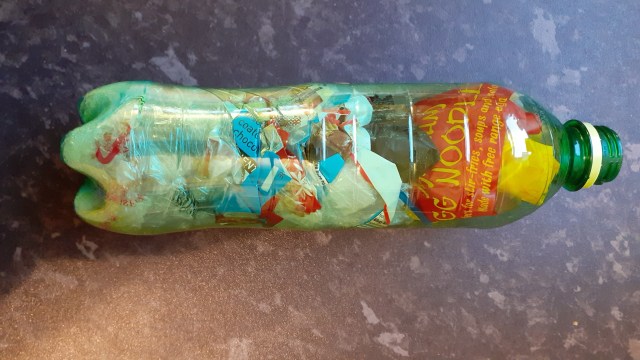
We could use plastic recycling networks to gather the plastic, but we would need to public to fully engage with capturing their plastic and not allowing it to litter.  A start would be to compressing all our plastic sheet waste in plastic bottles.

Amazon Rain-forest Fires – are we being hypocritical?

Pictures of the burning Amazon rain-forests are horrifying enough to bring despair.  Surely the world is doomed unless they stop!

Easy to say, isn’t it.  And I have found myself responding like that to the media attention.  But is that really the situation?   Is this just a smokescreen (no pun intended) to distract attention from deeper problems?  Let’s see if we can find the facts:

Carbon uptake in the Amazon is important.  The following article https://phys.org/news/2017-02-carbon-uptake-amazon-forests-region.html  points out that the carbon captured by the Amazon rainforests is equal to “four times the UK emissions for 2016”.  It is also equivalent to emissions in the region.  The nations of the Amazon are carbon neutral!

The  entire combined emissions from deforestation and fossil fuels  from the nations in the Amazon is only four times the emissions of the UK.   UK emissions are about 1% of global emissions. https://www.ucsusa.org/global-warming/science-and-impacts/science/each-countrys-share-of-co2.html .  China emissions account for 28% of global emissions.  The same site shows the emissions per person, with the top few being Saudi Arabia, USA, Australia and Canada at over 15 tonnes per person per year.  By contrast Brazil emits 2.17 tonnes per person.  France (with reference to comments from M Macron) emits twice that – and remember that France has a lot of nuclear power.

Clearly the countries of the Amazon are not the culprits in producing carbon emissions.  But consider why they are burning the forest.  They want to improve their standard of living, fulfilling a market ‘need’ for food.  And which capitalist country can argue with that?  Why do they want to improve their standard of living?  Because they are nowhere near the top. Brazil ranks 62 in the quality of life index. UK ranks 18th and USA 13th.  https://www.numbeo.com/quality-of-life/rankings_by_country.jsp

So the scale of the problem is small compared to the global emissions of the rest of the world, and the reason for the burning of the forests is to improve the standard of living of the population in the only way possible in the capitalist culture of the modern world.

And things have improved considerably in recent years.  Deforestation in the Amazon is roughly a third of what it was at the turn of the century: https://rainforests.mongabay.com/amazon/deforestation_calculations.html  and is ‘reasonably’ stable at around 80% of the 1970 levels.  This is not to say it is not important, but that perhaps most of the damage has been done.

If we in the west value the contribution that the rain-forests make to the world then we should pay for it.  We should not be sanctioning, or even threatening to invade (which I saw suggested on one site).  We pay for oil, which we then use to produce CO2 for our comfort, so we should pay those who capture our carbon.

In fact, there are mechanisms in place if we are willing to put our money where our concerns are, then we can each do something to reduce deforestation.  Here is one example: https://www.carbonfootprint.com/brazil_para_redd.html. Why not commit to offset all your personal emissions in this way? And before you ask, yes, I have – my emissions for the last 35 years.

Foreword to The Big Picture

Scientific discovery has brought material benefits and physical comfort to mankind.  The predictability of matter leads us to assume that it behaves according to fixed laws, and this belief has led engineers to develop tools and machinery to manipulate the environment, doctors to develop cures for many diseases, and farmers to grow crops with greatly increased yields.  Many of the scourges of previous times have been overcome leading, in the Western world at least, to longer lifetimes and better health.  However, this has also led to the belief that everything is predictable and controllable. If anything goes wrong (by which we mean it causes us distress or discomfort) then it must be fixable, and if it hasn’t been fixed it must be someone else’s fault.

Personal rights have grown, but personal responsibility has diminished.  Laws to protect the weak have bred the belief that it is the state’s job and not our individual duty to help out those less fortunate than ourselves.  Mechanisation that was supposed to give more leisure time has led to lost jobs and loss of purpose.  Competition and the shrinking of the geographical world has meant that there is someone, somewhere who will work harder or longer hours than we do, and the pressure grows to produce more for less.  The availability of loans means that goods can be obtained now if we promise to pay later.  To pay the loan we need a job.  Fear of job loss drives us to work longer hours and accept less pay. The purpose of life becomes to produce.  The mechanism which fuels demand and production is the economy.  The economy becomes the measure of the health of a nation.

Is that what it’s all about?

Is my value simply what I can produce?

Am I measured just by what I can earn?

If I retain the worldview that the economy is king then the implication is yes, but that doesn’t feel right.  I want to be valued and loved as a person.  I want a worldview that speaks to my heart and my mind and not just my wallet, and I want it to be based on sound thinking and evidence.

Science has brought great technological and medical benefits to mankind; cars, televisions, fridges, telephones, electricity and so on.  But science has also brought guns and bullets, pollution, global drug trafficking and job losses.  Science seems to dominate my life, telling me what I should or shouldn’t do to keep healthy, avoid risk and live longer, but it doesn’t tell me why I would want to live longer.  Science doesn’t give any purpose to my life.

Religion offers purpose, but it too seems to want to control me and dominate me.  Religion has been used as justification for many great atrocities: the Spanish Inquisition, child sacrifices, the Crusades.  Religious people seem to want to tell me how to behave, and to judge and criticise me, claiming to represent the will of God.

I want to know the truth.  I want to know what science can tell me about how the universe works, and perhaps where I came from.  I want the benefits that science can bring, but not at the cost of becoming a slave to its dictates.  I want to know why I am here, what my purpose in life is, or even if there is one.  If there is a God I want to know what He thinks. I want the benefit of knowing that I have a purpose, but not at the cost of becoming a slave to rules from another human being.

And so I investigate, weigh up evidence in all forms and seek a holistic worldview that works.  I have explored what we know from the physical and biological sciences, and I have researched historical evidence for God. I have tested what is actually known, and what is speculation, extrapolation or personal opinion and rhetoric.

This book presents my conclusions, and some of the evidence that brought me to draw them.  I offer what I believe is a consistent, healthy and constructive worldview based on sound evidence.  I’ve called it Minimalist Christianity.  Whether you agree with my conclusion or not, I hope that many of the myths that currently inhibit so many of us will have been weakened or dispelled.  I hope that a step can be taken towards finding purpose and experiencing life in abundance.

“A good robot is hard to find”

I came across this article, and it reminded me how amazing the animal world is, and in particular human beings.  It only took  250 million generations since the first fossil evidence of animals to evolve a human, and each one is built from a single fertilised egg.

http://www.computerworld.com/s/article/9249079/A_good_robot_is_hard_to_find_or_build?pageNumber=1


Direct from the San Francisco Book Review

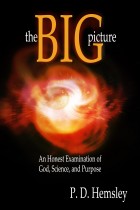
The Big Picture – An Honest Examination of God, Science and Purpose
By P D Hemsley
eLectio Publishing, $4.99, 266 pages, Format: eBook

A former atheist/agnostic who gave God a chance offers open-minded readers this work which is both ambitious in scope and credible in approach: //The Big Picture: An Honest Examination of God, Science, and Purpose//.  Polarizing subject matter such as God and science, evolution, and intelligent design are revisited with the goal of gently challenging entrenched thinking on both sides.

Hemsley, a Chartered Engineer, “has lived on both sides of the faith fence.” His book is comparable to a technical presentation designed for a general audience. It is highly organized with stated goals, evidence, and the author’s conclusions. Fluid, straightforward writing helps the reader progress through several chapters or conclusions dealing with faith, science, purpose and design, quantum physics, free will, reason, Jesus, and more. Even so, those with less of a scientific bent will need to exercise their concentration skills in the scientific sections.

The strength of this book lies in complexity and compatibility. The chapters “Science Describes an Incredible Universe” and “The Universe Exhibits Design and Purpose” make for fascinating reading, especially the subsection where “challenged by the complexity of the biological machinery” Hemsley explores how a modern-day designer would engineer a human being and how long it would take. Additionally, the author’s version of the Genesis creation account featuring the compatibility of scientific discoveries and God’s design is an interesting interpretation to consider.

No emotional appeals are made to the atheist, agnostic, hardcore creationist, or plain honest seeker for a change in his or her worldview. In the words of the author, a self-described Minimalist Christian: “Whether you agree with my conclusion or not, I hope that many of the myths that currently inhibit so many of us will have been weakened or dispelled. I hope that a step can be taken towards finding purpose and experiencing life in abundance.”

http://citybookreview.com/the-big-picture-an-honest-examination-of-god-science-and-purpose/

Click HERE to buy a copy.

Am I just a computer simulation?

Research suggests that human brain has more switches than the entire internet.  Each of the 125 trillion synapses that connect our 200 billion brain cells appears to have perhaps 1000 molecular scale switches. (ref 1)

Some areas of our brain take the input from our nerve cells and begin to process them.  They pass through other processing areas that start to interpret the signals; this sequence of signals from an eye might show us that an object is moving for instance.  Other areas deal with hearing or touch or smell.  Most of these areas carry out their functions without imposing on our consciousness.  At the top level, our brain presents a model of our environment to our conscious self.  The conclusion of this would seem to be that we are living within a computer simulation: generated by our brains based on input from the senses around our bodies interacting with our environment.  The question is, are we interacting with the computer simulation or are we the simulation itself?

Back in 2001 the Nick Bostrom speculated that scientific knowledge and computer power would at some time in the future increase sufficiently to build a simulation of the human brain in a computer (ref 2).  That computer would also be able to build a sufficiently complete model of the universe that an individual simulated human brain would not be able to distinguish it from the real thing.  The model would include not only one simulated person, but many, so that each ‘person’ had the true ‘experience’ of interacting with other ‘people’.

He reasoned that since the people who created this simulation would be likely to run a number of simulations (like our kids run lots of ‘Sims’ scenarios)  “Then it could be the case that the vast majority of minds like ours do not belong to the original race but rather to people simulated by the advanced descendants of an original race.”

There are inherent assumptions that Bostom builds on:  that our consciousness and ‘me-ness’ are simply emerging characteristics of the complex computer circuitry within our brain, and that science and technology will continue to advance until we understand and can model the brain operation.  The reasoned conclusion is that if these assumptions are correct then you and I are simulated beings in a computer simulation.

If that is the case, then we might conclude that it is of little consequence to switch off a particular simulation, in the same way that we are quite happy to switch off our computer.

But what if an alternative view is correct, that ‘we’ are not the simulation itself?  What if there is something about us that is more than an emergent property of a highly complex computer? What if there is a ‘me’ that transcends the ‘matter’ that makes up the computer in my head?  What happens then if the computer is switched off?  Do I cease to exist, or do I simply cease to interact with this particular computer?

The answer to that question lies beyond science and technology. We will have to look elsewhere for guidance.

———————————

References:

1) http://www.cnet.com/uk/news/human-brain-has-more-switches-than-all-computers-on-earth/

2) Are you living in a computer simulation? Philosophical Quarterly (2003) Vol. 53, No 211, pp.243-255. (First Version: 2001)) Nick Bostrom

———————————

For more on this topic and others see The Big Picture- an honest examination of God, Science and Purpose

———————————

A Masterpiece of Engineering

We think that we design pretty neat things these days.  We laugh at the man who said that the world would probably only need four or five computers.  Those of us who are old enough can remember when we did a sum on the newly invented pocket calculator that gave us the answer 0.7734, which said “hello” when we turned the calculator upside down.

But whilst researching my latest book I came across some pretty amazing statistics about a design that we all treat as commonplace – each and every human being.

Our 1.5kg brain comprises around 100 billion neurons, of 10,000 different types. Each neuron can have thousands of synapses (input connections from other neurons) and each synapse has perhaps a thousand molecular scale switches.  A single human brain is estimated to contain more switches than the entire internet.

Contained within our skin are around 650 muscles attached to over 200 bones, which vary in size from the femur in our thigh to the stirrup bone in the ear.  The muscle/bone combination is precise enough to paint a masterpiece, or to putt a golf ball twenty feet into a hole.

We have around 60,000 miles of veins and arteries and 1500 miles of pipes in our lungs.

Within our lymph nodes we have billions of B cells, each of which is different and each one defends against a particular very specific infection.

The list goes on – but you get the point.

Yet this whole complex organism is built from a single cell.

We begin as one single cell.  Within the cell is our DNA, the supposed blueprint for our manufacture.  We have a massive 3 billion base pairs (characters in the ‘code’) in our DNA. Yet there are around 50,000 billion different cells in the body.  Each cell is different, in function and in position – some nerve cells can be several feet long.  How can we imagine that there is enough information contained within our DNA to define our fully functioning body?

But we do start from just one cell.  And each cell only responds to the signals that cross the cell membrane.   As we develop, the cell is what it is as a result of its history – its ancestor cells.  And each of those cells only responded to the signals that crossed it’s membrane.  It’s like a massive pyramid, built the wrong way up – with the apex at the bottom.  The process is incredibly robust.  Look at identical twins.  Most of their development is as separate human beings and yet the final ‘product’ is identical.

A human being is truly a masterpiece of engineering.

Is it reasonable to state with certainty that this happened by chance?  Is it reasonable to assert that the properties of the sub-atomic particles in the universe are such that they behave in precisely the right way to manufacture you or I from a single cell by sheer luck? Or would that be a blind leap of faith?


See also:

https://philhemsley.wordpress.com/2013/03/03/information-dna-and-evolution/

https://philhemsley.wordpress.com/2012/09/17/the-dna-enigma/


Fear of science

There are millions of people spending their working life pushing forward scientific knowledge.  The breadth of knowledge discovered by the hands of so many scientists is beyond anyone’s comprehension.  Pronouncements by the scientific community have become almost the word of God.  Nobody has the evidence to question them. And yet…. sometimes they just don’t seem right.  They make us uneasy.  We fear that scientists have overstepped their knowledge, and often rightly so. We must not be afraid to voice our concerns, see for example https://philhemsley.wordpress.com/2013/11/22/mitochondrial-donation-some-concerns/

With so much knowledge out there, and so many people working on science, many in society have come to believe that science will eventually be able to answer every question.  “Eventually we will know everything about how the universe works. Science will allow us to live forever.  Technology will reverse global warming.  We will finally leave earth and colonise the solar system and universe.  Maybe we will even learn to travel through time itself, and finally we will be able to meet the maker of it all and ask why he made such a mess of things….”

Of course, many of these ideas come from science fiction, but literature influences our culture and outlook.  All of the ideas above seem reasonable extrapolations of where we have got to, and are often reinforced by the fantasizing of high profile scientists. http://www.dailymail.co.uk/sciencetech/article-1270531/Stephen-Hawking-backs-possibility-time-travel-millions-years-future.html

There is another group of people who have a different outlook. They believe that the literal explanation for everything that has happened, and prediction of everything that is going to happen in the future is written in a collection of books and manuscripts compiled from 2000-4000 years ago, called the Bible.  The first of these books describes how the world was created and populated with all the plants and animals as completely formed organisms. The whole process took just six days.  This literal interpretation of the book of Genesis will inevitably lead to a fear of science; “Will those millions of people prove my belief’s wrong?  Have I built my life on a lie?”

How can we overcome our fear of science?  How can we tame and control this beast, and stop it turning round and destroying us?

The only way to overcome our fears is to face them.  We need the courage to try to understand what science is and what it isn’t, what it can tell us and what it can’t.  We need to understand the assumptions behind all science.  We must not get lost in the detail, but we need to set the whole in context.  We need a guide.

Many of my posts on this blog are intended to help us think about scientific issues:

https://philhemsley.wordpress.com/2013/03/11/how-far-should-we-trust-scientific-prediction/

https://philhemsley.wordpress.com/2013/03/03/information-dna-and-evolution/

https://philhemsley.wordpress.com/2013/04/07/god-miracles-and-the-laws-of-physics/

and my book “The Big Picture” can equip the reader to begin to understand how to deal with science.  Reviewers seem to think it works:

https://www.goodreads.com/review/show/766354330

https://www.goodreads.com/review/show/767596412

There are other resources that help understand how we might deal with science, and I refer to many in the book.  But I hope that my years of spare time researching of these big questions will be of benefit to others, if only as a starting point for further discovery.

As I mentioned above,  if we are afraid of science, the best thing to do is to confront our fears.  And it’s best to confront them with a friendly guide.