Am I just a computer simulation?

Research suggests that human brain has more switches than the entire internet.  Each of the 125 trillion synapses that connect our 200 billion brain cells appears to have perhaps 1000 molecular scale switches. (ref 1)

Some areas of our brain take the input from our nerve cells and begin to process them.  They pass through other processing areas that start to interpret the signals; this sequence of signals from an eye might show us that an object is moving for instance.  Other areas deal with hearing or touch or smell.  Most of these areas carry out their functions without imposing on our consciousness.  At the top level, our brain presents a model of our environment to our conscious self.  The conclusion of this would seem to be that we are living within a computer simulation: generated by our brains based on input from the senses around our bodies interacting with our environment.  The question is, are we interacting with the computer simulation or are we the simulation itself?

Back in 2001 the Nick Bostrom speculated that scientific knowledge and computer power would at some time in the future increase sufficiently to build a simulation of the human brain in a computer (ref 2).  That computer would also be able to build a sufficiently complete model of the universe that an individual simulated human brain would not be able to distinguish it from the real thing.  The model would include not only one simulated person, but many, so that each ‘person’ had the true ‘experience’ of interacting with other ‘people’.

He reasoned that since the people who created this simulation would be likely to run a number of simulations (like our kids run lots of ‘Sims’ scenarios)  “Then it could be the case that the vast majority of minds like ours do not belong to the original race but rather to people simulated by the advanced descendants of an original race.”

There are inherent assumptions that Bostom builds on:  that our consciousness and ‘me-ness’ are simply emerging characteristics of the complex computer circuitry within our brain, and that science and technology will continue to advance until we understand and can model the brain operation.  The reasoned conclusion is that if these assumptions are correct then you and I are simulated beings in a computer simulation.

If that is the case, then we might conclude that it is of little consequence to switch off a particular simulation, in the same way that we are quite happy to switch off our computer.

But what if an alternative view is correct, that ‘we’ are not the simulation itself?  What if there is something about us that is more than an emergent property of a highly complex computer? What if there is a ‘me’ that transcends the ‘matter’ that makes up the computer in my head?  What happens then if the computer is switched off?  Do I cease to exist, or do I simply cease to interact with this particular computer?

The answer to that question lies beyond science and technology. We will have to look elsewhere for guidance.

———————————

References:

1) http://www.cnet.com/uk/news/human-brain-has-more-switches-than-all-computers-on-earth/

2) Are you living in a computer simulation? Philosophical Quarterly (2003) Vol. 53, No 211, pp.243-255. (First Version: 2001)) Nick Bostrom

———————————

For more on this topic and others see The Big Picture- an honest examination of God, Science and Purpose

———————————

Four steps of reason leading to a personal God

As I begin this post, I ask myself “Am I deciding what to write?”  You might think that a strange question with an obvious answer, but if I were to have a materialist view of things then I would struggle to answer with a ‘yes’.  At the heart of the problem is the question of whether I have free will or not.  Am I able to exert any choice on any decision (such as what to write) or is my action simply a result of the state of the molecules in my brain at the particular time when I think I am making a choice?

If there is nothing but matter, and matter behaves according to strict laws then there is no scope for me, or you, to make a free choice about anything.  Holders of the materialist view have argued that those who believe in free will need to demonstrate a mechanism before free will can be accepted to exist.

I do not subscribe to that view of things.  A bumblebee flies even if I am unable to demonstrate the mechanism.

Other disagreements with such a view are subjective.  Whilst I recognise that many of my actions might indeed be simply as a result of my brain state at a given time, I identify situations where I stop myself behaving according to ‘habit’ and consciously choose to behave differently.

From a practical viewpoint, our whole society is built on the basis that we have free will.  If I have no free will to be able to choose how to behave, then what right has society to imprison me for murder?  I would have had no choice but to kill my neighbour – it would have been an action that simply resulted from the chemical configuration in my brain at the time.

So for all practical and from all subjective points of view, I accept that we have free will.

That is step one; that we have free will.

The fact that I can call an opinion subjective inherently means that there is an “I” that is choosing to have an opinion.  Similarly, I speak about personal experience which requires there to be a person.  My personal subjective view is that there is indeed an “I” who is considering the facts and deciding what to write.  Descartes’ famous statement “I think therefore I am” argues that the only thing I know is that there is an “I” who thinks, and therefore “I” must exist – even if everything else is just my imagination.

So step two is that there is an “I” who exists.

The next thing to consider is how I exist (with the proviso that my physical being might be a delusion – but I still exist).   I exist because I have the ability to exist; something is causing me to exist.  I am not causing myself to exist, it is something apart from me that is ensuring that I exist.  Some might call that something ‘the laws of physics’, but I shall choose here to call that something God.

That is step three.  There is something that sustains me (and everything else) that can be called God.

The final step is to ask whether it is reasonable to imagine that this something (God) could sustain an “I”, who has free-will (which must operate outside the laws of physics) without itself having an “I-ness” to it.  Can the physical properties of a human being, which are sustained by God, ‘create’ an “I-ness” that God does not have itself?  Can “I-ness” be dependent on the sustaining power of God and yet above and separate from God?  And if not, then the power that sustains us must also have an “I-ness” about it.

Step four: the power that sustains us has itself the characteristics of “I-ness”: it is a person God.

“The Big Picture” – an honest examination of God, science and purpose – OUT NOW

“I recommend this book to all thinking people – we might just change the world.” 

“This book will definitely make you think and then think again. Hemsley did his research for this book, and I received many answers to questions I’ve pondered over the years.”

“it is a welcome relief to come across a book that presents such a broad and balanced overview”

“This book covers an considerable amount of territory in its 253 pages.”

The Big Picture is a much-needed book that allows the reader to consider the big questions of life without feeling bludgeoned to adopt the author’s opinion. The book explains basics of science, philosophy and religion in a straightforward manner.

It will encourage all those who want to live a good and purposeful life and would like a sound basis for doing so. Such readers may find a resonance with the teaching of Jesus and this book will explore whether we can trust what has been recorded in the gospel accounts, and whether the findings of science and a reasoned understanding of the Bible are consistent or contradictory.

Many books in the arena of science and faith are hostile and adversarial. The authors set up straw men of their opponent’s arguments, dismantle them and then preach their own arguments to their disciples. The author of The Big Picture recognises that there are intelligent atheists and intelligent believers, and that a case can always be made for whatever someone wants to believe. The reader is therefore treated with respect

ebook

paperback

Amazon UK

The Big Picture - cover

Proof of God?

A friend asked “Let us suppose it was absolutely certain there was no god but many people honestly believed there was – how different would the world look today?”

I could answer that if there was no God there would be no universe and no people to observe it.

Clearly, as we are both intelligent people we must be talking about something different when we say the word ‘god’.

The God that I conclude exists is a creator, and a God who sustains the universe.  Clearly the universe exists and continues to exist.  Ask a physicist why and he will probably say ‘because of the laws of physics’.  A rose is a rose by any other name, so at minimum my God is the laws of physics – we just choose to give it different names.

Perhaps my friend’s question is going beyond that definition of God.  Perhaps he is asking about a God who has ‘character’, a ‘me’-ness that I have.  (I know that I exist, there is an essence that is ‘me’).  What would things be like if there was not a God who had an essence of ‘me’?

It’s actually not easy to define what ‘I’ am.  Science of course shows that my brain has massively complex computational ability, but that doesn’t really help.  Literature and philosophy, and our daily experience tells me that there are things like love, joy, peace, thoughts, free will.  Let’s consider these as parts of ‘me’, and think – what if there were not a god who also had these characteristics.

But once again, the same sort of argument applies.  God is love, joy, peace.  Therefore without God there would be no love, joy or peace.  There would be no literature, there would be no mathematics, no equations, there would be not science.

Free will though is slightly different.  We know we have free will, and yet it is inexplicable by science.  It is inconsistent with the laws of physics.  Free will seems a bit of a paradox.  If God is the laws of physics, and free will is inconsistent with the laws of physics then how can that work?  A rational explanation is that free will is something that is a gift of God, that is not constrained by the laws of physics.  Therefore we begin to see what would be different in my friends question.  Without God we would have no free will, we would not be able to choose right from wrong, we would simply be robots who respond to stimuli.

But to explore the question further.  My last paragraph introduced right and wrong.  We know that there is right and wrong – even if we don’t always know what is right and what is wrong.  Right and wrong are different from free will, so let’s suppose that we were able to have free will but had no knowledge of right and wrong.  Clearly right and wrong exist.  Goodness and evil exist.  And yes, my definition of God includes ultimate goodness.  So without God we would have no constraint on what we do, we would simply live to serve ourselves.  The world would be governed simply by whoever was strongest.  We would be like most of the rest of the animal kingdom.  States like North Korea would be everywhere and left unchecked.  Anarchy would reign.  The world would be a very different place to live.

So have I proved God exists?  I think so (but I would) – simply because my definition of God includes everything that we know exists.  I define that it is not possible for anything to exist without God, and so anything which exists must be God.

My friend asked what if God didn’t exist but people believed that he did.  I hope that I have shown that such a question is not directly answerable, it is like the “can god make a thing so heavy that he cannot lift it” question, or “can God make something that doesn’t exist”.  But perhaps I’ve also been able to answer the questions behind the question.  Will it satisfy my friend?  I doubt it.  If any of us really doesn’t want to change our views then no amount of logical reasoning will make a difference.  But perhaps others will find the discussion interesting….

If you found this post interesting you might also like:

https://philhemsley.wordpress.com/2013/05/03/goodness-me/

https://philhemsley.wordpress.com/2012/12/29/the-god-of-science/

https://philhemsley.wordpress.com/2012/06/19/can-god-answer-prayer-in-a-universe-that-operates-according-to-the-laws-of-physics/

Brian Cox’s “Wonders of life – what is life?” .. a review

Yesterday evening I watched the first in a new Brian Cox series on the wonders of life.  I was left with an uncomfortable feeling about the way the content was presented. In essence, the program shows very little science but a lot of metaphysical opinion. In essence it it propaganda.  As best as I can, I’ve transcribed phrases from the program in blue (thanks to iPlayer), to show what I mean.

“no matter how unscientific it sounds this, this idea that there is some kind of soul or spirit or animating force that makes us what we are that exists after our death is common.…. it ‘feels right’, it is hard to accept that you are … just something that emerges from an inanimate bag of stuff”.  This is filmed against the backdrop of smoky fires and gravestones where people are gathering to ‘connect with their dead relatives’. 

This section clearly communicates that spirituality is a magical force that is outside of science and is necessary to explain life – ‘spirit of the gaps’ – but that such an idea is wrong.  Although we might not like it we are just a bag of stuff (no explanation, but trust me, I’m a professor celebrity).

So this has set up the straw-man god that is not part of the natural world, but is outside of it, tinkering occasionally to start life through magical means.  No mention of a God who created and sustains the laws of physics themselves.

Feelings, and indeed we are ‘just something that emerges’ i.e. they have no meaning or purpose.  This is a metaphysical view that is essential if the idea of a purposeful God who set the universe in motion is abhorrent – yet the filming and presentation are designed to manipulate those same feelings.  This is not science, it is carefully crafted propaganda.

“if we are to say that science can explain everything about us then it is incumbent on science to answer the question what is it that animates living things what is it the difference between a piece of rock carved into a gravestone and me? …. For millennia, some form of spirituality has been evoked to explain what it means to be alive and how life began.  It is only recently that science has begun to answer these deepest of questions”  ,

Although the words don’t strictly say it, the message is clearly that science can explain life; no other explanation is necessary.  Again, the alternative is some magical force outside nature. The false dichotomy presented again (science OR spirituality) allows no space for a god who is consistent with scientific discovery, where scientific discovery allows us to learn more about God.  So science is getting busy and is providing the answers, which are:

  • Energy transforms from one form to another, and that caused and explains life – that is the reason we are here.  All life continues to be powered by the same process of transforming energy from one form to another.
  • We all have DNA, which is the “blueprint for life” and continues the organisation of the chemical processes from generation to generation, and shows that we have common ancestry with every other living things

“life is … a collection of chemical processes that harness flow of energy to create local islands of order…. Far from being some chance event ignited by some mystical spark the emergence of life on earth might have been the inevitable consequence of the laws of physics …. A living cosmos might be the only way our cosmos can be”

Mystical spark or science – the false dichotomy perpetuated.

The program focuses on a god of mysticism and magic, and appears not to know of the Christian God.

The God of Christianity is believed to be the creator of the universe, the cause of the Big Bang, the author of the laws of physics, the inventor and sustainer of a cosmos that has the inevitable consequence of producing life.  A God who cannot be seen – yet can be seen everywhere.  A God whose power has gifted us with the ability to feel and understand, and who gives meaning to each of us.  A God who is love; the love we feel is part of God rather than ‘just some emerging thing’.

It is frustrating when scientific programmes such as these don’t present a balanced view of the metaphysics.

Other posts which might be of interest:

https://philhemsley.wordpress.com/2013/04/07/god-miracles-and-the-laws-of-physics/

https://philhemsley.wordpress.com/2012/12/29/the-god-of-science/

https://philhemsley.wordpress.com/2013/04/14/proof-of-god/

https://philhemsley.wordpress.com/2012/06/21/an-argument-for-and-definition-of-god/


The God of Science

Neuroscientist Michael Graziano has speculated on the connection between the material and the spirit world.  His book “God Soul Mind Brain” has the stated aim to describe ‘the mechanistic understanding of the spirit world’.  With is background he makes the assumption that ‘mechanism’ is the reality and perception is the illusion.

“we do not perceive the world as it is, the brain constructs a simulated world”

“colour is not actually out there…. The same set of wavelengths may look green to you in a different context or grey or blue”

“We experience the model rather than the reality”

The statements are fascinating reminders of what the brain does: it constructs a simulated world, it provides the stimulus to allow the experience of colours, it somehow appears to create a model in our brains.

However, it is a false assumption that the mechanism is the reality and the perception is the illusion.   Accepting the assumption is like saying that the material pages of a book and the printed ink are the reality, and the story that the book tells or the information that it contains is not the reality.  Whist nobody would disagree that the book is the material and the story is not, which of them is the reality?

In a book, we read the words rather than perceiving the paper and letters and we construct in our imagination a picture and an experience based on the words and story within the book.  In the only scale of importance that matters to a human being, the book is the words, not the paper and ink.  War and Peace is a famous story, the paper that it was written on was just the framework for holding it. The story is eternal although the paper decays. To a human being, the story is the reality.

Consider a work of art; the material is not the masterpiece, it is merely a framework which holds the masterpiece.  The canvas and paint is meaningless, the picture is the meaning.

If we can free ourselves of the dogma of materialism then we can perhaps begin to consider that in the universe created from nothing, where particles are only potentialities until they are observed the reality is the experience, the qualia, the ‘I’, and that the material is just the skeleton for holding the reality.

The material universe is meaningless until it is perceived, the perception of it gives it meaning.

The butterfly nebula is beautiful when it is observed; without observation it is meaningless.

Two bags of chemicals are meaningless, but the intimate relationship between two people who are in love has immense meaning and purpose.

Is this so strange?  When we look at the quantum level of the material, there is no such thing as paper or ink.  There are particles and forces that we cannot understand.  They are outside of our ability to perceive, so we think of them as miniature versions of ping pong balls and sticks.  They are only potentialities until they are observed.  What we consider material reality is not really real, it performs its function only when it is perceived and observed.  So perhaps what we perceive as real day to day, the material world, is similarly non-material. Perhaps the only reality is our perception, our model.

So what of God in this?  Jesus spoke of God living in us and us in him.  Perhaps our material framework that holds us is part of God.  As Anselm wrote, everything is what it is through extreme goodness, through God, so we are what we are through and within God.  We are told that God is love, and that we are made in his image.  Jesus said that ‘if you have seen me, you have seen the father’; I don’t think he was talking about his flesh, but his ‘being’ – his ‘spirit’.  Our framework (our body and brain) is a small part of a material universe that is created and sustained by God.  If that universe is within God, part of God, then we too are ‘in him’, as he is ‘in us’.

And what of laws of physics, of evolution and biology?  We can create mathematical models of inanimate physical objects, and we can observe the behaviour of molecules and cells which seems to be beyond the possibility of simply responding to those physical laws – yet seems to be consistent, predictable, and purposeful. Within the framework where the universe is within and part of God there may be causes other than the laws of physics for the astonishing growth and development of the human being from the single cell; a God whose will ‘knits us together in our mother’s womb’. In the same way that our ‘will’ causes our hands to move, makes our choices, interacts with others, so God’s will can cause our bodies to grow and develop, to form our brain, to manufacture us as the masterpiece we are, our body being the receptacle for our spirit.

It is the non-material that motivates us, the non-material that leads to change, the non-material that makes our world like it is rather than a desolate moonscape.  The non-material is master over matter.  The non-material is the meaning, the meaning is the reality.

Who would disagree that there is a ‘spirit of Christmas’, all of society embracing a season of joy and giving.  People speak of the true spirit of Christmas; we know that there is something that transcends each of us as individuals.  It is part of the sprit that is God.

When we observe a beautiful woodland track, sunlight shining through the leaves to create a dappled light settling on a trickling stream, that beauty is part of the essence that is God.

When we listen to a sublime piece of music that moves us to tears, or an energising rock ballad that lifts our hearts with passion, that is part of God.

When we love someone, our love is part of the supreme love that is God.

When we meet friends in a party, in a community, that spirit of community is part of God’s spirit of community.

If we can appreciate that the greater reality is the spirit, and the material is just the framework then we can see God and the universe in a whole new light.  The universe can be considered the canvas for a cosmic work of art, a magnificent symphony of action and awe.  Life is a molecular dance of astonishing intricacy and beauty.  We are permitted to explore and understand through science.  We are permitted to glimpse the canvas and participate in the dance; characters created by the dance emerging as individual caring, loving, interacting beings partaking of some of the glory that is the story; individual masterpieces beyond the beautiful, whose reality is our character, our choices, our nature, our soul.  Creatures of purpose and with purpose.  Creatures honoured with the possibility of relating to our creator, the master artist, engineer, scientist, musician, teacher, parent, friend, but never are we his equal.

So this is the God of Science:  A God who was there before the universe began.  An un-created, creator God who gave ‘nothing’ the ability to become ‘something’.  A God who sustains, and maybe actually is, the very fabric of the universe. A God who actually is the laws of physics, who benevolently guides providence to bring life out of a set of chemicals.   A God who imbues the chemical dance that is us with the ability to feel, to taste, to see, to experience: love, joy, peace, fulfilment, intellectual challenge, selflessness, forgiveness, anger, hate, disgust, bitterness.  Perhaps even a God who is love, joy, peace, fulfilment…. But a God who allows us to experience both the good and the bad, and who allows us to choose to pursue that which is good, or that which is not.

Add to this the God revealed to us by Jesus Christ and we begin to understand the complete context.
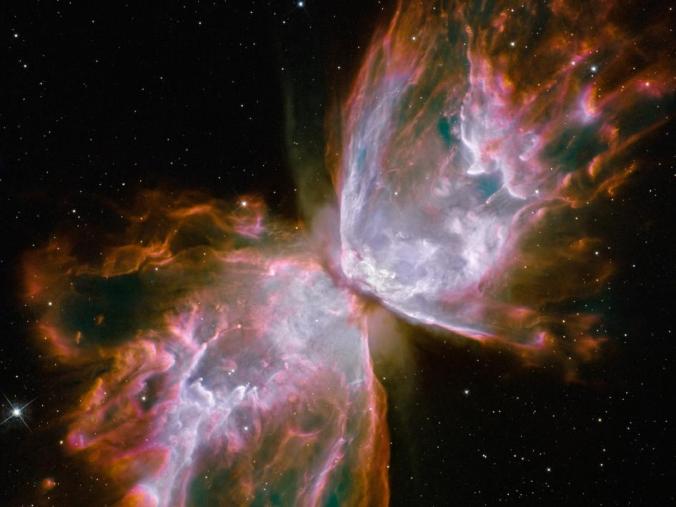
butterfly nebula

Questions raised by the Neon Roberts case

According to the BBC news the judge in the Neon Roberts said doctors accepted that radiotherapy had side effects: it could slightly impair intellect and carried some risks of causing infertility but most children coped well – and there would be no quality of life at all if you were dead.  At first this sounds very logical, but it seems to me that it reflects a very irrational view of life and death that has perhaps come to be accepted without thinking.

It assumes that there is no life after death, that the value of life is only the short period of life on earth, and it assumes that the only value in life is the quality of life of the individual.

This is a self-centred worldview, a Darwinian view that each individual is only important to himself and consequences for others are secondary.  The essence of humanity is lost.  All of Christ’s teaching about loving one’s neighbour is ignored.

If there is no life after death (the secular view) then a dead person no longer exists and it does not matter to them whether they are alive or dead.  Almost all religions view our spiritual being as continuing to exist after physical death.  If that is the case, then the quality of spiritual life continues after death, and again we should not fear death.

In each case, the impact of death is on those who remain behind; on those who miss the person who had died.  That is indeed a serious impact, but I wonder if it is something that institutions such as courts are best placed to decide on – they are not the ones left to pick up the pieces.

What’s it all mean?

I unashamedly quote the following that was written perhaps 3000 years ago.  If you’re having a stressful time, perhaps at work, this puts it into perspective:

“Everything is meaningless,” says the Teacher, “completely meaningless!”

What do people get for all their hard work under the sun? Generations come and generations go, but the earth never changes.  The sun rises and the sun sets, then hurries around to rise again.  The wind blows south, and then turns north. Around and around it goes, blowing in circles.  Rivers run into the sea, but the sea is never full. Then the water returns again to the rivers and flows out again to the sea.  Everything is wearisome beyond description. No matter how much we see, we are never satisfied. No matter how much we hear, we are not content.

 History merely repeats itself. It has all been done before. Nothing under the sun is truly new.  Sometimes people say, “Here is something new!” But actually it is old; nothing is ever truly new. We don’t remember what happened in the past, and in future generations, no one will remember what we are doing now.…….

So I decided there is nothing better than to enjoy food and drink and to find satisfaction in work. Then I realized that these pleasures are from the hand of God……

.... remember your Creator now while you are young, before the silver cord of life snaps and the golden bowl is broken. Don’t wait until the water jar is smashed at the spring and the pulley is broken at the well.  For then the dust will return to the earth, and the spirit will return to God who gave it.

…taken from the Holy Bible, New Living Translation, copyright © 1996, 2004. Used by permission of Tyndale House Publishers, Inc., Carol Stream, Illinois 60188. All rights reserved.

What do we do with our money?

Through no virtue of my own, I was born with skills that have allowed me to find a good job, and to manage my money. Before I was a Christian I thought that this was just good luck, and that I didn’t have to thank anyone for this. I could do with my money what I pleased (of course, in consultation with my wife!).

We have always had a joint bank account, but when she became a Christian many years before me, she suggested that we each have an additional private account which we can use completely as we please. I was happy with this, as I could then ‘treat’ myself without feeling guilty, and also it seemed to make the act of giving each other presents a bit more meaningful, and it allowed her to give money to charity without having to ask my permission.

I used to think myself reasonably charitable. I’d give to people in the street, and I gave a little to Macmillan nurses after my father died of cancer. I was probably like most of the rest of the country, quite happily giving less than 1% of my income away. And following worldly advice I set some financial targets for my life – I decided to have saved £100,000 by retirement age. (I have to admit I struggled to know what I was going to do with it, but it is something that you have to do, isn’t it).

On the road to becoming a Christian I read ‘challenging lifestyles’ by Nicky Gumbell. I decided that it was OK to give more away. I didn’t have to keep it all for myself for the future, and so I made a standing order from my bank to a Charity Card account, of a relatively small proportion of my income. Perhaps the surprising rate at which the amount I had in the account built up showed how little I was really giving away. But having that account meant that I had to give it away – and I found that really quite rewarding. “Now, who can I give this to” is quite a nice feeling. And I didn’t feel any poorer!

But when I first visited Mozambique I learned so much more!  It was so liberating to see how much closer people come to God when they have no money.  And if you put a Mozambican and an Englishman next to each other and dressed them the same, how would you know who was the richer?

But I also saw again the massive amount of good work that is not happening because of lack of money.  I wept when Pastor Caetano described how he had started the orphanage at the House of the Sparrow with all he had – how they don’t know each day where food is coming from, but God always provides.  Forty-seven children, being cared for and loved by a Christian pastor with nothing but what God provides.  I learned that God really cares what we do with our money.

If someone asks us to give to charity the first thought is, “Can we afford it?”  Of course we can – we still have so much more than the children in Mozambique.  Can we afford not to?  No, not unless we want to harden our hearts.

Do not store up riches for yourselves here on earth, where moths and rust destroy, and robbers break in and steal.  Instead, store up riches for yourselves in heaven, where moths and rust cannot destroy, and robbers cannot break in and steal. For your heart will always be where your riches are. (Matthew 6:19-21)

My experience is that my giving to charity has increased twenty-fold or more since choosing to follow Christ, and my financial savings goals have disappeared.  Where is the logic in saving for something that might be needed in the future when you can see something that is needed today?