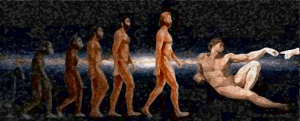
The hand of God

A few years ago I decided to dig deeper into the apparent conflict between science and religion.

Many people have the view that science can in theory explain everything, that even if we don’t know the answers yet then it is just a matter of time before we find them.  This view of Science has turned it into a faith.

I admit that I wondered if advances in science since I studied it might actually bring more powerful arguments than I was aware of. But I also wondered whether the extreme unlikeliness of life might be sufficient to prove that there must be a God and so I spent several years reviewing what science has discovered and assessing how that fits with Christianity. 

The first thing to say is that there are clearly things written in the Bible that are not to be taken literally.  And it causes problems when people do. When people hear both Christians and atheists claim that Christians believe that Genesis is the literal truth then they are unlikely to look any further.  It is that which put me off even considering God until I was forty, and so I feel that Creationists do God a disservice.

Putting Creationism aside, I have not found any serious conflict between science and faith.

I have found that when you try to calculate numbers, you find that the chances of us being here are extremely small – but we are here.  The chance of me winning the lottery if I buy one ticket is extremely small, but every week someone wins. If you try often enough then extremely unlikely events will happen. 

But how can I say that there isn’t any serious conflict between science and faith?  Isn’t there a conflict between science and miracles?  Hasn’t science shown that they are impossible?

To answer that we need to think about what we actually mean by science. It’s a term that is in such common use that we often don’t think about what it really is. A few years ago the Science Council realised that they didn’t have a definition of science, and so they came up with one.

“Science is the pursuit of knowledge and understanding of the natural and social world following a systematic methodology based on evidence.”

Let’s break that down a little:

“the pursuit of knowledge and understanding” – I’m sure we are happy with that, although it doesn’t say ALL knowledge and understanding.

“of the natural and social world” – that’s good, it defines the scope where it applies.  Science has nothing to do with what is not the natural and social world.

“following a systematic methodology based on evidence” We can expand on that a little.  The methodology includes steps of

  1. Observation of a phenomenon and experiment to find out what happens
  2. Trying to think of what the rules are that describe the phenomenon – the rules should be consistent with the accepted laws of science.
  3. Establishing new experiments or observations to test the theory
  4. Repeat the experiments
  5. Analyse and review the results, and publish.

Critical to this is repetition.  Science assumes that the “natural and social world” behaves in a manner that is repeatable.

Richard Feynman, a famous physicist was giving a talk about what is known as the ‘two slit experiment’ – you shoot electrons at a barrier which has two slits in it, and a screen behind it, and you observe where each electron hits the screen. He comments that

“A philosopher once said that: ‘It is necessary for the very existence of science that the same conditions always produce the same results’. Well, they do not. You set up the circumstances, with the same conditions every time, and you cannot predict behind which hole you will see the electron.”

Through repetition, science has discovered that if you look at enough numbers of electrons then a predictable pattern emerges.  However,  the behaviour of an individual electron cannot be predicted.

And what is a miracle?  The Cambridge Dictionary definition of a miracle is:

“An unusual and mysterious event that is thought to have been caused by a god because it does not follow the usual laws of nature

By definition, science and miracles are mutually exclusive.

  • Science defines the usual laws of nature
  • Miracles don’t follow the usual laws of nature

But this does NOT mean that science tells us that miracles cannot happen.

It’s like putting everything that behaves in a predictable manner into a box and calling that science.  I can learn all about what goes on inside the box.  But none of my knowledge about what goes on inside the box can tell me anything about what is outside the box.  

I might assume that nothing exists outside the box, but science can give me no evidence of whether my assumption is true.  Belief in that assumption is called materialism. The faith of materialism asserts that there cannot be miracles, but science itself can say nothing about whether miracles can happen. 

But what if there is evidence that the universe doesn’t always behave according to fixed materialistic laws? Does that disprove materialism?

What if I know that there are things outside the box?

It seems to us that we are able to make choices.  We can decide who to vote for in elections.  We can decide whether to come to a breakfast talk.  We can decide whether or not to kill our next door neighbour. 

It’s called free will.  We experience our free will every day.

But if the universe operates according to fixed laws of nature, where is there scope for free will? 

There are some who believe so completely in Materialsm that they think free will is an illusion.  Here’s an example from an on line discussion forum:

“. . . given our understanding of determinism and un-determinism there is nothing left that explains exactly what free will could be, in the traditional sense. It’s more a case of a challenge to those that assume free will to explain its mechanism.”

In other words, Materialists believe that free will cannot exist in a universe which operates according to fixed laws.  So if you or I believe that we have free will, then that is a strong hint that materialism is wrong – that there are things outside of our box. 

There is another definition of miracle in the Cambridge dictionary:

“a very lucky event that is surprising and unexpected”

Even within the laws of physics it is possible for miracles to happen. 

There is an account in the Bible of when Jesus told one of his followers to go and catch a fish, and that in the mouth of the fish he would find a gold coin, and then he was to use that coin to pay their tax.  That is such an extremely unlikely event that it becomes a miracle, but a miracle operating within the “laws of physics”.

I said earlier that I’d wondered whether the extreme unlikeliness of life might be sufficient to prove that there must be a God.  Whilst the origin of life may follow the laws of physics, is it so unlikely that it is classed as a miracle? Let’s explore that a little and try to get a feel for some numbers. 

It is difficult to define what life is, but one element that we are all aware of is the ability to reproduce, or replicate.

All life as we know it – plants and animals – contain long chain molecules.  Proteins are building blocks for much of the body, and DNA acts as a template for organising amino acids into the correct order to make proteins and to replicate itself.

DNA is made up of four nucleotides, called ‘bases’.  These are held in place on a sugar/phosphate backbone.  The order of the bases defines the order of amino acids that are assembled by machinery in the cell in order to form a protein.  The machinery in the cell includes other long chain molecules that are essential for the replication process.

Although human DNA has around 3 billion bases, scientists have estimated that the minimum length of a long chain molecule that would be able to replicate is around 40 bases.  Like DNA, those 40 bases would need to be in a precise order to be able to replicate.

The question is, where did this first long chain molecule come from?  It was not built by the mechanism in the cell, because there was no mechanism. 

Perhaps it might have self assembled by chance if we had a pot of molecules bubbling in a primordial soup.

Now, the number of different possible sequences of a chain of forty molecules of four different types is massive, and the chance of any particular one forming at random is on in a septillion!  That’s 1024  –  a million billion billion.

And if you needed two specific molecules to ensure replication then it would be the same as searching for a single molecule in the whole mass of the earth.

No wonder Richard Dawkins has said that

“Self-replicating molecules that made copies of themselves came into existence by sheer luck….. Nobody knows how it happened.”

We can agree I think that the origin of life is “a very lucky event that is surprising and unexpected” …. i.e. a miracle. 

Another extremely unlikely occurrence is the fine tuning of the universe.

We use equations to represent the laws of physics as we know them. The equations usually include a number of constants.   Some constants can be derived mathematically, such as the ratio of the circumference of a circle to the diameter which is known as Pi.

Other constants don’t appear to have their value for any particular reason – as far as I’m aware there is no particular reason why the speed of light is what it is.   These constants are only obtained by careful measurement.

Scientists can calculate what might have happened if the constants had been different. These calculations show us that the constants in this universe seem to be incredibly fine-tuned. 

John Lennox quotes that “If the ratio of the strong nuclear force to the electromagnetic force had been different by one part in 1016, no stars could have formed. If the ratio of electromagnetic force-constant to the gravitational force-constant was increased by only 1 part in 1040 then only small stars would exist; decrease it by the same amount and there will only be large stars. You must have both large and small stars in the universe; the large ones produce elements in their thermonuclear furnaces and it is only the small ones that burn long enough to sustain a planet with life. That is the kind of accuracy a marksman would need to hit a coin on the far side of the observable universe, twenty billion light years away.

Many thinkers and Christian scientists pursue the idea that these levels of extreme improbability must ‘prove’ that the laws of nature are insufficient, and that ‘The hand of God’ is required at critical points in the history of the universe to explain where we are today. I find the idea attractive, but it is not unquestionable proof as there is always the counter argument that with enough attempts unlikely things happen. 

And for me, trying to find God in the unlikely concedes too much.  It is a false way of thinking that seems to accept that if we can explain something scientifically then we don’t need God – so we have to look for things that we can’t explain scientifically and voila: God. This is called ‘God of the Gaps’, and constrains God to those things that we can’t explain – the gaps. 

But it is actually applying the faith of the Materialist to God.  “I’m going to claim everything that is explainable as my materialist faith, and just leave you with the gaps to explain by God” 

It implies that:

  • God is confined to the gaps
  • God only ‘appears’ intermittently
  • God only does miracles

That is a misunderstanding of God.

What if we apply this sort of ‘improbability thinking’ to the development of a human being from a single cell?

DNA is often called the blueprint of the body, and is the template to build all the protein molecules in the body. Human DNA has just under 3 billion bases.  There are around 3.5million letters in the Bible, so it would need around 800 books the size of the Bible to write out human DNA. That sounds a big number (although our DNA only a tenth of the size of that of an amoeba), but let’s look at what the DNA has to do.

An adult has fifty trillion human cells.  That’s 17000 cells for each DNA base. And scientists have said that 97% of our DNA is actually ‘junk’ … not used for producing proteins. If that is right, then there are over half a million cells for each non-junk DNA base.

Our fifty trillion cells are organised into systems:

  • Circulatory system
  • Skeletal system
  • Immune system
  • Muscular system
  • Hearing
  • Sight
  • Nervous system
  • Brain
  • ….

Those systems change with time.  Components are built at different times in the development process.  Cells have to die off to make way for other cells.  We have to stop growing at some point.  We are programmed to die.

And our “short” string of DNA is supposed to define all of this. The orchestrated operation of the fifty trillion cells for over seventy years is not something that is learned as the body grows. And the coding of these systems was contained in the DNA of one single fertilised cell.

Using a ‘probability’ type of thinking, we might deduce that it is impossible for a human to grow from a single fertilised cell without the hand of God.

And yet we see it happen every day, 350,000  new babies born a day around the world. This miracle has being repeated by the hand of God billions of times, just in humans. The hand of God is very busy!

Now actually, this is a better understanding of God.  This is not a ‘God of the gaps’ but a ‘God of everything’. This is a God who sustains the operation of matter in a consistent manner that we can predict through the scientific method.  This is a God who provides the raw materials for science to study.

This is a God of whom the psalmist wrote:  “For you created my inmost being; you knit me together in my mother’s womb.”

The behaviour of matter, as modelled by the laws of physics can be understood to be the hand of God. We no longer search for a God who lives outside the universe and occasionally pops in to correct it when it goes wrong, but we have a God who is intimately involved in the universe, sustaining not only the laws of physics but also our very being. Everything that science discovers is simply discovering more of the wonders of God. 

If we can grasp this it leads to two responses:

Wow! …. and…. Why?

To understand the Why, we can’t look to science – but we can look to Jesus. And when we understand the Why, and respond to it, the Wow becomes our worship.  The study of science returns to its origin, the search for a better understanding and knowledge of God.

Thank you for reading.
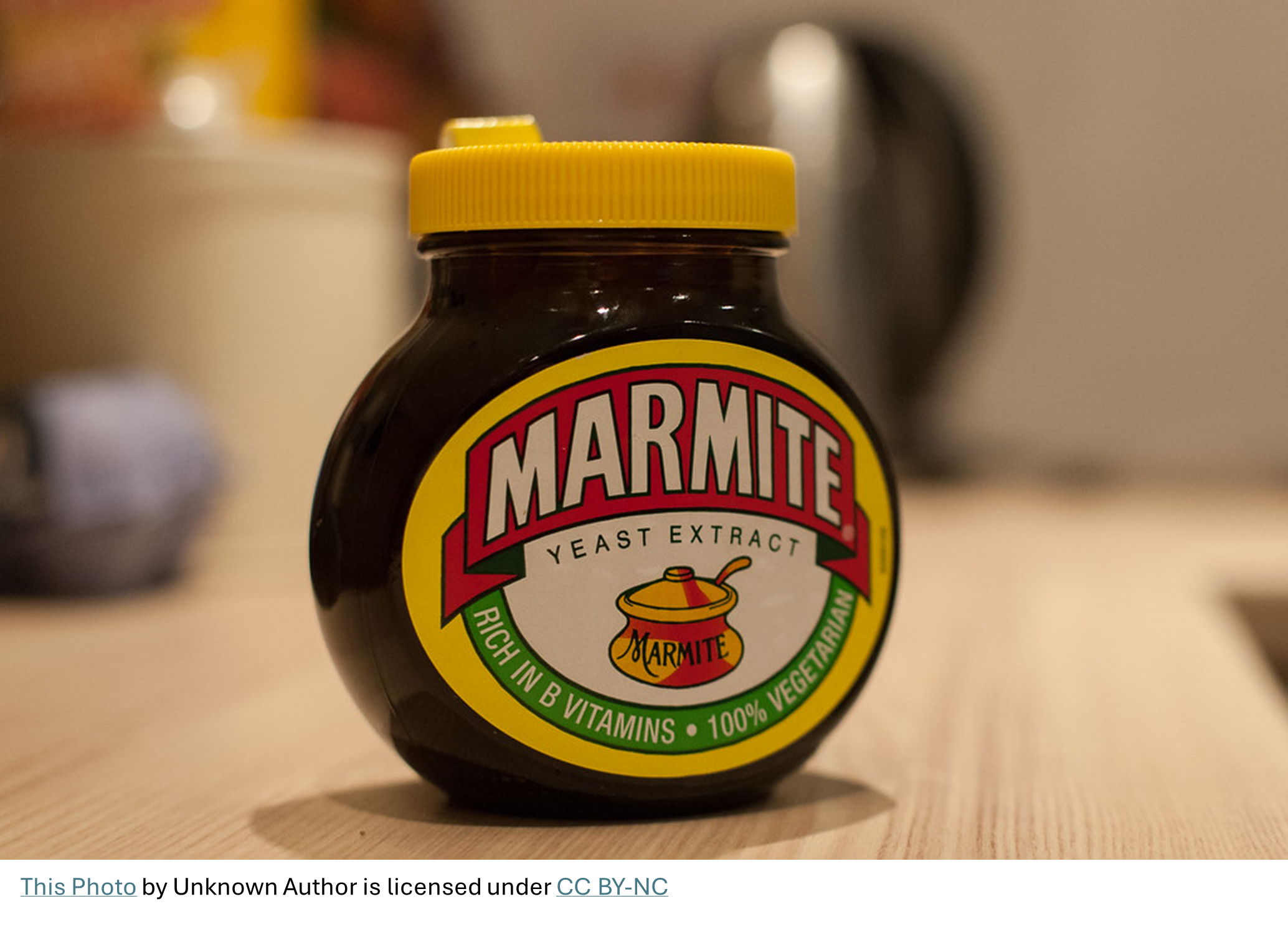
You wouldn’t hate someone because they like Marmite.

As decent human beings we accept that there are people who have different taste from ourselves. Society agrees that it would be wrong to hate someone because they liked (or disliked) Marmite for instance. We know that we should not shout abuse at them because of something that they have no control about.  Much of what we are is a result of our genes which have been honed through the process of evolution to provide a successful species, and it is generally accepted that it is not appropriate to judge someone on that basis.  Unfortunately, this is not a universal truth as we see for example when people consider other races to be ‘inferior’ – i.e. racist behaviour.  But society has agreed that this is unacceptable, and laws are drawn up in an effort to eliminate it.

And yet we seem to think it’s acceptable to mock, at best feel angry with and at worst hate those who hold different values to ourselves; the ‘left’ hates and mocks the ‘right’, and vice versa.  Just look at some of the memes that populate your social media stream.

I recently discovered that there is a strong genetic basis for our political leaning (left / right), and our ‘moral’ make-up.  We cannot help our ‘gut reaction’ to different actions or situations; it is largely defined by our genes.  And there are profound differences between the gut reaction of different people.

If we were to think about another person’s moral matrix in the same way that we think of someone who doesn’t like Marmite then might we start to treat them more considerately?

The book ‘The Righteous Mind’ by Jonathan Haidt describes how our gut reaction defines our response to a situation, and that we then use our reasoning to justify our gut reaction; rather than the other way round.  It takes a conscious effort for our reasoning to ‘train’ or change our response.  If we want to persuade someone else to our point of view, we have to earn their trust before explaining how things look to us.  It doesn’t help just criticising their ‘genetic’ opinion. 

And it’s also worth considering whether they might just have a point, and that there is a blind spot in our own thinking.  Maybe, we can reach a compromise or consensus on the best approach to an issue, combining the different viewpoints to get a full picture of a situation.  Maybe the diversity of points of view that evolved in successful societies and served us well for thousands of years might be worth resurrecting, rather than the present approach of division into ‘Marmite lovers’ and ‘Marmite haters’?  Think about that when you are about to ‘repost’ the latest mocking meme…

Covid Inquiry – lockdowns and saving lives.

When China introduced their strict lock-down I remember saying ‘That could never happen here’.  And when people on social media were saying ‘we’ve got to lock-down immediately’  I didn’t think it should – imprisoning the elderly in their homes for 3 months for no offense!

When my father died of prostate cancer after several years of suffering and treatment, I was relieved.  I was desperately sad and sat alone and cried to mourn the loss, but he was never going to be young and healthy again and his suffering was over.

Before my mother died I used to cry coming home from visiting her at the pointlessness of her days, she had no joy anymore and would sit on her bed looking out the window.  She would often say that she was ready to die, but her body kept holding on.  When she fell with a broken hip and was taken to hospital she signed a DNR.  She didn’t want to eat and only did when pressed by the kindly nurses.  When she died it was a relief but again desperately sad – but she was never going to be young and healthy again, and she had fulfilled her purpose.

The Covid inquiry is asking how many more lives could have been ‘saved’ by earlier lock-downs.   Would my mother or father’s lives have been ‘saved’ by extending them further?

In “Screwtape Letters” – letters from one demon to another CS Lewis writes “They, of course, do tend to regard death as the prime evil and survival as the greatest good. But that is because we (the demons) have taught them to do so.”  In his non-fictional writing Lewis points out that we have lost sight of the ‘true reality’ of God and the spiritual life.  In our earthly, material world everyone dies; it is just a question of when. 

In reality, it is not the length of our days but what we have striven to become on earth that matters – our character, or values, our loves.  Of course the death of a loved one is sad, but let’s have less of this ‘saving lives’ when we simply mean ‘extending lives’ and let’s focus more on reality.

——————————————

““Reality, in fact, is usually something you could not have guessed. That is one of the reasons I believe Christianity. It is a religion you could not have guessed. If it offered us just the kind of universe we had always expected, I should feel we were making it up. But, in fact, it is not the sort of thing anyone would have made up. It has just that queer twist about it that real things have. So let us leave behind all these boys’ philosophies–these over simple answers. The problem is not simple and the answer is not going to be simple either.”” ― C.S. Lewis

Supreme power and love indwelling all of space and time, or cheerless physics?

We live in an age of information. I know there is fake news, but there is a vast wealth of knowledge. You can find almost anything you need to know on-line.  Yet just a few decades ago nobody could even conceive of the internet.

It didn’t happen spontaneously. We got here through the hard work and inspiration of highly intelligent designers and visionaries.

Imagine now a vast cloud of molecules in space, the debris perhaps of an exploded star.  Just a collection of atoms and molecules: hydrogen, iron, oxygen, beryllium, carbon, nitrogen, silicone … a little bit of everything perhaps.  But a vast, lifeless, formless cloud drifting in space.

Imagine that there are no influences acting on the cloud of molecules apart from the forces of physics; gravity, weak and strong nuclear interaction, and electromagnetic forces.

We can imagine that those inanimate forces are sufficient to cause the molecule cloud to collapse into a star and some planets.  Over billions of years, gravity slowly pulls the gases together to form a solar system.

But can we imagine that those basic forces are sufficient to organise the lifeless cloud into a butterfly,  a magnolia tree or a human being?

Can we imagine that those basic forces are sufficient to organise the matter that they act on into the internet?  That the molecules organise themselves unaided into a smartphone, or the Mona Lisa, or a performance of Beethoven’s seventh symphony?

Take a molecule cloud, leave it completely alone for ten billion years, come back and you will find fitbits, contraceptive pills and life-forms intent on destroying themselves and each other.

Just through the laws of physics?

Intelligence creating itself, life with all its complexity spontaneously initiating and evolving.

Just through the laws of physics?

Love,  joy,  purpose existing without any material form that you can touch or measure.  Great stories and legends; “The Lord of the Rings” expressed in a myriad of forms…

All of these, with the only ingredients of a molecule cloud and the laws of physics.  Really?

Or is there something more? 

Something which indwells all of space and time, sustaining matter and the forces that act on it, imbuing form on the formless,  bestowing intelligence and ‘self’ on lifeforms, giving purpose to material and non-material reality.  Intelligence that gives intelligence.  Life that gives life? An eternal ‘something’, or ‘someone’ without cause but within everything?

If I put my pride aside, it seems to me that the universe, life, and love point to there being a supreme and eternal, creating, sustaining and loving God.

Not cheerless physics.

Image by David Mark from Pixabay

Is there place for God and religion in today’s world?

The first thing to realise is that we are all living in a computer generated world, and that we are living in the past.  Nothing exists in the form that we perceive it, and by the time we perceive it, it has already happened.

That steaming cup of coffee that you see is just the result of your eyes, optic nerves and brain processing photons that hit the back of your retina.  You are experiencing a brain (computer) generated model of what you now understand to be a cup of coffee.

Your brain’s processing inherently includes a delay to allow all of the bits of information to ‘catch up’.  It takes longer for visual stimuli to be processed than it does for sounds. When you experience the crash of your cup on the floor your brain has had to delay presenting the event to your consciousness until the signals from both your ears and your eyes have arrived.  Our reaction time is evidence of this, and the fact that we react faster to sounds than to lights.  If you start a sprint race with a gun then the sprinters set off faster than if you start it with a flash of light – although the speed of sound is much slower than the speed of light.

So we do not experience the world as it is, but we experience a three dimensional model created within our brain. 

As a child I used to wonder ‘does the colour green look the same to me as it does to you?’  Today I would answer almost certainly ‘no’.  First of all, we know that some people are colour-blind, and so all colours must be perceived differently by them.  And our eyes all have different sensitivities to shades of colours, and so the raw data that our brain has to process must be different between individuals.

But would we have the same ‘experience’ of the colour of our coffee cup if our brains received identical signals?  That is a hard one, because we can’t really explain what it means to ‘experience’ a colour. (Google ‘qualia’ to find out more).

So although our bodies live in real time, we ‘experience’ a computer generated world that has already happened.

Weird.

But weirder perhaps is to ask what we mean by ‘we’.  What is the ‘me’ that experiences this computer generated world?  Warning – science cannot answer this, it’s the meat and drink of philosophy; the discussion of abstract ideas by bright people who build arguments on certain basic assumptions that they continually disagree about.

My subjective view is that there is a ‘me’ that experiences things.  I interact with my brain (and hence body, and hence world) and can influence but not control what my brain and body does.  I can influence what my consciousness presents to me (ignoring distractions when focused on a task for instance), and I can influence how my body responds to things – but I am not really in control.  Just think of a tennis player returning a 140mph serve; there is no time for them to get directly involved in the process of selecting which direction to go, or what shot to play.  They have to leave the action up to their body. But they can influence what their body’s reaction will be by training, by giving it a strategy such as “don’t try to hit a winner off every shot”, and then they need to get out of the way!  Sportsmen know that consciousness gets in the way of winning; thinking too carefully about how to play a shot at best slows things down and at worst causes us to make a mess of it.

When we think about it we realise that ‘we’ have relatively little influence on what our minds and bodies do, and yet ‘we’ get to experience it all! 

And yet ‘we’ are unexplainable. To try to understand the unexplainable ‘we’, and much to the chagrin of materialistic scientists, we use terms like ‘soul’ and ‘spirit’ to define ‘us’. And we believe that other people have souls and spirit too.  And we spend a lot of time and money trying to find ways to interact with our brain/bodies that will lead to our soul’s wellbeing.  So much advertising money is spent on encouraging us to buy products to bring us ‘peace of mind’ or other palliatives for the soul.

It is natural, and not at all illogical, to imagine that in the same way that you and I are tiny individual souls (that happen to inhabit a bunch of chemicals that we had nothing to do with initiating) there is an overarching bigger ‘soul’ who initiated the material universe of space and time (God).  And if our individual soul ‘experiences’ interaction with this bigger soul then there is all the more reason to believe in its existence.  But of course, this can be frustrating to those souls who have not had similar experience…

So yes, there is a place for God in today’s world.  There is good intellectual reason to believe that there is a God, and this is reinforced by the experience and evidence of many witnesses who report interaction with and experience of God.  These interactions have been documented for millennia and continue today.  And there are many who feel that they have directly experienced such an ‘interaction’ yet believe that there is a larger ‘soul’, or God.   

In response to concluding that there is a God and recognising that our very existence is a gift, it is also natural to want to give thanks for that gift and to want to make best use of the gift.  Hence there is a place for religion too in today’s world.

How about you?  If you haven’t recognised them yet – why not start seeking God for yourself?

Have a blessed day.

How do I live a good life?

Nobody wakes up in the morning and thinks, “I’m going to hurt as many people and do as much damage as I can”, unless they are mentally deranged.  Usually we don’t even think about how we are going to live our day, but if we did we’d think something like “I’m going to try to be nice to people, to do my job well, to keep the environment safe”. 

Yet if we look back at the end of a day we are more than likely to think “I wasn’t very nice to X, I did that bit of work badly, I didn’t need to drive so fast”.   And most like as not, we would then justify our actions in our head to make us feel better, “He caught me at a bad moment,  I was late for lunch and wasn’t given time to do a good job,  that idiot in front of me was dawdling and I needed to get home.”  But we have let ourselves down.  We have not been the person we want to be, or could be.  And when we find ourselves doing the same thing every day we avoid thinking about it, and are likely to get angry if someone points it out to use.

There is a better way.  There is a way to be the people we want to be.  And it starts with understanding what’s going on.  An ancient letter written by Saul of Tarsus helps to enlighten us: 

Within us we have two ‘natures’.  We have our ‘sinful nature’ and we have our ‘spirit’.

Out sinful nature is that part of us which clamours ‘me, me, me’ all the time.  Its roots are in the animal instinct that successfully evolved us to survive when everything else was out to eat us, and where if we didn’t grab something for ourselves then something else would.  It is the instinct which leads a lion to defend its territory, the instinct which leads a gerbil to eat its young if there is not enough food, the instinct that leads the black widow spider to eat its mate.  It is the instinct that leads us to crave riches, to accumulate wealth beyond what we can ever use.  It is the instinct which says that the human beings in my tribe are more important than the human beings in yours.

And then there is our spirit.  Our spirit is revolted by the idea of eating our young; we know that we should not eat our babies.  It is our spirit which leads us to help and to make sacrifices for those who are suffering:  looking out for those shielding in the Covid crisis, giving to food banks, marching in Black Lives Matter rallies, campaigning to save the environment.  Our spirit calls us to love, and to goodness.

The ancient letter describes the consequences of following each ‘nature’.  Obeying the spirit leads to life and peace.  But giving in to our sinful nature leads to death; death of love, death of peace, death of goodness.  We become filled with anger, guilt, bitterness, self-pity, depression and despair.

We are slaves to whatever we choose to obey. But many are not willing to make that choice.  We flip flop between doing what we know is right and good, and giving in to our selfish ‘lusts’.  And we live in a constant state of dissatisfaction and guilt.  We strive for more wealth, but it doesn’t satisfy.  And at the same time we wish that injustice would go away; “how can we have food-banks in our country?”

Even if we were to say ‘I choose to obey the spirit, to love and to be good’ we would still find ourselves failing.  And at the end of the day we would be full of guilt and shame, and like as not we would give up.  “The spirit is willing but the flesh is weak”. We need help. 

And there is help available, and hope.  If we have made that decision to obey the spirit, and we do sinful or selfish things then the ancient letter tells us that it is not us that does them, but the sinful nature within us.  It is just that our spirit is not strong enough.  We need to strengthen our spirit, to resist the temptations to give up.  And we can do that. 

The spirit within us is a bit like a battery, it has power but only a limited amount.  We need to plug into the mains.  We need to connect our spirit battery to the mains supply of the spirit that is called the Holy Spirit; an inexhaustible supply of love and goodness – God.   Then the power of sin can be broken.  And how do we connect?  We ask.  We speak with God; we pray.

And we also need to reinforce our decision by focusing on what is good, by giving honour and praise to goodness and love – resisting out sinful nature telling us not to be a ‘goody-goody’.  We remind ourselves of the importance and value of self-sacrificial love.  In a word, we need to worship love and goodness.

We may still do sinful things, but we can plug back in to the mains, pick ourselves up and start again.  We do that by ‘repenting’; an old fashioned word that means wishing that we hadn’t done it and committing to try again. Part of repenting is accepting and confessing that we’ve sinned.  Then we receive forgiveness for what we did wrong and be re-energised to follow the spirit again.  We know that we receive forgiveness because Jesus – God – said that we are to forgive, and so we know that he will forgive us.  And if we are particularly stubborn about accepting that love and goodness (God) would forgive us, then we look at Jesus’s crucifixion; he gave himself as the ritual sacrifice that the Jewish people believed carried off their sins.  And we look at his resurrection – showing that those sins had been dealt with.

When we deliberately choose to obey the spirit, it is empowering.  We do things that please the spirit, and it makes us feel alive.  It brings us peace.  We take joy in the good that we do, and we are able to actively love others.

Think of people you know.  Can you recognise any who are obeying and following the spirit?  It is written that “By their fruit they will be known”.   Fruit that you might look out for are: love, joy, peace, patience, kindness, goodness, faithfulness, gentleness, and self-control.

Wouldn’t we all like to be like that? 

We can be!

On life, and death

Have you reached the point yet of wondering what happens when you die?  Perhaps the current pandemic will prompt more of us to think about this important question.  It is important because of the impact that the answer has on us whilst we are alive.

There is an unspoken assumption behind all the current fears and actions that death is a bad thing; that we must do whatever we can to extend life – even if the extended life comprises sitting in an armchair in a care home gazing out the window or watching daytime TV.  I use the term ‘extend’ deliberately instead of the more common term ‘save’ because we are all destined to die;  rescuing someone from drowning does not ‘save’ their life, it extends it.  But to what purpose?

Actually, it may be that rescuing someone from drowning does ‘save’ their life, in that the experience may cause them to turn from a previous pointless and self-centred existence to a life of love and purpose.  The fact that someone cared about them enough to rescue them may make them realise the importance of relationships, the importance of selflessness, the importance of love.

People who have gone through near death experiences often become dramatically changed, dedicating the rest of their lives to acts of loving kindness to others.  So it is indeed possible to save someone’s life. But it is the quality, value and purpose of the life that is saved rather than the biological state of being alive for ever.

We confuse the biological life with what I will call spiritual life.  An amoeba has biological life, a tree has biological life, and so does a virus.  But none of these have spiritual life.  They do not ‘experience’ life, they have not brain to sustain any form of consciousness and they simply live biologically.  There may be other forms of higher life (apes, dolphins) that can ‘experience’ life; I don’t know because I’m not one of them.  But I do know that I experience life.  When I eat a curry I ‘experience’ a taste, but even that is hard to pin down.

If you Google “The Qualia Problem” you will find a paper by Frank Jackson which states that:

“I think that there are certain features of the bodily sensations especially, but also of certain perceptual experiences, which no amount of purely physical information includes. Tell me everything physical there is to tell about what is going on in a living brain, the kind of states, their functional role, their relation to what goes on at other times and in other brains, and so on and so forth, and be I as clever as can be in fitting it all together, you won’t have told me about the hurtfulness of pains, the itchiness of itches, pangs of jealousy, or about the characteristic experience of tasting a lemon, smelling a rose, hearing a loud noise or seeing the sky.”

But whatever it means for me to experience the taste of the curry, I know that there is a ‘me’ to experience it.  It is that ‘me’, not the biological me which I long to preserve, whose ‘life’ I want to save.  And so the big question is, does that ‘me’, that spiritual me, cease to be when my physical body ceases to be?

If the spiritual ‘me’ will end when the biological me ends, there will be no ‘me’ to experience that I am dead.  Do not grieve for me, I will no longer exist.

Of course I will remain in your memory, and you will look back on your memories with joy and sadness – as with all memories.  They are not erased simply because I die; they are as real as they are today while I live.   But if extending my life gives me no ‘spiritual’ life at all, then any new memories will bring sadness in remembering my final days.  So what will be the value of extending my biological life when I have no spiritual life?  The preservation of my decaying body simply to avoid biological death will bring sadness to overshadow previous memories, and will in practice bring mourning forward before my death.

This may sound heartless, particularly if you have not yet lost your parents or other loved ones.  But before you condemn me, I have suffered loss.  I have lost a child, at birth.  I have lost both of my parents.  And I know the pain that the pointlessness of the latter days of their lives brought them.  My father knowing he had to suffer the pain of prostate cancer with no hope of end other than death; my mother wondering when the pointlessness would end, her daily routine seeing her sitting on her bed gazing out at the suburban street for hours.  I grieved over them all when they died, and the grief is still there of course, many years later, just less acute.

I am not heartless.  No.  I want to see people truly, spiritually ‘live’ whilst they have biological life.

But what if the spiritual ‘me’ continues to exist beyond death?  What if my purpose is indeed eternal?  And how can I know?

The crew of early sailing ships believed that there were other lands over the horizon.  Europeans believed that there must be a large land mass south of the equator before they found it.  And brave adventurous souls set off to find it.  Some came back and told others that it was true, and soon constant travel to and fro confirmed it.  That made it easy for those who had not been there to ‘know’ that Australia existed.

But it’s not quite the same with life beyond biological death.  Our bodies cease to function and eventually the flesh rots and we are left with a skeleton.  We don’t find dead people returning to re-inhabit their skeletons; there is no free travel between here and any ‘afterlife’.  At least, not that we are aware of.

Imagine for a moment a caterpillar.  It has a physical body, it eats and excretes, it moves around and (pretending for a moment that it has the capability) experiences the physical domain of the leaf.  And then, after it has grown and fattened up, it appears to die.  It becomes encased in a shell and the caterpillar’s physical form decays.  But it is still alive, rather than being dead, it is being transformed into something different.  The butterfly that emerges from the cocoon bears no resemblance to the caterpillar, and is not even constrained to living on the leaf.  A thing of beauty, it soars into the air and is a delight to see.  Yet it cannot return and tell the caterpillars who remain on the leaf that there is life beyond the cocoon.  Neither should we expect human spirits return to tell us what happens beyond biological death.

And yet… one did return.  No ordinary man, but a man who had turned the lives of those he met upside down;  A man who taught the secrets of true spiritual life to those who would listen – yet more than a great teacher;  A man who healed those who were physically ill by the touch of his hand, yet more than a great doctor;  A man who brought biological life back into a friend’s physical body after they had been buried in a tomb for three days;  A man who willingly surrendered his body to excruciating crucifixion and inevitable physical death and burial in a tomb.

Two days later, his tomb was empty.  Although his friends and more importantly his enemies searched everywhere for it, no body was to be found, just some folded grave clothes.  His enemies were desperate to find the body to disprove the claims of his closest friends that he was alive; that they had seen him, spoken with him, and touched him.

Madness we say – they must have imagined it.  And yet such a madness that they were willing to die rather than deny it.  Such a madness that they were filled with joy, and their lives were transformed;  freed from the greed and selfishness of their world – sharing all they had with one another, loving one another.  Such a madness that they began to understand the secrets their friend had taught them about what a true spiritual life looks like.  Such a madness that brought ‘life in abundance’, not just for them but for all who listened to their eye witness accounts and trusted and believed them.  A madness that has affected millions upon millions over the past 2000 years.

Our decision of what we believe happens when our bodies physically die has enormous impact on our lives whilst our physical bodies live. Do we trust in the eyewitness accounts of what happened to that man, and hope and expect  that spiritual life is not snuffed out with our decaying bodies?   Do we choose to believe that our spiritual selves will live on, no longer constrained to the two dimensional leaf of this world but soaring into the sky of eternity; that we will be transformed from caterpillars to butterflies.  Do we start putting into practice the words of wisdom that bring spiritual life today?

Madness?  Or the sanest decision that we ever make?  Do we trust or ignore the evidence?  Do we dare to find out?

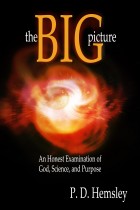
Foreword to The Big Picture

Scientific discovery has brought material benefits and physical comfort to mankind.  The predictability of matter leads us to assume that it behaves according to fixed laws, and this belief has led engineers to develop tools and machinery to manipulate the environment, doctors to develop cures for many diseases, and farmers to grow crops with greatly increased yields.  Many of the scourges of previous times have been overcome leading, in the Western world at least, to longer lifetimes and better health.  However, this has also led to the belief that everything is predictable and controllable. If anything goes wrong (by which we mean it causes us distress or discomfort) then it must be fixable, and if it hasn’t been fixed it must be someone else’s fault.

Personal rights have grown, but personal responsibility has diminished.  Laws to protect the weak have bred the belief that it is the state’s job and not our individual duty to help out those less fortunate than ourselves.  Mechanisation that was supposed to give more leisure time has led to lost jobs and loss of purpose.  Competition and the shrinking of the geographical world has meant that there is someone, somewhere who will work harder or longer hours than we do, and the pressure grows to produce more for less.  The availability of loans means that goods can be obtained now if we promise to pay later.  To pay the loan we need a job.  Fear of job loss drives us to work longer hours and accept less pay. The purpose of life becomes to produce.  The mechanism which fuels demand and production is the economy.  The economy becomes the measure of the health of a nation.

Is that what it’s all about?

Is my value simply what I can produce?

Am I measured just by what I can earn?

If I retain the worldview that the economy is king then the implication is yes, but that doesn’t feel right.  I want to be valued and loved as a person.  I want a worldview that speaks to my heart and my mind and not just my wallet, and I want it to be based on sound thinking and evidence.

Science has brought great technological and medical benefits to mankind; cars, televisions, fridges, telephones, electricity and so on.  But science has also brought guns and bullets, pollution, global drug trafficking and job losses.  Science seems to dominate my life, telling me what I should or shouldn’t do to keep healthy, avoid risk and live longer, but it doesn’t tell me why I would want to live longer.  Science doesn’t give any purpose to my life.

Religion offers purpose, but it too seems to want to control me and dominate me.  Religion has been used as justification for many great atrocities: the Spanish Inquisition, child sacrifices, the Crusades.  Religious people seem to want to tell me how to behave, and to judge and criticise me, claiming to represent the will of God.

I want to know the truth.  I want to know what science can tell me about how the universe works, and perhaps where I came from.  I want the benefits that science can bring, but not at the cost of becoming a slave to its dictates.  I want to know why I am here, what my purpose in life is, or even if there is one.  If there is a God I want to know what He thinks. I want the benefit of knowing that I have a purpose, but not at the cost of becoming a slave to rules from another human being.

And so I investigate, weigh up evidence in all forms and seek a holistic worldview that works.  I have explored what we know from the physical and biological sciences, and I have researched historical evidence for God. I have tested what is actually known, and what is speculation, extrapolation or personal opinion and rhetoric.

This book presents my conclusions, and some of the evidence that brought me to draw them.  I offer what I believe is a consistent, healthy and constructive worldview based on sound evidence.  I’ve called it Minimalist Christianity.  Whether you agree with my conclusion or not, I hope that many of the myths that currently inhibit so many of us will have been weakened or dispelled.  I hope that a step can be taken towards finding purpose and experiencing life in abundance.

A contemporary Genesis

One morning I felt the inspiration to write a modern version of the Genesis account of creation, incorporating and alluding to the scientific discoveries of recent times.  I hope that nobody chooses to take offence:

Before the beginning of time and matter in our universe, there was God.  Of his works other than our universe we know nothing, but of his works in this universe we have learned much through the gift of our intellect. Of all his purpose in our universe we can know only what he has chosen to reveal to us, and he has revealed that we were his purpose.  One purpose alone or one purpose among many is not for us to know.

God chose to create this universe.  He created time, and then he tore nothingness into matter and antimatter, and in that great explosion from nothing he caused there to be an excess of matter over antimatter.  And he causes matter to interact with matter through invisible forces acting across nothingness. And ripples of that rending apart of nothing remain until this day for us to observe with wonder.

Since God knows his plans, he chooses to cause matter to behave in a consistent way. He allows the tiniest particles to behave in individually unpredictable ways, but in community he causes them to follow his chosen laws.  In the presence of spirit, whether God’s own or that of humans or other spiritual beings, God allows his laws to be suspended.  God continues to sustain and guide his creation, acting as and when he chooses and allowing individuals to choose how to act.

And so for billions of years, although years were yet to be invented, the universe unrolled according to the laws that God had chosen.  Particles formed into atoms, atoms formed into great stars and stars drew together into galaxies.  The first stars grew to such a size that the interaction between the matter and the forces caused great energy and the explosion of the stars, and in those explosions new atoms were formed.  God was making the building blocks of life, the carbon and the oxygen atoms.  Out of those explosions, and according to God’s laws of interaction new stars formed, and planets were formed around those stars.

One of those planets, the earth, had the right conditions for the next phase in God’s plan.  The planet was at first a molten mass, bombarded from space by asteroids and meteors as the turmoil of the formation of the particular sun and galaxy subsided.  A crust was formed on the molten mass, and a gaseous atmosphere formed above the crust.  In that atmosphere and on the crust, the carbon, hydrogen and oxygen atoms joined to form more complex short molecules.  When the time was right, these short molecules formed into long chain molecules.  These very special molecules continued to work according to the laws that God had chosen for the atoms and particles.  The molecules had different purposes, some formed into cell membranes, some formed into little molecular machines, and some formed into very long instruction chains.  And God caused them to be combined into what we today would call cells, and God had given them the mechanism to multiply in number.

To the first cells he gave the task of changing the atmosphere of the earth.  Using the energy of the nearest star, the sun, the cells separated oxygen from carbon dioxide and pumped the oxygen into the atmosphere.  For more than a billion years the cells carried out their task of preparing the atmosphere of the earth, getting ready for the more complex organisms that were next on his plan.

When conditions were right, the individual cells formed into groups or communities that were dependant on each other, where each cell in the group performed slightly different functions and so the new organism was able to both become larger but also to perform more complex functions.  God gave the individual cells the means to evolve a mechanism that would carry the instructions for each cell in the group to perform its function, and to respond to the communications from other cells within the group.  And so, multicellular organisms were formed.

The instructions embedded in each of these cells ran to billions of characters in length.  The mechanisms of the cell and these instructions were both necessary for the cells to operate and grow, and to reproduce from generation to generation.  God didn’t plan to make all organisms identical, so he designed ways and means of bringing variation to the offspring of the organisms.  He allowed “random” variations due to inaccurate copying, and he caused deliberate mixing of the instructions in one organism with another, requiring separate organisms to come together in order to create the next generation.  The organisms themselves thus had to live in partnership and community to survive.

So God had established a process of growing a wide diversity of organisms of increasing functionality that relied on each other to survive and thrive.  Whilst each individual organism would be allowed to behave in an individual way, only those that were successful in progressing God’s plan survived and reproduced.  God chose to allow a process of competition to develop the organisms as he wanted; a process which required individual capability and cooperation between individual cells within an organism, and between organisms of the same type.  Through this phase of God’s plan he used the law of “survival of the fittest” to perfect each organism, and to select which organisms to perfect.  The organisms didn’t know anything of right and wrong.

But that was not the end of God’s purpose, although it took billions of years to accomplish.  His plans were greater than that, for there to be beings in his likeness; beings that would design and create, but more than that, beings that would know right from wrong, beings that would love, spiritual beings that would know and seek God himself.

So he selected one of the organisms and he planted his spirit in that organism and gave it an awareness of God himself, and he gave that organism the ability to know what is right and what is wrong, and he gave that organism the ability to choose to do what is right or what is wrong.  That organism is mankind, the pinnacle of God’s creation. 

You might not be ready to accept this new account. Certainly it is not literally correct, but maybe it is more relevant to today’s society in the same way that the original Genesis was relevant to the society of its day.  It conveys that all of us are spiritual and material beings, willed by God as the culmination of a creative process of unimaginable complexity spanning billions of years, following the creation of time itself.  Mankind: created with the opportunity to know God and to relate to him, but allowed the alternative of rejecting and ignoring him.

Excerpt from “The Big Picture – an honest examination of God, Science and Purpose”

evolution

I think I might be a panentheist – I hope it’s catching!

The ancient Celts knew a thing or two. They were not the wild fighters who the Sheriff of Nottingham brought in to drive Kevin Costner’s Robin Hood from his idyllic woodland village. They had a special understanding of the nature of things. According to “The Celtic Way” by Ian Bradley they held “a conviction that the presence of God was to be found throughout creation – in the physical elements of earth, rock and water, in plants trees and animals and in the wayward forces of wind and storm.”

Bradley goes on to say that “We are not in the world of pantheism here but in the much more subtle and suggestive realm of panentheism – the sense that God is found both within creation and outside it.”

Elsewhere I have written that God is ‘the laws of physics’ – it’s just another name for the thing which causes matter to behave in the way that it does. Without God/’the laws of physics’ there can be no matter – God and matter are not independent, and so matter is (part of) God. (see “Proof of God?”)

I have also noted that there are non-material things: love, justice, purpose etc. These must similarly be part of God – reflected in the Biblical passages which state that God is love. (see “An argument for, and definition of God”)

This understanding of the nature of God leads us to realise that you don’t need to go somewhere to meet God – he doesn’t live in church or a monastery – he is all around us, and within us, sustaining our physical bodies and our environment: “we are what we are through and within God”. (see “The God of Science”)

The Celts understood this. Not within the scientific context that I have described, but in the practical day-to-day knowledge of God. Perhaps we need to refresh our view and understanding of science to reflect this Celtic wisdom: science is simply the study of God!
There is no separate sacred / secular division, no God / nature division, no heaven / earth division; they are all part of God who is God of everything.