Basic economics?

Have we forgotten what money is?  Money is a promise.  I do something helpful for you, but since you can’t do something helpful in return at the same time you promise to do something later.  Money is the lubricant that allows us to be helpful to each other but know that we will receive something helpful to us in return.  Banknotes carry the words “I promise to pay the bearer …”

This basic principle has been forgotten, and greed and fear leads people to collect more promises, or to put too high a price on their helpful work.  In an economic crisis people are afraid to use their promises, hoarding them instead.  Those who have made the promises are not able to redeem them, and to survive they have to make more promises – more than they are able to deliver.  Money, the lubricant, is taken out of the system and it stops working – try running your car without lubricant!

This presents an obvious solution to our present economic difficulties.  We should stop hoarding promises, and those who have lots of promises should allow others to discharge them.

What does that mean in practice?  Stop, or reduce what we save, and instead spend our money to give employment to others so that they don’t have to borrow to live.

A controversial suggestion to encourage this would be to change income tax to a saving tax.     If you earn a million and spend 900,000 then it is not taxed, but the 100,000 is taxed.  You can keep whatever you spent the 900,000 on, because that’s giving employment to others, who then give employment to others…..  it keeps the system lubricated.

But even without governmental tinkering we can all do our bit.  Be happy to buy what you need,  employ others instead of doing it yourself, give away the promises (money) that you don’t need.

Simple? Worth a try?

………………………………………………………………………………………………………………….

https://philhemsley.wordpress.com/2013/12/10/austerity-is-working/

https://philhemsley.wordpress.com/2013/12/27/austerity-is-working-ii/
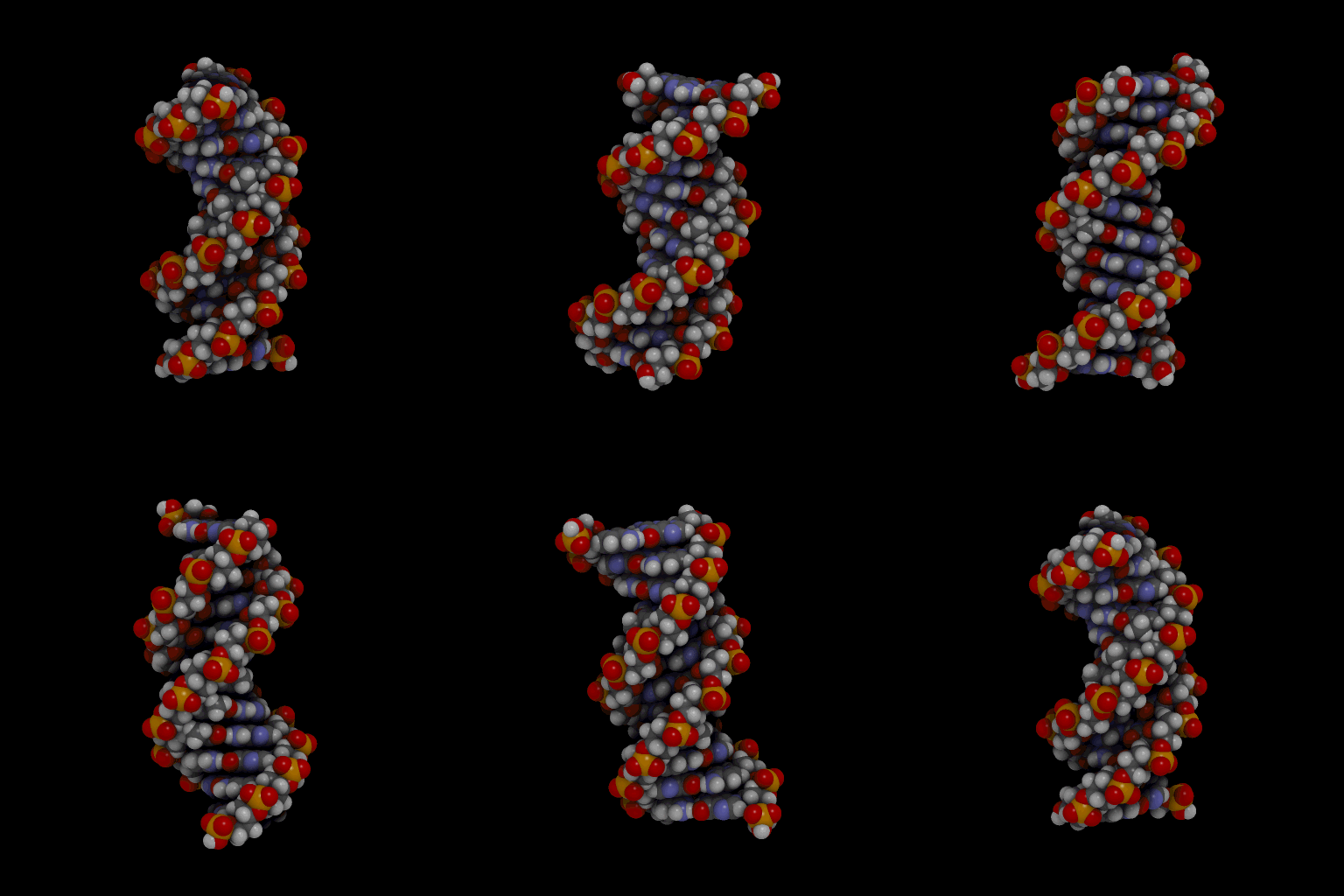
The DNA enigma

DNA is amazing stuff.  A precisely structured sequence of base pairs that is unique to each of us as an individual.  A record of our ancestral history.  A template for the manufacture of our proteins.  The blueprint for each of us.

The human DNA chain of around 3 billion characters has been assembled over perhaps the last billion and a half years (from the first evidence of cells with a nucleus), and has changed with the changing animals that carried it, through perhaps a billion generations.

DNA appears to be the mechanism of inheritance, the instruction set that ensures that beneficial features from parents are transmitted to the offspring.  It appears to be the key that defines a naturalistic explanation of how we have come to be here.  But is it?

Is there enough information within DNA to define each of us?  Or is something more needed?

As we remember that each of us begins as a single fertilised cell containing the combined DNA from our father’s sperm and our mother’s egg, then let’s remind ourselves of what the information in the DNA is being asked to define.

  1. The precise geometric construction of our bodies:
    1. The position, shape, type and interconnection of each of our fifty trillion cells
    2. The complete development cycle, that is robust enough to cope with different environments and with physical damage.  A development cycle which maintains the living organism as a functional entity at each stage in the process
    3. Major systems, fully functioning and cooperating with each other
      1. Circulatory System
      2. Respiratory System
      3. Immune System
      4. Skeletal System
      5. Excretory System
      6. Urinary System
      7. Muscular System
      8. Endocrine System
      9. Digestive System
      10. Nervous System
      11. Reproductive System
      12. A fully programmed brain that can control the operation of the body, but that can also think, conceptualise, communicate, empathise, create works of art, music, appreciate beauty, love, hate, choose.  A brain that appears to have, and for all practical purposes has free will.

This is weighty stuff to place onto DNA.

Indeed, the functionality does not seem to match the information capacity of the DNA; the DNA of an amoeba is ten times longer than that of a human, yet the functionality is minimal in comparison.

Has familiarity bred contempt?  Do we see ourselves too superficially?  Have we lost our awe at our own construction?  Have we deluded ourselves into thinking that we understand?

Have we forgotten that all that we are physically began with that one cell?  One cell and its DNA, is it really sufficient to make a human?

Image