Parable Lives

Recommended reading:

via Parable Lives

The blog I never wanted to write: Stage 4 Breast Cancer

From a lovely lady – deserves this to be shared

via The blog I never wanted to write: Stage 4 Breast Cancer

We can all afford to help.

In the west, if our fence blows down we can usually afford to fix it without any worry.  In Mozambique, they have suffered a devastating cyclone, with 90% of Beira damaged or destroyed.

https://www.theguardian.com/world/2019/mar/19/cyclone-idai-worst-weather-disaster-to-hit-southern-hemisphere-mozambique-malawi

I was heavily involved in setting up the Casa Reom centre for street children.  It suffered severe damage.  Can you help them recover from this disaster?  Every little helps…

https://www.give.net/CycloneAppeal


The universe is so big and has been here so long …

Big Bang was about 14 billion years ago; the universe is older and bigger than we can possibly imagine.  Dinosaurs were on the earth for over a hundred million of years, a thousand times longer than the humans have been around. And looking at the population of the world today, as an individual among 9 billion people alive, In comparison with the totality of space and time, each individual is surely completely insignificant.

But… there is an alternative.

If God exists they must be bigger than all this, and older than all this and they must have had a reason to bring the universe into being and sustain it, and to wait while the stars and planets formed and reformed, life began and evolved, and  mankind emerged and developed.  And if, as many of us believe, they sent their son to teach us and to die for us then we move from being completely insignificant to enormously significant.

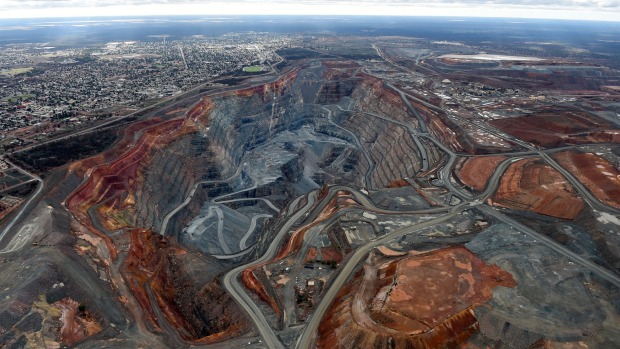
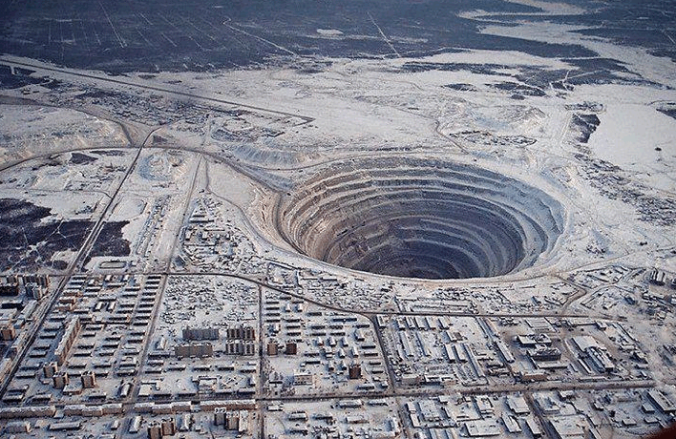
But perhaps it still seems an awful lot of effort for God, too much to believe perhaps. But think about the effort that we put in to the smallest of things used for enrich a very short period of time.  Think of how much time, energy and space goes into making a simple gold ring with a diamond on it, and getting it to a shop so that someone can buy it to propose an engagement.  Just compare the size of the gold and diamond mines with the end product – let alone all the work needed to refine, shape and manufacture the ring, and to transport it to the shop.  We are pleased to do all that, God’s work just takes things to a bigger scale…

Jesus teaching on workers pay

Jesus taught about the kingdom of God. In one example a wealthy man ensured that the workers all received enough pay for their needs, although it cost him more than it needed to. He knew that he would still have sufficient for himself.

If you are wealthy then this might be a good example to follow.

And if you are a worker, take heed too: if you are lucky enough to have a job, your needs are no different from the one who doesn’t.

The story is recorded in Matthew 20:

“For the Kingdom of Heaven is like the landowner who went out early one morning to hire workers for his vineyard. He agreed to pay the normal daily wage and sent them out to work.

“At nine o’clock in the morning he was passing through the marketplace and saw some people standing around doing nothing. So he hired them, telling them he would pay them whatever was right at the end of the day. So they went to work in the vineyard. At noon and again at three o’clock he did the same thing.

“At five o’clock that afternoon he was in town again and saw some more people standing around. He asked them, ‘Why haven’t you been working today?’

“They replied, ‘Because no one hired us.’

“The landowner told them, ‘Then go out and join the others in my vineyard.’

“That evening he told the foreman to call the workers in and pay them, beginning with the last workers first. When those hired at five o’clock were paid, each received a full day’s wage. 10 When those hired first came to get their pay, they assumed they would receive more. But they, too, were paid a day’s wage. 11 When they received their pay, they protested to the owner, 12 ‘Those people worked only one hour, and yet you’ve paid them just as much as you paid us who worked all day in the scorching heat.’

13 “He answered one of them, ‘Friend, I haven’t been unfair! Didn’t you agree to work all day for the usual wage? 14 Take your money and go. I wanted to pay this last worker the same as you. 15 Is it against the law for me to do what I want with my money? Should you be jealous because I am kind to others?’

16 “So those who are last now will be first then, and those who are first will be last.”

How to dry your clothes – a comparison of tumble drying methods.

I’ve been investigating tumble dryers to see which is most environmentally friendly. Surprisingly, I’ve not found a good comparison of the basic types, so here’s mine.

There are three main types of tumble dryer: vented, condensing and heat pump. And then there are washer dryers, which combine a washing machine and a condensing dryer.

Rather than looking at brands, colours and gadgetry, let’s look at some basics.

  • Heat is needed to dry the clothes.  This generate humid air that contains that heat energy.
  • Condensing and heat pump dryers both use cool air from outside the tumble dryer to condense the water from the humid air. The heat in the humid air is transferred into the air from outside the dryer, and so heats up the house.
  • Heat pumps are more efficient than heating elements for generating the temperatures to evaporate the water on your clothes and so will use less electricity than condensing driers.  But it will also heat up the house less.
  • Vented dryers and washer dryers (which are an inefficient form of condensing drier) both discard the heat from the humid air outside the house. That’s OK in summer, but in winter that is wasted energy that could be heating your home and saving on heating fuel bills.
    • The vented dryer throws it away via the vent pipe.
    • The washer dryer is worse, it takes in fresh cold water, heats it up with the humid air from drying the clothes and then throws it away down the drain. i.e. it throws the heat away and it wastes lots of water.
  • Vented dryers also suffer from the high likelihood of the vent pipe coming loose and flooding the room with very humid air, often causing mould growth when undetected.

So:

If you heat your house in winter, both vented dryers and washer driers are throwing away heat that you then have to provide with your heating system.  i.e. they are wasteful.

Washer dryers not only waste heat, but they waste water too.

If you heat your house with electricity there is no benefit in winter from a heat pump dryer, as the energy saved in the dryer must be added by your electrical heater.  But it will save you energy in the summer (but why not dry your clothes outside in the summer?)

So, my conclusion is that although heat pump dryers will be marginally better from a total energy usage point of view, the extra complexity is probably not worth it and a condensing dryer is probably the best choice.

And in the summer, use a washing line or internal drying rack.  The internal drying rack has the advantage that the drying of the clothes will actually cool the surrounding air like a primitive air conditioning system.

Image from http://worldartsme.com/

Making decisions as a community

Often we have to make decisions as a community; a family, a nation, a team.  How do we go about it?  Usually we will simply ask “what do you think we should do?”  And then we will argue against the other person’s proposal.   When the decision is finally made there is conflict and resentment from those who suggested doing something else.  The results of this approach can be extremely damaging.

For instance, the government ask “do you want to leave the EU?”  Half of us say yes and half of us say no, and so half of us are very upset that we have not been listened to.  The nation is split in two.

Or a local authority will make a proposal to close Children’s Centres and then ask people’s opinion on the proposal, calling it a consultation.  But it is simply a consultation on whether you like the proposal or not.  The consultation doesn’t lead to a better solution, but just to anger from those who will be harmed by the proposal.

The steps we go through, probably unconsciously, when we decide something for ourselves can be summarised as:

  1. What is a the problem
  2. What are the alternative solutions
  3. What are the advantages and disadvantages of each
  4. What do we want to do

But when we try to make decisions as a community our normal approach is:

  1. What do you want to do?
  2. I don’t want to do that, but this.

We end up arguing, simply because trying to decide something without even knowing what problem we are trying to solve.

In both of the examples above, the process could have been different.

For example, the question could have been “What factors are important in deciding whether to remain in the EU, and how important do you think each factor is?”

With the results of this consultation, the government could have framed a proposal for how to deal with the different issues, explained the proposal and the reasoning used to get to it, and then (if necessary) asked for agreement to proceed.  In essence this is requiring the government to carry out ‘completed staff work’ (http://govleaders.org/completed-staff-work.htm) before submitting a proposal for approval.  If they have done their work well, the conclusion would simply need our approval.

Try this approach in your community.  Let me know if it helps.

Terror attacks

These murderers were once normal people like you and me.  But they have been corrupted by allowing the seed of hatred to grow and fester in their hearts.  They have turned from all that is good.

We must not and cannot allow that same seed of hatred to take root in our hearts.

We must not look at our neighbours of different skin, different religion or different political beliefs and allow hatred to grow in our hearts.

The only revenge that we must take is not to become as they are.

Why public ownership makes sense

If I need some basic repairs carrying out on my car or my house, I know that the cheapest way to get the repairs done is to do it myself.  It is faster and easier and cheaper.

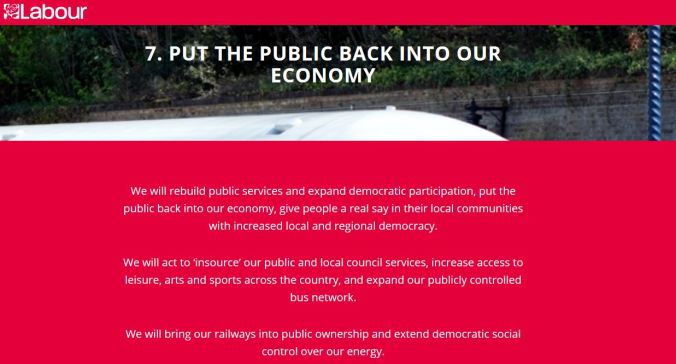
Why should it be any different for the nation?  If we want cost-effective roads, railways and other essential infrastructure, it is common sense for us to own and maintain them ourselves.  It’s faster and easier and because we are not paying someone else’s profits it is far cheaper.  Public ownership simply makes sense.

Other nations make a success of it. They are even running our rail services and taking the profits for their governments.

Keolis is 70% owned by the French government’s national rail service SNCF. It owns 35% of Govia, which runs the Govia Thameslink, Southern, Southeastern and London Midland franchises.

Arriva UK Trains, which operates a string of services including Chiltern, CrossCountry, Grand Central, Northern, Arriva Rail London and Arriva Trains Wales, is owned by Deutsche Bahn – whose sole shareholder is the Federal Republic of Germany.

Abellio is the international arm of the state-owned Dutch national rail operator Nederlandse Spoorwegen.

If you really want to upset yourself about this, watch the video: https://www.youtube.com/watch?v=gvagsSOlAy4

Do we think so little of ourselves that we can’t do the same?  Isn’t it time to bring essential public services back into public ownership?

Why the media and the establishment hate Jeremy Corbyn….

“This is the message that you have heard from the beginning: We should love one another.  We must not be like Cain, who belonged to the evil one and killed his brother.  And why did he kill him?  Because Cain had been doing what was evil, and his brother had been doing what was righteous. So don’t be surprised dear brothers and sisters, if the world hates you.”

I don’t really need to add anything.  We can all recognise who is who in this story.

(There really is a lot of wisdom in the Bible. This was written by St John.)