How do we manage the pressure to worry and despair about what is going on in the world?

There is so much that we can see that is worrying, and that we can do nothing about.  (As I write this Los Angeles is suffering intense wildfires, Trump is threatening to take over Greenland, the wars in Ukraine and Gaza are still taking lives, global temperatures continue to rise…)  Yet if we didn’t look at our TVs, papers or phones we would know nothing of this – and surprisingly little is ‘in our face’ – we are not directly affected by most of the list above.

The secret is to realise that we are not God.  These things are beyond our power to control, but we are not helpless or hopeless – we can play our part using the prayer that Jesus taught us:

“May Your kingdom come; may Your will be done on earth – as it is in heaven”

We might reflect that what is going on actually is God’s will; his permissive will.  Throughout history greedy, power hungry bullies have oppressed ordinary people and we have ransacked the natural world.  Jesus was fully aware of the brutal Roman regime, but he didn’t overthrow it.  He healed people, focusing on the individuals around him – and we can do that too.  We can pray the Lord’s prayer and leave the state of the world in his hands, but then get on with interacting with those around us according to his will.  We don’t care less about the global situation, but we can worry less. And we can use our energy to influence our local communities instead.

After putting the world’s troubles in God’s hands, the Lord’s prayer allows us to ask for God’s heap meeting our own needs:  give us our food for the day, forgive our sins (as we forgive), don’t let us yield to temptation, save us from evil.  All of which do personally affect us day by day, and which will allow us to fulfil our daily purpose.

Jesus’ prayer is a powerful gift from God.

An affordable net zero house retrofit

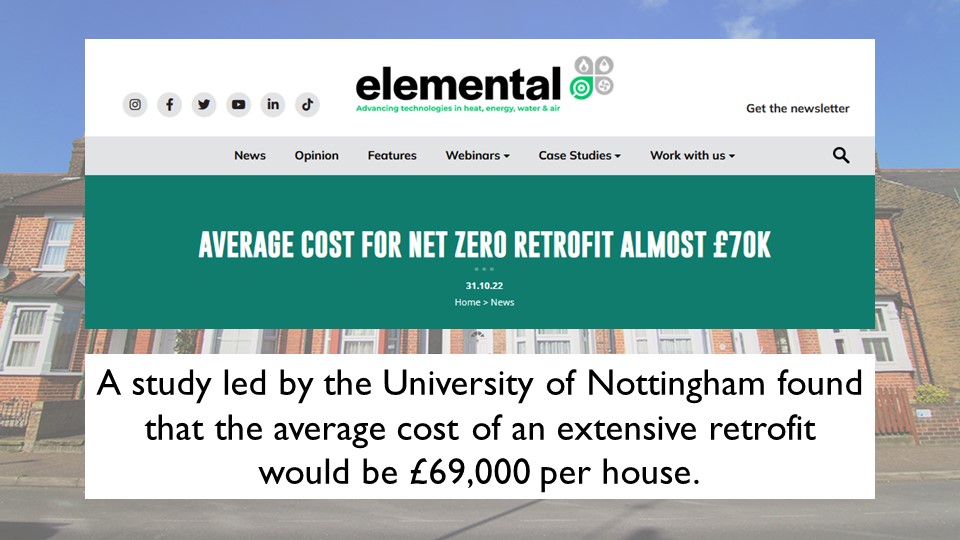
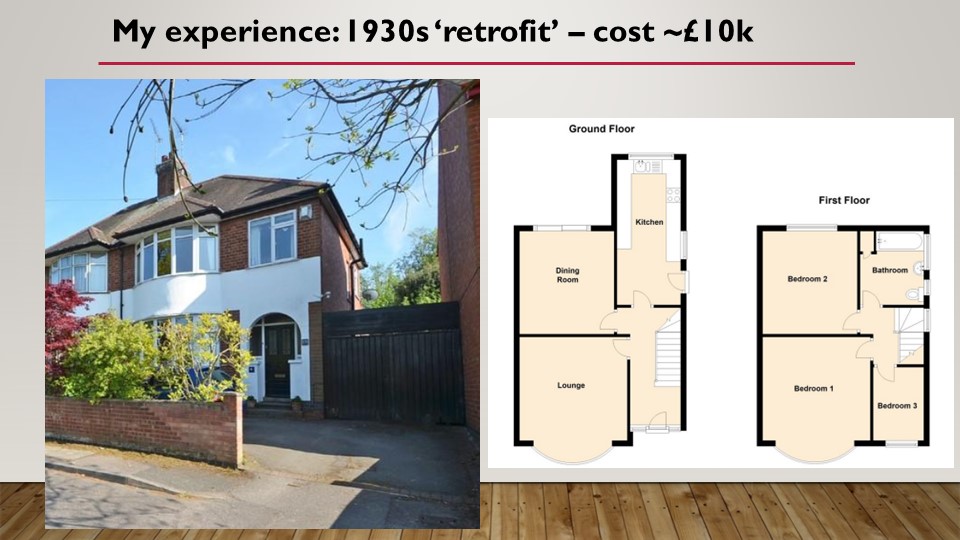
Headlines such as “Average cost for net zero retrofit almost £70k” make the task of CO2 reduction seem daunting or unaffordable.  It doesn’t have to be that way.  I describe affordable and available technologies that allowed me to make my home carbon neutral for around £10k, verified by detailed energy measurements over several years.  The solutions also make living through increasingly frequent heat waves bearable and even comfortable. 

Conventional wisdom and solutions suggest that cutting emissions is a hobby for the wealthy. Technological solutions are too expensive for the majority of householders. This is not true.

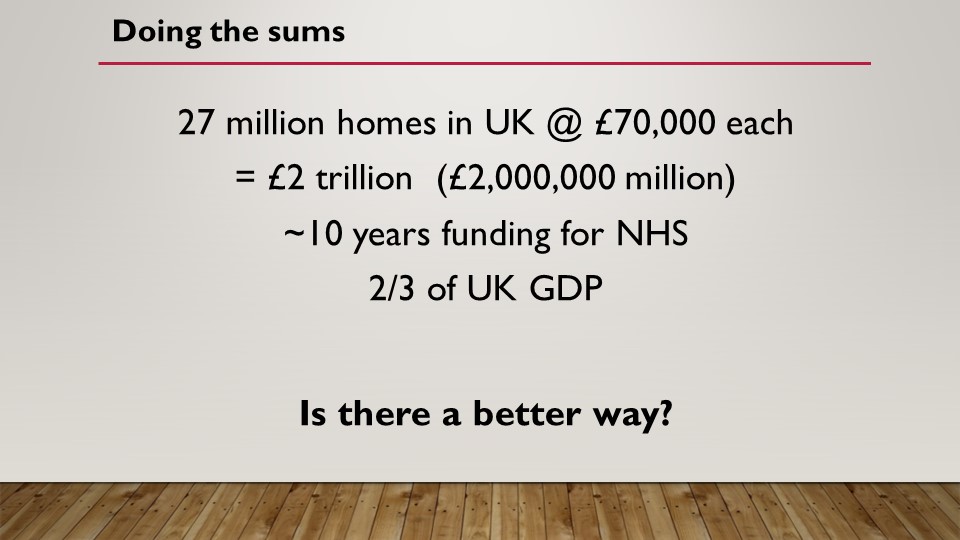
‘Conventional’ solutions are simply too expensive for individuals or the country to afford, but there is a better way.

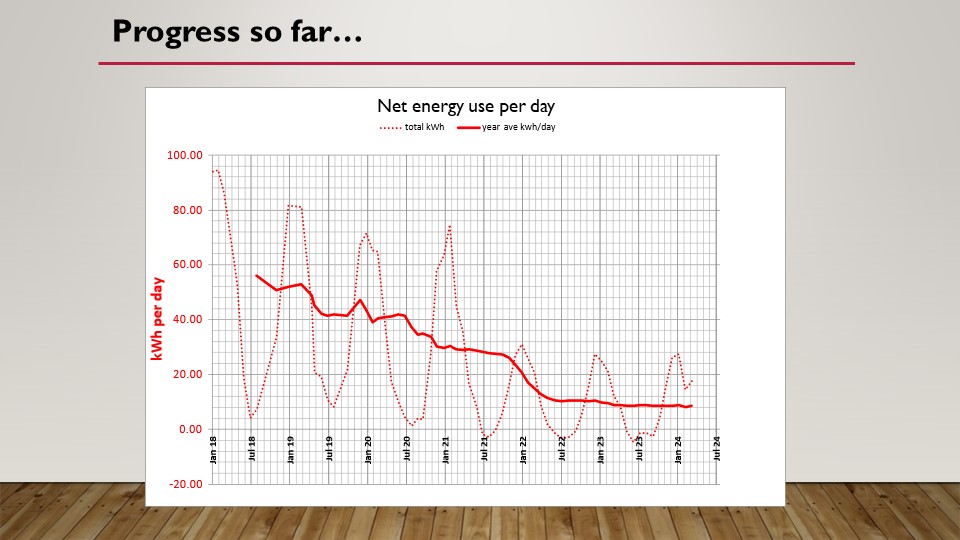
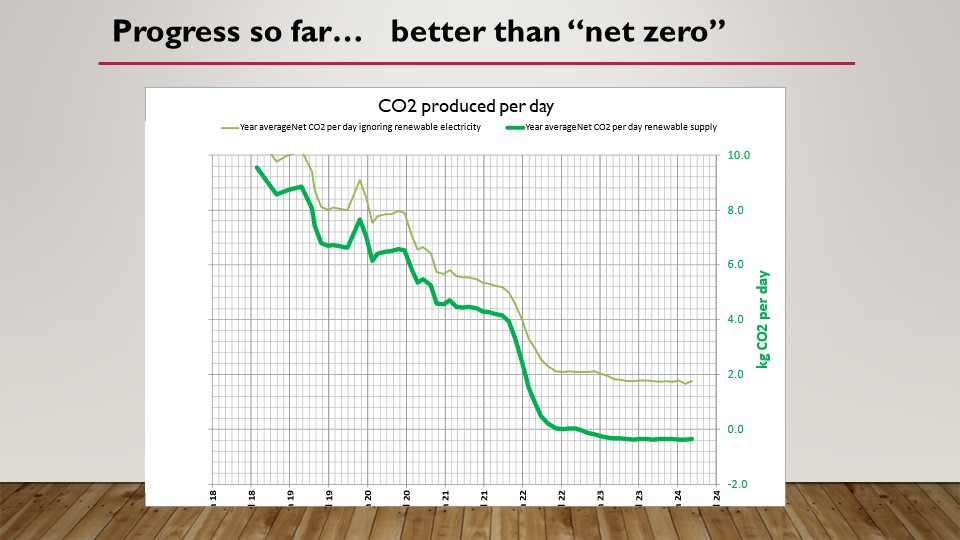
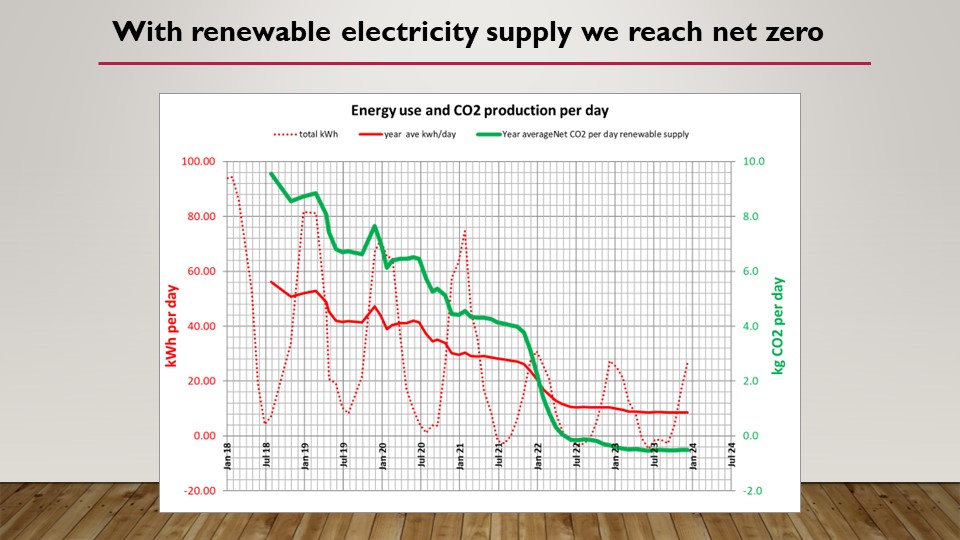
The chart below shows that if we count electricity from a renewable energy supply as zero emissions then we are better than net zero. If we count the carbon intensity of electricity at grid average then we have reduced our CO2 by 80%.

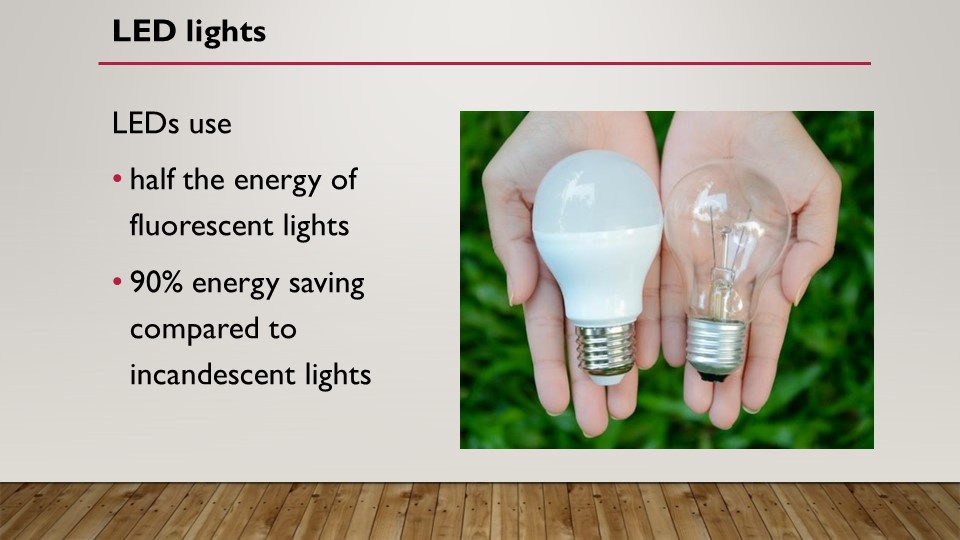
A quick win is to replace all lights by LED.

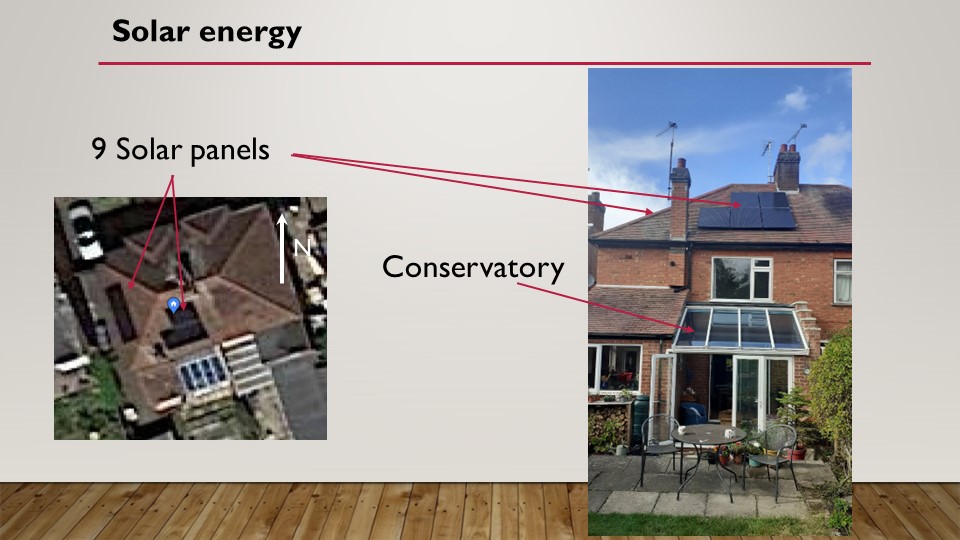
We installed solar panels without a battery early on, and the conservatory also captures solar energy (not included in the £10k as it was built for the space rather than energy reduction).

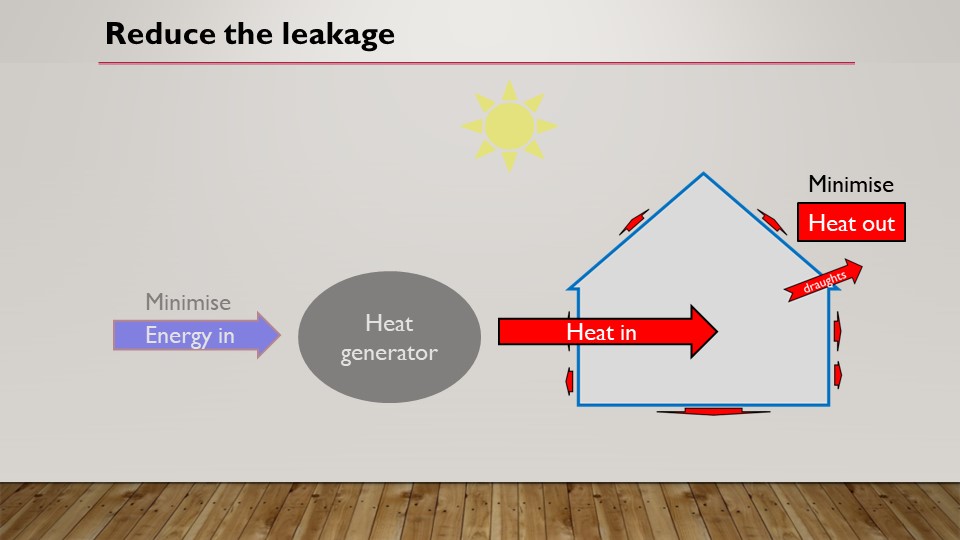
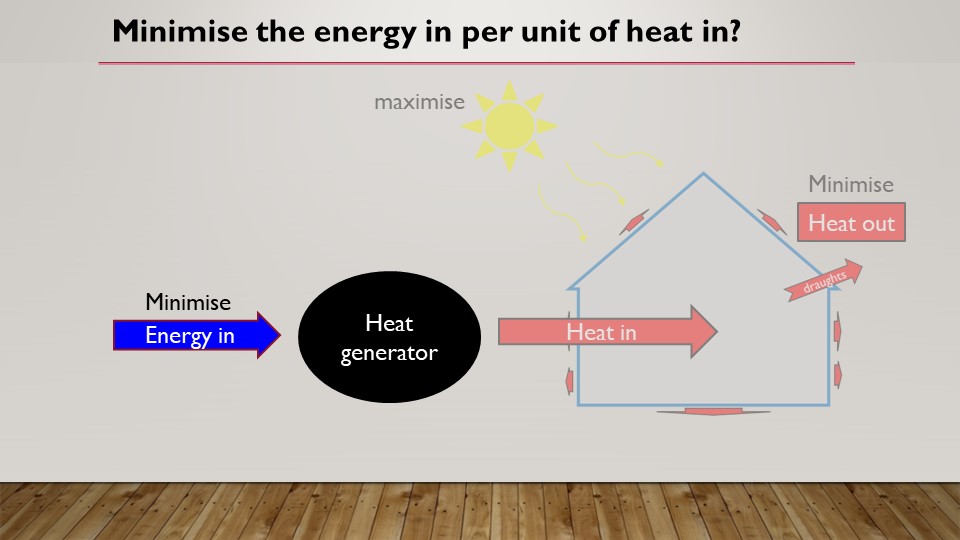
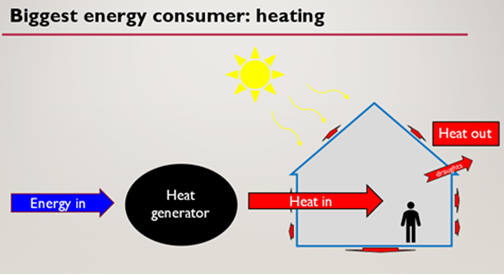
By far the biggest part of the energy footprint of a house is the heating. We need to minimise the energy in. We can do this by minimising the heat out and by optimising the efficiency of the heat generator (conventionally a boiler).

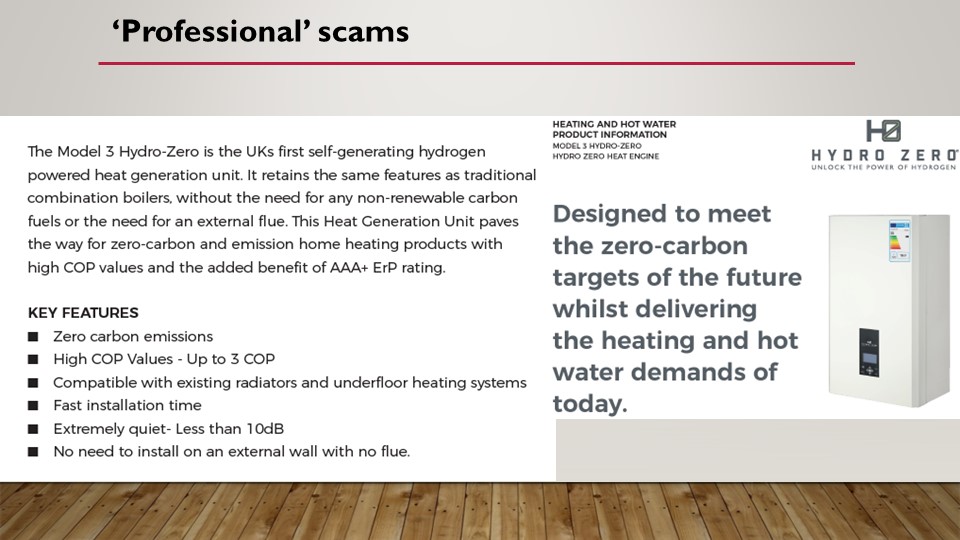
Lots of companies offer ‘wonder solutions’ online, but don’t be caught out by scams such as these:

Professionals have been ‘duped’ by rogue products such as the one below whose claims broke the first law of thermodynamics.

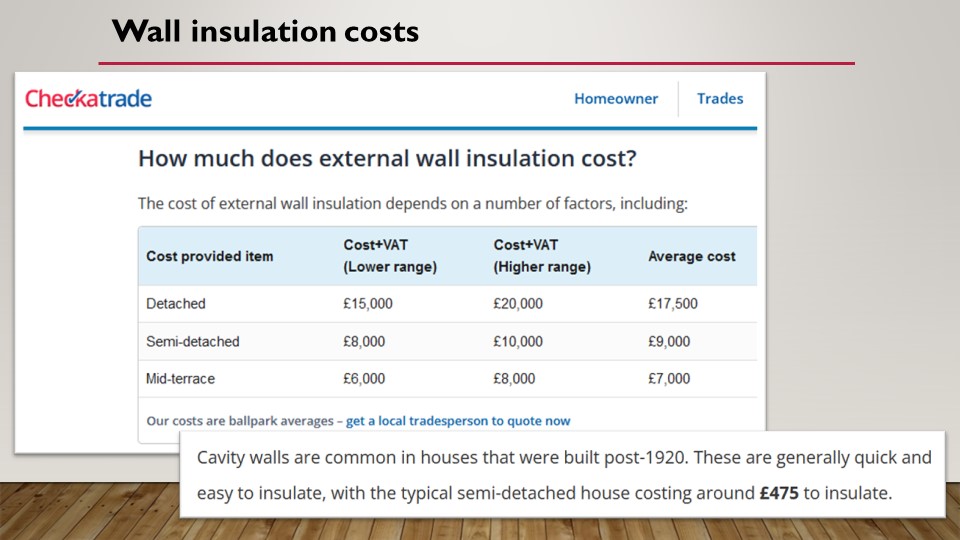
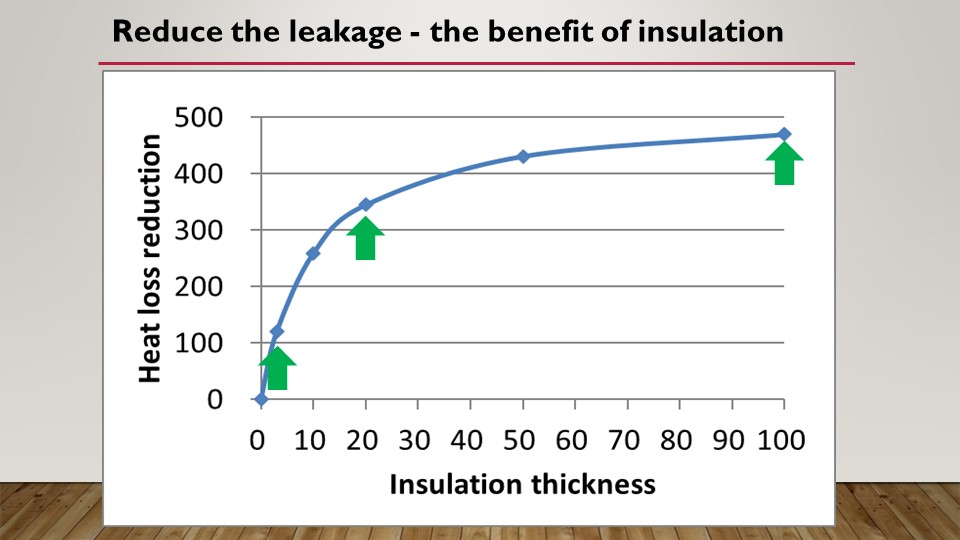
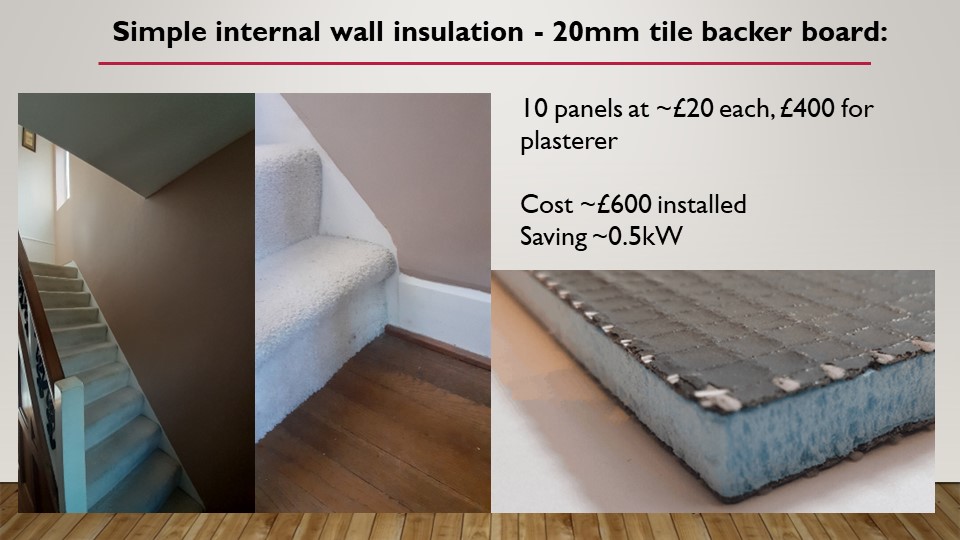
External wall insulation is just too expensive! Cavity wall insulation is great, and affordable, but a better solution is needed for solid walls. Physics tells us that there are decreasing returns from increasing the thickness of insulation. Just 20mm can be very effective.

Underfloor insulation is cheap from a material point of view, but disruptive and labour intensive. We needed to replace our joists and floorboards anyway so it was a cheap and obvious improvement. We tried two different insulation approaches – the solid insulation board was simplest and is the way I’d do it again.

The biggest benefit from double or triple glazing is the poor heat transfer between air and the surface of the glass, rather than the insulating property of glass or the air gap. We achieved this by a simple improvement to the original door glass and windows.

Curtains also reduce heat loss by the same mechanism. The thickness of the curtain material is less important than simply preventing the air passing from one side to another. The following temperature measurements either side of the curtain show the benefit when they are closed.

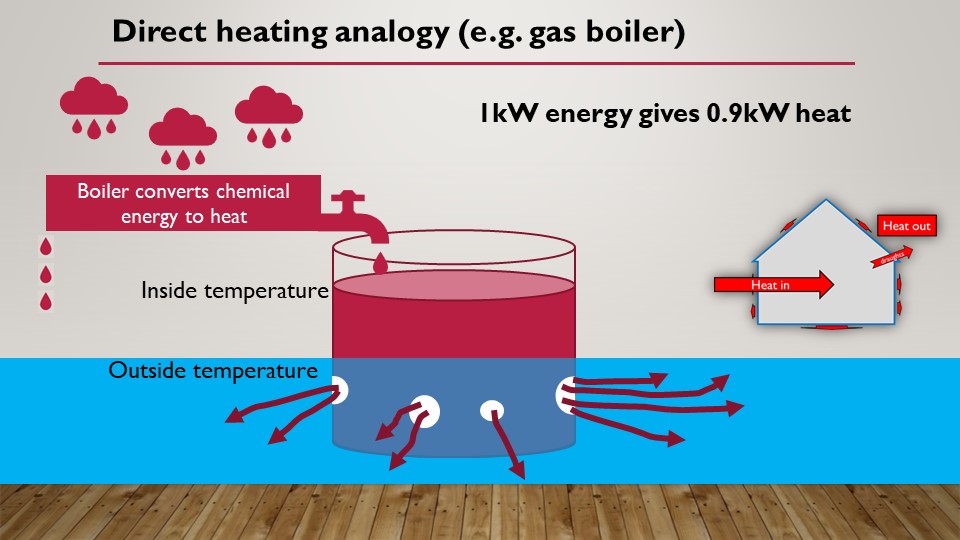
The biggest benefit in energy saving can come from choosing the best heat generator. The traditional approach is to use a gas boiler:

In contrast to converting chemical energy in the boiler to heat, a heat pump uses electrical energy to pump heat from the cold outside to the warm inside using the same thermodynamic process that cools the fridge and freezer in our kitchens.

Government promoted air to water heat pumps have a LOT of disadvantages, and will probably cost a little more to run than a gas boiler. No wonder they are not taking off!

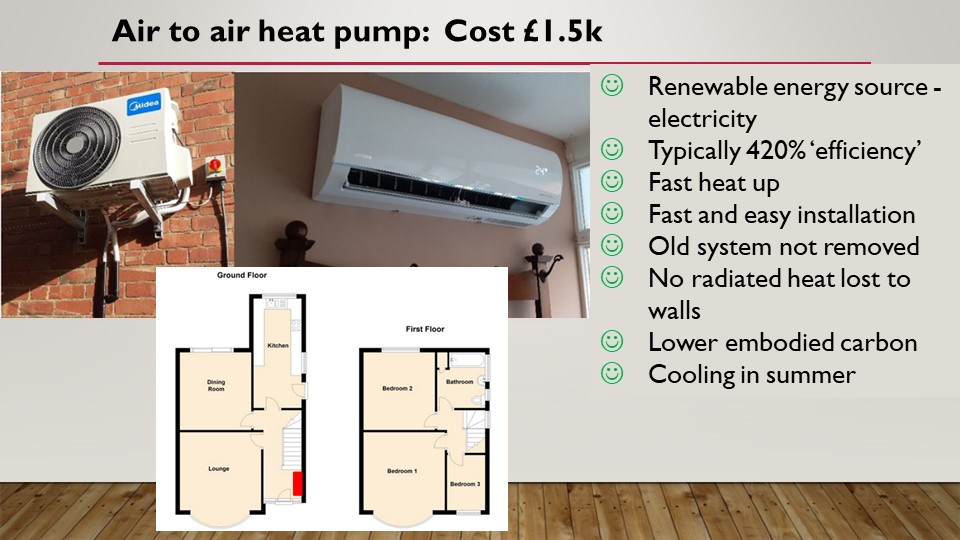
A far better alternative is a traditional air conditioning unit, which is an air to air heat pump – warming the air in the house directly and efficiently. It can be installed without touching the existing boiler and radiator system, which can be retained as a back-up.

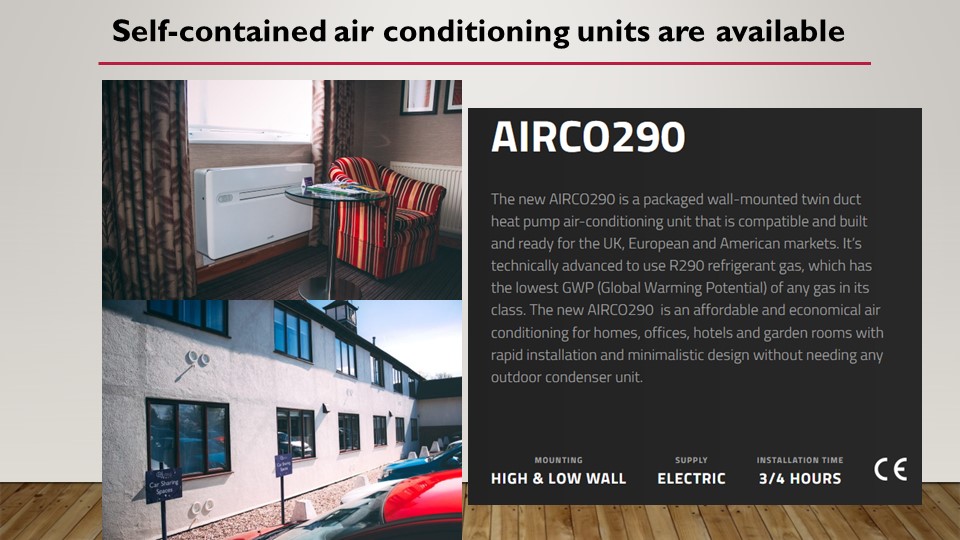
If you have nowhere to fit the outside unit of the heat pump, there are self contained units available that might solve the problem. They are slightly less efficient but are worth considering.

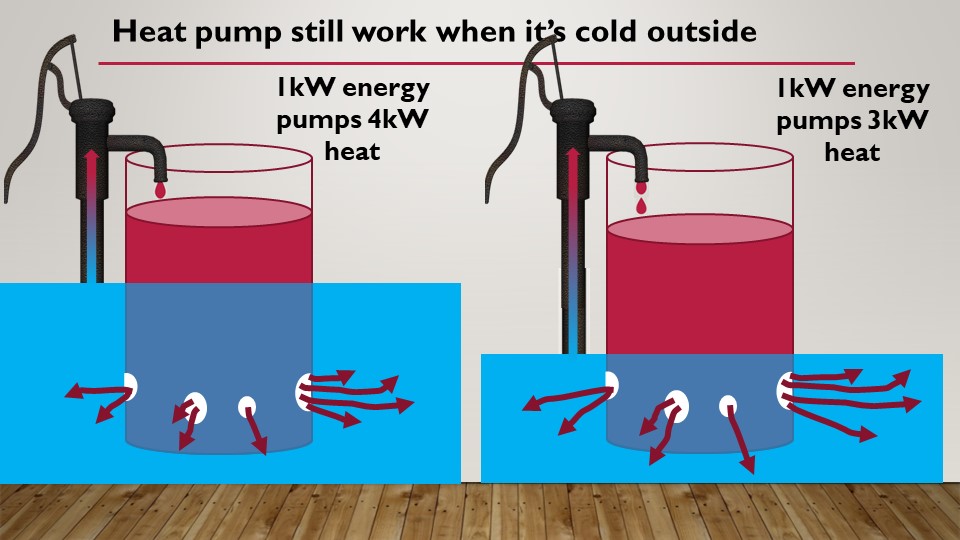
Don’t be misled by people who say heat pumps don’t work in cold weather. They do – although they will pump slightly less heat than in warm weather.

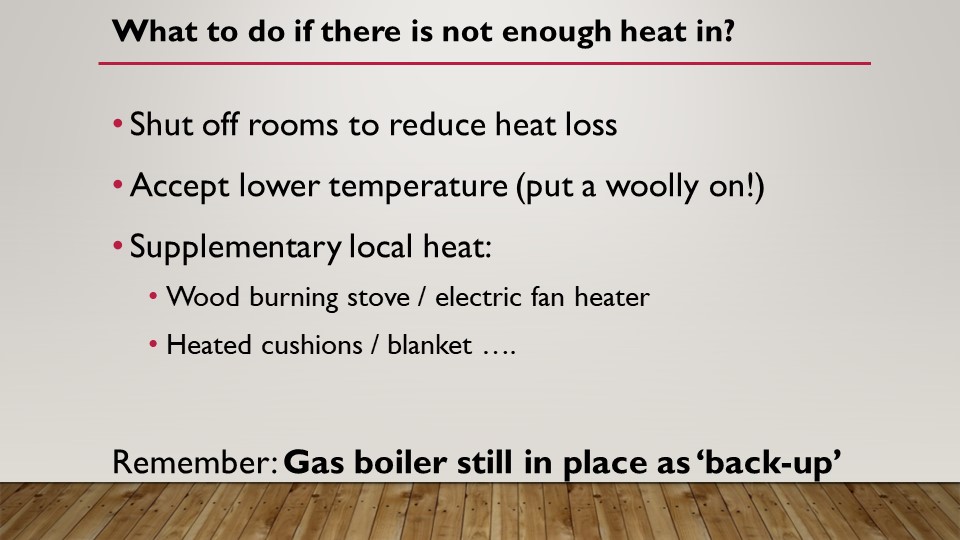
With any heating system, you will reach a point where you can’t get enough heat into the house to maintain the temperature.

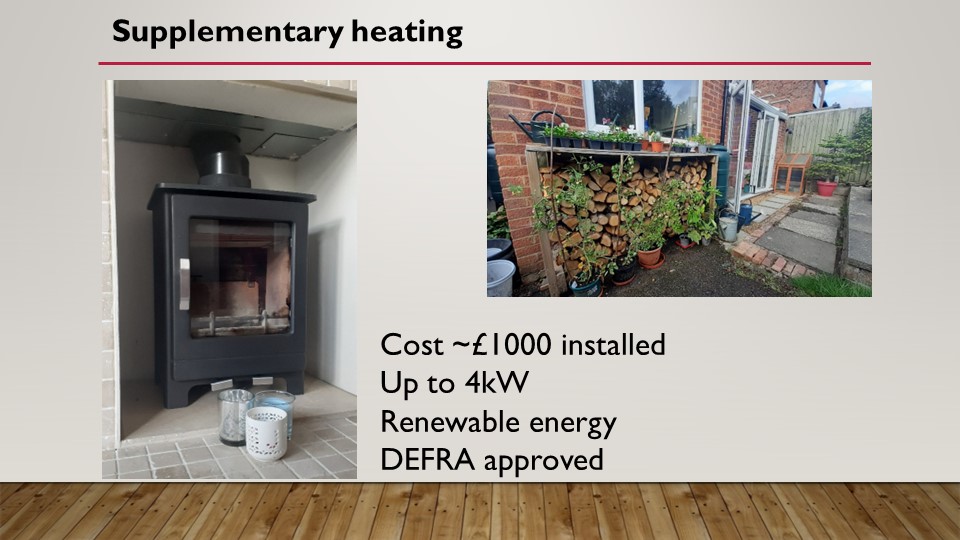
We fitted a DEFRA wood burning stove, and use waste wood that we season as fuel. This is carbon neutral as the wood would rot and give off it’s CO2 anyway.

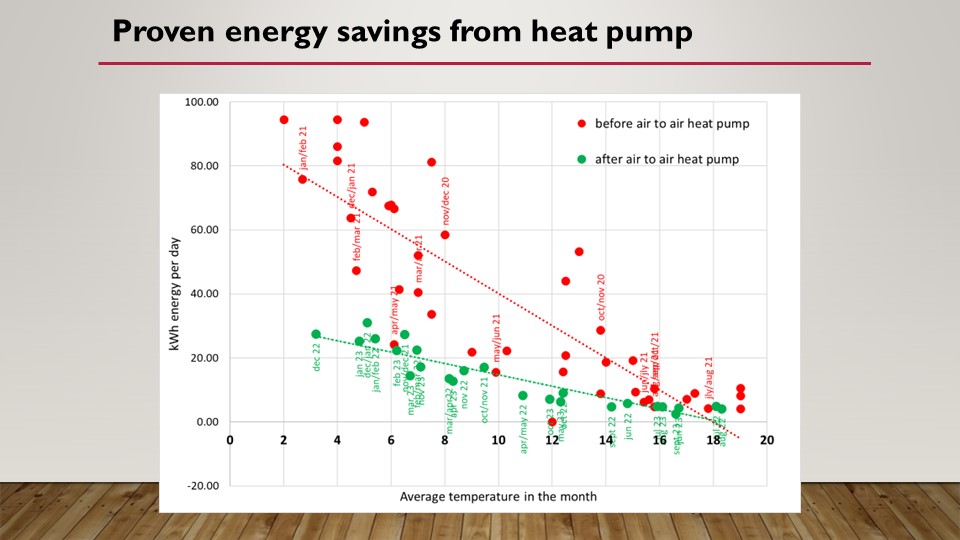
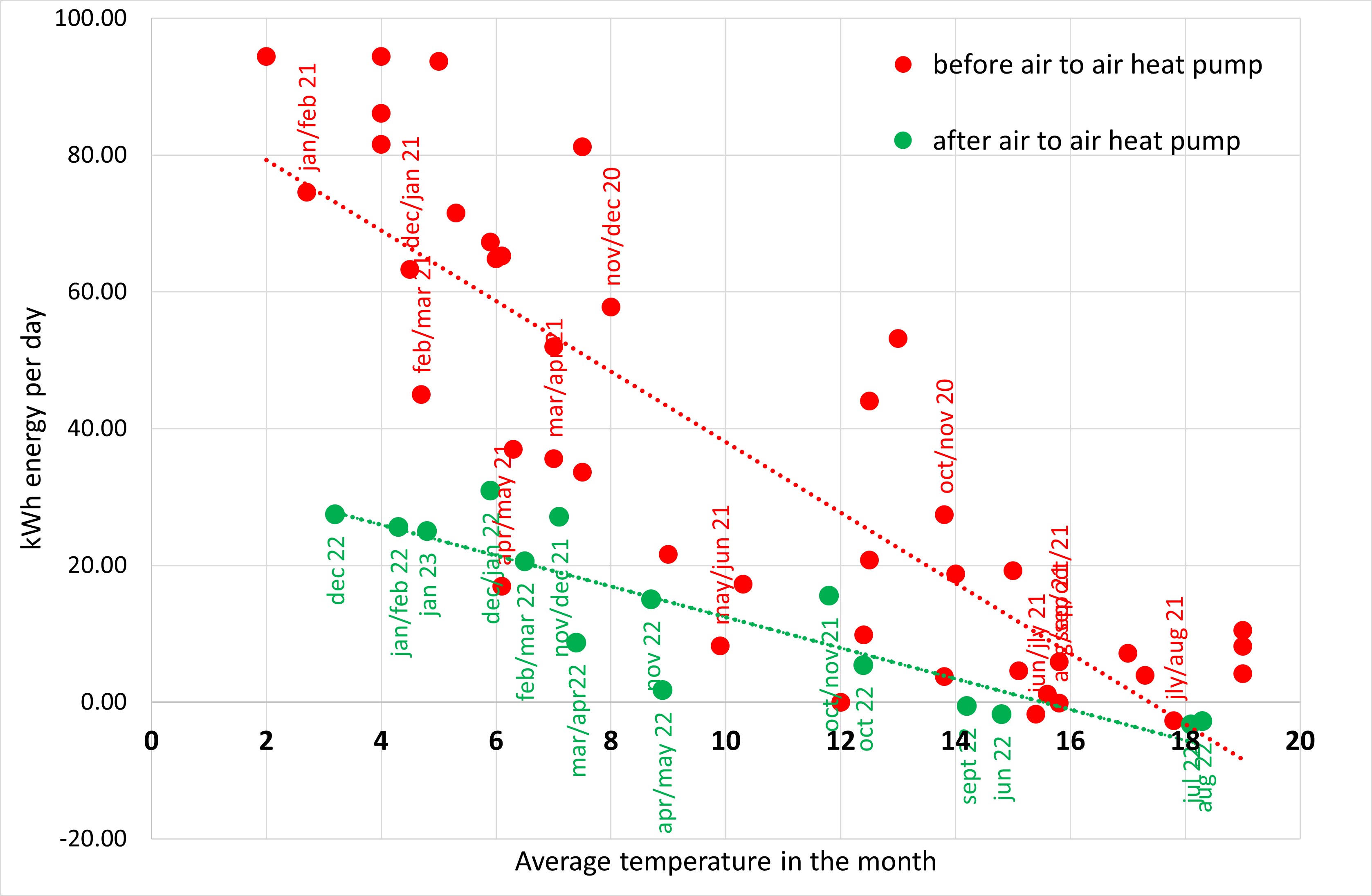
Energy measurements show that for the same heating demand (average outside temperature) the heat pump saves a large proportion of our energy – even when it is very cold. The total energy below includes heating, water heating, cooking, washing, TV etc. i.e. everything!

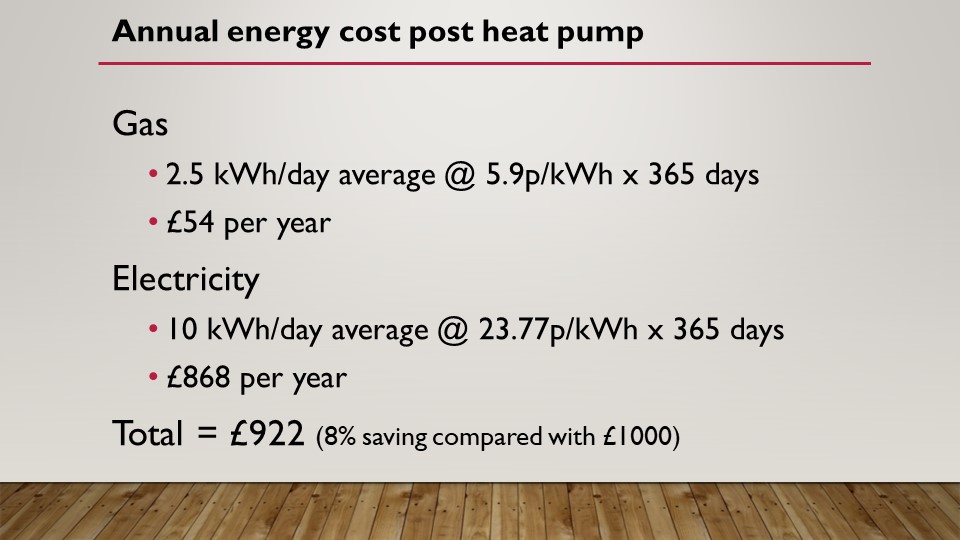
From the average daily gas and electricity use before and after the heat pump we can work out how much we have saved by fitting the air to air heat pump:

When buying a heat pump, it’s important to get the most efficient model. The cost difference will quickly pay back in energy savings, and the CO2 saving will be biggest.

Just a reminder of what can be done:

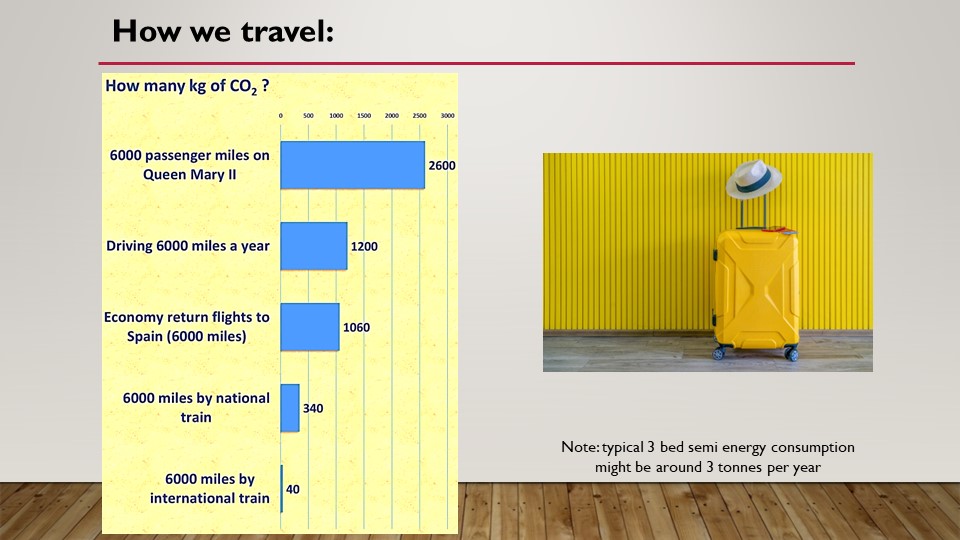
Housing is only a proportion of our CO2 footprint. The data below allows us to consider the benefit of changes to our life choices.

It’s a stark fact that those who are suffering most from our high CO2 production are those who produce least themselves and who are least able to bear the consequences. My wife and I run a small charity that sends funds to help some of the most vulnerable in Mozambique. A simple breeze block house can be life-changing, but will only cost around £1300. If you would like to join us in helping those in greatest need, or if you have simply found this helpful then please donate to the account below.

What is the best heating approach for CO2 reduction and cost effectiveness?

In this post I share some of what I have learnt and worked out about how to reduce the carbon footprint of heating a house. There is an awful lot of misinformation and misleading advertising out there, and very few have reached the most sensible solution, particularly for fitting in older houses. I hope that this post will help you choose the best approach. I hope I have achieved the right balance between technical detail and simple explanation, and I would welcome feedback on that. Clarity may improve over time!

The biggest use of energy in housing is heating.  The amount of heat required to maintain a temperature depends on the loss of heat from the building (e.g. heat loss through the walls). The energy required to provide that heat depends on the efficiency of the heat generator (e.g. boiler). The amount of carbon dioxide to heat the house depends on the CO2 released to produce the energy.

 The majority of a house’s carbon footprint is through heating and so having the most efficient way of generating heat is essential.  There are many different heat generation technologies. Some burn fuel and some use electricity to either directly converting it to heat (e.g. fan heater, storage heater) or by using the electricity to pump heat into the house from the environment.

Technical and economic comparison of different heat generation technologies

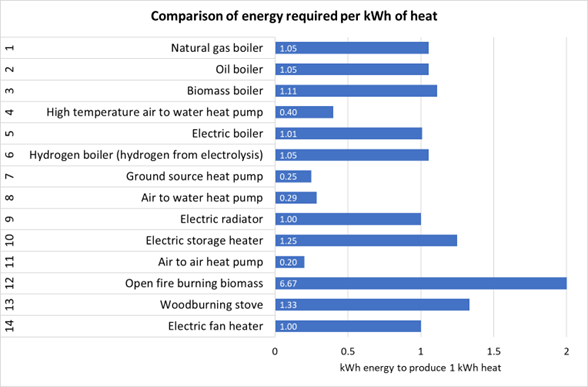
The following chart compares the heat generation efficiency of different heat generators, it shows how much energy is needed to provide 1kWh of heat. The best technology has the lowest value:

Most houses are currently heated via gas or oil-fired boilers. With that assumption, how easy are the different technologies to install?

1-6: can be considered as straight boiler replacements and offer the potential for relatively low disruption

7-8: can connect to an existing radiator system but would not provide the same heat input as the system they replace due to lower water temperatures.  They will need additional measures such as increased insulation, or increasing radiator size. Installation will be disruptive, taking several days at least.

9-10:  replace the present system and would need existing radiators to be removed to make space for the new heaters. Additional electrical wiring might be needed too. There would be some disruption.

11: can be installed quickly and with little disruption, perhaps in less than a day.  Existing heating systems can be left in place.

12-14: are supplementary heating options which may be valuable to ‘top up’ in cold weather or are suitable for infrequently used areas.

From an efficiency point of view all of the heat pumps are very attractive, although from a disruption point of view the water systems are quite disruptive to install.  The low disruption of fitting air to air heat pumps is very attractive.

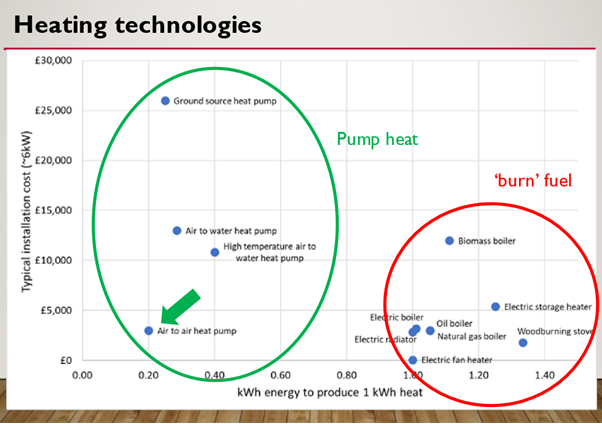
I have compiled some typical installation costs of the different technologies:

The water heat pump options are much more expensive than straight boiler replacement.  However, air to air heat pumps offer not only the highest efficiency but at a comparable installation cost to traditional boiler replacement.

The government is currently offering £5000 off the cost and installation of an air source heat pump (ASHP systems must be hydronic (air-to-water) to be eligible under BUS.  Air-to-air systems are not eligible.), £5000 off the cost and installation of a biomass boiler and £6000 off the cost and installation of a ground source heat pump, including water source heat pumps. This subsidy brings the costs closer, but they are still more costly and disruptive – perhaps explaining why uptake has been poor.

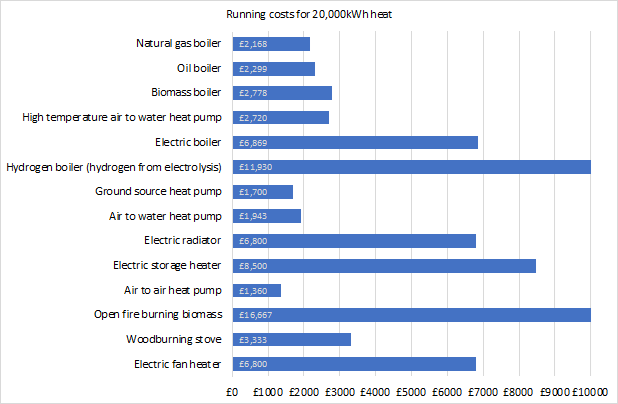
But what about running costs?  The following chart shows the comparative running costs to provide 20MWh of heat, based on energy prices of:

Electricity 34.0p/kWh (government price cap value)

Gas 10.3p/kWh (government price cap value)

Oil 10.9p/kWh

Biomass 12.5p/kWh (price paid by a friend with a biomass boiler)

Hydrogen 56.7p/kWh (cost of electricity / 60% electrolysis efficiency)

Although energy prices are rather unstable, this shows that the efficiency benefit of electrically driven heat pumps outweighs the price premium of the fuel.  If electricity is generated ‘for free’ on site by solar panels perhaps, then the benefit will be larger.

Based on the data above, it is clear that heat pump technology must form the basis of the net zero heating approach, and that air-to-air heat pumps are by far the most attractive having the lowest installation and running costs and the highest efficiency. Additionally air to air heat pumps (air conditioning units) offer the benefit of being reversible and being able to cool the home in summer heat waves.

Heat pumps don’t work the same way as boilers

We need to understand the behaviour of heat pumps, because they don’t provide heat in the same way as burning fuel.   Instead, they use a refrigerant cycle (just like on a fridge or freezer) to pump heat from a cold temperature to a hot temperature. 

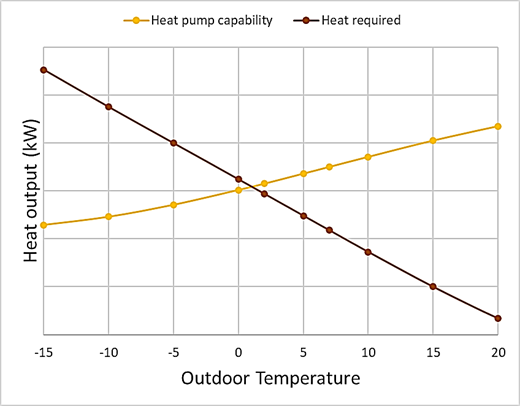
A heat pump has a certain amount of power. If you are pushing a car up a steep hill you can’t push such a heavy car as you could on the flat, and similarly a heat pump can’t pump so much heat when there is a big temperature rise between outside and inside. At cold outside temperatures, the heat pump capability reduces – they still pump heat, but just not quite so much.

However, as the outside temperature reduces the amount of heat leaking out of a building increases; at cold outside temperatures the amount of heat needed increases. 

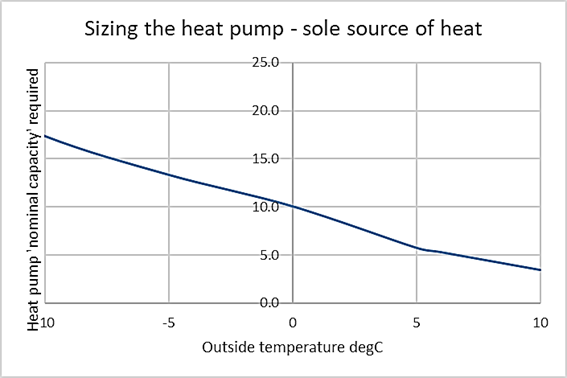
These two factors mean that the increase in design size of the heat pump for satisfactory heat in cold climates is rather bigger than for a conventional boiler. This is shown graphically here:

The following chart shows an example of how the heat pump rated output needs to increase as the design external temperature decreases, taking into account the need for more heat at lower temperature and the reduction in heat pump output at lower temperature.

If we choose a heat pumps size that can cope with a very low outside temperature, then we need a big heat pump.  So if we decide we must rely only on the heat pump at minus 10C then the heat pump will need to be 3.5 times bigger (and more expensive) than if we design the heat pump down to plus 5C. 

If we were to design for 5C, then what do we do when the outside temperature drops to -15C? In simple terms we need to provide some additional supplementary heat. There are many ways of supplementing the heat from the heat pump, perhaps by using a wood-burning stove, or electric fans. 

However, for the air to air heat pump solution, and attractive option in a ‘retrofit’ situation is to retain at least part of the current heating system as a ‘backup’ – for use only in the coldest weather.  In other words: if you fit an air to air heat pump, don’t rip out the current central heating system – just avoid using it unless absolutely necessary. 

This is not an option if the boiler is being replaced by an air to water system or a ground source heat pump system.

How many units, and where to put them?

In a traditional radiator based heating system, you can work out the heat needed for each room and put in a suitably sized radiator – each room having at least one radiator. Many radiators are only 1kW or less. If you are retrofitting air to air heat pumps you may want to economise significantly on that option, not least because the smallest internal unit is typically over 2kW.

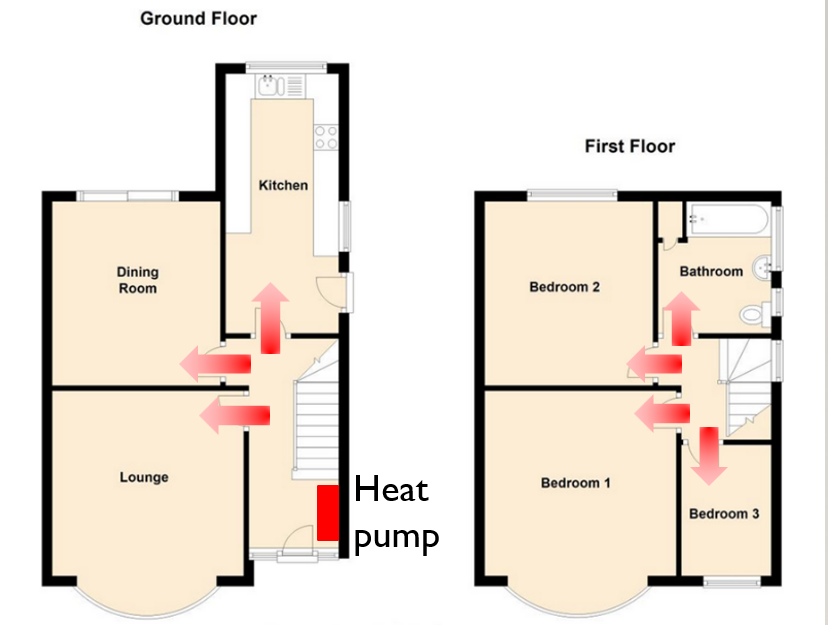
In my own home, a traditional 3 bed semi, we have 8 rooms and had 8 radiators. We chose to fit a single internal unit in the hallway and our experience shows that we could heat all the rooms adequately simply by allowing the heat to dissipate through open doors into the occupied rooms. The temperature in the hallway needs to be higher than the temperature required in the other rooms – so if you follow a similar approach you will need to experiment with the ideal temperature setting on the air-con unit to sufficiently heat the other rooms. We also find that this approach does not heat the bedrooms to such a high temperature as the downstairs rooms. This suits us, but to avoid this, fit an internal unit on each level in the house.

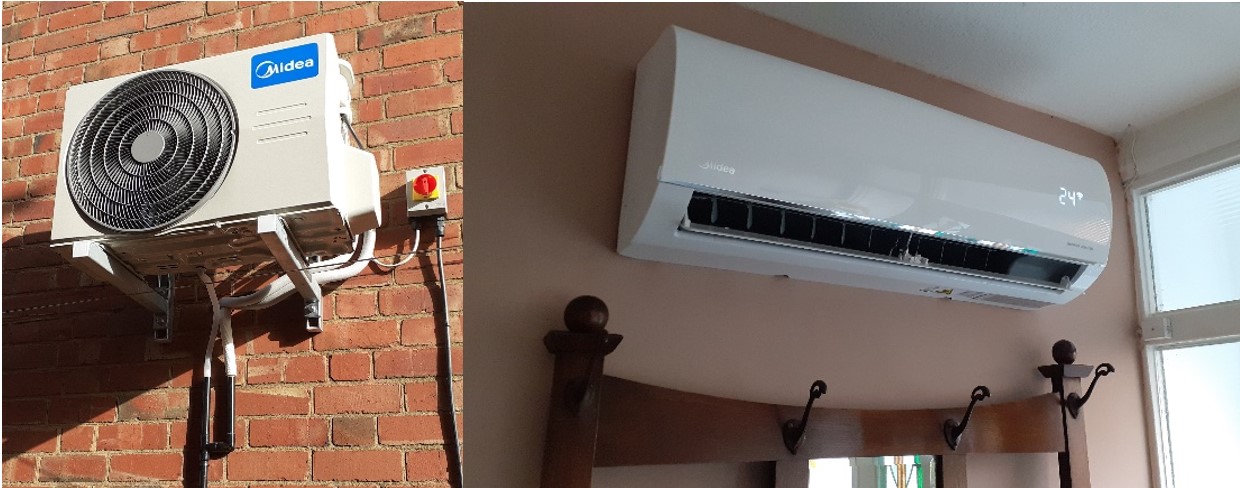
The picture below shows our internal and external units.

A single unit may not be sufficient for a larger our more complex house, but it is very likely that two or perhaps three internal units would be enough for most houses. There is perhaps as much art a science to where to put them, but think about where you would put a fan heater to best circulate the heat – that is in effect what these units are.

Note too that the internal unit does not need to be mounted on an external wall. Indeed, the most effective position may be in the middle of the house so that for the heat to finally escape it will pass through all the other rooms.

Often there is a single external unit for each internal unit, but a ‘multi-split’ system can provide many internal units run from a single external unit.

Our heat pump is size matches the steady state heat loss at around zero degrees outside temperature. In comparison, our boiler heat capability is perhaps five times as big. This high capacity is needed because traditionally the boiler would be turned off to save energy at night or when the house is unoccupied, and so a very high heat input would be needed to bring the temperature back up to comfort level. Since the heat pump is so efficient it can be run 24 hours a day, maintaining the temperature and avoiding the need for a short burst of high energy consumption. So, unlike a central heating boiler, the total heat pump capacity needs to be selected to match the steady heat loss from the house.

If you want an idea of how big a heat pump you might need, you could use an online radiator size calculator such as https://www.bestheating.com/btu-calculator for each room, and then add up the total for the house. This is likely to be rather higher than the steady state required, as the radiators need to be able to heat the house quickly from cold perhaps twice a day and to deal with the very coldest outside weather. I developed my own calculator to work out the heat loss, and taking into account the characteristics of a typical heat pump I can work out a heat pump size.

In conclusion – I hope that this is helpful, but it is a quite abbreviated summary of my experience and it may not be written as clearly as it should. If you have any comments or feedback, please get in touch. Thanks.

The secret heat pump that doesn’t cost the earth

There is a lot of noise about air source heat pumps at the moment, and in particular air to water heat pumps that replace the gas boiler in your house and feed the radiators. Heat pumps are extremely energy efficient, because instead of generating heat (from gas or electricity) they pump heat from outside a building to the inside. They might pump 3 – 4kW of heat for every 1kW of electricity that they use.  But systems that replace your gas boiler are costly, according to the Energy Saving Trust “Typical costs are around £7,000 to £13,000” https://energysavingtrust.org.uk/advice/air-to-water-heat-pumps/

An air to water heat pump system typically heats the water to 50 degrees C. This is lower than a normal central heating boiler, and so you might need bigger radiators for the system to provide enough heat to each room, or expensive additional insulation to reduce the heat demand. Air to water heat pump systems need space for the internal plant, and installation will take days and be very intrusive. This is probably why the government has little take up of the Boiler Upgrade Scheme.

There is an alternative to these expensive air to water heat pumps, namely air to air heat pumps – commonly called air conditioning units.

In an air to air system, instead of the heat pump being used to heat the water for your central heating radiators, it heats the air directly in a fan unit inside the house – hence the term “air to air”.  In effect, it is an extremely efficient fan heater. Air to air heat pumps are better known as air conditioning units because they have the additional advantage of being able to provide cooling in summer, making life bearable when outside temperatures are 40+ degrees.

We live in a typical 1930s 3 bedroom semi-detatched house with solid walls. We paid around £1500 for a 4kW air conditioning unit. It was installed in less than a day and sited in the hallway it provides heat to all the rooms in the house.  There is none of the ‘plant’ associated with air-to-water heat pump systems and so no loss of space.   Because the unit pumps heat, it only takes 1kW of electricity to provide 4kW heat – the most efficient heating technology on the market.

These pictures show the internal and external units.

We have been delighted with the performance.  The heat from the hall dissipates throughout the house through open doorways (both upstairs and downstairs), and we can avoid heating rooms that we don’t use simply by closing the doors. 

We have retained our gas boiler to heat our water, but have removed several radiators. We have kept a few as backup but have not had to use them. We have a wood burning stove to lift the living room temperature in the evenings and provide supplementary heat in the very coldest weather. Our only ‘regret’ is that we didn’t fit a slightly bigger unit, which would be better when temperature outside reached -5 to -7 degrees.

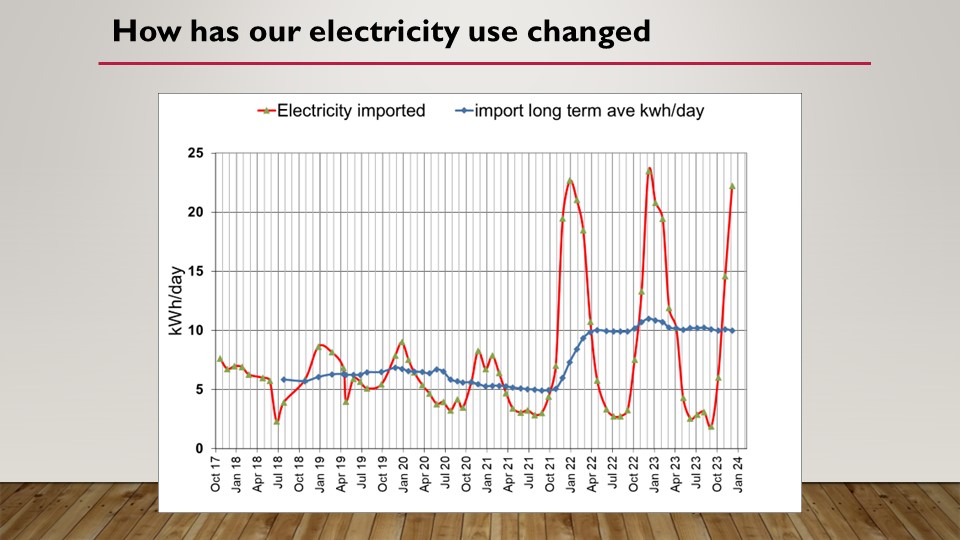
The chart below shows how much our energy consumption has changed as a result of the heat pump. Combined with our solar panels and renewable electricity supply, our house is now net zero.

In summary, there is a readily available, low cost, low disruption, extremely high efficiency heat pump available which you can install straight away without having to make your radiators bigger or spend thousands on insulation, and which will also provide cooling in summer.

So why haven’t we heard of this before? I don’t know – but you are in on the secret now.

Living with Hope in the Climate Tragedy

There are different phases as a tragedy unfolds.  Perhaps like when someone is diagnosed with terminal disease.

First of all, there is ignorance – the problem is not known about.  The tragedy is ‘undercover’ and waiting to unfold.

Then there is awareness – maybe a doctor’s diagnosis, or a smoke alarm going off in the middle of the night

Then there is anguish – the understanding of what is to come suddenly becomes real, and heart wrenching.

  • Reading up on the illness
  • Realising that flames have taken hold
  • First picture of the invasion of Ukraine
  • Seeing an ancient woodland being torn up for HS2, or the Amazon being burned down for cattle farming
  • The disciples seeing Jesus arrested, tied up and carried off by the mob

We are desperate to do something, we want the tragedy to stop and do all we can to prevent it.  Even if what we do will make no difference, we need to do it – mopping someone’s brow, sitting by their bedside.  Throwing buckets of water on the flames.  Striking off an ear.

We get frustrated and angry with others who get in the way – holding us back from putting out the flames.  Setting regulations preventing us from even seeing our child suffering in hospital, let alone hugging them tightly.

The anguish grows the more we care.  If we hear of a distant acquaintance getting cancer we might say ‘ah well, that’s sad’, but if it’s our child, or our spouse it is like a kick in the stomach.

The anguish gnaws our heart and becomes almost unbearable.

And when we are in the middle of a crisis and we realise there is no hope, anguish turns to despair:

No matter what we do, Russian troops are still pounding Ukrainian cities with artillery.  No matter what we do, the cancer is spreading.  And Jesus is bound, beaten, and nailed to a cross – and we are helpless to do anything.  But we continue to try. And we cry out in despair, even though hope is gone.

And then it is finished.  Grief takes hold as we look on the result – the dead child, the burnt house, the destroyed city, the body taken down from the cross.

The mourning for what was, for what has been lost, for what could have been.

The feeling of purposelessness – what is the point of anything anymore?  Why bother?

Hope has gone.

We are in a global climate tragedy.  Humanity is destroying life on this planet. We are condemning future generations to extreme climate and weather events, to suffering, to rising sea levels, maybe to extinction.

It’s actually a multitude of mini tragedies.  Each goes through the same stages, but they are relentless. At the grieving stage of one, another is waiting.  And they combine into one big tragedy.

In the past few of years I have become more and more aware of the desperate situation that the world is in.  The relentless rise in CO2 and average temperature.  The worsening climate disasters and weather events.  The melting of glaciers, Greenland ice and the poles.  The extinctions, and destruction of life.

That took me deep into the anguish phase – prompting me to do what I can!

My wife and I have invested our money and made changes in our lifestyle to radically reduce our CO2 footprint – almost meat free diet, using the train instead of flying, insulating our house, fitting solar panels and a heat pump – our house is now carbon neutral! 

I invest a lot of time and energy trying to put the message across to others, researching the facts and trying to put them into simple terms.  There is some encouragement when we see others doing the same, and when we see vegan burgers that taste like meat, plant-based butter, and other replacements for meat produce.

But people still don’t realise the scale of change needed, or the urgency: 

According to a poll carried out in G20 countries the vast majority – 83% – said they wanted to do more to protect and restore nature. However, when asked what actions they would take, they prioritised increasing recycling and avoiding excess packaging. ‘Higher impact changes like diet change and flying less are consistently bottom of their list,’ said Sophie Thompson, part of the Ipsos MORI team that carried out the survey.”

I can see that the technology is available, but action is too slow.  The world still wants to follow the rules of financial justification.  And poor countries rightly want to experience the same quality of life that rich countries do, and so don’t want to sign up to CO2 targets.   Time is running out – it has already run out for several mini-tragedies, but there is little sense of urgency. 

The steady stream of cars and trucks, the rush to book flights after covid, the meat-fest menus, people buying multi-packs of plastic bottled water, the waste …. You can’t get away from it, the relentless ‘in your face’ inaction that says, “I don’t care”, but that I realise may simply be “I don’t know”.

I moved beyond anguish to despair.  And sometimes I have felt I need to give up completely; get a log cabin on the coast in Northumberland and watch the sea.

And then I realised that whatever I do, much more climate change will happen.  Even with all the current government pledges, global temperatures will continue to increase.  And to imagine that our institutions will honour climate commitments, or that individuals will change enough to prevent further deterioration is to delude ourselves.  But also, for the majority world to be dragged out of poverty to share the lifestyle that I have enjoyed since I was born will need increased carbon emissions.  Population will grow as better sanitation, medicine and housing allows people to live longer – consuming more energy through their lifetime.  Reading the signs shows that CO2 emissions will rise further, and global warming will go beyond 2 towards 3 degrees – or higher!  It’s going to happen and nothing I can do will stop it.

And I entered the grief phase.  Do we ever leave that phase?  We recognise what is lost, or what is destined to be lost and it saddens us deeply.  Accepting the loss, the grief means the intensity of feeling fades.  The loss is still there, and we are no longer frustrated and angry at our helplessness.  And we are changed. 

And where is God in this?

“Father, in our despair, in our grief, bring us hope.  Show us the hope we can bring to others.  Tell us what you want us to do.  And give us the courage we need to act.  Amen”

God’s hope comes from where it has always come – but we have forgotten it.

There is nothing I can do that will prevent climate change.

There is nothing I can do that will prevent the powerful having their way.

There is nothing I can do that will make the world good.

These are things that are beyond the power of the individual.  It has always been so, and in a world where many choose selfishness over goodness it will always be so. 

My individual goodness does not make the world good.  The omnipresence of the spirit of goodness acting in all individuals could make things good, if each individual were to respond.  We can see this – if only everyone was good, then the world would be a good place; it would be heaven!  And it is because ‘they’ are not good (we are not either!) we find ourselves responding with anger and frustration and are tempted to despair.  

In the battle for good to prevail we have a great ally in ‘The Law’.   Laws, enforced by appointed guardians, codify what we understand to be good.  The law limits the power of the selfish, those who don’t respond to the spirit of goodness.  The law tries to teach what is good behaviour – but the law is made by human hands trying to define goodness.  Human hands can be wrong.  Human hands can corrupt the law.  And so the law does not reach goodness.  Although we say that nobody is above the law, the law is not above goodness.  We cannot be fully good by following the law.

The law is a powerful tool towards preventing climate change, and towards preventing the powerful having their way.  It is good and necessary to have good laws, but those who have the power to make the law are also those who have personal interests to serve, and so they do not always make good laws.  And people do not always keep the law.

So where is hope?

Christian hope comes from the power of the spirit of God; from a bigger picture that we have forgotten. People in the past understood that there was a life to come, that this world is not all there is.  The bigger picture is that we are offered everlasting life, against which this world fades into nothing.  Everlasting life in a new world where everyone chooses to be and is truly good, in the presence of the spirit of goodness and love.

My wife Cathy writes that:

“humanity has always been up to its chest in its own mire, mistakes, and sin. Because we live relatively fulfilled lives, we can forget that most people did, and still do, endure lives of fear, pain, hunger, death, and drudgery. Consider the slums of Victorian England, the lives of medieval peasants, the wars and diseases that have stained our history. It has always been thus. The Bible shows that this is the story of humanity: drowned in our self-inflicted suffering, with no hope that we can rescue ourselves, but that somehow, beyond anything that we can possibly understand, God has intervened to initiate a great rescue plan. That at some point, the mess will be tidied up and ‘every tear will be dried’.”

Many passages in the Bible describe this hope:

‘Look! God’s dwelling-place is now among the people, and he will dwell with them. They will be his people, and God himself will be with them and be their God.  “He will wipe every tear from their eyes. There will be no more death” or mourning or crying or pain, for the old order of things has passed away.’

He who was seated on the throne said, ‘I am making everything new!’ Then he said, ‘Write this down, for these words are trustworthy and true.’

He said to me: ‘It is done. I am the Alpha and the Omega, the Beginning and the End. To the thirsty I will give water without cost from the spring of the water of life.  Those who are victorious will inherit all this, and I will be their God and they will be my children.

And from the apostle Peter:

Praise be to the God and Father of our Lord Jesus Christ! In his great mercy he has given us new birth into a living hope through the resurrection of Jesus Christ from the dead, and into an inheritance that can never perish, spoil, or fade. This inheritance is kept in heaven for you, who through faith are shielded by God’s power until the coming of the salvation that is ready to be revealed in the last time.  In all this you greatly rejoice, though now for a little while you may have had to suffer grief in all kinds of trials.  These have come so that the proven genuineness of your faith – of greater worth than gold, which perishes even though refined by fire – may result in praise, glory, and honour when Jesus Christ is revealed.  Though you have not seen him, you love him; and even though you do not see him now, you believe in him and are filled with an inexpressible and glorious joy, for you are receiving the end result of your faith, the salvation of your souls.

Cathy continues

“I find hope in the belief that every person is unique, loved, precious.  That every person has something incredibly valuable to offer to others, whether teaching, engineering, dancing, poetry, cooking, listening, encouraging, smiling, gardening… and that God wants everyone to have the chance to grow into their own potential.  So, as part of His rescue plan, the child that drowns in Pakistan will – somehow – be restored, healed, and given the chance to become its full self.

Furthermore, I think that the earth itself, and all that lives on it, is also valued and precious to God.  That the koala bears that died in the fires in Australia, the glaciers that have disappeared, the animals hunted to extinction, the trees killed by drought, the hedges uprooted, may also be restored.

But this isn’t a ‘pie in the sky’ hope that gives me an excuse to do nothing now. I believe that I am called to take part in this great plan, and that my actions; not flying abroad but taking the train, moving to a more plant based diet, donating to charities to help feed the poor or plant trees, turning down my heating thermostat, biking more; are part of a great unnoticed movement of rescue.

I think and hope that the kingdom of heaven, a kingdom of fairness and wisdom, will be established in a restored, peaceful, green earth; bursting with life and enjoyed by loved, healed and beautiful people living their lives to the full.  And I believe that my efforts towards that are not wasted.”

So there is hope in the future, and purpose in what we do now.  But in the now there is more than just duty and hope for the future. We can and need to find happiness, peace, and joy. I have found some secrets to this in a short book called ‘Finding Happiness’ by Abbot Christopher Jamison.  And even if we do not accept the Christian hope we can benefit from the wisdom of the ancients.

Considering the ideas of the philosopher Plato, he describes that “contemplation of the good and the beautiful is Platonic happiness”.  Taking time to really observe and to absorb into ones immediate being that which is good and beautiful draws out joy and wonder.  A form of worship is appreciating the beauty of an ever-changing landscape, the journey of a piece of music, the wholeness of a novel.  Goodness and beauty contemplated in every diverse opportunity, fought for against the pressures of the rush of daily life, brings peace, joy, and happiness.

This is what the Apostle Paul said too, ‘brothers and sisters, whatever is true, whatever is noble, whatever is right, whatever is pure, whatever is lovely, whatever is admirable—if anything is excellent or praiseworthy—think about such things.’

Abbot Christopher also tells us that “Happiness for Aristotle is ‘the activity of the soul expressing virtue’.  So in essence where Plato sees happiness as contemplation, Aristotle sees happiness as living virtuously.”  The call to action that Cathy described is thus not just a call of duty, but a call to happiness.  Living virtuously brings happiness. It will take courage, and effort, and perseverance.  It will test our reserves and frustrate us.  But as we persist in scrupulously examining our actions and our motives and seeking to live virtuously then we will begin and grow happiness in our lives.

Again, Paul wrote “For we are God’s handiwork, created in Christ Jesus to do good works, which God prepared in advance for us to do.”  Doing good deeds is part to becoming who we are.

We are not responsible for anyone’s behaviour but our own. That’s why the world is in the state it is – many choose the selfish path to death.  And as a consequence, we will experience global warming way beyond where it is today.  It is a tragedy, but it is the same tragedy that has been unfolding since the world began – the tragedy that many choose the path of selfishness.  But let us choose to be a people of hope.

A heat pump strategy that works.

The government heat pump strategy is on the rocks.  I present an alternative, with data to prove that it would work.

The government is offering a ‘boiler upgrade scheme’ whereby the present boiler is replaced by a heat pump.  This is failing because the cost of the heat pump are typically over £7000[i].  And on top of that, radiators may need to be increased in size in order to provide the same heat as the boiler that is being replaced.  Installation would be disruptive and take many days.  People are unfamiliar with the technology (although it is in their fridge) and don’t want to risk it not working properly, or the efficiency gains not being as high as expected.  The approach is an ‘all or nothing’ approach, whereby the existing heat source is scrapped and fully replaced – there is no going back if it doesn’t work.

An approach that would work, and which I have demonstrated successfully in my own home, is to provide a high efficiency heat source that provides a base load of heat in addition to the present boiler system

The high efficiency heat source uses heat pump technology, but without the complication of integrating with a water radiator system.  The ratio of heat out to electricity in is around 4 to 1, which is better than that of the boiler replacement heat pump which in practice only offers around 2.7 times as much heat as the electricity it consumes[ii].

The technology is air conditioning air to air heat pumps. It is well proven, and we encounter it every day without realising it in shops, offices, and hotel rooms.  It works.  It is many times cheaper, simpler, and faster to instal.  And in addition it can provide cooling to make life tolerable in heat waves – something that will be more important in the future.
Let me describe our application.  We have a traditional 3-bedroom semi-detached house built around 1930.  we have fitted an air-to-air heat pump in our hallway, which provides around 4kW heat for around 1kW electricity.   Installation took half a day, with minimal disruption.  The outdoor unit is on the wall back-to-back with the internal unit, with no pipe runs inside the house.  The cost was under £1500, a fraction of what we were quoted for air to water systems.

We retained our gas combi-boiler to provide hot water, and to allow us to top up the heat if needed.

For every kilowatt hour (kWh) electricity to the heat pump, the gas usage reduces by 4 kWh.  The question is how many kWh the heat pump can provide.  Our house needs around 7000kWh heat per year, using up to 60kWh gas per day in mid-winter.  A 4kW heat pump running flat out could provide 4kW x 24hr = 96kWh of heat per day – more than enough to eliminate the need for the gas boiler, and offering the possibility to reduce our energy use by 75%.

But how did it perform in practice?  It performed well! 

The chart below shows our total energy use, which includes heating, cooking, washing up, showering, watching TV – everything.  As you can see achieved big energy savings.  Not quite 75% each month, but dramatic.  Over the heating season we saved 5500kWh of energy.  Since the cost of electricity is much higher than gas, at today’s tariffs you won’t expect to save a lot of money (we saved less than £50 over the winter) UPDATE – WITH THE NEW ENERGY CAP RATES THIS WILL SAVE US £180 PER YEAR . 

In order for the heat to spread around the house we set the heat pump temperature to maximum, and to maximise the heat into the house we left it running overnight in the coldest weather.  Both of these reduced the real saving compared to the theoretical, but both made the house warmer and more comfortable.  Remember that this approach still leaves the opportunity of using the gas boiler.

Although it is important not to use the cooling function unless really necessary, the technology makes life manageable in the ten or so days of extreme temperature in the summer.

So what’s the way forward?

If you are willing to spend £1500 to cut drastically cut your carbon footprint and save you £1200 each year then why not just go for it. 

Or perhaps the government might adopt a strategy to encourage roll-out.

The government has set aside £450 million for the boiler upgrade scheme, offering £5000 per installation[iii]. If successful, that would provide the less efficient heat pump solution to 90,000 homes – and only in households that can afford the difference between the grant and the actual cost.

Instead, it could channel the same budget into air conditioning heat pumps as described above, offering perhaps £1000 per home, that would provide highly efficient heat pump solutions to 450,000 homes – including those who are less well off. 

We have found that several friends and acquaintances have followed our example, having seen how the technology works, and so the 450,000 homes might well encourage another two homes each, giving a total of nearly one and a half million homes saving 5000kWh each per year. Now that would be a heat pump strategy that worked.


[i] https://energysavingtrust.org.uk/advice/air-source-heat-pumps/

[ii] https://assets.publishing.service.gov.uk/government/uploads/system/uploads/attachment_data/file/606818/DECC_RHPP_161214_Final_Report_v1-13.pdf

[iii] https://www.greenmatch.co.uk/blog/clean-heat-grant

The secret heat pump that doesn’t cost the earth

There is a lot of noise about air source heat pumps at the moment, and in particular air to water heat pumps that replace the gas boiler in your house and feed the radiators. Heat pumps are extremely energy efficient, because instead of generating heat (from gas or electricity) they pump heat from outside a building to the inside. They might pump 3 – 4kW of heat for every 1kW of electricity that they use.  But systems that replace your gas boiler are costly, according to the Energy Saving Trust “Typical costs are around £7,000 to £13,000” https://energysavingtrust.org.uk/advice/air-to-water-heat-pumps/

An air to water heat pump system typically heats the water to 50 degrees C. This is lower than a normal central heating boiler, and so you might need bigger radiators for the system to provide enough heat to each room, or expensive additional insulation to reduce the heat demand. Air to water heat pump systems need space for the internal plant, and installation will take days and be very intrusive. This is probably why the government has little take up of the Boiler Upgrade Scheme.

There is an alternative to these expensive air to water heat pumps, namely air to air heat pumps – commonly called air conditioning units.

In an air to air system, instead of the heat pump being used to heat the water for your central heating radiators, it heats the air directly in a fan unit inside the house – hence the term “air to air”.  In effect, it is an extremely efficient fan heater. Air to air heat pumps are better known as air conditioning units because they have the additional advantage of being able to provide cooling in summer, making life bearable when outside temperatures are 40+ degrees.

We live in a typical 1930s 3 bedroom semi-detatched house with solid walls. We paid around £1500 for a 4kW air conditioning unit. It was installed in less than a day and sited in the hallway it provides heat to all the rooms in the house.  There is none of the ‘plant’ associated with air-to-water heat pump systems and so no loss of space.   Because the unit pumps heat, it only takes 1kW of electricity to provide 4kW heat – the most efficient heating technology on the market.

These pictures show the internal and external units.

We have been delighted with the performance.  The heat from the hall dissipates throughout the house through open doorways (both upstairs and downstairs), and we can avoid heating rooms that we don’t use simply by closing the doors. 

We have retained our gas boiler to heat our water, but have removed several radiators. We have kept a few as backup but have not had to use them. We have a wood burning stove to lift the living room temperature in the evenings and provide supplementary heat in the very coldest weather. Our only ‘regret’ is that we didn’t fit a slightly bigger unit, which would be better when temperature outside reached -5 to -7 degrees.

The chart below shows how much our energy consumption has changed as a result of the heat pump. Combined with our solar panels and renewable electricity supply, our house is now net zero.

In summary, there is a readily available, low cost, low disruption, extremely high efficiency heat pump available which you can install straight away without having to make your radiators bigger or spend thousands on insulation, and which will also provide cooling in summer.

So why haven’t we heard of this before? I don’t know – but you are in on the secret now.

Our role in tackling climate change

Tackling climate change is not just the job of government.  We all have to do our bit. We all have to change our habits, particularly today when renewable energy is insufficient to meet demand and when demand is growing.

Demand is us.  Growth in demand is us.

Yes, government can offer grants and subsidies for insulation, for improved heating and for solar panels but we have to take up those offers.  And this is one area where the government can and should do more, with pubic information advertising.  We need a culture change.

We need to choose low energy foods, locally sources, less meat, less waste.

We need to think before we drive.  Every mile we drive causes global warming of ten square metres – is that an incentive to walk, or cycle, or take a train?

We need to think before we fly.  Do we really need to go half way round the planet on holiday?  Or to that meeting (I know one example of a business trip comprising a flight to Australia, a one hour meeting, a flight straight back.  And I was summoned to Brussels for a meeting but was bumped off the agenda).  Can we use the train instead, and make that part of the ‘adventure’?

Do we really need to wash our clothes so often, on such a high temperature? Do we really need to wash ourselves so often, on such a high temperature, for such long showers?

Do we really need to heat all of our houses for so long, to such a high temperature?

These are but a few examples.

There is so much that we can do without any detriment to our joy of life, but which will make such a difference.  But we need to accept low energy decisions as the ‘norm’.