Supreme power and love indwelling all of space and time, or cheerless physics?

We live in an age of information. I know there is fake news, but there is a vast wealth of knowledge. You can find almost anything you need to know on-line.  Yet just a few decades ago nobody could even conceive of the internet.

It didn’t happen spontaneously. We got here through the hard work and inspiration of highly intelligent designers and visionaries.

Imagine now a vast cloud of molecules in space, the debris perhaps of an exploded star.  Just a collection of atoms and molecules: hydrogen, iron, oxygen, beryllium, carbon, nitrogen, silicone … a little bit of everything perhaps.  But a vast, lifeless, formless cloud drifting in space.

Imagine that there are no influences acting on the cloud of molecules apart from the forces of physics; gravity, weak and strong nuclear interaction, and electromagnetic forces.

We can imagine that those inanimate forces are sufficient to cause the molecule cloud to collapse into a star and some planets.  Over billions of years, gravity slowly pulls the gases together to form a solar system.

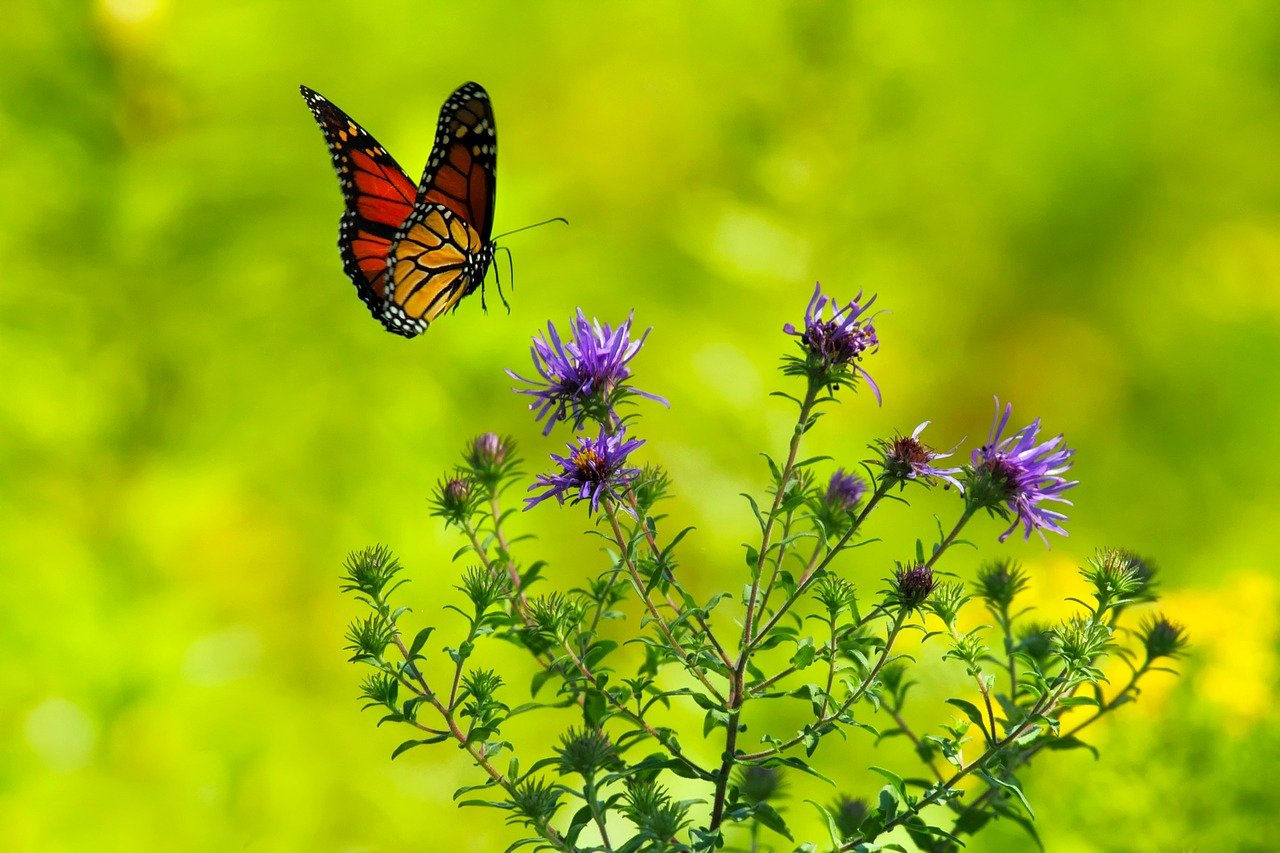
But can we imagine that those basic forces are sufficient to organise the lifeless cloud into a butterfly,  a magnolia tree or a human being?

Can we imagine that those basic forces are sufficient to organise the matter that they act on into the internet?  That the molecules organise themselves unaided into a smartphone, or the Mona Lisa, or a performance of Beethoven’s seventh symphony?

Take a molecule cloud, leave it completely alone for ten billion years, come back and you will find fitbits, contraceptive pills and life-forms intent on destroying themselves and each other.

Just through the laws of physics?

Intelligence creating itself, life with all its complexity spontaneously initiating and evolving.

Just through the laws of physics?

Love,  joy,  purpose existing without any material form that you can touch or measure.  Great stories and legends; “The Lord of the Rings” expressed in a myriad of forms…

All of these, with the only ingredients of a molecule cloud and the laws of physics.  Really?

Or is there something more? 

Something which indwells all of space and time, sustaining matter and the forces that act on it, imbuing form on the formless,  bestowing intelligence and ‘self’ on lifeforms, giving purpose to material and non-material reality.  Intelligence that gives intelligence.  Life that gives life? An eternal ‘something’, or ‘someone’ without cause but within everything?

If I put my pride aside, it seems to me that the universe, life, and love point to there being a supreme and eternal, creating, sustaining and loving God.

Not cheerless physics.

Image by David Mark from Pixabay

Why choose a renewable electricity tariff?

Can I really buy renewable electricity, or is the whole renewable tariff thing just a political stunt?

It is to an extent political, and it is to an extent how capitalism works. 

Starting with how the grid and distribution system works:

Imagine instead of electrons, the grid is a big water reservoir (the power pool).  It is essential that the amount of water in the reservoir stays constant. We are on the south side taking out water, so someone needs to put in water to cover what we take out.  We used to just buy water from the ‘pool’, but today we have to buy from someone who is putting water into the reservoir.  Say we agree with someone on the north side that they will put in what we use.  It’s clear that we won’t actually take out the water molecules that they put in.  In fact, if someone next to us is putting in water, we will probably actually take out their molecules.  But one molecule is the same as another and so it doesn’t make any difference.  The point is, we have made an agreement, outside of the reservoir, with someone who is putting water into it.  So we might choose a ‘renewable water’ provider (e.g. a rainwater collector) to put water into it, and then we claim that we are using renewable water – it is as if we had a direct pipe from them to us.

But, if we didn’t make that agreement with the rainwater collector, he would still put his rainwater into the reservoir!  So what’s the benefit of us making the agreement to buy electricity from him?

Well, he had to invest in his rainwater capture system, and he needs to know that he’s going to get his investment back.  If he doesn’t have a specific agreement for the water he captures then he will only be able to sell his water at the price anyone will pay – which may be close to zero!  So by choosing to buy ‘renewable water’ we would be allowing him to know that he can safely invest in his new plant and get his money back.

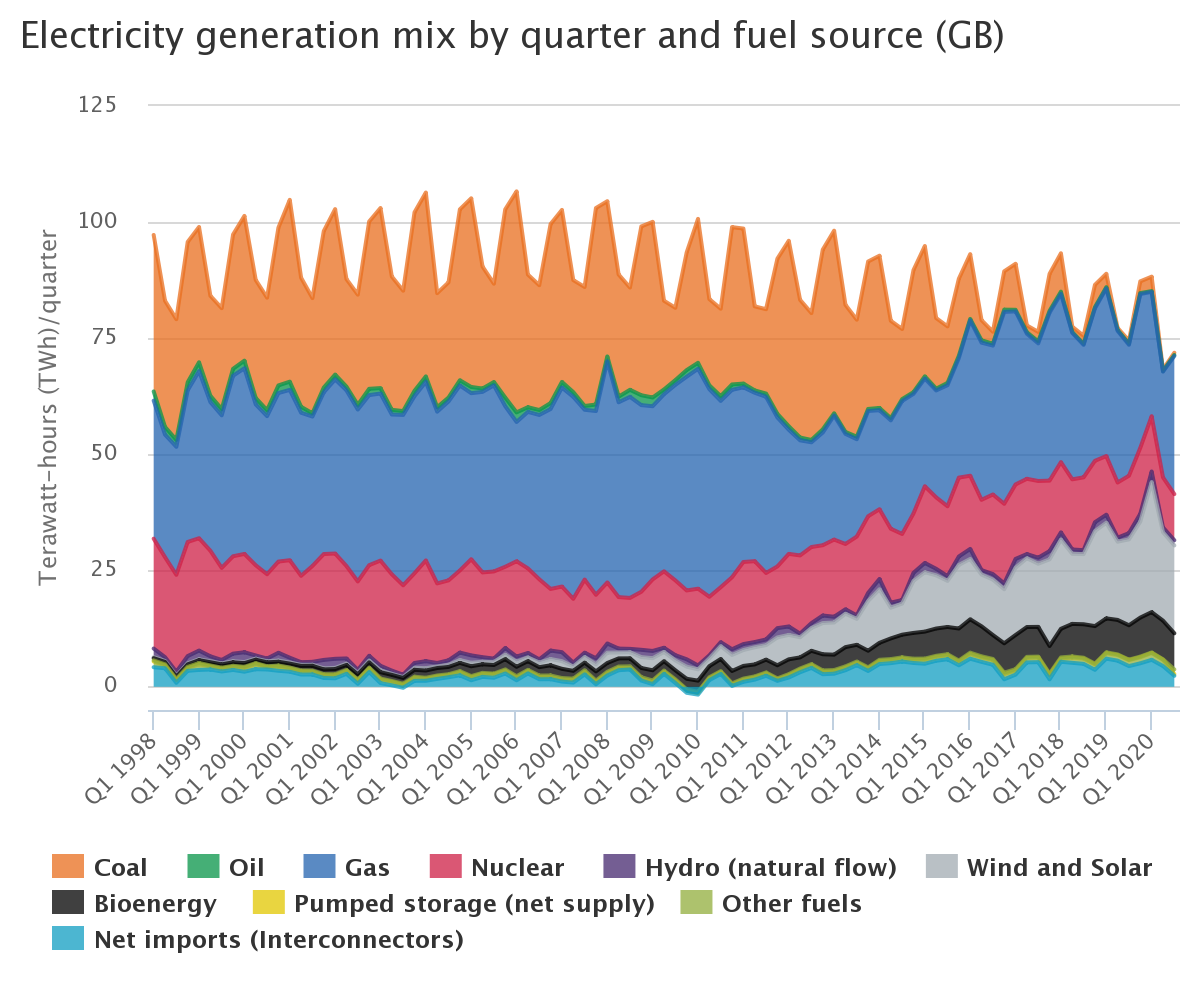
Buying from a renewable tariff is the mechanism whereby politics and capitalism invests in renewable energy.  And it seems to be working!  The proportion of wind and solar has grown dramatically, at the expense of coal.

(source https://www.ofgem.gov.uk/data-portal/electricity-generation-mix-quarter-and-fuel-source-gb)

So in practice, are we using renewable energy each time we switch on a light? 

No, not at all.  There would be a certain mix of generation producing the power that everyone else is using before we switch on our light.  That would already include all the renewable sources, and ‘carbon free’ nuclear.  Every extra kW that has to be generated would come from fossil fuel.  i.e. every time we switch on a light, the marginal generation will be the highest carbon producer!  Hence we should continue to minimise our usage, even on a renewable tariff. 

And it will be the same if we have solar panels and generate our own electricity – every kW that we don’t use will prevent someone else having to use fossil fuel generated electricity so we should still minimise our use.

As the amount of renewables increases though, we may get to the stage where there is no fossil fuel generation at all.  When we reach that point, we still need to balance the peaks and troughs of demand but with unpredictable renewable supply.  For that reason people are developing ways of storing the overproduced electricity (like if we fit panels, we might fit a battery to save the electricity generated when the sun shines for when we need it).   I recently did a bit of consultancy work for a company developing a compressed air energy storage project – a bit like pumped storage at Dinorwig but using compressed air pumped in to vast salt caverns underground. 

Another way to store the excess electricity is to convert it through electrolysis into hydrogen gas.  And gradually the expectation is that hydrogen will replace natural gas in the grid – hence some organisations who want to fit gas heating are buying ‘hydrogen ready’ equipment.  But to my mind, that will be a long way off, and since hydrolysis process is only around 60% efficient, gas must be less energy efficient that direct use of renewable electricity.

Carbon offsetting is again a mechanism whereby politics and capitalism can lead to the right projects going ahead.  The route is a bit indirect, and it can be an excuse to keep burning fossil fuels and so it should only be the last resort.

Hope this makes things clearer…

Is there place for God and religion in today’s world?

The first thing to realise is that we are all living in a computer generated world, and that we are living in the past.  Nothing exists in the form that we perceive it, and by the time we perceive it, it has already happened.

That steaming cup of coffee that you see is just the result of your eyes, optic nerves and brain processing photons that hit the back of your retina.  You are experiencing a brain (computer) generated model of what you now understand to be a cup of coffee.

Your brain’s processing inherently includes a delay to allow all of the bits of information to ‘catch up’.  It takes longer for visual stimuli to be processed than it does for sounds. When you experience the crash of your cup on the floor your brain has had to delay presenting the event to your consciousness until the signals from both your ears and your eyes have arrived.  Our reaction time is evidence of this, and the fact that we react faster to sounds than to lights.  If you start a sprint race with a gun then the sprinters set off faster than if you start it with a flash of light – although the speed of sound is much slower than the speed of light.

So we do not experience the world as it is, but we experience a three dimensional model created within our brain. 

As a child I used to wonder ‘does the colour green look the same to me as it does to you?’  Today I would answer almost certainly ‘no’.  First of all, we know that some people are colour-blind, and so all colours must be perceived differently by them.  And our eyes all have different sensitivities to shades of colours, and so the raw data that our brain has to process must be different between individuals.

But would we have the same ‘experience’ of the colour of our coffee cup if our brains received identical signals?  That is a hard one, because we can’t really explain what it means to ‘experience’ a colour. (Google ‘qualia’ to find out more).

So although our bodies live in real time, we ‘experience’ a computer generated world that has already happened.

Weird.

But weirder perhaps is to ask what we mean by ‘we’.  What is the ‘me’ that experiences this computer generated world?  Warning – science cannot answer this, it’s the meat and drink of philosophy; the discussion of abstract ideas by bright people who build arguments on certain basic assumptions that they continually disagree about.

My subjective view is that there is a ‘me’ that experiences things.  I interact with my brain (and hence body, and hence world) and can influence but not control what my brain and body does.  I can influence what my consciousness presents to me (ignoring distractions when focused on a task for instance), and I can influence how my body responds to things – but I am not really in control.  Just think of a tennis player returning a 140mph serve; there is no time for them to get directly involved in the process of selecting which direction to go, or what shot to play.  They have to leave the action up to their body. But they can influence what their body’s reaction will be by training, by giving it a strategy such as “don’t try to hit a winner off every shot”, and then they need to get out of the way!  Sportsmen know that consciousness gets in the way of winning; thinking too carefully about how to play a shot at best slows things down and at worst causes us to make a mess of it.

When we think about it we realise that ‘we’ have relatively little influence on what our minds and bodies do, and yet ‘we’ get to experience it all! 

And yet ‘we’ are unexplainable. To try to understand the unexplainable ‘we’, and much to the chagrin of materialistic scientists, we use terms like ‘soul’ and ‘spirit’ to define ‘us’. And we believe that other people have souls and spirit too.  And we spend a lot of time and money trying to find ways to interact with our brain/bodies that will lead to our soul’s wellbeing.  So much advertising money is spent on encouraging us to buy products to bring us ‘peace of mind’ or other palliatives for the soul.

It is natural, and not at all illogical, to imagine that in the same way that you and I are tiny individual souls (that happen to inhabit a bunch of chemicals that we had nothing to do with initiating) there is an overarching bigger ‘soul’ who initiated the material universe of space and time (God).  And if our individual soul ‘experiences’ interaction with this bigger soul then there is all the more reason to believe in its existence.  But of course, this can be frustrating to those souls who have not had similar experience…

So yes, there is a place for God in today’s world.  There is good intellectual reason to believe that there is a God, and this is reinforced by the experience and evidence of many witnesses who report interaction with and experience of God.  These interactions have been documented for millennia and continue today.  And there are many who feel that they have directly experienced such an ‘interaction’ yet believe that there is a larger ‘soul’, or God.   

In response to concluding that there is a God and recognising that our very existence is a gift, it is also natural to want to give thanks for that gift and to want to make best use of the gift.  Hence there is a place for religion too in today’s world.

How about you?  If you haven’t recognised them yet – why not start seeking God for yourself?

Have a blessed day.

How do I live a good life?

Nobody wakes up in the morning and thinks, “I’m going to hurt as many people and do as much damage as I can”, unless they are mentally deranged.  Usually we don’t even think about how we are going to live our day, but if we did we’d think something like “I’m going to try to be nice to people, to do my job well, to keep the environment safe”. 

Yet if we look back at the end of a day we are more than likely to think “I wasn’t very nice to X, I did that bit of work badly, I didn’t need to drive so fast”.   And most like as not, we would then justify our actions in our head to make us feel better, “He caught me at a bad moment,  I was late for lunch and wasn’t given time to do a good job,  that idiot in front of me was dawdling and I needed to get home.”  But we have let ourselves down.  We have not been the person we want to be, or could be.  And when we find ourselves doing the same thing every day we avoid thinking about it, and are likely to get angry if someone points it out to use.

There is a better way.  There is a way to be the people we want to be.  And it starts with understanding what’s going on.  An ancient letter written by Saul of Tarsus helps to enlighten us: 

Within us we have two ‘natures’.  We have our ‘sinful nature’ and we have our ‘spirit’.

Out sinful nature is that part of us which clamours ‘me, me, me’ all the time.  Its roots are in the animal instinct that successfully evolved us to survive when everything else was out to eat us, and where if we didn’t grab something for ourselves then something else would.  It is the instinct which leads a lion to defend its territory, the instinct which leads a gerbil to eat its young if there is not enough food, the instinct that leads the black widow spider to eat its mate.  It is the instinct that leads us to crave riches, to accumulate wealth beyond what we can ever use.  It is the instinct which says that the human beings in my tribe are more important than the human beings in yours.

And then there is our spirit.  Our spirit is revolted by the idea of eating our young; we know that we should not eat our babies.  It is our spirit which leads us to help and to make sacrifices for those who are suffering:  looking out for those shielding in the Covid crisis, giving to food banks, marching in Black Lives Matter rallies, campaigning to save the environment.  Our spirit calls us to love, and to goodness.

The ancient letter describes the consequences of following each ‘nature’.  Obeying the spirit leads to life and peace.  But giving in to our sinful nature leads to death; death of love, death of peace, death of goodness.  We become filled with anger, guilt, bitterness, self-pity, depression and despair.

We are slaves to whatever we choose to obey. But many are not willing to make that choice.  We flip flop between doing what we know is right and good, and giving in to our selfish ‘lusts’.  And we live in a constant state of dissatisfaction and guilt.  We strive for more wealth, but it doesn’t satisfy.  And at the same time we wish that injustice would go away; “how can we have food-banks in our country?”

Even if we were to say ‘I choose to obey the spirit, to love and to be good’ we would still find ourselves failing.  And at the end of the day we would be full of guilt and shame, and like as not we would give up.  “The spirit is willing but the flesh is weak”. We need help. 

And there is help available, and hope.  If we have made that decision to obey the spirit, and we do sinful or selfish things then the ancient letter tells us that it is not us that does them, but the sinful nature within us.  It is just that our spirit is not strong enough.  We need to strengthen our spirit, to resist the temptations to give up.  And we can do that. 

The spirit within us is a bit like a battery, it has power but only a limited amount.  We need to plug into the mains.  We need to connect our spirit battery to the mains supply of the spirit that is called the Holy Spirit; an inexhaustible supply of love and goodness – God.   Then the power of sin can be broken.  And how do we connect?  We ask.  We speak with God; we pray.

And we also need to reinforce our decision by focusing on what is good, by giving honour and praise to goodness and love – resisting out sinful nature telling us not to be a ‘goody-goody’.  We remind ourselves of the importance and value of self-sacrificial love.  In a word, we need to worship love and goodness.

We may still do sinful things, but we can plug back in to the mains, pick ourselves up and start again.  We do that by ‘repenting’; an old fashioned word that means wishing that we hadn’t done it and committing to try again. Part of repenting is accepting and confessing that we’ve sinned.  Then we receive forgiveness for what we did wrong and be re-energised to follow the spirit again.  We know that we receive forgiveness because Jesus – God – said that we are to forgive, and so we know that he will forgive us.  And if we are particularly stubborn about accepting that love and goodness (God) would forgive us, then we look at Jesus’s crucifixion; he gave himself as the ritual sacrifice that the Jewish people believed carried off their sins.  And we look at his resurrection – showing that those sins had been dealt with.

When we deliberately choose to obey the spirit, it is empowering.  We do things that please the spirit, and it makes us feel alive.  It brings us peace.  We take joy in the good that we do, and we are able to actively love others.

Think of people you know.  Can you recognise any who are obeying and following the spirit?  It is written that “By their fruit they will be known”.   Fruit that you might look out for are: love, joy, peace, patience, kindness, goodness, faithfulness, gentleness, and self-control.

Wouldn’t we all like to be like that? 

We can be!
The Big Picture – Introduction – read by the author

Why we still need the pandemic.

As I listened to the news this morning, I began to realise that we are not yet ready for this pandemic to end.  We still haven’t learned what we need to learn.

We still haven’t learned that one person is just as valuable and important as another.

We haven’t learned that money and economic systems must be our servant and not our master.

Can you believe that as a nation we are debating whether it is necessary to ensure that children should be fed?  Of course it is!  We would not contemplate not feeding our own children, so the question betrays that we think ‘our’ children are more valuable than ‘their’ children. 

We are debating whether, if we do have to help, is it better to give food vouchers or food parcels to the poor.  Why would we not simply give the money? Because ‘they’ are not to be trusted to spend it wisely, whilst ‘we’ have so much money that we can spend it frivolously and still have full bellies.

Within this nation, within this world, we don’t value one person as much as another .  The pandemic is forcing us to see this and learn our lesson – but we are not there yet.

Money is a man-made invention; a tool that should allow everyone to contribute what they are able to society and to receive what they need from society.  Yet an alien would see that although there is food in supermarkets, there are people who have no food but are not allowed to eat it.   The alien would see that whilst some people are contributing according to their abilities, others are not permitted to – those same people who are not allowed to eat.  The alien would see that – for instance – there are those who have no homes but that those with building skills are building bigger houses for those who already have them. 

The alien would ask why.  Why is this person allowed to eat, but that one is not?  Why are people building this person a bigger house when that person has nowhere to live?  The alien would conclude that ‘this’ person must be different from ‘that’ person; a superior being, more valuable and important.

Our actions show that we do not believe that one person is just as valuable and important as another.

We might say ‘everyone matters’ and ‘everyone is equally important’. And if we really mean it, then we have become subservient to an economic system that does not allow us to express that belief.  We have sacrificed our beliefs in fundamental  morality and truth to an artificially generated concept – money – that is supposed to be our servant but that has become our master.

We have become slaves to an economic situation where two equally important human beings receive grossly unequal shares of the fruits of the labour of society, and where two equally important human beings are given vastly different opportunities to use their skills and abilities to contribute to society.

The Nazis outwardly claimed superiority over other races – but don’t our actions show that we hold those beliefs in our hearts?  

That is one lesson of this pandemic. Have we learned it yet? If we have learned it, are we not ashamed?  If so, we can repent and amend our thinking and our actions. 

And have we learned yet from that pandemic that we have become slaves to our economic system?  That we have sacrificed our morality, our humanity to a man-made mechanism?  When we have learnt that lesson we need to decide what we are going to do about it:  Individually, and as a nation.

So perhaps we are not yet ready for this pandemic to end.  Perhaps we still haven’t learned what we need to learn.  But I hope it won’t take us too long!

With such a low Covid death rate, why do we have to accept a “draconian” lock-down?

I have been challenged to give an opinion on the lock-down, based on a claim that “99.7% of people recover” (source unknown).  A referenced and logically argued study suggests that in fact the death rate is much higher.

But let’s assume for a moment that the death rate is only 3 in every thousand (0.3%). 

Evidence shows that “a 20-year age-gap increased the risk by around 10-fold. So, compared to a 20-year-old, an 80-year-old had 10 * 10 * 10 ~ 1000 times the risk of dying.”  And the same document references that 90% of deaths have pre-exisiting conditions, and the chance of a healthy 30 year old woman  dying if infected is only one in 30,000.  In other words, the risk is highest for older people, and those with pre-existing conditions.  Roughly  two thirds of deaths are in those over 75.

So, if we were to simply allow the virus to ‘let rip’, and the death rate were only the 0.3% quoted we would see deaths in the over 75s equivalent to two in every thousand of the population. 

Deaths from the disease are highly selective.  Accepting this situation would be equivalent to sacrificing our over 75’s population.   To put the ‘two in every thousand of the population’ into context, roughly two in every thousand of the world’s population are Jews – so this would be equivalent to eliminating all the Jews.  Do I need to go on?

Data shows that hospital treatment has improved, with the chance of surviving if hospitalised with Covid increasing from 70% to nearly 90%.  Without hospital treatment the death toll would increase between three and ten times.  This is why there is so much focus on ‘protecting the NHS’. 

If we were to let the virus ‘let rip’ then our hospitals would indeed be overwhelmed and the death rate would conservatively increase by a factor of 3.  Using the death rate from my challenger of 0.3% today, that would increase it to about one in every hundred of the population.

 Again this would be targeted at the older generation, and equivalent in numbers to eliminating the world’s population of Jews three times over.  Or globally that would be equivalent to wiping out the whole population of the United Kingdom.

We have a clear choice. 

Either we accept personal restrictions in order to save a category of our population.  Or we ‘sacrifice’ that population for the sake of our ‘personal freedom’.

This is something that I completely oppose.  And many of our fathers and grandfathers fought and died in the Second World War to destroy a regime which had that approach;  I deliberately used the example of the number of Jews to reinforce the point.

I for one am willing to accept some personal sacrifice in order to protect the vulnerable, and those who dedicate their lives to care for those who are vulnerable, and I call on everyone to do the same.

POSTSCRIPT

To be clear – there have been appalling decisions, profiteering and cronyism by those in power.  But we must not let such behaviour prevent us from doing what is right.  We have to make up for the shortcomings of leadership, but perhaps we might remember this when we next get the chance to choose who will lead our country.

Image by enriquelopezgarre from Pixabay

Christmas Joy?

Christmas is supposed to be a time of joy, yet my heart is torn by so much that is wrong in our world that it can be hard to find joy. 

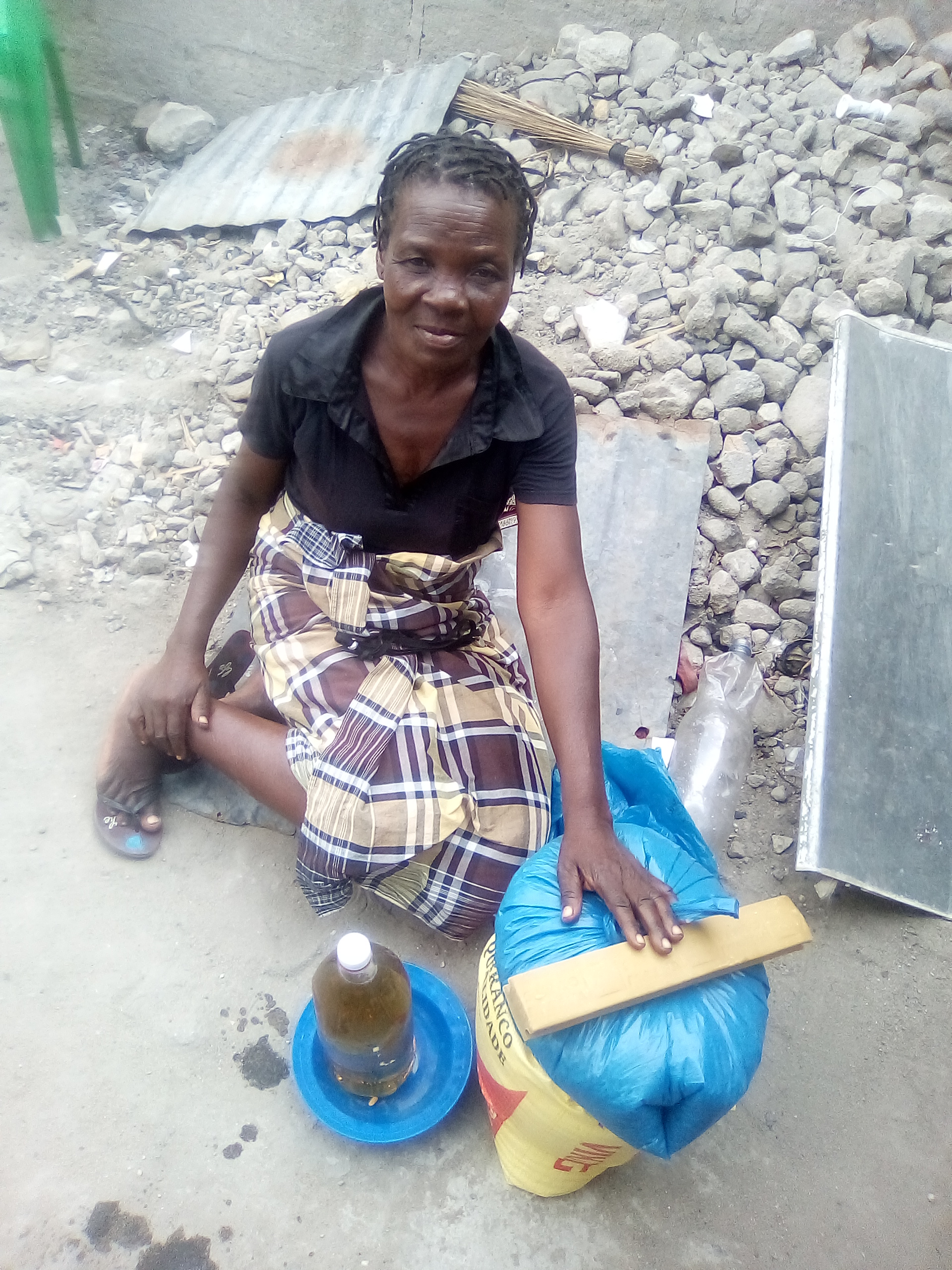
I was privileged to have visited Mozambique some years ago.  Having experienced a tiny glimpse of life there, I now regularly send money to help some of the poorest who live there.   This picture shows one lady with all that she has to live on for the next month:

Is she any less valuable human being than me, or you?  Does she matter less because she happens to have been born in a poor country?  Or because she’s black?  Isn’t that what we think deep down if we deny help to people in this situation?

It’s not just our government cutting back that matters.  What about each of us as individuals?  There is a line in a song “my Chinese take away would pay for someone’s drugs”  (medicines) – that is so true.   I know many people, quite a few now retired or close to retiring – university professors, doctors, professional engineers, teachers, civil servants – who have amassed significant amounts of money, own big houses, take expensive holidays.  Healthy pension funds and investments have secured a comfortable retirement – as our culture tells us that that is what we have to do.  

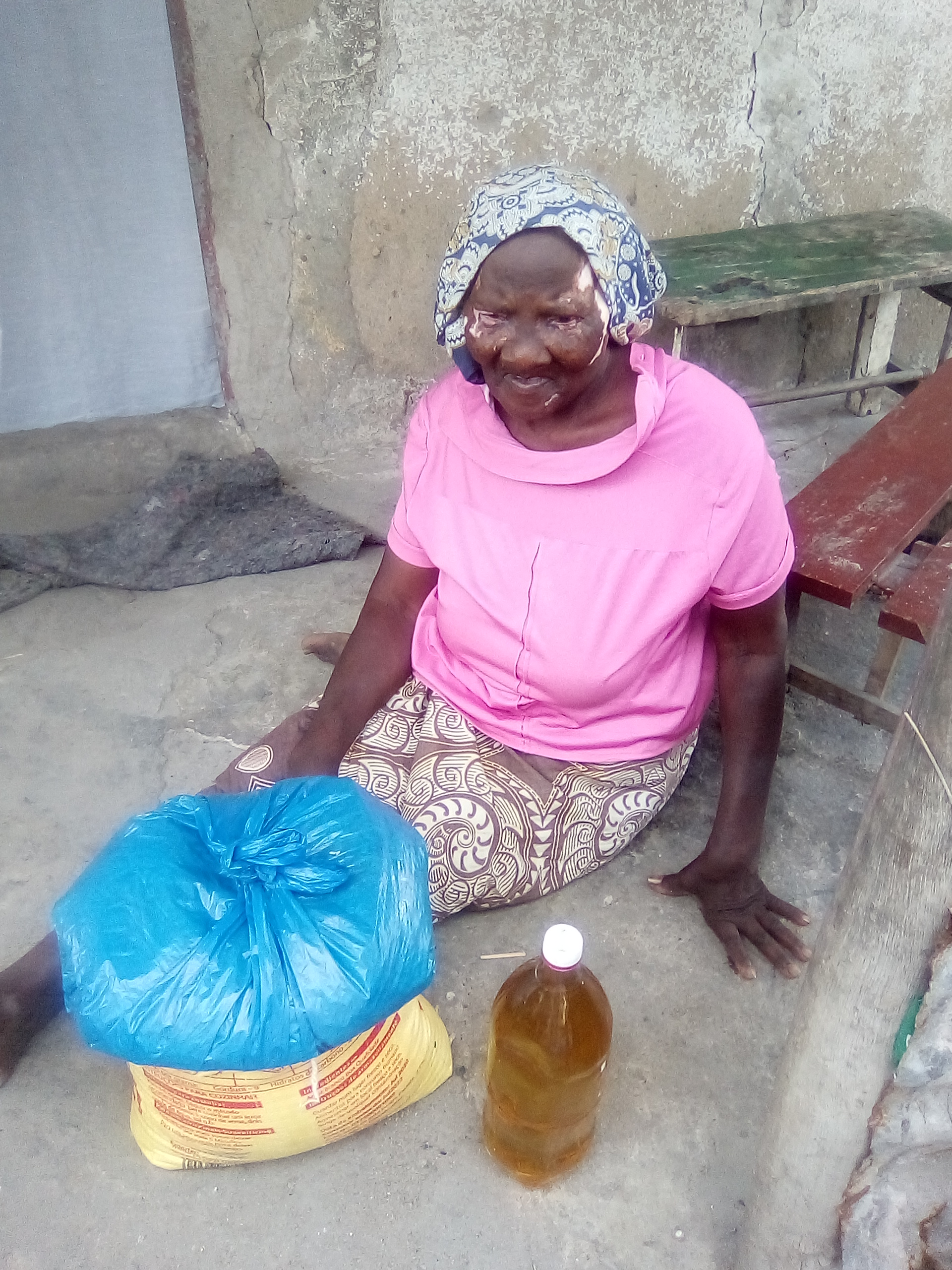
And yet this old lady has no such ‘essentials’.   She lives day to day in accommodation that we would not give space to in our garden, and is desperately grateful for a sack of rice and some cooking oil:

We in the ‘developed’ world are not deliberately evil, but we are ignorant.  We are ignorant of the life of the majority of the world.  We have money but are fearful of losing it.  We are taught to save for our rainy day, but we do that when so many others are already being flooded out by a deluge. 

It would be hypocritical of me to say we should sell all we have and give to the poor – although since Jesus said it, it is probably right.  But we can start to move in that direction.  It does not cause any discomfort if the total of our investments drop by (say) 10% when we still don’t think twice before having our Chinese takeaway – and yet I have found that joy comes from seeing the images of those who I have been able to help.  This person has something to eat because I chose to send some money.  That person can now put a tin sheet over the hole in the roof of their house because I chose to send some money.  When I  give, I feel no pain, only gain.  And yet it is still not ‘easy’ – still the pressures of sixty years of western capitalist propaganda take effort to resist.  It takes an act of will sometimes to give, but it is worth it.

Try it this Christmas?

May God bless us all.

The Covid biopsy

The world is in crisis.  It has been for some time, but we have all been too busy to really notice.  Maybe we have noticed big obvious things like climate change, or obscene rates of top pay, or housing crisis, but there is so much that is deeply wrong that we have simply not observed it.

Covid19 has given us the time to look.  Covid19 has shone a spotlight on so many wrongs, intensifying their effect.  It is like a biopsy, and unfortunately the results are not looking good.  There are of course many signs of good health, but we need to look for the cancer.  Within the UK we see

  • hypocritical and untrustworthy government
  • under-equipped NHS
  • gross inequality
  • institutional racism – reflected in the higher rates of death among BAME people
  • the availability of money to pay for things that we deem important

Many of these are seen in more exaggerated forms in the US.

But  we are not yet focusing on the global wrongs.  You need to look beyond the normal media news outlets to hear what is happening in majority world countries; across Africa, India, Pakistan…  In these countries the lockdown is causing more deaths and fear than the virus itself.

What does the world need to do?  What do each of us as individuals need to do? There are 5 steps:

  1. We need to recognise what’s wrong – Covid is helping us do that.
  2. We need to take responsibility for it, to own the part that our behaviour has played in it.
  3. We need to repent of that behaviour.  To commit that we will apply our energy to changing our behaviour.
  4. We need to receive forgiveness for what we have done and cannot change, to liberate us to make a new start.  In the same way that the priest flooded Jean Valjean with gifts and forgiveness in Les Miserables, so Jesus Christ has flooded us with the gift of God’s love and forgiveness.  We need to accept this gift to empower us with the determination to live changed lifes.
  5. We need to live out our new commitments

It may all seem daunting, we are just one among billions.  But we are not called to be the Cathedral of Love, but to be individual stones in that cathedral.  We each have our part to play in the great and glorious endeavour.

Be blessed, and a blessing.

“Will you return to me?” asks the Lord

For many years now I have been offended by the gross inequality in the world and in our nation.  I particularly became aware of how bad it was in the UK when my children were of an age to think about buying a house (Cathy and I were able to buy our first house at the age of 22!).  I looked at how much building societies would lend for a given income, and so what income one would need to buy a house.  I then looked at the income distribution in the country, and realised that without ‘parental’ help only a quarter of individual earners would be able to buy their own home.  And if your parents are unable to help, then there is no chance for someone on minimum wage.  The system ensures that the poorest are doomed to remain poor, particularly when you realise that the rental costs that they have to pay are far higher than the equivalent mortgage cost if they were able to buy a home.

This institutionalized system of stealing from the poor to give to the rich let me to become an active political campaigner.  But to no avail…

We are in the midst of the Covid19 pandemic, which I am hopefully will be the catalyst for great social re-engineering.  Poor and rich alike are realising who it is that keeps our world going; our key workers.  We are realising how fragile our safety nets are.  The government, who claimed that there was no money, and inflicted a decade of austerity has suddenly found it possible to inject billions into the economy – the money is there, we just need to choose what is important.  People are talking about a Universal Basic Income.

Some billionaires are giving large sums to help those in the majority world – and realising that their own day to day living standards are unaffected, but that giving brings the joy of helping and showing love to others.

Society could be transformed in ways that I’ve longed for, but been helpless to achieve.  The hearts and minds of people needed to change – and it seems that they are. Yet this is not being done by human hand, or by leaders rhetoric but by a consequence of the biological design of life.

It is not unreasonable to think that this powerful persuading force might be a providential gift from the one who created and sustains the universe.  A gift which, although it brings fear and immediate pain could lead to a transformed society that has the courage to value each human being, and to retreat from its wanton destruction of our natural environment.  Is this a glorious example of the power and love of God to bring us back to spiritual health?

I hope we choose to accept this gift, although I know that human beings are a stubborn people.  Thousands of years ago the prophet Amos wrote: “I sent among you a pestilence after the manner of Egypt ... yet you did not return to me, says the Lord.”  I pray the same won’t be said of us.