We are all the same

A doctor has the resources to help those who are injured or unwell, to make them comfortable and to set them on the path to healing and recovery.  Would it be wrong for a doctor to walk past a person injured and dying on the street and do nothing to help, even if the doctor didn’t know them or like them? 

We know it would be wrong for a doctor to not do what they were able to help someone who is suffering severely or dying through sickness or injury.  Yet doctors are only people like us so it must also be wrong too for us not to help someone who is dying through – for instance – malnutrition, or lack of clean water, or military oppression even if they are not on our doorstep.  It would be wrong of us not to make room in our country for those who would die from war or persecution in their home country.

Let’s not shirk our responsibilities to our fellow human beings.  Let’s remember that every single person is equally valuable and worthy of our love and care and do what we can to help and accommodate them. When we fall short of doing all we can, let’s recognise that that is our shortcoming.  Let’s not justify our inaction by claiming that they are somehow inferior to us, and that we ‘don’t want them here’.

The wonder of life: a slipped disc can heal itself!

I have just about recovered from damaging my back twice in succession.  Two lots of 6 weeks out of action and on constant painkillers has not been fun.  These days one expects that the doctors will just be able to fix stuff, but the ‘treatment’ available was basically take painkillers and when it’s feeling well enough do some exercises to strengthen it.

So it was down to me, or at least my body to fix itself.  Although I don’t think I had a slipped disc, with nothing much to do I spent some time on the internet to understand more about back problems and found that “The body’s defense mechanism can spontaneously retract, shrink, or eliminate disc herniation.” https://www.spine-health.com/blog/can-herniated-discs-heal-their-own

Just let that sink in for a moment. 

If my car has a worn joint, there is no way that it can heal itself.

If a computer program has a fault there is no way it can heal itself.

There is nothing that I personally can do to cause my back to heal.  It is ‘simply’ that my body has the ability to heal itself.  And if you look at how our bodies heal themselves, and how our immune systems work you will be astounded by the complexity of the processes.

Now I don’t want to question the process of evolution, but it is beyond me (or I believe beyond anyone) to explain how a completely unguided or undesigned process would lead to a mechanism within the body to heal a slipped disc.

And even if that’s not a challenge enough, isn’t it astonishing that the fabric of the universe; the raw elements (Hydrogen, Carbon, Oxygen etc) can combine together to create a living organism that contains within it the power to heal itself of a slipped disc?

We take these things for granted every day and grumble when our bodies don’t function as ‘normal’.  Isn’t it more appropriate to take a step back and let the wonder of what our bodies do do just sink in?  And maybe to thank the creator of the universe for the amazing gift of our lives?

Have a blessed day.

https://www.instagram.com/pixvalen/

How do we manage the pressure to worry and despair about what is going on in the world?

There is so much that we can see that is worrying, and that we can do nothing about.  (As I write this Los Angeles is suffering intense wildfires, Trump is threatening to take over Greenland, the wars in Ukraine and Gaza are still taking lives, global temperatures continue to rise…)  Yet if we didn’t look at our TVs, papers or phones we would know nothing of this – and surprisingly little is ‘in our face’ – we are not directly affected by most of the list above.

The secret is to realise that we are not God.  These things are beyond our power to control, but we are not helpless or hopeless – we can play our part using the prayer that Jesus taught us:

“May Your kingdom come; may Your will be done on earth – as it is in heaven”

We might reflect that what is going on actually is God’s will; his permissive will.  Throughout history greedy, power hungry bullies have oppressed ordinary people and we have ransacked the natural world.  Jesus was fully aware of the brutal Roman regime, but he didn’t overthrow it.  He healed people, focusing on the individuals around him – and we can do that too.  We can pray the Lord’s prayer and leave the state of the world in his hands, but then get on with interacting with those around us according to his will.  We don’t care less about the global situation, but we can worry less. And we can use our energy to influence our local communities instead.

After putting the world’s troubles in God’s hands, the Lord’s prayer allows us to ask for God’s heap meeting our own needs:  give us our food for the day, forgive our sins (as we forgive), don’t let us yield to temptation, save us from evil.  All of which do personally affect us day by day, and which will allow us to fulfil our daily purpose.

Jesus’ prayer is a powerful gift from God.

The hand of God

A few years ago I decided to dig deeper into the apparent conflict between science and religion.

Many people have the view that science can in theory explain everything, that even if we don’t know the answers yet then it is just a matter of time before we find them.  This view of Science has turned it into a faith.

I admit that I wondered if advances in science since I studied it might actually bring more powerful arguments than I was aware of. But I also wondered whether the extreme unlikeliness of life might be sufficient to prove that there must be a God and so I spent several years reviewing what science has discovered and assessing how that fits with Christianity. 

The first thing to say is that there are clearly things written in the Bible that are not to be taken literally.  And it causes problems when people do. When people hear both Christians and atheists claim that Christians believe that Genesis is the literal truth then they are unlikely to look any further.  It is that which put me off even considering God until I was forty, and so I feel that Creationists do God a disservice.

Putting Creationism aside, I have not found any serious conflict between science and faith.

I have found that when you try to calculate numbers, you find that the chances of us being here are extremely small – but we are here.  The chance of me winning the lottery if I buy one ticket is extremely small, but every week someone wins. If you try often enough then extremely unlikely events will happen. 

But how can I say that there isn’t any serious conflict between science and faith?  Isn’t there a conflict between science and miracles?  Hasn’t science shown that they are impossible?

To answer that we need to think about what we actually mean by science. It’s a term that is in such common use that we often don’t think about what it really is. A few years ago the Science Council realised that they didn’t have a definition of science, and so they came up with one.

“Science is the pursuit of knowledge and understanding of the natural and social world following a systematic methodology based on evidence.”

Let’s break that down a little:

“the pursuit of knowledge and understanding” – I’m sure we are happy with that, although it doesn’t say ALL knowledge and understanding.

“of the natural and social world” – that’s good, it defines the scope where it applies.  Science has nothing to do with what is not the natural and social world.

“following a systematic methodology based on evidence” We can expand on that a little.  The methodology includes steps of

  1. Observation of a phenomenon and experiment to find out what happens
  2. Trying to think of what the rules are that describe the phenomenon – the rules should be consistent with the accepted laws of science.
  3. Establishing new experiments or observations to test the theory
  4. Repeat the experiments
  5. Analyse and review the results, and publish.

Critical to this is repetition.  Science assumes that the “natural and social world” behaves in a manner that is repeatable.

Richard Feynman, a famous physicist was giving a talk about what is known as the ‘two slit experiment’ – you shoot electrons at a barrier which has two slits in it, and a screen behind it, and you observe where each electron hits the screen. He comments that

“A philosopher once said that: ‘It is necessary for the very existence of science that the same conditions always produce the same results’. Well, they do not. You set up the circumstances, with the same conditions every time, and you cannot predict behind which hole you will see the electron.”

Through repetition, science has discovered that if you look at enough numbers of electrons then a predictable pattern emerges.  However,  the behaviour of an individual electron cannot be predicted.

And what is a miracle?  The Cambridge Dictionary definition of a miracle is:

“An unusual and mysterious event that is thought to have been caused by a god because it does not follow the usual laws of nature

By definition, science and miracles are mutually exclusive.

  • Science defines the usual laws of nature
  • Miracles don’t follow the usual laws of nature

But this does NOT mean that science tells us that miracles cannot happen.

It’s like putting everything that behaves in a predictable manner into a box and calling that science.  I can learn all about what goes on inside the box.  But none of my knowledge about what goes on inside the box can tell me anything about what is outside the box.  

I might assume that nothing exists outside the box, but science can give me no evidence of whether my assumption is true.  Belief in that assumption is called materialism. The faith of materialism asserts that there cannot be miracles, but science itself can say nothing about whether miracles can happen. 

But what if there is evidence that the universe doesn’t always behave according to fixed materialistic laws? Does that disprove materialism?

What if I know that there are things outside the box?

It seems to us that we are able to make choices.  We can decide who to vote for in elections.  We can decide whether to come to a breakfast talk.  We can decide whether or not to kill our next door neighbour. 

It’s called free will.  We experience our free will every day.

But if the universe operates according to fixed laws of nature, where is there scope for free will? 

There are some who believe so completely in Materialsm that they think free will is an illusion.  Here’s an example from an on line discussion forum:

“. . . given our understanding of determinism and un-determinism there is nothing left that explains exactly what free will could be, in the traditional sense. It’s more a case of a challenge to those that assume free will to explain its mechanism.”

In other words, Materialists believe that free will cannot exist in a universe which operates according to fixed laws.  So if you or I believe that we have free will, then that is a strong hint that materialism is wrong – that there are things outside of our box. 

There is another definition of miracle in the Cambridge dictionary:

“a very lucky event that is surprising and unexpected”

Even within the laws of physics it is possible for miracles to happen. 

There is an account in the Bible of when Jesus told one of his followers to go and catch a fish, and that in the mouth of the fish he would find a gold coin, and then he was to use that coin to pay their tax.  That is such an extremely unlikely event that it becomes a miracle, but a miracle operating within the “laws of physics”.

I said earlier that I’d wondered whether the extreme unlikeliness of life might be sufficient to prove that there must be a God.  Whilst the origin of life may follow the laws of physics, is it so unlikely that it is classed as a miracle? Let’s explore that a little and try to get a feel for some numbers. 

It is difficult to define what life is, but one element that we are all aware of is the ability to reproduce, or replicate.

All life as we know it – plants and animals – contain long chain molecules.  Proteins are building blocks for much of the body, and DNA acts as a template for organising amino acids into the correct order to make proteins and to replicate itself.

DNA is made up of four nucleotides, called ‘bases’.  These are held in place on a sugar/phosphate backbone.  The order of the bases defines the order of amino acids that are assembled by machinery in the cell in order to form a protein.  The machinery in the cell includes other long chain molecules that are essential for the replication process.

Although human DNA has around 3 billion bases, scientists have estimated that the minimum length of a long chain molecule that would be able to replicate is around 40 bases.  Like DNA, those 40 bases would need to be in a precise order to be able to replicate.

The question is, where did this first long chain molecule come from?  It was not built by the mechanism in the cell, because there was no mechanism. 

Perhaps it might have self assembled by chance if we had a pot of molecules bubbling in a primordial soup.

Now, the number of different possible sequences of a chain of forty molecules of four different types is massive, and the chance of any particular one forming at random is on in a septillion!  That’s 1024  –  a million billion billion.

And if you needed two specific molecules to ensure replication then it would be the same as searching for a single molecule in the whole mass of the earth.

No wonder Richard Dawkins has said that

“Self-replicating molecules that made copies of themselves came into existence by sheer luck….. Nobody knows how it happened.”

We can agree I think that the origin of life is “a very lucky event that is surprising and unexpected” …. i.e. a miracle. 

Another extremely unlikely occurrence is the fine tuning of the universe.

We use equations to represent the laws of physics as we know them. The equations usually include a number of constants.   Some constants can be derived mathematically, such as the ratio of the circumference of a circle to the diameter which is known as Pi.

Other constants don’t appear to have their value for any particular reason – as far as I’m aware there is no particular reason why the speed of light is what it is.   These constants are only obtained by careful measurement.

Scientists can calculate what might have happened if the constants had been different. These calculations show us that the constants in this universe seem to be incredibly fine-tuned. 

John Lennox quotes that “If the ratio of the strong nuclear force to the electromagnetic force had been different by one part in 1016, no stars could have formed. If the ratio of electromagnetic force-constant to the gravitational force-constant was increased by only 1 part in 1040 then only small stars would exist; decrease it by the same amount and there will only be large stars. You must have both large and small stars in the universe; the large ones produce elements in their thermonuclear furnaces and it is only the small ones that burn long enough to sustain a planet with life. That is the kind of accuracy a marksman would need to hit a coin on the far side of the observable universe, twenty billion light years away.

Many thinkers and Christian scientists pursue the idea that these levels of extreme improbability must ‘prove’ that the laws of nature are insufficient, and that ‘The hand of God’ is required at critical points in the history of the universe to explain where we are today. I find the idea attractive, but it is not unquestionable proof as there is always the counter argument that with enough attempts unlikely things happen. 

And for me, trying to find God in the unlikely concedes too much.  It is a false way of thinking that seems to accept that if we can explain something scientifically then we don’t need God – so we have to look for things that we can’t explain scientifically and voila: God. This is called ‘God of the Gaps’, and constrains God to those things that we can’t explain – the gaps. 

But it is actually applying the faith of the Materialist to God.  “I’m going to claim everything that is explainable as my materialist faith, and just leave you with the gaps to explain by God” 

It implies that:

  • God is confined to the gaps
  • God only ‘appears’ intermittently
  • God only does miracles

That is a misunderstanding of God.

What if we apply this sort of ‘improbability thinking’ to the development of a human being from a single cell?

DNA is often called the blueprint of the body, and is the template to build all the protein molecules in the body. Human DNA has just under 3 billion bases.  There are around 3.5million letters in the Bible, so it would need around 800 books the size of the Bible to write out human DNA. That sounds a big number (although our DNA only a tenth of the size of that of an amoeba), but let’s look at what the DNA has to do.

An adult has fifty trillion human cells.  That’s 17000 cells for each DNA base. And scientists have said that 97% of our DNA is actually ‘junk’ … not used for producing proteins. If that is right, then there are over half a million cells for each non-junk DNA base.

Our fifty trillion cells are organised into systems:

  • Circulatory system
  • Skeletal system
  • Immune system
  • Muscular system
  • Hearing
  • Sight
  • Nervous system
  • Brain
  • ….

Those systems change with time.  Components are built at different times in the development process.  Cells have to die off to make way for other cells.  We have to stop growing at some point.  We are programmed to die.

And our “short” string of DNA is supposed to define all of this. The orchestrated operation of the fifty trillion cells for over seventy years is not something that is learned as the body grows. And the coding of these systems was contained in the DNA of one single fertilised cell.

Using a ‘probability’ type of thinking, we might deduce that it is impossible for a human to grow from a single fertilised cell without the hand of God.

And yet we see it happen every day, 350,000  new babies born a day around the world. This miracle has being repeated by the hand of God billions of times, just in humans. The hand of God is very busy!

Now actually, this is a better understanding of God.  This is not a ‘God of the gaps’ but a ‘God of everything’. This is a God who sustains the operation of matter in a consistent manner that we can predict through the scientific method.  This is a God who provides the raw materials for science to study.

This is a God of whom the psalmist wrote:  “For you created my inmost being; you knit me together in my mother’s womb.”

The behaviour of matter, as modelled by the laws of physics can be understood to be the hand of God. We no longer search for a God who lives outside the universe and occasionally pops in to correct it when it goes wrong, but we have a God who is intimately involved in the universe, sustaining not only the laws of physics but also our very being. Everything that science discovers is simply discovering more of the wonders of God. 

If we can grasp this it leads to two responses:

Wow! …. and…. Why?

To understand the Why, we can’t look to science – but we can look to Jesus. And when we understand the Why, and respond to it, the Wow becomes our worship.  The study of science returns to its origin, the search for a better understanding and knowledge of God.

Thank you for reading.

You wouldn’t hate someone because they like Marmite.

As decent human beings we accept that there are people who have different taste from ourselves. Society agrees that it would be wrong to hate someone because they liked (or disliked) Marmite for instance. We know that we should not shout abuse at them because of something that they have no control about.  Much of what we are is a result of our genes which have been honed through the process of evolution to provide a successful species, and it is generally accepted that it is not appropriate to judge someone on that basis.  Unfortunately, this is not a universal truth as we see for example when people consider other races to be ‘inferior’ – i.e. racist behaviour.  But society has agreed that this is unacceptable, and laws are drawn up in an effort to eliminate it.

And yet we seem to think it’s acceptable to mock, at best feel angry with and at worst hate those who hold different values to ourselves; the ‘left’ hates and mocks the ‘right’, and vice versa.  Just look at some of the memes that populate your social media stream.

I recently discovered that there is a strong genetic basis for our political leaning (left / right), and our ‘moral’ make-up.  We cannot help our ‘gut reaction’ to different actions or situations; it is largely defined by our genes.  And there are profound differences between the gut reaction of different people.

If we were to think about another person’s moral matrix in the same way that we think of someone who doesn’t like Marmite then might we start to treat them more considerately?

The book ‘The Righteous Mind’ by Jonathan Haidt describes how our gut reaction defines our response to a situation, and that we then use our reasoning to justify our gut reaction; rather than the other way round.  It takes a conscious effort for our reasoning to ‘train’ or change our response.  If we want to persuade someone else to our point of view, we have to earn their trust before explaining how things look to us.  It doesn’t help just criticising their ‘genetic’ opinion. 

And it’s also worth considering whether they might just have a point, and that there is a blind spot in our own thinking.  Maybe, we can reach a compromise or consensus on the best approach to an issue, combining the different viewpoints to get a full picture of a situation.  Maybe the diversity of points of view that evolved in successful societies and served us well for thousands of years might be worth resurrecting, rather than the present approach of division into ‘Marmite lovers’ and ‘Marmite haters’?  Think about that when you are about to ‘repost’ the latest mocking meme…
An affordable net zero house retrofit

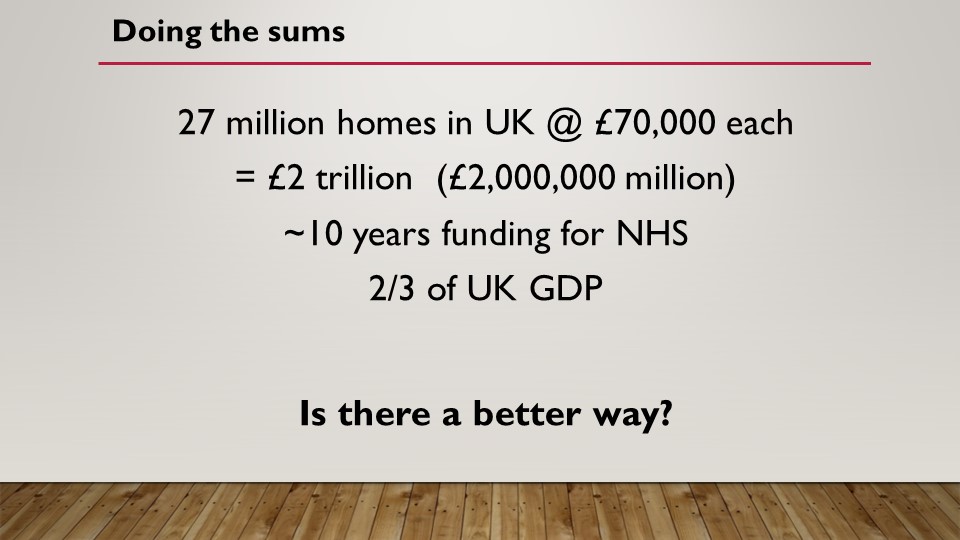
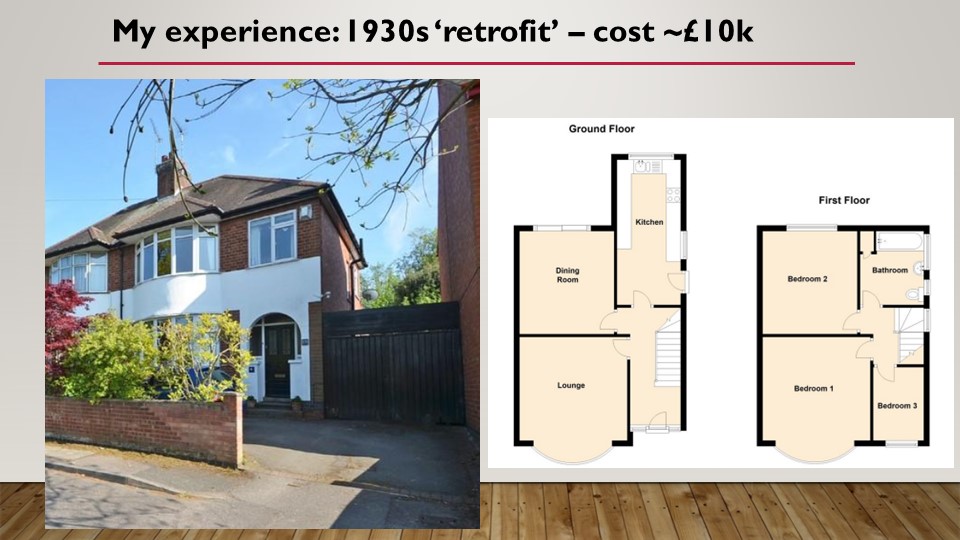
Headlines such as “Average cost for net zero retrofit almost £70k” make the task of CO2 reduction seem daunting or unaffordable.  It doesn’t have to be that way.  I describe affordable and available technologies that allowed me to make my home carbon neutral for around £10k, verified by detailed energy measurements over several years.  The solutions also make living through increasingly frequent heat waves bearable and even comfortable. 

Conventional wisdom and solutions suggest that cutting emissions is a hobby for the wealthy. Technological solutions are too expensive for the majority of householders. This is not true.

‘Conventional’ solutions are simply too expensive for individuals or the country to afford, but there is a better way.

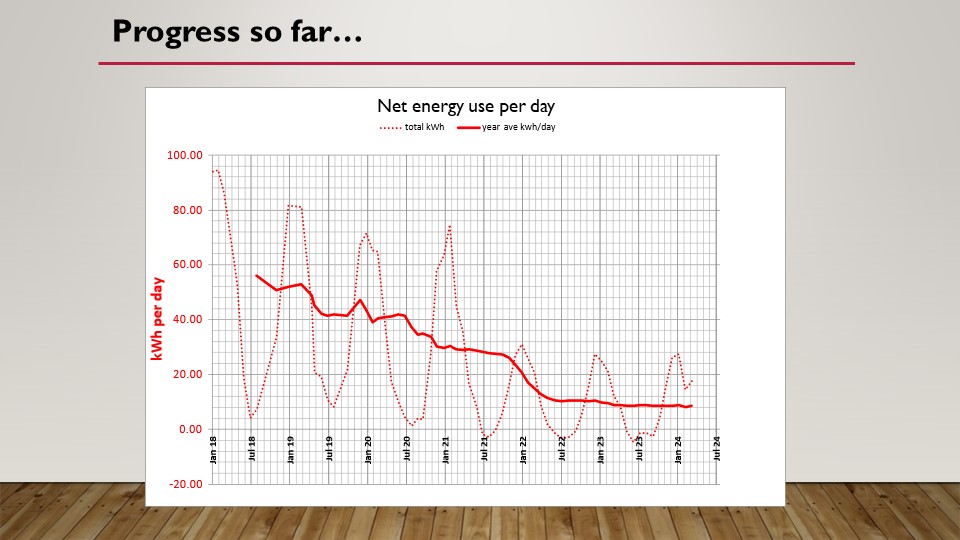
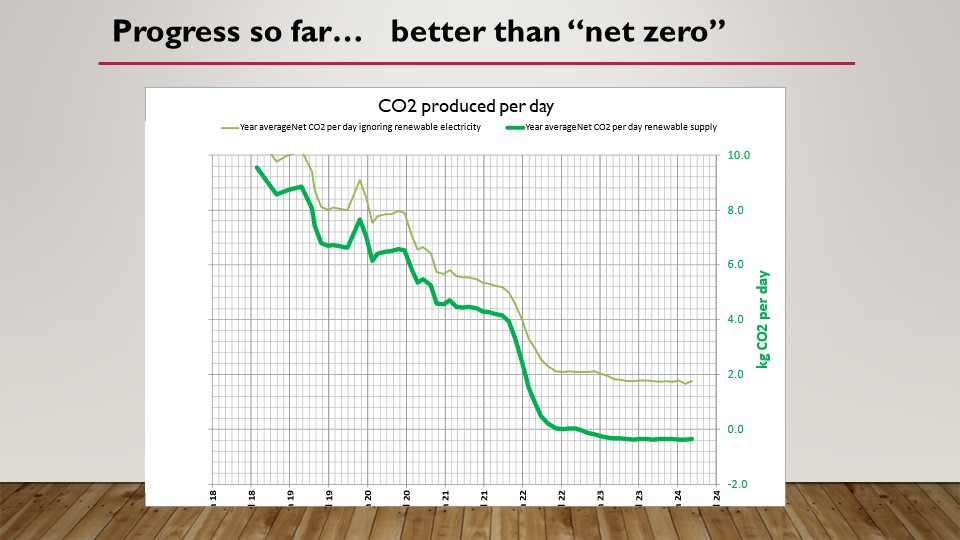
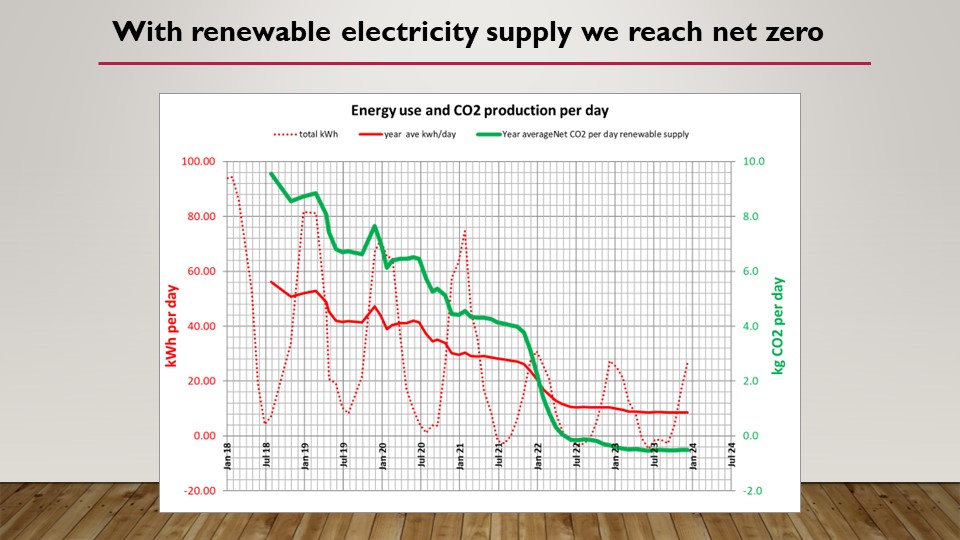
The chart below shows that if we count electricity from a renewable energy supply as zero emissions then we are better than net zero. If we count the carbon intensity of electricity at grid average then we have reduced our CO2 by 80%.

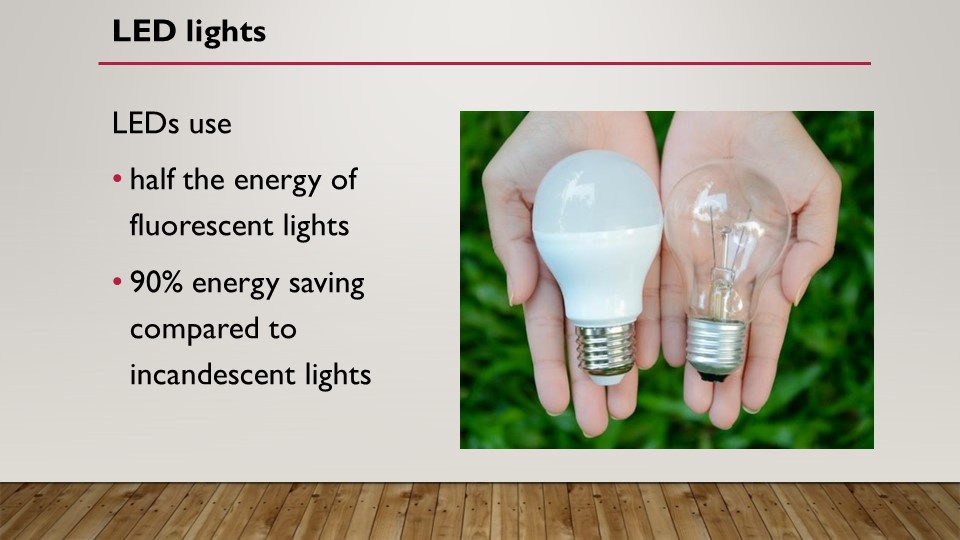
A quick win is to replace all lights by LED.

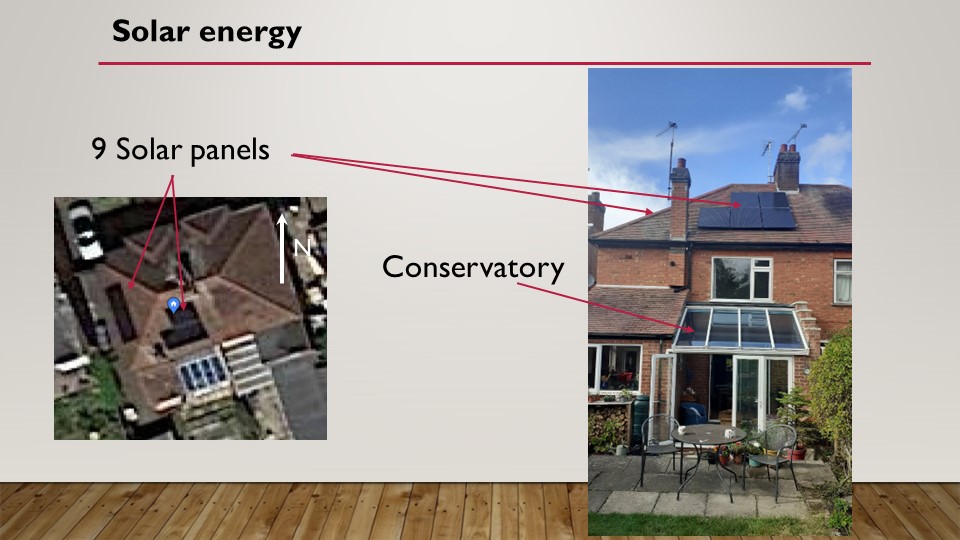
We installed solar panels without a battery early on, and the conservatory also captures solar energy (not included in the £10k as it was built for the space rather than energy reduction).

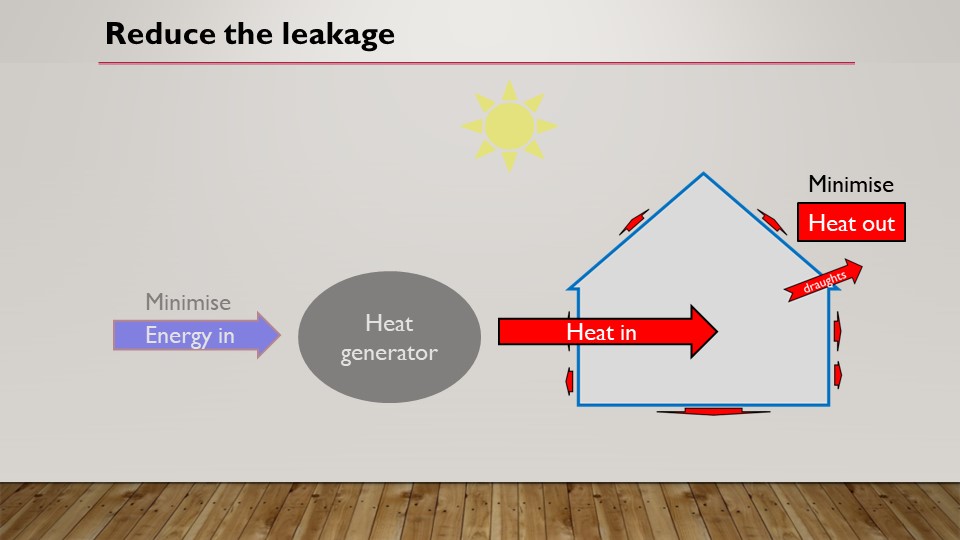
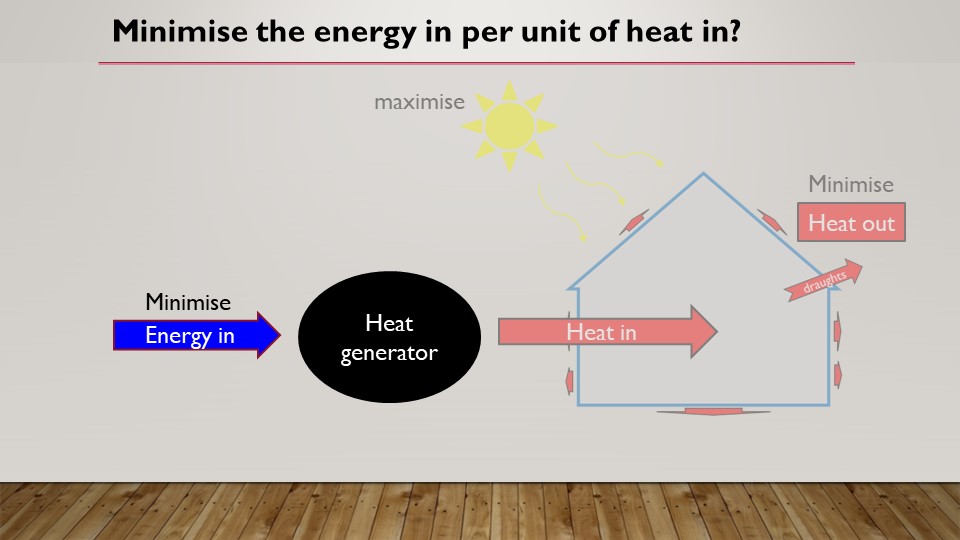
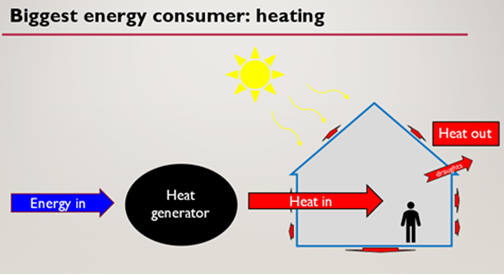
By far the biggest part of the energy footprint of a house is the heating. We need to minimise the energy in. We can do this by minimising the heat out and by optimising the efficiency of the heat generator (conventionally a boiler).

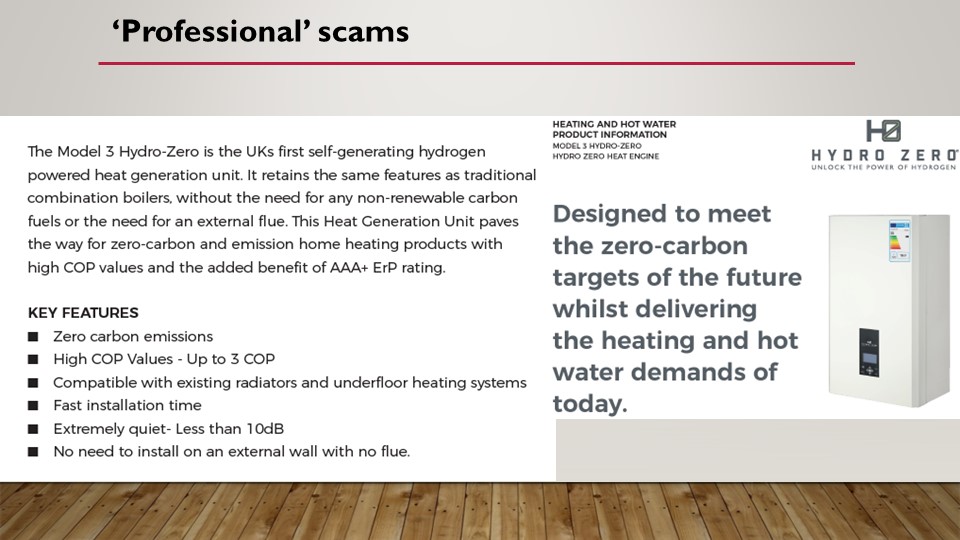
Lots of companies offer ‘wonder solutions’ online, but don’t be caught out by scams such as these:

Professionals have been ‘duped’ by rogue products such as the one below whose claims broke the first law of thermodynamics.

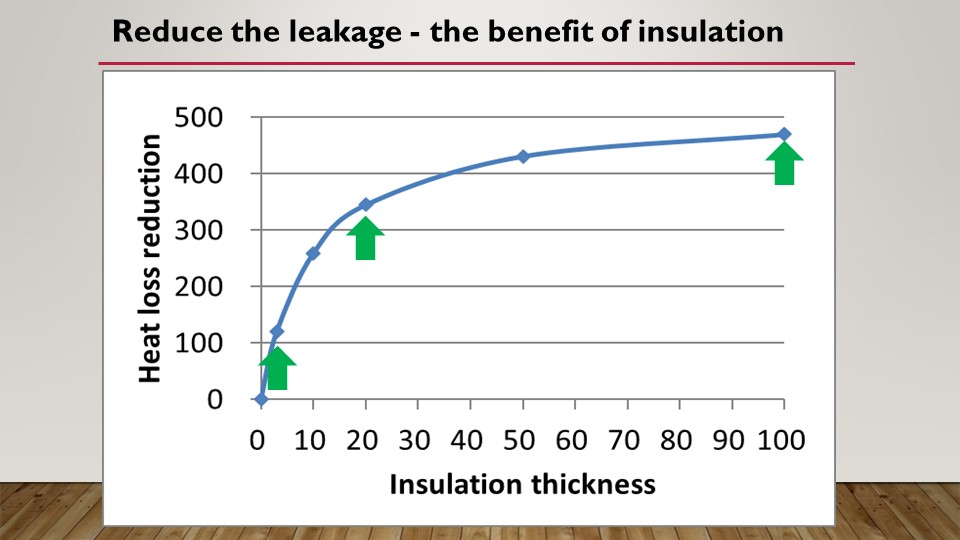
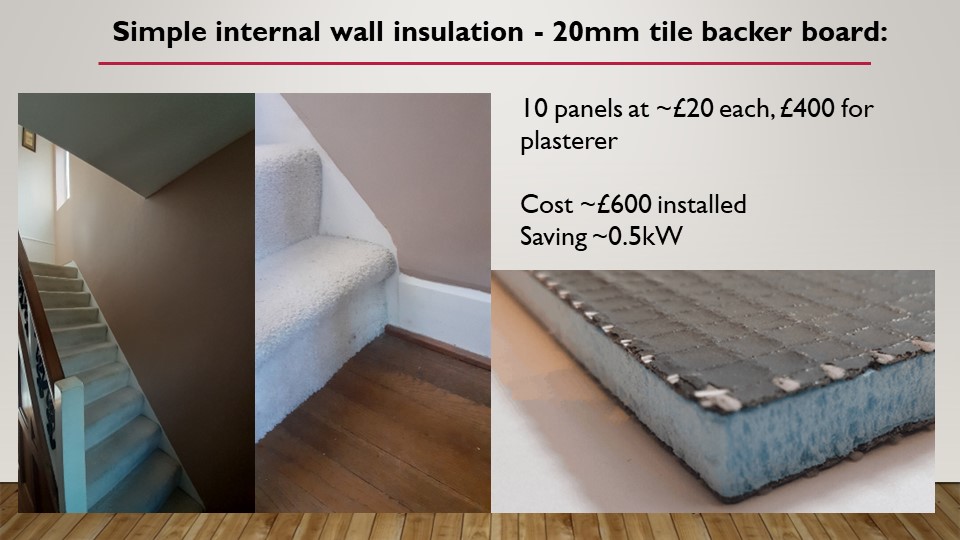
External wall insulation is just too expensive! Cavity wall insulation is great, and affordable, but a better solution is needed for solid walls. Physics tells us that there are decreasing returns from increasing the thickness of insulation. Just 20mm can be very effective.

Underfloor insulation is cheap from a material point of view, but disruptive and labour intensive. We needed to replace our joists and floorboards anyway so it was a cheap and obvious improvement. We tried two different insulation approaches – the solid insulation board was simplest and is the way I’d do it again.

The biggest benefit from double or triple glazing is the poor heat transfer between air and the surface of the glass, rather than the insulating property of glass or the air gap. We achieved this by a simple improvement to the original door glass and windows.

Curtains also reduce heat loss by the same mechanism. The thickness of the curtain material is less important than simply preventing the air passing from one side to another. The following temperature measurements either side of the curtain show the benefit when they are closed.

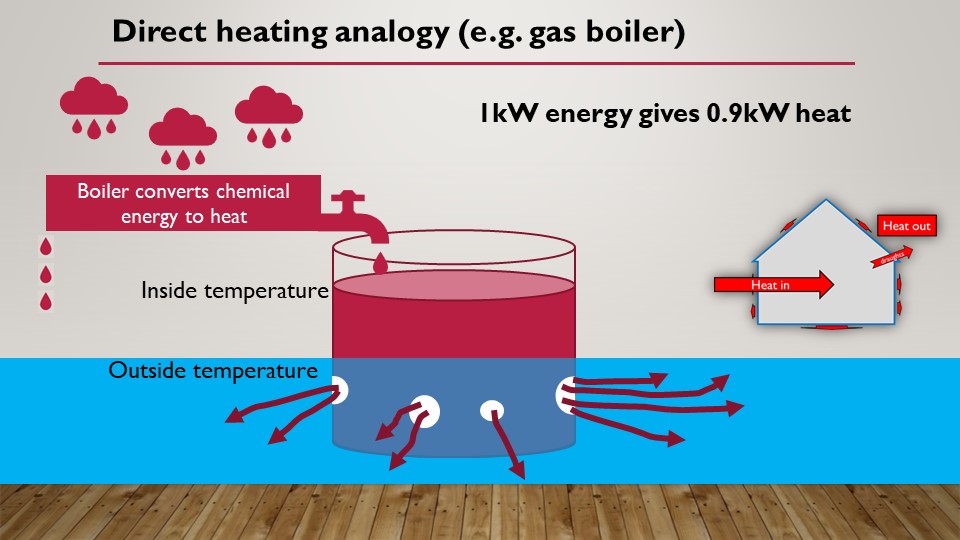
The biggest benefit in energy saving can come from choosing the best heat generator. The traditional approach is to use a gas boiler:

In contrast to converting chemical energy in the boiler to heat, a heat pump uses electrical energy to pump heat from the cold outside to the warm inside using the same thermodynamic process that cools the fridge and freezer in our kitchens.

Government promoted air to water heat pumps have a LOT of disadvantages, and will probably cost a little more to run than a gas boiler. No wonder they are not taking off!

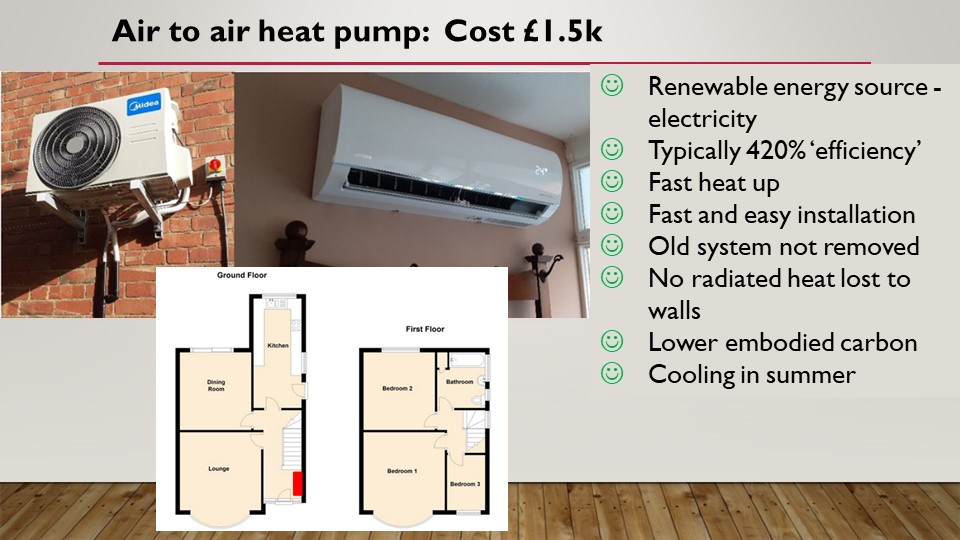
A far better alternative is a traditional air conditioning unit, which is an air to air heat pump – warming the air in the house directly and efficiently. It can be installed without touching the existing boiler and radiator system, which can be retained as a back-up.

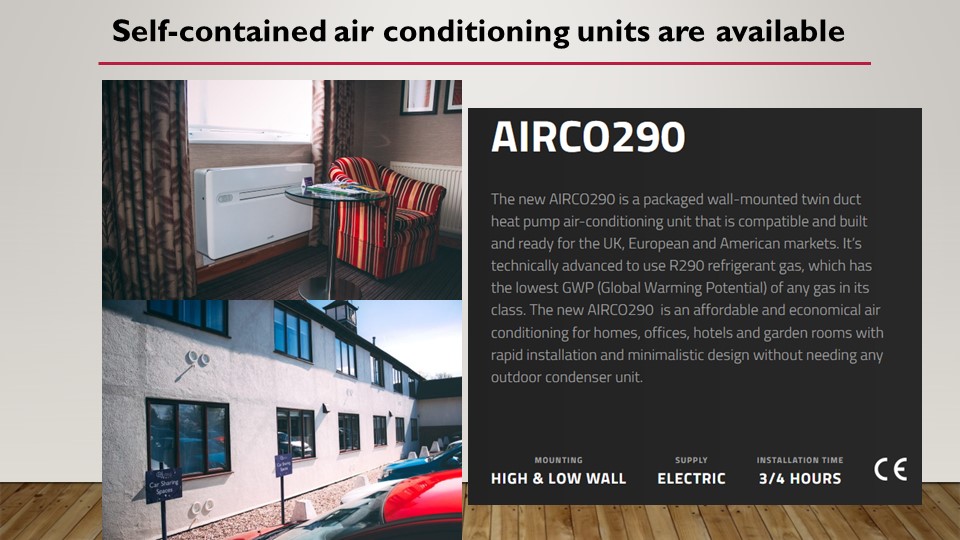
If you have nowhere to fit the outside unit of the heat pump, there are self contained units available that might solve the problem. They are slightly less efficient but are worth considering.
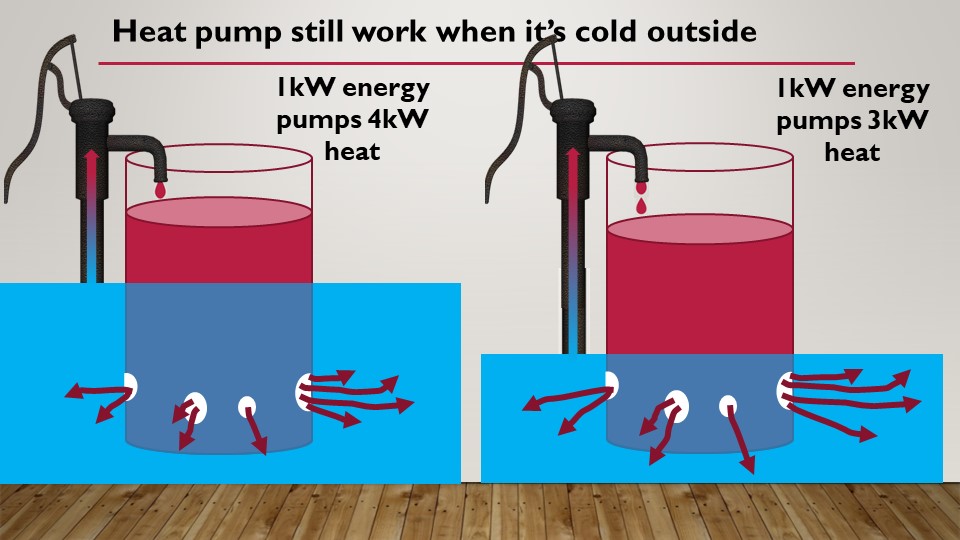
Don’t be misled by people who say heat pumps don’t work in cold weather. They do – although they will pump slightly less heat than in warm weather.

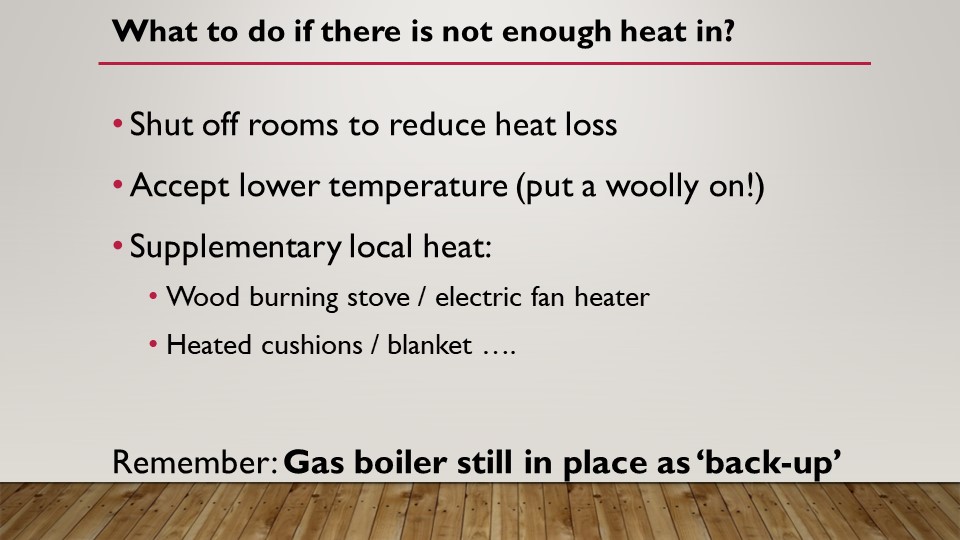
With any heating system, you will reach a point where you can’t get enough heat into the house to maintain the temperature.

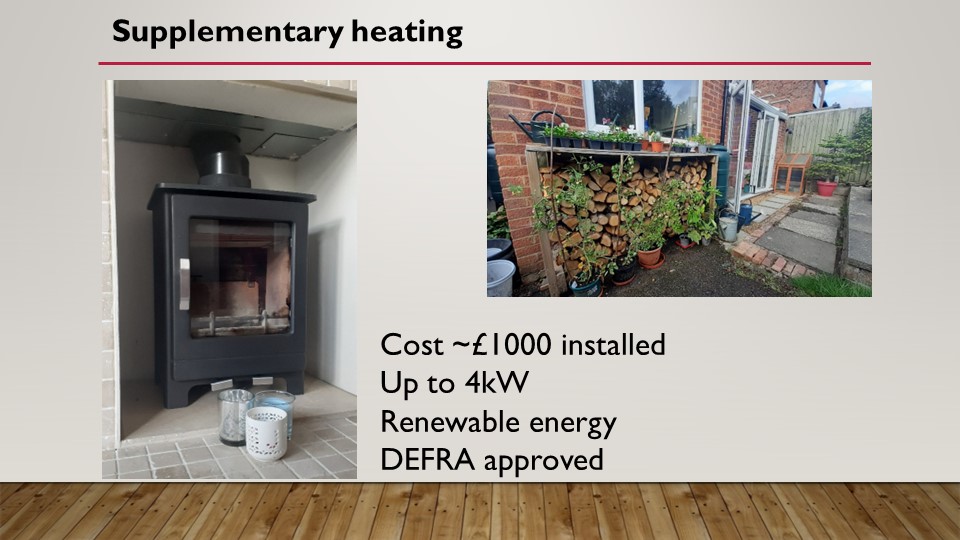
We fitted a DEFRA wood burning stove, and use waste wood that we season as fuel. This is carbon neutral as the wood would rot and give off it’s CO2 anyway.

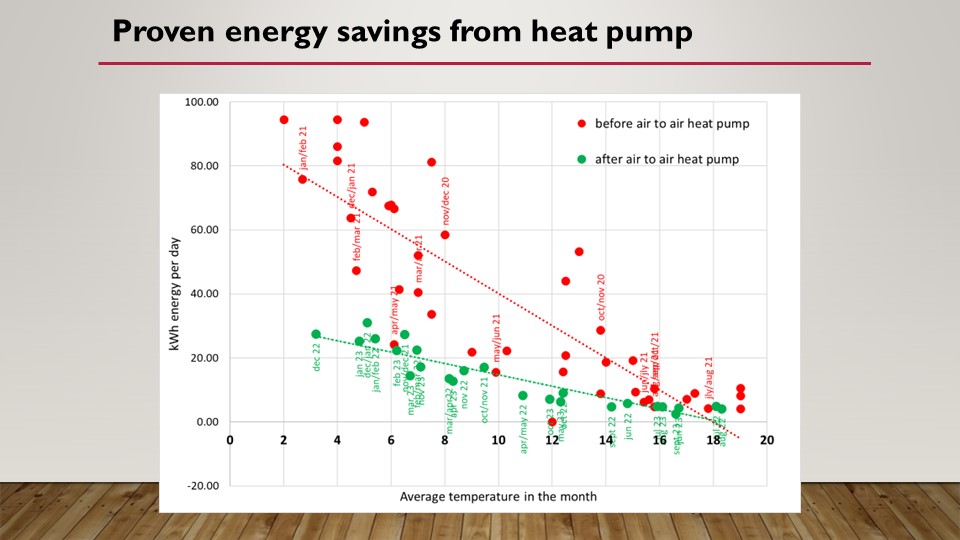
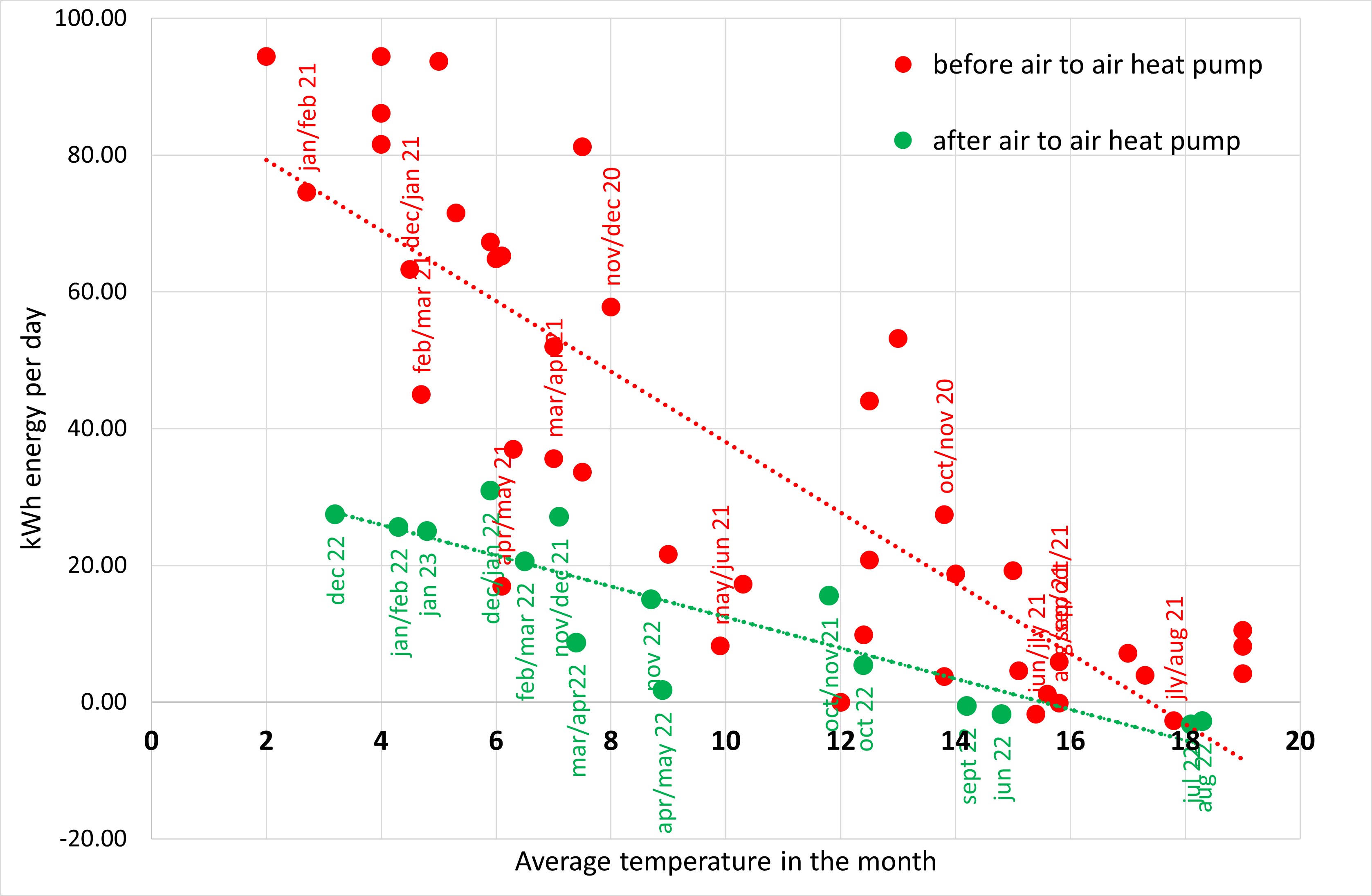
Energy measurements show that for the same heating demand (average outside temperature) the heat pump saves a large proportion of our energy – even when it is very cold. The total energy below includes heating, water heating, cooking, washing, TV etc. i.e. everything!

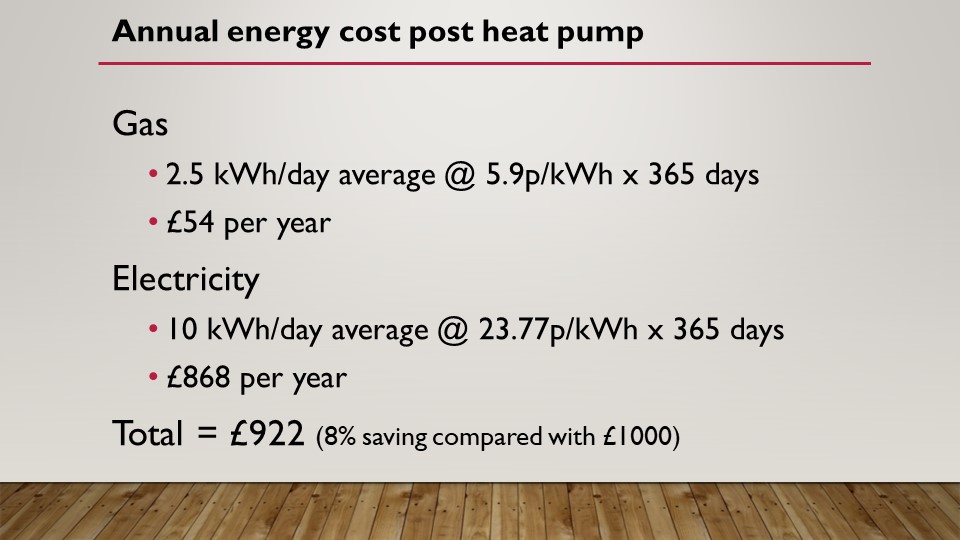
From the average daily gas and electricity use before and after the heat pump we can work out how much we have saved by fitting the air to air heat pump:

When buying a heat pump, it’s important to get the most efficient model. The cost difference will quickly pay back in energy savings, and the CO2 saving will be biggest.

Just a reminder of what can be done:

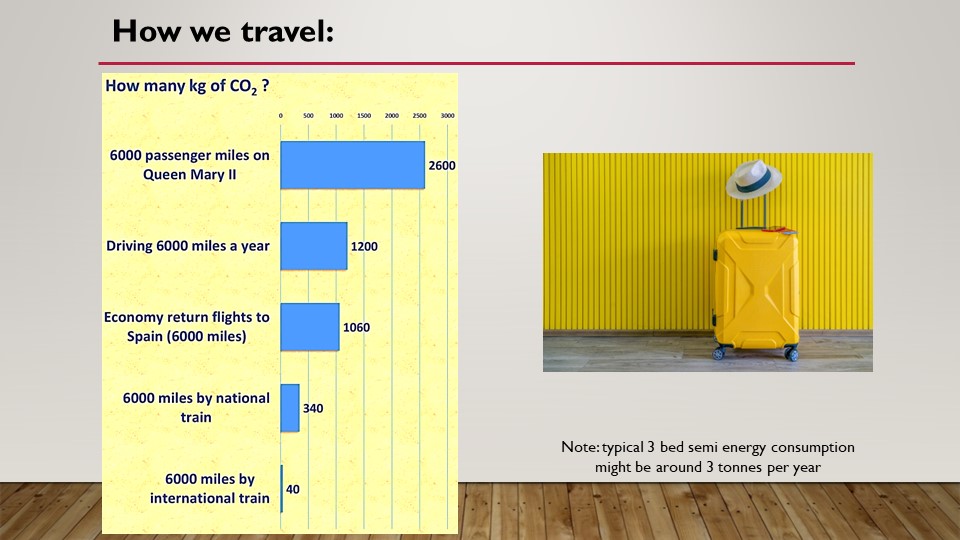
Housing is only a proportion of our CO2 footprint. The data below allows us to consider the benefit of changes to our life choices.

It’s a stark fact that those who are suffering most from our high CO2 production are those who produce least themselves and who are least able to bear the consequences. My wife and I run a small charity that sends funds to help some of the most vulnerable in Mozambique. A simple breeze block house can be life-changing, but will only cost around £1300. If you would like to join us in helping those in greatest need, or if you have simply found this helpful then please donate to the account below.

Covid Inquiry – lockdowns and saving lives.

When China introduced their strict lock-down I remember saying ‘That could never happen here’.  And when people on social media were saying ‘we’ve got to lock-down immediately’  I didn’t think it should – imprisoning the elderly in their homes for 3 months for no offense!

When my father died of prostate cancer after several years of suffering and treatment, I was relieved.  I was desperately sad and sat alone and cried to mourn the loss, but he was never going to be young and healthy again and his suffering was over.

Before my mother died I used to cry coming home from visiting her at the pointlessness of her days, she had no joy anymore and would sit on her bed looking out the window.  She would often say that she was ready to die, but her body kept holding on.  When she fell with a broken hip and was taken to hospital she signed a DNR.  She didn’t want to eat and only did when pressed by the kindly nurses.  When she died it was a relief but again desperately sad – but she was never going to be young and healthy again, and she had fulfilled her purpose.

The Covid inquiry is asking how many more lives could have been ‘saved’ by earlier lock-downs.   Would my mother or father’s lives have been ‘saved’ by extending them further?

In “Screwtape Letters” – letters from one demon to another CS Lewis writes “They, of course, do tend to regard death as the prime evil and survival as the greatest good. But that is because we (the demons) have taught them to do so.”  In his non-fictional writing Lewis points out that we have lost sight of the ‘true reality’ of God and the spiritual life.  In our earthly, material world everyone dies; it is just a question of when. 

In reality, it is not the length of our days but what we have striven to become on earth that matters – our character, or values, our loves.  Of course the death of a loved one is sad, but let’s have less of this ‘saving lives’ when we simply mean ‘extending lives’ and let’s focus more on reality.

——————————————

““Reality, in fact, is usually something you could not have guessed. That is one of the reasons I believe Christianity. It is a religion you could not have guessed. If it offered us just the kind of universe we had always expected, I should feel we were making it up. But, in fact, it is not the sort of thing anyone would have made up. It has just that queer twist about it that real things have. So let us leave behind all these boys’ philosophies–these over simple answers. The problem is not simple and the answer is not going to be simple either.”” ― C.S. Lewis

What is the best heating approach for CO2 reduction and cost effectiveness?

In this post I share some of what I have learnt and worked out about how to reduce the carbon footprint of heating a house. There is an awful lot of misinformation and misleading advertising out there, and very few have reached the most sensible solution, particularly for fitting in older houses. I hope that this post will help you choose the best approach. I hope I have achieved the right balance between technical detail and simple explanation, and I would welcome feedback on that. Clarity may improve over time!

The biggest use of energy in housing is heating.  The amount of heat required to maintain a temperature depends on the loss of heat from the building (e.g. heat loss through the walls). The energy required to provide that heat depends on the efficiency of the heat generator (e.g. boiler). The amount of carbon dioxide to heat the house depends on the CO2 released to produce the energy.

 The majority of a house’s carbon footprint is through heating and so having the most efficient way of generating heat is essential.  There are many different heat generation technologies. Some burn fuel and some use electricity to either directly converting it to heat (e.g. fan heater, storage heater) or by using the electricity to pump heat into the house from the environment.

Technical and economic comparison of different heat generation technologies

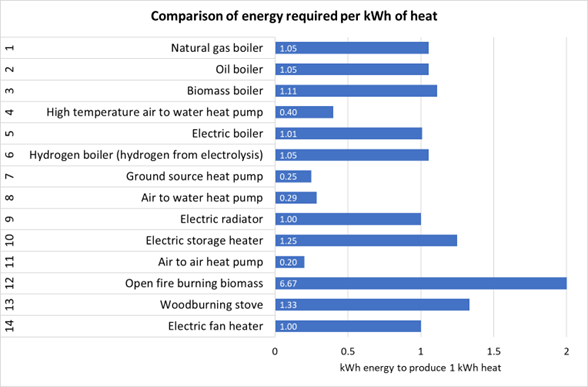
The following chart compares the heat generation efficiency of different heat generators, it shows how much energy is needed to provide 1kWh of heat. The best technology has the lowest value:

Most houses are currently heated via gas or oil-fired boilers. With that assumption, how easy are the different technologies to install?

1-6: can be considered as straight boiler replacements and offer the potential for relatively low disruption

7-8: can connect to an existing radiator system but would not provide the same heat input as the system they replace due to lower water temperatures.  They will need additional measures such as increased insulation, or increasing radiator size. Installation will be disruptive, taking several days at least.

9-10:  replace the present system and would need existing radiators to be removed to make space for the new heaters. Additional electrical wiring might be needed too. There would be some disruption.

11: can be installed quickly and with little disruption, perhaps in less than a day.  Existing heating systems can be left in place.

12-14: are supplementary heating options which may be valuable to ‘top up’ in cold weather or are suitable for infrequently used areas.

From an efficiency point of view all of the heat pumps are very attractive, although from a disruption point of view the water systems are quite disruptive to install.  The low disruption of fitting air to air heat pumps is very attractive.

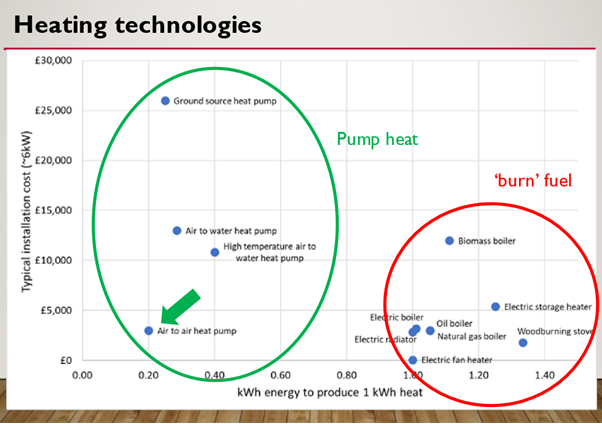
I have compiled some typical installation costs of the different technologies:

The water heat pump options are much more expensive than straight boiler replacement.  However, air to air heat pumps offer not only the highest efficiency but at a comparable installation cost to traditional boiler replacement.

The government is currently offering £5000 off the cost and installation of an air source heat pump (ASHP systems must be hydronic (air-to-water) to be eligible under BUS.  Air-to-air systems are not eligible.), £5000 off the cost and installation of a biomass boiler and £6000 off the cost and installation of a ground source heat pump, including water source heat pumps. This subsidy brings the costs closer, but they are still more costly and disruptive – perhaps explaining why uptake has been poor.

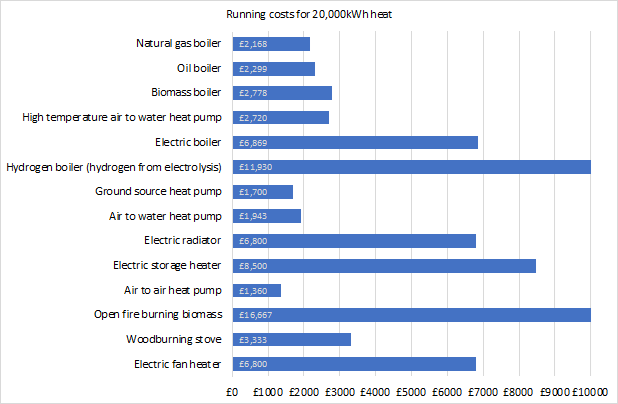
But what about running costs?  The following chart shows the comparative running costs to provide 20MWh of heat, based on energy prices of:

Electricity 34.0p/kWh (government price cap value)

Gas 10.3p/kWh (government price cap value)

Oil 10.9p/kWh

Biomass 12.5p/kWh (price paid by a friend with a biomass boiler)

Hydrogen 56.7p/kWh (cost of electricity / 60% electrolysis efficiency)

Although energy prices are rather unstable, this shows that the efficiency benefit of electrically driven heat pumps outweighs the price premium of the fuel.  If electricity is generated ‘for free’ on site by solar panels perhaps, then the benefit will be larger.

Based on the data above, it is clear that heat pump technology must form the basis of the net zero heating approach, and that air-to-air heat pumps are by far the most attractive having the lowest installation and running costs and the highest efficiency. Additionally air to air heat pumps (air conditioning units) offer the benefit of being reversible and being able to cool the home in summer heat waves.

Heat pumps don’t work the same way as boilers

We need to understand the behaviour of heat pumps, because they don’t provide heat in the same way as burning fuel.   Instead, they use a refrigerant cycle (just like on a fridge or freezer) to pump heat from a cold temperature to a hot temperature. 

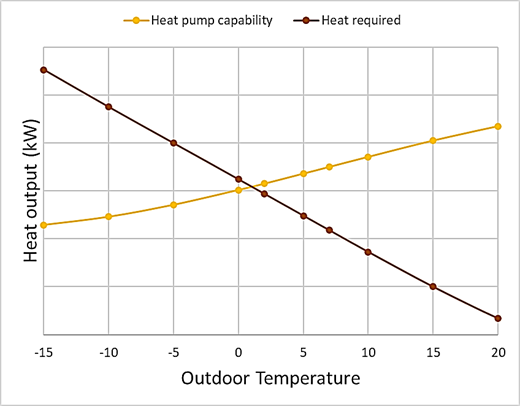
A heat pump has a certain amount of power. If you are pushing a car up a steep hill you can’t push such a heavy car as you could on the flat, and similarly a heat pump can’t pump so much heat when there is a big temperature rise between outside and inside. At cold outside temperatures, the heat pump capability reduces – they still pump heat, but just not quite so much.

However, as the outside temperature reduces the amount of heat leaking out of a building increases; at cold outside temperatures the amount of heat needed increases. 

These two factors mean that the increase in design size of the heat pump for satisfactory heat in cold climates is rather bigger than for a conventional boiler. This is shown graphically here:

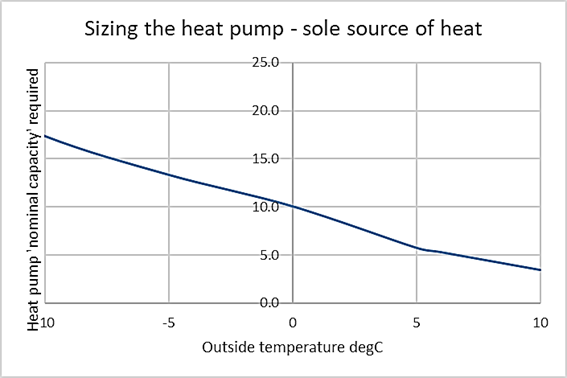
The following chart shows an example of how the heat pump rated output needs to increase as the design external temperature decreases, taking into account the need for more heat at lower temperature and the reduction in heat pump output at lower temperature.

If we choose a heat pumps size that can cope with a very low outside temperature, then we need a big heat pump.  So if we decide we must rely only on the heat pump at minus 10C then the heat pump will need to be 3.5 times bigger (and more expensive) than if we design the heat pump down to plus 5C. 

If we were to design for 5C, then what do we do when the outside temperature drops to -15C? In simple terms we need to provide some additional supplementary heat. There are many ways of supplementing the heat from the heat pump, perhaps by using a wood-burning stove, or electric fans. 

However, for the air to air heat pump solution, and attractive option in a ‘retrofit’ situation is to retain at least part of the current heating system as a ‘backup’ – for use only in the coldest weather.  In other words: if you fit an air to air heat pump, don’t rip out the current central heating system – just avoid using it unless absolutely necessary. 

This is not an option if the boiler is being replaced by an air to water system or a ground source heat pump system.

How many units, and where to put them?

In a traditional radiator based heating system, you can work out the heat needed for each room and put in a suitably sized radiator – each room having at least one radiator. Many radiators are only 1kW or less. If you are retrofitting air to air heat pumps you may want to economise significantly on that option, not least because the smallest internal unit is typically over 2kW.

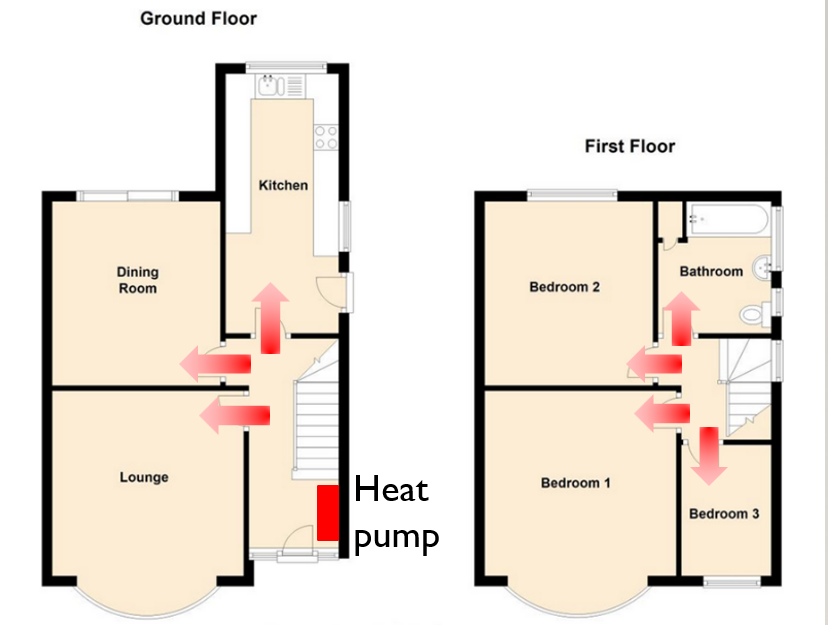
In my own home, a traditional 3 bed semi, we have 8 rooms and had 8 radiators. We chose to fit a single internal unit in the hallway and our experience shows that we could heat all the rooms adequately simply by allowing the heat to dissipate through open doors into the occupied rooms. The temperature in the hallway needs to be higher than the temperature required in the other rooms – so if you follow a similar approach you will need to experiment with the ideal temperature setting on the air-con unit to sufficiently heat the other rooms. We also find that this approach does not heat the bedrooms to such a high temperature as the downstairs rooms. This suits us, but to avoid this, fit an internal unit on each level in the house.

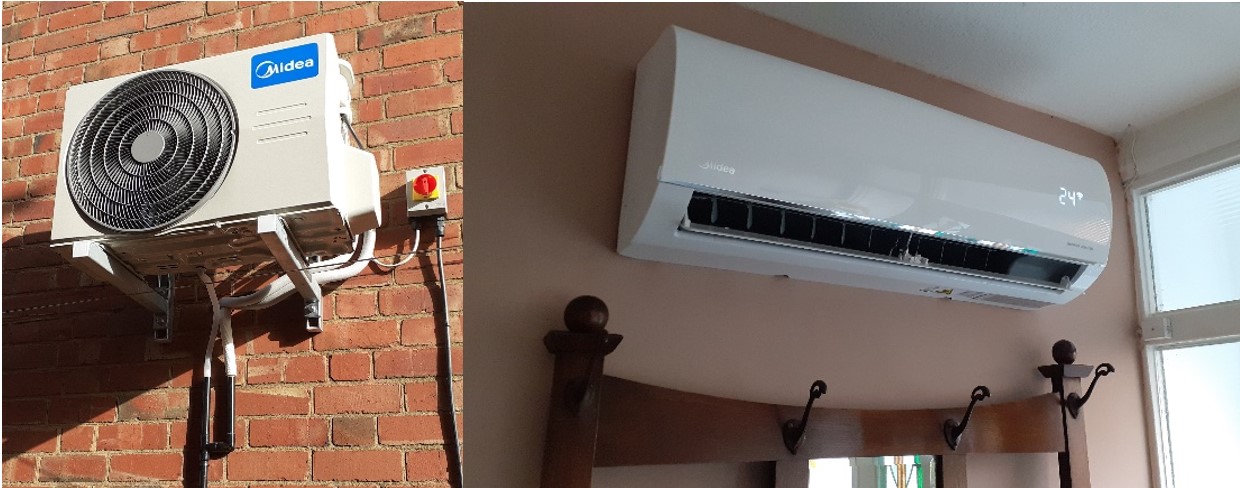
The picture below shows our internal and external units.

A single unit may not be sufficient for a larger our more complex house, but it is very likely that two or perhaps three internal units would be enough for most houses. There is perhaps as much art a science to where to put them, but think about where you would put a fan heater to best circulate the heat – that is in effect what these units are.

Note too that the internal unit does not need to be mounted on an external wall. Indeed, the most effective position may be in the middle of the house so that for the heat to finally escape it will pass through all the other rooms.

Often there is a single external unit for each internal unit, but a ‘multi-split’ system can provide many internal units run from a single external unit.

Our heat pump is size matches the steady state heat loss at around zero degrees outside temperature. In comparison, our boiler heat capability is perhaps five times as big. This high capacity is needed because traditionally the boiler would be turned off to save energy at night or when the house is unoccupied, and so a very high heat input would be needed to bring the temperature back up to comfort level. Since the heat pump is so efficient it can be run 24 hours a day, maintaining the temperature and avoiding the need for a short burst of high energy consumption. So, unlike a central heating boiler, the total heat pump capacity needs to be selected to match the steady heat loss from the house.

If you want an idea of how big a heat pump you might need, you could use an online radiator size calculator such as https://www.bestheating.com/btu-calculator for each room, and then add up the total for the house. This is likely to be rather higher than the steady state required, as the radiators need to be able to heat the house quickly from cold perhaps twice a day and to deal with the very coldest outside weather. I developed my own calculator to work out the heat loss, and taking into account the characteristics of a typical heat pump I can work out a heat pump size.

In conclusion – I hope that this is helpful, but it is a quite abbreviated summary of my experience and it may not be written as clearly as it should. If you have any comments or feedback, please get in touch. Thanks.

How can one God be Father, Son and Holy Spirit?

Christian doctrine tells us that Jesus is God, that the Holy Spirit is God and that ‘the Father’ is God.  And that Jesus is not the Father, who is not the Holy Spirit, who is not Jesus.  And that there is only one God.

Doesn’t it defy common sense and logic? How might we think about this mystery? 

Consider an analogy:  what is War and Peace?  It is a novel by Leo Tolstoy of course.  And of course, we all know what a novel is.  Or do we? 

It is of course the book that you buy in a bookshop?  But is it the paper and ink? No, it’s more than that.  Is it the pattern made by the dark ink on the white paper? No, the same words can be written in different fonts?  And what about different translations? And what if the book is read out loud?

Is it the precise set of words that Tolstoy wrote? – were early drafts not War and Peace? 

Is it the precise story? – then what of screenplays, are they not War and Peace?

War and Peace is the book, it’s the film, it’s the spoken word, it’s all the translations.  The book is not the film, which is not the spoken word.  The Chinese translation is War and Peace, the English translation is War and Peace, but the English translation is not the Chinese translation – there is only one War and Peace.

Something which we think is simple is actually much more complex! 

And so it is with God.  We might think we know who or what God is, but most certainly we don’t.  They are far more complex!  But perhaps thinking about the analogy of War and Peace we will understand a little more.

And here’s a bonus question – did the story exist before Tolstoy wrote it?  Would it cease to exist if humanity was wiped out and there was nobody to remember it? (Isn’t memory just another medium for recording the story anyway).  If another civilisation emerged ten thousand years after humanity died out and were able to read the book, would War and Peace come into existence again?  Or did it continue to exist throughout that period.  Did the tale exist before it was written down, in the same way that 1 + 1 has always equalled 2 – even before there was intelligent life to discover it.  Has War and Peace always existed?  Does this help us understand how Jesus always existed, how ‘in the beginning was the word’?

The secret heat pump that doesn’t cost the earth

There is a lot of noise about air source heat pumps at the moment, and in particular air to water heat pumps that replace the gas boiler in your house and feed the radiators. Heat pumps are extremely energy efficient, because instead of generating heat (from gas or electricity) they pump heat from outside a building to the inside. They might pump 3 – 4kW of heat for every 1kW of electricity that they use.  But systems that replace your gas boiler are costly, according to the Energy Saving Trust “Typical costs are around £7,000 to £13,000” https://energysavingtrust.org.uk/advice/air-to-water-heat-pumps/

An air to water heat pump system typically heats the water to 50 degrees C. This is lower than a normal central heating boiler, and so you might need bigger radiators for the system to provide enough heat to each room, or expensive additional insulation to reduce the heat demand. Air to water heat pump systems need space for the internal plant, and installation will take days and be very intrusive. This is probably why the government has little take up of the Boiler Upgrade Scheme.

There is an alternative to these expensive air to water heat pumps, namely air to air heat pumps – commonly called air conditioning units.

In an air to air system, instead of the heat pump being used to heat the water for your central heating radiators, it heats the air directly in a fan unit inside the house – hence the term “air to air”.  In effect, it is an extremely efficient fan heater. Air to air heat pumps are better known as air conditioning units because they have the additional advantage of being able to provide cooling in summer, making life bearable when outside temperatures are 40+ degrees.

We live in a typical 1930s 3 bedroom semi-detatched house with solid walls. We paid around £1500 for a 4kW air conditioning unit. It was installed in less than a day and sited in the hallway it provides heat to all the rooms in the house.  There is none of the ‘plant’ associated with air-to-water heat pump systems and so no loss of space.   Because the unit pumps heat, it only takes 1kW of electricity to provide 4kW heat – the most efficient heating technology on the market.

These pictures show the internal and external units.

We have been delighted with the performance.  The heat from the hall dissipates throughout the house through open doorways (both upstairs and downstairs), and we can avoid heating rooms that we don’t use simply by closing the doors. 

We have retained our gas boiler to heat our water, but have removed several radiators. We have kept a few as backup but have not had to use them. We have a wood burning stove to lift the living room temperature in the evenings and provide supplementary heat in the very coldest weather. Our only ‘regret’ is that we didn’t fit a slightly bigger unit, which would be better when temperature outside reached -5 to -7 degrees.

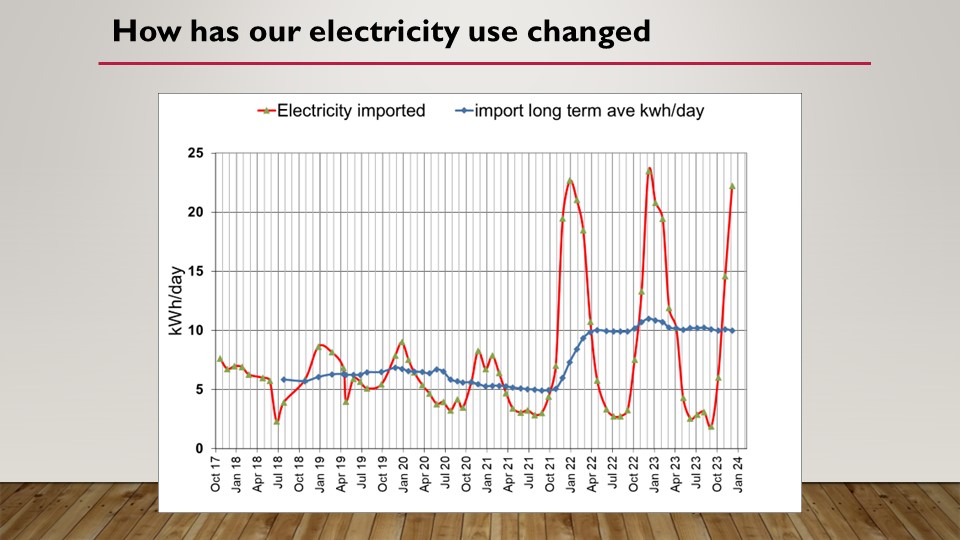
The chart below shows how much our energy consumption has changed as a result of the heat pump. Combined with our solar panels and renewable electricity supply, our house is now net zero.

In summary, there is a readily available, low cost, low disruption, extremely high efficiency heat pump available which you can install straight away without having to make your radiators bigger or spend thousands on insulation, and which will also provide cooling in summer.

So why haven’t we heard of this before? I don’t know – but you are in on the secret now.